
Published · Updated
why hybrid financingWhy hybrid financing works for UK property investors
By James Dawes, CeMAP, Founder, James William & Co Capital

TL;DR:
- Hybrid financing in UK real estate combines debt and equity instruments, filling capital gaps without diluting control. Preferred equity and mezzanine debt are key components, with preferences depending on intercreditor agreements and risk profiles. It has become a mainstream, structural tool for complex deals due to market constraints and evolving capital deployment strategies.
Hybrid financing is defined as a capital structure that combines debt and equity instruments within a single funding arrangement, giving sponsors and investors the flexibility to fill gaps in the capital stack without surrendering control or accepting a binary risk profile. In UK real estate, the two most common hybrid instruments are mezzanine debt and preferred equity, each sitting between senior debt and common equity in the capital stack. As property finance trends in 2026 show, demand for these structures has accelerated sharply, driven by constrained senior lending, volatile interest rates, and the need for creative solutions on complex developments. For sponsors who need more capital than a senior lender will provide, and for investors who want returns above senior debt without taking full equity risk, hybrid financing is the most direct answer.
Why hybrid financing has become the structure of choice
The UK property market between 2024 and 2026 has created conditions that make hybrid capital almost unavoidable on larger transactions. Demand for hybrid capital has grown materially due to unstable interest rates, valuation challenges, and subdued exit opportunities across commercial real estate. That combination matters because it means senior lenders are lending less against each pound of asset value, leaving a funding gap that neither pure debt nor pure equity fills efficiently.

The benefits of hybrid financing in this environment are structural, not cyclical. Sponsors can access the additional capital they need without diluting their equity position to the extent a joint venture partner would demand. Investors, meanwhile, receive priority returns and defined protections that common equity does not offer. Goldman Sachs raised $15 billion in hybrid capital funds by 2021 and announced plans for a further $10 billion in 2025, specifically to address liquidity constraints and support dividend distributions upstream where exits were blocked. That scale of institutional commitment signals that hybrid financing is not a niche workaround. It is a mainstream tool for sophisticated capital deployment.
Pro Tip: Before committing to a hybrid structure, map your senior lender’s intercreditor requirements first. Many senior lenders will permit preferred equity but prohibit mezzanine debt outright, and discovering this late in a deal can collapse a carefully constructed capital stack.
What are the main components of hybrid financing structures?
Understanding the hybrid financing advantages available to you depends on knowing how each instrument actually works within the capital stack. The two primary components are preferred equity and mezzanine debt, and while they serve similar purposes, they are legally and economically distinct.
Preferred equity is an ownership interest in the borrowing entity, typically structured at the holding company level. It sits junior to senior debt but senior to common equity, and preferred equity carries fixed preferred returns typically in the range of 10% to 14% on multifamily and commercial developments. Critically, preferred equity does not grant foreclosure rights. The preferred equity investor holds an ownership stake with priority return rights, not a creditor position. This distinction is what makes it acceptable to senior lenders who would otherwise block additional debt.
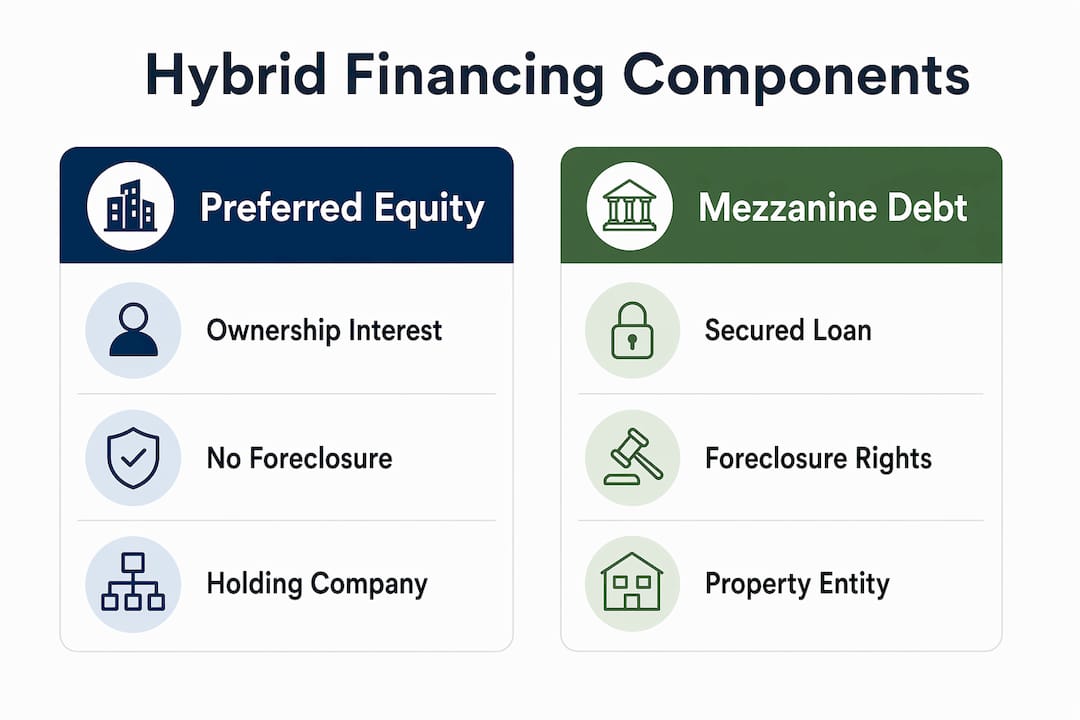
Mezzanine debt, by contrast, is a loan secured against the LLC or partnership interests in the property-owning entity. It carries creditor rights, and the mezzanine lender can foreclose on those LLC interests if the borrower defaults. Mezzanine debt holds creditor rights that preferred equity does not, which is why many senior lenders prohibit it under their intercreditor agreements. Mezzanine debt typically carries higher returns than preferred equity to compensate for this additional enforcement risk.
| Feature | Preferred equity | Mezzanine debt |
|---|---|---|
| Legal form | Equity ownership interest | Loan secured on LLC interests |
| Foreclosure rights | No | Yes |
| Senior lender acceptance | Generally permitted | Often prohibited |
| Typical return range | 10%–14% | 12%–18% |
| Position in capital stack | Junior to senior, senior to common | Junior to senior, senior to common |
| Tax treatment | Equity distribution | Interest deduction (subject to classification) |
The practical implication is straightforward. When a senior lender’s intercreditor agreement prohibits mezzanine debt, preferred equity becomes the only viable instrument to fill the capital gap. Senior lender acceptance of preferred equity stems precisely from the absence of foreclosure rights, which protects the senior lender’s collateral position. Sponsors who understand this distinction can structure deals that would otherwise stall.
How does hybrid financing compare with traditional debt or equity?
The case for why you should use hybrid financing becomes clearest when you place it alongside the alternatives. Pure senior debt is the cheapest capital available, but it covers only a portion of total project costs, typically 55% to 70% of gross development value on UK development schemes. Anything above that threshold requires either equity or a hybrid instrument.
Pure equity, whether from a joint venture partner or a co-investor, solves the capital gap but at a significant cost to the sponsor. A JV partner taking a 30% to 50% equity stake will expect a proportionate share of profits and often a degree of governance control. For sponsors with strong conviction in their project, giving away that upside is an expensive solution to what is fundamentally a gap-filling problem.
Hybrid financing sits between these two positions. It costs more than senior debt but less than equity in terms of profit dilution. It provides capital without the governance intrusion of a full equity partner. And it can be structured with cash-pay or payment-in-kind (PIK) interest mechanics, giving sponsors flexibility on cash flow during the development or stabilisation period.
| Financing type | Cost | Control impact | Suitable for |
|---|---|---|---|
| Senior debt | Lowest | Minimal | Core acquisitions, stabilised assets |
| Mezzanine debt | Moderate to high | Low | Development gaps where senior lenders permit |
| Preferred equity | Moderate to high | Low to moderate | Gaps where mezzanine is prohibited |
| Common equity / JV | Highest (profit share) | Significant | Early-stage or high-risk projects |
The hybrid capital advantages over pure structures come down to tailoring. A well-structured hybrid instrument can align cash flows with the project’s income profile, defer returns where necessary, and provide investors with protections that pure equity cannot offer. For a ground-up residential scheme in London, for example, where no income is generated during construction, a PIK preferred equity structure allows the sponsor to preserve cash while the investor accrues their preferred return for payment on exit.
For a deeper look at how these structures fit within broader real estate funding sources available to UK developers, the interplay between senior debt, hybrid capital, and equity is worth examining carefully before committing to a structure.
What practical considerations should investors and sponsors keep in mind?
Hybrid financing explained at a conceptual level is straightforward. Executing it correctly requires attention to several structural, legal, and tax details that can materially affect the outcome of a transaction.
Holdco-level issuance is the starting point. Hybrid capital is typically issued at the holding company level, subordinated to operating senior debt but senior to common equity. This placement determines how governance rights, covenants, and remedies are structured. A preferred equity investor sitting at holdco level has different enforcement options than a mezzanine lender sitting at the same level, and those differences must be reflected in the legal documentation from day one.
Tax classification is the area where most sponsors underestimate complexity. Hybrid instruments can be classified as debt or equity for tax purposes, and misclassification creates unexpected costs. In a UK context, the distinction affects whether returns are treated as interest (deductible) or distributions (not deductible), which has a direct impact on the effective cost of capital. Engaging specialist tax counsel before finalising the term sheet is not optional on a hybrid transaction.
Exit strategy alignment is the third critical consideration. Hybrid investors expect a defined exit, whether through refinancing, asset sale, or recapitalisation. Sponsors who structure hybrid capital without a credible exit path create a governance problem. Preferred equity investors who cannot exit on schedule have contractual remedies that can include forced sale provisions or step-in rights, neither of which a sponsor wants to trigger.
- Confirm senior lender intercreditor position before selecting the instrument (mezzanine versus preferred equity)
- Negotiate PIK versus cash-pay mechanics based on the project’s income profile during the investment period
- Obtain specialist tax advice on classification before executing documentation
- Model exit scenarios at the outset and ensure hybrid instrument terms align with realistic exit timelines
- Review governance rights carefully, particularly any consent rights the hybrid investor holds over major decisions
Pro Tip: When negotiating preferred equity terms, pay close attention to the definition of a “preferred return event of default.” Some instruments trigger investor remedies on a missed preferred return even where the project is otherwise performing. Clarifying this threshold before signing protects both parties.
For sponsors looking to optimise their real estate funding structure, the practical structuring decisions above are where value is created or destroyed.
Key takeaways
Hybrid financing is the most effective capital stack solution for UK property sponsors who need to fill funding gaps above senior debt without surrendering equity control or accepting binary risk.
| Point | Details |
|---|---|
| Preferred equity versus mezzanine | Preferred equity lacks foreclosure rights, making it acceptable to senior lenders who prohibit mezzanine debt. |
| Market timing | Unstable rates and constrained senior lending between 2024 and 2026 have made hybrid capital a mainstream requirement on complex UK deals. |
| Cost versus control trade-off | Hybrid financing costs more than senior debt but dilutes sponsor control far less than a full JV equity partner. |
| Tax and legal complexity | Misclassification of hybrid instruments creates unexpected tax costs; specialist counsel is required before documentation is finalised. |
| Exit alignment | Hybrid investors hold contractual remedies if exits are delayed; sponsors must model realistic exit scenarios before structuring. |
The honest reality of hybrid financing in 2026
I have structured enough hybrid transactions over the past several years to know that the instrument itself is rarely the problem. The problem is almost always the sequence in which decisions are made. Sponsors come to us having already agreed heads of terms with a senior lender, only to discover that the intercreditor agreement prohibits the mezzanine debt they were counting on. At that point, preferred equity is the only viable route, and the terms available are shaped by urgency rather than negotiating strength.
The sponsors who use hybrid financing most effectively treat it as a first-order structuring decision, not a gap-filling afterthought. They know before they approach a senior lender whether they will need hybrid capital, what instrument is appropriate, and what return profile is realistic for their project. That preparation changes the quality of the deal they can execute.
What I find genuinely underappreciated is how much the holdco structuring question matters. Most sponsors focus on the headline return and the intercreditor position, but the governance rights embedded in a preferred equity instrument at holdco level can be more consequential than either. Consent rights over refinancing, asset sales, or additional debt can effectively give a preferred equity investor veto power over the sponsor’s exit strategy. Negotiating those rights carefully, before the term sheet is signed, is where experienced structuring advice pays for itself many times over.
The UK market in 2026 is producing more hybrid transactions than at any point in the past decade. That is not a temporary response to rate volatility. It reflects a structural shift in how capital is deployed across complex real estate transactions, and sponsors who understand the instrument will consistently outperform those who treat it as a last resort.
— James
How James William & Co structures hybrid finance for UK developers
James William & Co works with UK property developers, investors, and high-net-worth clients who need more than a standard debt arrangement. The firm structures specialist property finance across preferred equity, mezzanine debt, and multi-layered capital stacks, working with family offices, private credit funds, and specialist lenders to deliver bespoke solutions at pace.
Whether you are filling a capital gap on a ground-up development, refinancing a complex asset, or structuring a JV alongside senior debt, James William & Co acts as a single point of contact for end-to-end structuring, negotiation, and execution. The firm’s case studies demonstrate a consistent record of executing under pressure on high-value transactions where conventional brokers cannot move fast enough. If hybrid financing is the right structure for your next deal, speak to James William & Co before you approach a senior lender.
FAQ
What is hybrid financing in UK real estate?
Hybrid financing is a capital structure combining debt and equity instruments, typically preferred equity or mezzanine debt, positioned between senior debt and common equity in the capital stack. It gives sponsors access to additional capital without full equity dilution.
Why use hybrid financing instead of a joint venture?
A joint venture partner takes a proportionate share of profits and often governance rights, whereas hybrid capital provides defined returns and limited control intrusion. Hybrid financing is more cost-efficient for sponsors with strong conviction in their project’s upside.
Is hybrid financing effective for ground-up developments?
Hybrid financing is particularly effective for ground-up schemes because PIK mechanics allow preferred returns to accrue rather than be paid in cash during construction, preserving sponsor liquidity until the asset generates income or is sold.
What is the difference between preferred equity and mezzanine debt?
Preferred equity is an ownership interest without foreclosure rights, while mezzanine debt is a loan secured on LLC interests that carries creditor rights including the ability to foreclose. Senior lenders frequently permit preferred equity but prohibit mezzanine debt under intercreditor agreements.
How complex is the tax treatment of hybrid instruments?
Hybrid instruments can be classified as either debt or equity for tax purposes, and misclassification creates unexpected costs. Specialist tax counsel should be engaged before any hybrid instrument is documented to avoid adverse treatment on distributions or deductions.
Recommended
Related Topics
Speak to a specialist
Discuss your finance with James directly
Whole-of-market specialist finance — bridging, development, commercial and residential. No call centres, no obligation. James reviews every enquiry personally.
New to specialist finance? How unbiased broker advice works · Deals we have completed
Explore Related Finance