
Published · Updated
why sophisticated fundingWhy sophisticated funding is essential for UK developers
By James Dawes, CeMAP, Founder, James William & Co Capital

Bank lending to UK SME property developers has nearly halved since 2017, creating a critical funding gap that traditional mortgages cannot fill. Sophisticated funding structures now provide the multi-layered capital and flexible covenants necessary to complete complex large-scale projects. This approach combines senior debt, mezzanine finance, and joint venture equity to meet the unique demands of modern UK property development.
Table of Contents
- Understanding Sophisticated Funding In UK Property Development
- The Mechanics And Benefits Of Forward Funding
- Multi-Layered Debt And Bespoke Structuring For Complex Deals
- Institutional Capital’s Role In Sophisticated Funding
- Common Misconceptions About Sophisticated Funding
- Practical Frameworks For Developers And Investors
- Explore Specialist Property Finance Solutions With James William & Co Capital
Key takeaways
| Point | Details |
|---|---|
| Sophisticated funding delivers tailored multi-layered financing essential for complex UK developments | Structures combine senior debt, mezzanine loans, and JV equity in bespoke arrangements |
| Forward funding reduces exit risk and provides early capital access tied to construction milestones | Tranche payments align investor control with developer liquidity needs |
| Institutional capital is a growing vital source for sustainable UK property investment | 72% of UK institutions forecast increased residential property funding by 2028 |
| Common misconceptions hinder optimal deal structuring and capital efficiency | Myths about cost and accessibility limit adoption of sophisticated solutions |
| Practical frameworks balance risk, leverage, and investor requirements effectively | Structured approaches optimise capital stacks and align with provider mandates |
Understanding sophisticated funding in UK property development
Sophisticated funding represents a departure from traditional single-lender bank mortgages. It encompasses multi-layered debt structures, mezzanine financing, and joint venture equity arrangements tailored to specific project requirements. These bespoke covenant packages and offshore vehicles optimise tax treatment, providing flexibility impossible with conventional lending.
The distinction lies in structure and scale. Traditional bank loans offer fixed terms with rigid covenants suited to straightforward acquisitions. Sophisticated funding adapts to complex ground-up developments, phased construction programmes, and mixed-use schemes requiring multiple capital sources at different risk levels.
Growing project complexity demands these arrangements. A £50 million mixed-use scheme in Manchester might layer senior debt at 60% loan-to-cost, mezzanine finance at 15%, and developer equity plus JV capital for the remainder. Each tranche carries different pricing, security positions, and covenant requirements matched to investor risk appetite.
Key components include:
- Senior debt providing the largest, lowest-cost tranche secured by first charge
- Mezzanine loans filling the gap between senior debt and equity at higher rates
- Joint venture equity offering development profit share in exchange for capital
- Tailored covenants addressing specific project milestones and investor controls
- Offshore special purpose vehicles optimising tax efficiency and liability structures
Pro Tip: Engage specialist mortgage brokers during early feasibility stages to identify optimal capital structures before committing to site acquisition, reducing unexpected funding gaps and accelerating financial close.
Understanding these fundamentals enables developers to structure deals matching capital provider mandates whilst maintaining operational control. The structured property finance UK developers landscape continues evolving as institutional capital seeks higher-yielding real estate opportunities. Early advisory input helps navigate this complexity, ensuring projects access appropriate funding sources aligned with risk profiles and return expectations. Developers who optimise real estate funding UK strategies position themselves competitively in tight capital markets, securing terms that traditional routes cannot offer.
The mechanics and benefits of forward funding
Forward funding provides capital commitments before construction starts, with payments released in tranches tied to verified milestones. This structure gives investors oversight whilst delivering developers early liquidity without waiting for practical completion or sales. It fundamentally reshapes project risk allocation compared to traditional development loans.
Mechanics involve negotiated milestones such as foundation completion, weathertight envelope, mechanical and electrical first fix, and practical completion. Each milestone triggers a predetermined capital release after third-party verification. Investors often take a forward purchase commitment or long lease arrangement, locking in future income streams whilst developers receive construction capital.
Tightened traditional debt markets have accelerated forward funding uptake, providing earlier capital access and reduced exit risk. Developers avoid the uncertainty of refinancing or selling into weak markets at project end. Investors gain control through milestone approvals and long-term income visibility from day one.
| Feature | Forward Funding | Traditional Development Loan |
|---|---|---|
| Capital timing | Tranche releases at milestones | Drawdown during construction |
| Exit requirement | Pre-agreed forward purchase | Refinance or sales needed |
| Investor control | Milestone verification rights | Limited construction oversight |
| Income visibility | Locked in from commitment | Uncertain until completion |
| Developer risk | Construction and delivery only | Construction plus exit market |
This comparison illustrates why forward funding suits large-scale build-to-rent or institutional-grade schemes where long-term holds align with investor mandates. Developers trade some profit upside for certainty and early capital, whilst investors secure assets at development cost with embedded value creation.
Benefits extend beyond capital access. Forward funding structures often incorporate institutional-grade property management and ESG requirements from inception, enhancing finished asset quality. They also reduce developer balance sheet strain, freeing capacity for additional projects rather than tying capital through extended sales periods.
Pro Tip: Define milestones with precise technical specifications and independent verification protocols in funding agreements to prevent disputes and payment delays that can derail construction programmes and damage investor relationships.
Developers pursuing real estate funding sources UK developers guide strategies should evaluate forward funding against traditional routes based on project scale, investor appetite, and exit strategy. Forward structures work best when alignment exists between developer delivery capability and investor long-term hold objectives, creating win-win outcomes that traditional debt cannot replicate.
Multi-layered debt and bespoke structuring for complex deals
Complex UK property developments require capital stacks combining multiple funding sources at different risk and return levels. Multi-layered structures use senior loans, mezzanine debt, and joint venture equity in hierarchical order, each with distinct pricing, security, and covenant terms. This layering optimises capital efficiency whilst meeting diverse investor requirements.

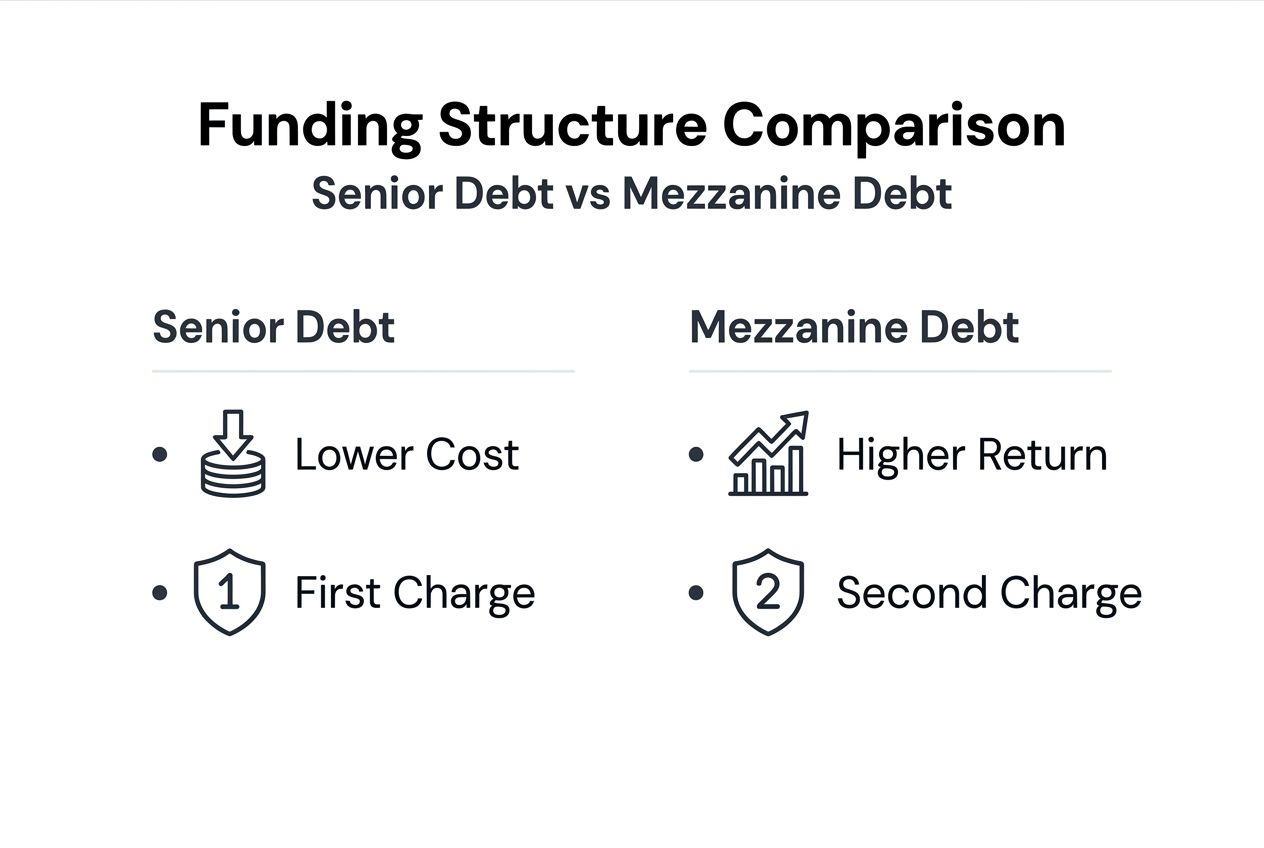
Senior debt forms the foundation, typically provided by banks or debt funds at 55-65% loan-to-cost. It carries first charge security, lowest interest rates, and strictest covenants. Mezzanine finance sits above senior debt at 10-20% loan-to-cost, accepting second charge positions for higher returns. Joint venture equity fills the remaining gap, taking profit share in exchange for risk capital.
Tailored covenant packages balance leverage and investor protections unique to each project. Covenants might include milestone-based drawdown conditions, minimum presales thresholds, cost overrun controls, and developer cash equity retention requirements. Offshore special purpose vehicles can optimise tax treatment and ring-fence liabilities, particularly for international investors or complex ownership structures.
Practical steps for structuring sophisticated funding stacks:
- Conduct detailed feasibility analysis quantifying total capital requirements, phasing, and return projections across all scenarios
- Identify optimal senior debt quantum based on conservative valuations and lender appetite for the specific asset class and location
- Determine mezzanine or preferred equity requirements to bridge the gap between senior debt and available developer equity
- Structure joint venture terms including profit waterfalls, promote thresholds, and decision-making controls that align investor and developer incentives
- Negotiate bespoke covenant packages addressing specific project risks whilst maintaining operational flexibility for the development team
- Establish clear reporting and milestone verification protocols ensuring transparency and maintaining investor confidence throughout the programme
| Feature | Mezzanine Debt | Senior Loans |
|---|---|---|
| Typical cost | 12-18% per annum | 6-9% per annum |
| Security position | Second charge subordinated | First charge priority |
| Loan-to-cost | 10-20% | 55-65% |
| Covenant flexibility | Moderate, negotiable | Strict, standardised |
| Risk level | Higher, equity-like exposure | Lower, asset-backed |
This data illustrates the risk-return trade-off across capital stack layers. Mezzanine providers accept higher risk and subordination for returns approaching equity levels, filling gaps that senior lenders cannot. Developers access higher leverage without diluting equity positions excessively.
Bespoke structuring enables creative solutions for unique challenges. A historic building conversion might use heritage tax credits within an offshore SPV structure, layering specialist heritage lenders, mezzanine funds comfortable with listed building risk, and preservation-focused equity partners. Standard bank products cannot accommodate this complexity.
Developers tracking UK property finance trends 2026 observe increasing sophistication as capital providers specialise by risk layer and asset class. Understanding how property finance trends 2026 UK evolve helps position projects competitively. The real estate debt UK property market rewards developers demonstrating structured thinking and alignment with investor mandates through well-conceived capital stacks.
Institutional capital’s role in sophisticated funding
UK institutional investors increasingly allocate capital to residential property, driven by housing supply shortages and attractive risk-adjusted returns. This trend fundamentally reshapes funding availability for sophisticated developers who align projects with institutional mandates. Understanding institutional preferences enables access to patient, large-scale capital unavailable through traditional banking channels.
72% of UK institutional investors forecast slight increases and 22% forecast dramatic increases in residential property funding by 2028. This growing appetite stems from demographics, undersupply, and inflation-hedging characteristics of real estate income. Institutions seek long-term stable returns matching pension and insurance liabilities, making properly structured developments attractive portfolio additions.
Preferred sectors reflect institutional investment criteria:
- Build-to-rent schemes delivering predictable rental income with professional management and economies of scale
- Healthcare and senior living assets providing inflation-linked revenues and addressing demographic demands
- Student accommodation in university cities offering defensive income characteristics and limited supply
- Affordable housing with government backing, stable tenancies, and social impact alignment for ESG mandates
Build-to-rent pipelines exceeded 180,000 units with yields between 4-6% annually and total returns reaching 12-15% over development cycles. These returns attract institutional capital whilst providing developers committed funding partners for large-scale schemes impossible to finance through traditional development loans or presales.
Institutional capital comes with requirements. Investors demand institutional-grade specifications, professional property management from day one, and often retain long-term ownership rather than providing pure development finance. This aligns with forward funding structures where institutions commit capital during construction for completed asset acquisition.
ESG considerations increasingly drive mandates. Institutions require BREEAM Excellent ratings, EPC A ratings, and social value metrics demonstrating community benefit. Developments incorporating these elements access wider capital pools and often achieve better pricing than purely commercial schemes.
“Institutional investors forecast significant increases in residential property funding by 2028, with 72% expecting slight growth and 22% expecting dramatic expansion, driven by supply-demand imbalances and attractive risk-adjusted returns in sectors like build-to-rent and affordable housing.”
Developers pursuing real estate funding sources UK developers guide strategies must understand institutional appetite extends beyond simple development finance. Institutions seek partnership opportunities, forward commitments, and occasionally joint venture equity positions offering development profit participation. Structuring deals matching these preferences unlocks substantial capital pools whilst reducing reliance on stretched banking capacity.
Common misconceptions about sophisticated funding
Several myths obstruct optimal use of sophisticated funding solutions, limiting developers’ access to appropriate capital structures. Addressing these misconceptions clarifies the true nature and scope of sophisticated funding in UK property finance, enabling better-informed decision-making.
Myth one suggests sophisticated funding equals expensive debt. Whilst mezzanine layers carry higher rates than senior loans, overall capital costs can prove lower than equity dilution alternatives. A developer contributing 30% equity at 20% target return costs 6% weighted average. Replacing 10% with mezzanine at 15% reduces blended cost whilst preserving upside.
Myth two claims institutional investors avoid affordable housing. Institutional capital increasingly flows into affordable housing due to supply-demand imbalances and stable income profiles. Government backing, inflation-linked rents, and ESG alignment make affordable housing attractive for long-term institutional portfolios, contradicting outdated assumptions.
Myth three assumes traditional bank loans suffice for large developments. Banks face regulatory capital constraints limiting single exposures and development loan appetite. A £100 million scheme often requires multiple banks or alternative capital sources. Sophisticated structures using mezzanine, forward funding, and JV equity provide necessary scale where single-lender solutions fail.
Myth four believes sophisticated funding suits only London or prime locations. Regional developments with strong fundamentals access sophisticated capital when properly structured. Build-to-rent in Manchester, student accommodation in Nottingham, and logistics in Birmingham all attract institutional funding based on sector fundamentals rather than just location.
Key misconceptions debunked:
- Sophisticated funding is not inherently more expensive when comparing true capital costs including equity dilution
- Institutional investors actively seek affordable housing opportunities with appropriate risk-return profiles and government support
- Traditional bank lending cannot scale to meet large development requirements, necessitating multi-source capital structures
- Regional developments with solid fundamentals and professional execution access sophisticated funding beyond just prime London schemes
Pro Tip: Engage specialist advisors early to navigate funding complexities and challenge assumptions about capital availability, cost, and structure that might otherwise limit deal optimisation and create expensive mistakes.
Developers questioning why use development finance UK often labour under these misconceptions. Understanding the reality helps match projects with appropriate capital sources, optimising leverage, cost, and alignment with provider mandates. Sophisticated funding offers flexibility and scale impossible through traditional routes when properly understood and structured.
Practical frameworks for developers and investors
Structured decision-making frameworks help developers and investors select and configure sophisticated funding aligned with project scale, risk profile, and capital provider criteria. These practical approaches translate theoretical understanding into actionable strategies optimising capital efficiency and deal execution.
A multi-layered financing framework organises funding sources by risk, cost, and control, optimising leverage, liquidity, and investor requirements. This systematic approach ensures comprehensive evaluation of alternatives before committing to specific capital structures that may prove suboptimal or difficult to refinance.
Framework for structuring sophisticated funding deals:
- Assess total capital requirements across all project phases including acquisition, construction, contingency, and holding costs until stabilisation or exit
- Evaluate project complexity including planning risk, construction difficulty, market absorption, and exit strategy to determine appropriate risk layering
- Identify senior debt capacity based on conservative loan-to-cost ratios, lender appetite for the asset class, and covenant requirements you can realistically meet
- Determine optimal mezzanine or preferred equity quantum balancing cost of capital against desire to preserve developer equity and maintain control
- Structure joint venture terms if required, including profit waterfalls, promote hurdles, decision-making rights, and exit mechanisms aligned with partner objectives
- Negotiate bespoke covenant packages addressing specific project risks whilst retaining operational flexibility necessary for effective development management
- Establish robust reporting and milestone verification protocols maintaining investor confidence through transparent communication and early issue identification
- Plan exit strategies for each capital layer ensuring alignment between investor requirements and realistic market conditions at anticipated completion dates
Balancing leverage, risk, return, and investor mandates requires understanding each capital provider’s motivations. Senior lenders prioritise security and timely repayment. Mezzanine providers seek high current returns with limited equity upside. Joint venture partners want profit participation and often operational involvement or strategic alignment.
Robust exit strategies prove critical. Senior debt typically requires refinancing or sales proceeds at completion. Mezzanine might extend if yield continues. Joint venture partners may seek ongoing ownership or predetermined exit pricing. Structuring these elements coherently prevents forced sales or value-destructive refinancing under pressure.
Regular milestone reporting maintains investor confidence and identifies issues early when solutions cost less. Monthly reporting covering progress, costs, sales or lettings, and forecast variances keeps all parties aligned. Quarterly formal reviews with senior lender and equity partners ensure no surprises derail relationships or trigger adverse covenant events.
Developers seeking capital advisory UK property finance expertise benefit from structured approaches translating complex funding landscapes into clear decision frameworks. These practical tools enable confident navigation of sophisticated funding markets, optimising outcomes for all stakeholders whilst managing risks effectively throughout development programmes.
Explore specialist property finance solutions with James William & Co Capital
Navigating sophisticated funding requires expertise in multi-layered debt structures, institutional capital, and bespoke covenant arrangements. James William & Co Capital specialises in arranging complex specialist property finance services for UK developers and investors undertaking large-scale projects requiring tailored capital solutions beyond traditional banking capacity.
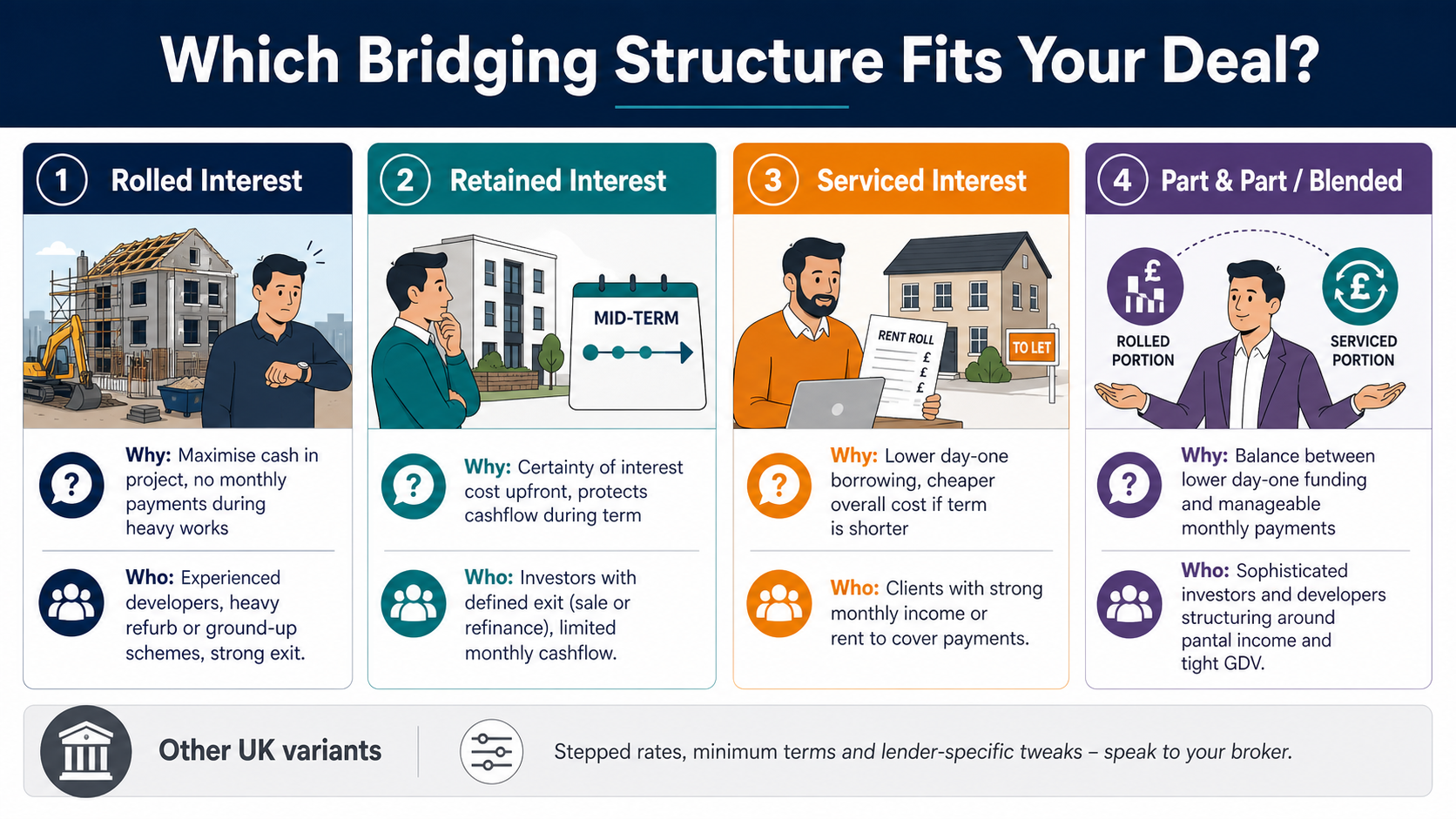
Our team structures bridging and development finance, mezzanine debt, commercial mortgages, and joint venture equity for ground-up developments, major acquisitions, and complex refinances. We work with family offices, private credit funds, and specialist lenders to deliver rapid, bespoke solutions matching your project requirements and investor mandates. Our property finance services cover end-to-end structuring, negotiation, and execution.
Explore our property finance case studies demonstrating successful delivery of sophisticated funding for challenging UK property transactions. Whether you need forward funding for build-to-rent, mezzanine for a mixed-use scheme, or institutional capital for affordable housing, our capital concierge approach provides single-point accountability and expert guidance throughout the process.
FAQ
What types of projects benefit most from sophisticated funding?
Large-scale UK developments exceeding £10-20 million with multiple phases, mixed uses, or complex planning benefit most from sophisticated funding structures. Projects requiring risk layering across acquisition, construction, and stabilisation phases also qualify. Ground-up developments, major refurbishments, and schemes targeting institutional ownership particularly suit these approaches.
How does forward funding reduce exit risk for developers?
Forward funding secures capital commitments before construction with pre-agreed acquisition or long lease terms at completion. This eliminates reliance on uncertain refinancing or sales into potentially weak markets when projects finish. Developers receive construction capital through verified milestones whilst investors lock in long-term income, creating certainty for both parties and reducing exit risk substantially.
Are institutional investors interested in affordable housing projects?
Yes, institutional investors increasingly fund affordable housing due to stable government-backed income, supply-demand imbalances, and strong ESG alignment. Institutional capital flows into affordable housing have accelerated as investors recognise inflation-linked revenues and defensive characteristics. Long-term hold strategies and social impact reporting make affordable housing attractive for pension funds and insurance companies.
What are common pitfalls in structuring sophisticated funding deals?
Common pitfalls include overleveraging beyond sustainable debt service coverage and neglecting clear exit strategies for each capital layer. Developers sometimes ignore ESG requirements and investor mandates, creating misalignment that derails deals. Mitigation involves conservative leverage ratios, detailed covenant negotiation, and ensuring all capital providers share realistic expectations about project timing, returns, and exit mechanisms before financial close.
Recommended
Related Topics
Speak to a specialist
Discuss your finance with James directly
Whole-of-market specialist finance — bridging, development, commercial and residential. No call centres, no obligation. James reviews every enquiry personally.
New to specialist finance? How unbiased broker advice works · Deals we have completed
Explore Related Finance