
Published · Updated
why use mezzanine debtMezzanine Debt for UK Developers: When It Makes Sense
By James Dawes, CeMAP, Founder, James William & Co Capital

Many UK developers mistakenly view mezzanine debt as a financing tool of last resort, but survey data reveals that 60% of property professionals deploy it proactively to scale projects and enhance returns. Mezzanine finance sits strategically between senior debt and equity in the capital stack, bridging funding gaps that would otherwise limit project scale or force ownership dilution. Understanding how to structure and leverage this hybrid instrument enables smarter capital decisions for complex developments.
Table of Contents
- Understanding Mezzanine Debt In UK Property Finance
- How Mezzanine Debt Bridges Funding Gaps
- Advantages And Tradeoffs Of Using Mezzanine Finance
- Comparing Mezzanine Debt To Senior Debt And Equity Financing
- Common Misconceptions About Mezzanine Debt
- When And Why To Use Mezzanine Debt In UK Property Development
- Practical Structuring And Negotiation Of Mezzanine Finance Deals
- Summary And Strategic Takeaways
- Explore Specialist Mezzanine Finance Solutions With James William & Co Capital
Key takeaways
| Point | Details |
|---|---|
| Bridges funding gaps | Mezzanine finance covers 10-20% of project cost, filling the equity shortfall between senior debt and developer capital. |
| Boosts returns | Increases developer internal rate of return by 10-15% through optimised leverage without equity dilution. |
| Flexible repayment | Offers payment-in-kind interest and profit-sharing structures tailored to project cash flow milestones. |
| Preserves control | Maintains majority ownership compared to equity financing while enabling larger project scale. |
| Strategic deployment | Used proactively by experienced developers for complex refinancing and portfolio growth, not just emergencies. |
Understanding mezzanine debt in UK property finance
Mezzanine finance allows UK property developers to bridge funding gaps between senior debt and equity, enabling larger-scale developments that would otherwise remain unaffordable. This hybrid instrument sits in the middle layer of the capital stack, subordinate to senior loans but ranking above pure equity.
Typically covering 10-20% of total project capital, mezzanine debt extends leverage beyond what senior lenders provide. Where traditional banks cap exposure at 60-70% loan-to-value, mezzanine providers fill the gap, pushing total debt financing to around 85% of project cost. This positioning creates both opportunity and complexity.
The subordinated claim means mezzanine lenders accept higher risk than senior creditors but retain priority over equity holders if projects encounter distress. That risk profile drives pricing and covenant structures distinct from conventional mortgages. For UK developers tackling large acquisitions or ground-up schemes, mezzanine debt in UK property finance offers access to capital that unlocks deals senior debt alone cannot support.
Key characteristics include:
- Second charge security position behind senior lenders
- Interest rates between 10-20% reflecting subordinated risk
- Flexible repayment terms aligned to development phases
- Covenant packages negotiated around project-specific metrics
- Popular among institutional investors and family offices seeking yield
How mezzanine debt bridges funding gaps
Senior lenders typically restrict exposure to 60-70% loan-to-value, leaving developers to fund the remaining 30-40% through equity or alternative sources. For a £10 million project, that gap represents £3-4 million in capital the developer must inject or raise elsewhere. Typical mezzanine finance covers 10-20% of total project cost, dramatically reducing the equity burden.
By layering mezzanine debt into the structure, developers can achieve combined leverage up to 85% loan-to-cost. This approach preserves scarce equity for other opportunities or contingencies whilst maintaining control. Where equity partners might demand 30-50% ownership stakes, mezzanine lenders settle for debt returns without governance rights.

The mechanism proves particularly valuable in complex UK developments where phased construction, planning risks, or tenant pre-lets create timing challenges for traditional finance. Mezzanine providers structure repayment around these realities, offering bullet payments at exit or profit participation rather than rigid monthly schedules.
Common applications include:
- Large-scale mixed-use schemes requiring extended construction periods
- Portfolio acquisitions where immediate refinancing opportunities exist
- Ground-up developments with delayed revenue recognition
- Bridge-to-permanent financing during stabilisation phases
Exploring UK real estate funding sources reveals how mezzanine debt complements rather than competes with senior loans, creating layered structures that optimise both cost and flexibility for sophisticated developers.
Advantages and tradeoffs of using mezzanine finance
Mezzanine finance can increase developer IRR by 10-15% through financial leverage that replaces expensive equity with debt capital. When project returns exceed the cost of mezzanine debt, the amplification effect delivers substantial profit enhancement. A scheme generating 20% returns on total cost might yield 35-40% returns on the smaller equity base once mezzanine leverage is applied.
This enhanced performance comes at a price. Interest rates between 10-20% reflect the subordinated repayment position and higher risk mezzanine lenders accept. However, these costs remain predictable and tax-deductible, unlike equity returns that fluctuate with project performance and require permanent dilution.
Flexibility represents another significant advantage. Payment-in-kind structures allow interest to accrue and compound rather than draining cash flow during construction. Profit-sharing arrangements align lender and developer interests, creating partnerships rather than adversarial relationships. These bespoke terms adapt to project-specific constraints senior lenders cannot accommodate.
Ownership preservation matters critically for developers building long-term portfolios. Mezzanine debt maintains your control and upside potential whilst providing capital to execute larger strategies. Compare this to equity investors who claim permanent stakes and decision-making authority.
Key tradeoffs to weigh:
- Higher interest costs versus equity dilution avoidance
- Subordinated security versus maintained ownership control
- Covenant compliance requirements versus flexible repayment timing
- Limited recourse structures versus personal guarantee exposures
Pro Tip: Structure mezzanine repayment schedules around anticipated sales or refinancing events rather than construction milestones to avoid liquidity pressure during development phases.
Reviewing property development funding tips provides additional context on balancing these factors within your overall capital strategy.
Comparing mezzanine debt to senior debt and equity financing
Understanding where mezzanine sits relative to other financing options clarifies its strategic value. Senior debt offers lowest risk and lowest cost; mezzanine debt is riskier with higher cost but preserves ownership; equity financing dilutes ownership but can be cheaper in some terms.
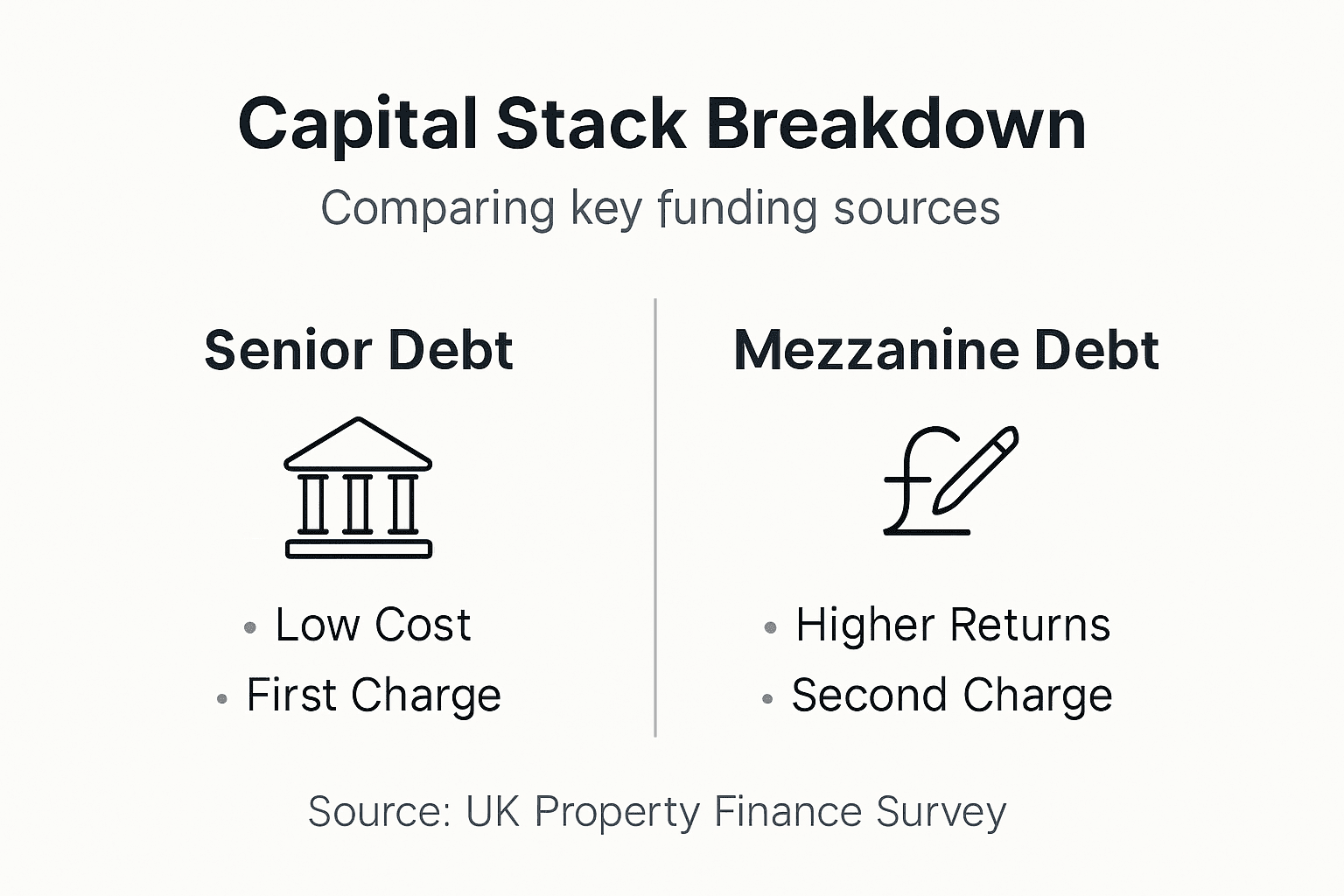
| Feature | Senior Debt | Mezzanine Debt | Equity Financing |
|---|---|---|---|
| Interest/Return | 5-8% | 10-20% | 20-30%+ (variable) |
| Security Position | First charge | Second charge | Unsecured/ownership |
| Loan-to-Value | 60-70% | 10-20% additional | Unlimited |
| Repayment Priority | Highest | Middle | Lowest |
| Ownership Dilution | None | None | 20-50% typical |
| Covenant Flexibility | Rigid | Moderate | Minimal |
Senior lenders provide the foundation layer at the lowest cost because they hold first charge security and strictest covenants. Their conservative underwriting limits leverage but ensures capital preservation. You sacrifice flexibility for pricing efficiency.
Mezzanine debt occupies the middle ground, accepting subordination in exchange for higher returns. Lenders price this risk through elevated interest rates but typically avoid equity participation unless negotiated. The structure maintains your ownership whilst extending leverage beyond senior limits.
Equity partners take the highest risk with no guaranteed returns, earning their premium through profit sharing and potential capital gains. They dilute your ownership permanently and often demand governance rights that constrain operational freedom.
The optimal capital stack combines these instruments strategically. For a £10 million development, you might structure £6.5 million senior debt (65%), £1.5 million mezzanine (15%), and £2 million equity (20%). This configuration minimises equity dilution whilst maintaining acceptable debt service coverage.
Assessing structured property finance options reveals how experienced developers layer these instruments to match project risk profiles and return objectives across different asset classes and geographies.
Common misconceptions about mezzanine debt
Many developers avoid mezzanine finance based on outdated assumptions or incomplete information. Survey data shows 60% of UK property professionals deploy mezzanine debt proactively rather than reactively, contradicting the belief it serves only as emergency funding. Forward-thinking capital planning incorporates mezzanine from initial feasibility studies.
Another persistent myth suggests mezzanine financing always dilutes ownership like equity investment. In reality, pure mezzanine debt preserves 100% ownership whilst providing capital senior lenders cannot offer. Only hybrid structures with equity kickers or profit participation introduce dilution, and developers negotiate these terms voluntarily for pricing benefits.
The perception that mezzanine debt costs prohibitively more than alternatives ignores the total capital structure mathematics. Whilst individual mezzanine interest rates reach 10-20%, the blended cost of capital across senior and mezzanine layers often produces better returns than pure equity financing. A project generating 25% returns easily absorbs 15% mezzanine costs whilst delivering enhanced equity performance.
Standardisation concerns also mislead developers. Unlike commoditised senior mortgages, every mezzanine facility reflects bespoke negotiation around project specifics, borrower experience, and market conditions. This customisation enables creative solutions for complex situations but requires specialist advisory support.
Common myths debunked:
- Mezzanine is not exclusively for distressed situations or failed refinancing attempts
- It does not automatically dilute ownership or control like equity
- Higher individual costs can improve overall returns through optimised leverage
- Terms are negotiable and project-specific, not standardised products
- Both institutional lenders and private credit funds actively seek mezzanine opportunities
Pro Tip: Evaluate mezzanine finance options during early feasibility stages rather than after senior debt rejection, allowing time to structure optimal terms and compare multiple providers.
Exploring diverse real estate funding sources demonstrates how mezzanine debt complements rather than competes with traditional financing, creating sophisticated capital stacks that balance cost, risk, and flexibility.
When and why to use mezzanine debt in UK property development
Mezzanine finance delivers maximum value in specific scenarios where project economics, scale, and developer experience align. Projects exceeding £5 million typically justify the structuring complexity and legal costs involved in layered debt arrangements. Smaller developments rarely generate sufficient returns to absorb mezzanine pricing whilst maintaining acceptable equity performance.
Experienced developers with proven track records access better mezzanine terms because lenders assess management capability alongside project fundamentals. First-time developers may struggle to secure mezzanine facilities or face punitive pricing that erodes financial benefits. Your operating history and successful exits directly influence both availability and cost.
Refinancing scenarios present ideal mezzanine opportunities. When existing projects have appreciated but lack sufficient equity for traditional refinancing, mezzanine debt bridges the gap whilst extracting capital for new investments. This recycling strategy accelerates portfolio growth without additional equity injections.
Internal rate of return enhancement represents the primary financial motivation. By replacing expensive equity with cheaper debt capital, developers amplify returns on their invested capital. Projects generating 20% returns on total cost might yield 35% returns on reduced equity once optimised leverage is applied through mezzanine structures.
Best use cases include:
- Large mixed-use developments with phased construction and revenue recognition
- Portfolio acquisitions requiring bridge financing until permanent loans close
- Value-add repositioning where immediate equity is limited but exit value is clear
- Ground-up construction with delayed leasing or sales revenue
- Experienced developers scaling operations beyond available equity capacity
Understanding various property finance types UK developers employ reveals how mezzanine debt functions as one tool within a broader financing toolkit, selected strategically based on project characteristics and sponsor objectives.
Practical structuring and negotiation of mezzanine finance deals
Successful mezzanine transactions require careful structuring around project cash flows, exit strategies, and covenant compatibility with senior lenders. Fixed interest structures provide predictability but constrain flexibility during construction phases. Payment-in-kind arrangements allow interest to compound and pay at exit, preserving working capital but increasing total debt service.
Equity participation or profit-sharing mechanisms reduce upfront interest costs by giving lenders upside exposure. A structure might combine 10% cash interest with 20% profit participation, lowering immediate carrying costs whilst sharing backend returns. These hybrid approaches suit projects with strong exit potential but constrained interim cash flow.
Negotiation priorities centre on several key variables. Interest rates reflect risk assessment, borrower quality, and market conditions. Typical ranges span 10-20%, with experienced developers and lower-leverage positions commanding better pricing. Repayment schedules must align with project milestones, refinancing opportunities, or sale timelines to avoid premature repayment pressure.
Covenants require careful coordination between senior and mezzanine lenders. Interest coverage ratios, loan-to-value triggers, and draw conditions must nest properly to avoid conflicting requirements. Intercreditor agreements formalise these relationships, defining how lenders interact during both normal operations and potential distress scenarios.
Practical structuring steps:
- Assess total project capital requirements and senior debt capacity to identify mezzanine sizing needs
- Model multiple structures comparing fixed interest, PIK, and equity participation to optimise blended returns
- Engage specialist brokers early to access competitive mezzanine provider networks and term sheets
- Negotiate repayment timing around anticipated refinancing or sales events rather than arbitrary dates
- Coordinate covenant packages between senior and mezzanine lenders through intercreditor negotiations
- Build adequate contingency into draw schedules for construction delays or cost overruns
- Structure exit mechanisms including refinancing rights, sale processes, and extension options
Pro Tip: Seek specialist advisory support from professionals experienced in multi-layered debt structures to ensure covenant compatibility and avoid conflicts between senior and mezzanine lenders that could trigger technical defaults.
Reviewing proven development finance structuring approaches provides additional insights into coordinating complex capital stacks across different lenders and instruments for optimal project outcomes.
Summary and strategic takeaways
Mezzanine debt serves as a powerful strategic instrument for UK property developers seeking to scale operations, enhance returns, and preserve ownership control. By filling the gap between conservative senior lending limits and expensive equity capital, mezzanine finance enables larger project ambitions without excessive dilution or control loss.
The financial mathematics prove compelling when properly structured. Boosting developer IRR by 10-15% through optimised leverage creates substantial wealth-building opportunities for experienced sponsors with proven track records. This amplification effect works best on projects generating strong absolute returns that exceed mezzanine borrowing costs.
Preserving ownership represents equally important strategic value. Where equity partners demand 30-50% stakes plus governance rights, mezzanine lenders settle for debt returns and subordinated security. You maintain complete control over asset management, disposition timing, and operational decisions critical to maximising long-term portfolio value.
Successful deployment requires bespoke structuring that balances cost, risk, and flexibility around project-specific characteristics. Payment timing, covenant structures, and exit mechanisms must align with development phases, cash flow patterns, and refinancing opportunities to avoid liquidity constraints or technical defaults.
Strategic considerations include:
- Evaluate mezzanine options proactively during feasibility rather than reactively after senior debt rejection
- Structure repayment schedules around anticipated exit events to preserve working capital
- Coordinate covenant packages between senior and mezzanine lenders through proper intercreditor agreements
- Model multiple scenarios comparing mezzanine debt against equity alternatives on total return basis
- Partner with specialist advisors experienced in complex capital stacks and institutional lender relationships
Explore specialist mezzanine finance solutions with James William & Co Capital
Navigating complex mezzanine structures and institutional lender networks demands specialist expertise that understands both financial engineering and UK property market dynamics. James William & Co Capital structures bespoke mezzanine facilities for developers and investors pursuing ambitious projects requiring sophisticated capital solutions.
Our capital concierge approach provides single-point coordination across senior lenders, mezzanine providers, and equity partners to construct optimal funding arrangements. We negotiate covenant packages, structure repayment terms around your project milestones, and coordinate intercreditor agreements that prevent conflicts whilst maximising available leverage.
Whether you are scaling a development portfolio, executing a complex refinancing, or structuring acquisition finance for institutional-grade assets, exploring diverse real estate funding options reveals opportunities to enhance returns through strategic mezzanine deployment. Our network spans family offices, private credit funds, and specialist lenders actively seeking well-structured opportunities.
Discover how expert guidance can optimise real estate funding strategies that balance cost, flexibility, and control across your property portfolio. Partner with advisors who structure solutions rather than simply present options.
Frequently asked questions
What is mezzanine debt in UK property development?
Mezzanine debt is hybrid financing positioned between senior debt and equity in the capital stack, designed to bridge funding gaps in property projects. It typically covers 10-20% of project costs whilst preserving developer ownership and control.
How does mezzanine finance improve returns for developers?
By reducing equity requirements and increasing leverage, mezzanine debt can boost internal rate of return by 10-15% through financial amplification. Flexible repayment structures also enable better cash flow management aligned to project milestones and exit timing.
What are the key risks of using mezzanine debt?
Mezzanine debt is junior to senior debt with a second charge on assets, so it is repaid after the senior lenders, which increases the risk for mezzanine lenders. Interest rates of 10-20% reflect this subordinated position, and delayed project milestones can strain cash flow. Lenders impose covenants requiring careful negotiation and monitoring.
Can mezzanine debt be customised for my project needs?
Yes, mezzanine finance terms are highly negotiable and project-specific, including fixed or payment-in-kind interest, profit-sharing arrangements, and bespoke covenant structures. Proper structuring ensures alignment with your cash flow patterns, development phases, and planned exit strategy.
When should developers consider mezzanine finance?
Mezzanine debt suits projects exceeding £5 million where senior lending caps at 60-70% loan-to-value leave significant equity gaps. Experienced developers with proven track records access the best terms for scaling portfolios, executing complex refinancing, or pursuing large acquisitions without excessive equity dilution.
Recommended
Related Topics
Speak to a specialist
Discuss your finance with James directly
Whole-of-market specialist finance — bridging, development, commercial and residential. No call centres, no obligation. James reviews every enquiry personally.
New to specialist finance? How unbiased broker advice works · Deals we have completed
Explore Related Finance