
Published
covenant headroom property loansCovenant Headroom on Property Loans: A UK Guide
By James Dawes, CeMAP, Founder, James William & Co Capital

Covenant headroom is the gap between where your property loan sits today and the limit at which a financial covenant is breached. On a loan with a 70% maximum LTV and a current LTV of 60%, for example, the headroom is the fall in value you can absorb before the lender can call a breach. The wider that gap, the more room you have to cope with a void, a rate rise or a soft valuation. This guide explains how to measure it, how much to build in, and what to do when it narrows.
TL;DR
- Headroom is the cushion between your current position and a covenant threshold. It is what lets you absorb shocks without a breach.
- For LTV, headroom is the percentage fall in value you can take. For interest cover or DSCR, it is the percentage fall in income.
- Negotiate headroom at term sheet stage, before you sign. Tightening it afterwards usually means a waiver or amendment.
- A breach is typically an event of default, but many facilities give cure rights, such as extra security or a partial prepayment.
- Monitor the trend, not just the quarterly test. Early conversations with the lender give you more options.
Table of Contents
- What covenant headroom means on a UK property loan
- The covenants that headroom is measured against
- How to calculate covenant headroom
- What eats into headroom
- How much headroom should you build in?
- Monitoring headroom through the loan
- What happens if you approach or breach a covenant
- Structuring for headroom from the outset
- Our perspective
- Talk to us about your structure
- FAQ
- Sources
What covenant headroom means on a UK property loan
A financial covenant is a promise in the loan agreement that you will keep certain ratios within set limits. Hamlins LLP explains that these covenants set the parameters you operate within during the loan term, and that the lender uses them to check you are meeting the projections it relied on when it assessed how you would repay and pay interest.
Headroom is the margin you have left. Azets describes it as the cushion between your current financial position and the covenant limits, which is the room you have to absorb fluctuations and keep operating without a breach.
It matters for two reasons.
- It is the lender’s early warning system. Hamlins notes that covenant levels are usually set so that a breach works as a warning signal, letting the lender act before it faces a shortfall, rather than automatically signalling insolvency. LexisNexis makes a similar point: covenants test performance on an objective, measurable basis and indicate difficulty before a payment default.
- It shapes your future options. Azets observes that healthy headroom gives you flexibility, while limited headroom makes refinancing, growth investment or further borrowing harder to discuss.
For a developer or investor, that last point is practical. A lender looking at your next deal will look at how comfortably your existing facilities are performing.
The covenants that headroom is measured against
Most UK property facilities rely on a short list of tests. Each has its own definition of headroom, so it helps to know which one will bite first on your deal.
Loan to value (LTV)
An LTV covenant limits the loan to a percentage of the property’s market value. Hamlins states that it is measured against the latest valuation by an independent valuer acceptable to the lender, and the agreement specifies how often the lender can ask for a new valuation at your cost.
That last detail is easy to miss. Your headroom can shrink without any change in your own trading, simply because a fresh valuation lands lower.
Interest cover ratio (ICR)
An interest cover covenant checks that there will be enough profit to pay the loan interest. Hamlins explains that it compares net rental income with interest and fees, on a historic or projected basis. Whether the test looks backwards or forwards changes how quickly a void or a rent review shows up in the numbers.
Debt service cover and debt yield
Debt service cover ratio (DSCR) adds capital repayments to the interest in the test. Debt yield compares net operating income to the loan balance. Both are common on larger commercial and structured deals. They work the same way as ICR for headroom purposes: income has to stay above a minimum multiple of the cost, or yield, that the lender has set.

How to calculate covenant headroom
The arithmetic is simple. The useful step is to express every covenant in the same terms: how far can the thing that drives it fall before you hit the limit?
For a maximum LTV covenant

Headroom is 1 minus (current LTV divided by maximum LTV). This assumes the loan balance stays the same and value is what moves.
Worked example: you have borrowed £6m against a property valued at £10m, so LTV is 60%. The covenant allows 70%.
- 1 − (60 ÷ 70) = 14.3%
- Value can fall by about 14.3%, to roughly £8.57m, before the covenant is reached.
For a minimum ICR, DSCR or debt yield covenant
Headroom is 1 minus (minimum ratio divided by current ratio). Here income is what moves.
Worked example: your ICR is 1.50x and the covenant minimum is 1.20x.
- 1 − (1.20 ÷ 1.50) = 20%
- Net income can fall by 20% before the test fails.
Compare them side by side
| Covenant | Current | Limit | What moves | Headroom |
|---|---|---|---|---|
| Maximum LTV | 60% | 70% | Property value | 14.3% fall |
| Minimum ICR | 1.50x | 1.20x | Net income | 20% fall |
| Minimum DSCR | 1.35x | 1.20x | Net income | 11.1% fall |
The tightest line is the one that will breach first, so it is the one to watch. Notice that a covenant that looks comfortable in ratio terms (1.35x against 1.20x) can leave less room than one that looks tight. Always convert to a percentage.

What eats into headroom
Headroom is not fixed. Several things move it during the loan term.
- Valuation. Because LTV is tested on an independent valuer’s figure, a market move or a lower yield assumption cuts headroom. Fladgate LLP advises borrowers who feel exposed to check the valuation and consider whether to refinance, and to take proactive steps to maintain or enhance capital value where possible.
- Rental income. Voids, tenant defaults and rent-free periods reduce the numerator in ICR and DSCR tests.
- Interest costs. A higher rate on a floating facility raises the cost the income has to cover. Stress-testing realistic rate rises, income reductions, tenant voids and repair costs is sensible, because a forecast that only just passes is vulnerable.
- Capital drawn or capitalised interest. On development facilities, rolled-up interest and further drawdowns lift the loan balance, so LTV and loan-to-cost headroom tighten as the project progresses.
- Costs and delays. Overruns on a build reduce the margin in the appraisal before any covenant is even tested.
Azets notes that lenders now place greater weight on cash flow resilience, forecasting, covenant headroom and your ability to perform under different trading scenarios. Showing that you have modelled these in advance strengthens your position when you apply.
How much headroom should you build in?
There is no universal number. The right level depends on how volatile your income is, how often the lender can revalue, whether the test is historic or projected, and how long the loan runs.
Herrington Carmichael advises that covenant levels should include enough headroom for fluctuations in trading and changing market conditions, and that careful forecasting and scenario planning help identify pressure points early.
In practice, we suggest working through these questions before you agree terms:
- Run the downside case. Take your base-case income and value, then apply a realistic fall in each. Where do you land against each covenant?
- Check the testing frequency. Quarterly tests give less time to react than annual ones.
- Check how the covenant is defined. Net rental income, permitted deductions and the valuation basis all change the result.
- Look for step-ups. Some covenants tighten over the term. Make sure your forecast covers the tightest date, not only the first.
- Ask about cure rights. If a test fails, what can you do and in what time?
It is far easier to negotiate a looser covenant or a better definition before signing than to ask for a waiver once the numbers have moved.
Monitoring headroom through the loan
A single figure at quarter end tells you where you are, not where you are heading. Matchpoint Partners suggests showing headroom through three lenses: distance (the gap to the threshold), time (how long until the next test or cash low point) and confidence (how good the evidence behind the forecast is). It also recommends trend lines over single snapshots, since they show direction and speed.
The same source points out that financial covenants are often lagging indicators because they use historical or rolling results. So pair them with forward-looking signals:
- rent collection and arrears
- lease expiries and break dates
- development cost-to-complete against budget
- sales or letting progress
- refinance dates on any other debt in the structure
A simple monthly dashboard with headroom for each covenant, the date of the next test and a forecast for that date is usually enough for a single-asset borrower. For a portfolio or a multi-layered debt stack, it is worth tracking each facility separately and noting where cross-default clauses connect them.
What happens if you approach or breach a covenant
A covenant breach is serious, but it is not always the end of the conversation.
The legal position. Fladgate explains that a breach of an LTV covenant is typically an event of default, usually entitling the lender to demand repayment, but first the borrower is normally given a fixed number of grace days to cure by restoring compliance. Herrington Carmichael adds that if a breach cannot be cured and the lender will not waive it, the lender may be entitled, depending on the agreement, to accelerate the debt, demand immediate repayment, charge default interest, enforce security or trigger cross-default provisions.
The practical position. Kreston Reeves says the next steps depend on the relationship and may include capital repayment holidays, term extensions or covenant relaxations. Its view is that lenders look at whether they can see credible remedies, rather than reacting with immediate alarm.
Cure rights, waivers and amendments
Many facilities contain cure rights. Herrington Carmichael notes that a breach does not always lead straight to an event of default, because cure rights can allow additional funding to be injected after a failed test to restore compliance. Hamlins says cure rights may allow additional security or a partial prepayment within a set period.
If the agreement has no cure right, lenders may still consider a conditional waiver or an amendment, typically documented in a consent or amendment letter.
If the lender says your LTV is breached
Fladgate recommends checking first whether the lender’s valuation is correct. You may wish to obtain your own valuation to assess whether there is genuinely an event of default. Your facility agreement and a property finance solicitor will tell you what the valuation clause allows.
A sensible order of steps
- Read the covenant definition, the testing dates, the cure period and any cross-default wording.
- Re-run your numbers on the lender’s basis, not yours.
- Speak to the lender early, with a plan rather than a problem.
- Line up your cure options: additional security, a partial paydown, or fresh equity.
- If the structure no longer fits, look at refinancing before the position worsens.
Structuring for headroom from the outset
We think the best covenant management happens at the term sheet. A few structuring choices make a real difference.
- Match the facility to the stage. Short-term needs can sit in bridging finance, with a clear exit into a longer-term product, rather than being forced into covenants designed for a stabilised asset.
- Layer the debt deliberately. On larger projects, senior debt, mezzanine finance and joint venture equity can reduce the senior LTV and widen the gap to the covenant. Our piece on how to structure a development finance deal when margins are tight covers the trade-offs.
- Think about security packages. Where more than one asset is involved, our guide to cross-collateralisation loans explains how pooled security can affect LTV testing.
- Use the right lender for the profile. Different lenders set different covenant packages. Our overview of types of property finance for UK developers and the UK real estate funding sources guide show how the market is divided.
- Plan the refinance. A commercial mortgage taken at the end of a project should be sized on income that passes the lender’s ICR test with room to spare.
Our perspective
We see covenant headroom as a structuring decision, not a compliance chore. By the time a borrower is calculating it quarterly, most of the important choices have already been made: the leverage, the layers, the testing basis and the lender.
Our approach is to model the downside before a term sheet is agreed. We ask what a lower valuation, a longer void or a slower sale does to each covenant, and we use that to shape the capital stack. Sometimes the answer is less senior debt and a mezzanine or JV equity layer. Sometimes it is a different lender with a different covenant package, drawn from the specialist lenders and private credit funds we work with beyond mainstream banks.
We also believe in speed and a single point of contact. When a position starts to tighten, a borrower needs one person who understands the whole structure, can speak to the lender and can move quickly on a refinance, bridge or restructure. That is how we aim to work: calm, constructive and focused on keeping your plans moving.
James William Dawes
Talk to us about your structure
If you are planning an acquisition, a development or a refinance and want covenants that leave room to operate, we can help you structure it. We arrange bridging, development finance, commercial mortgages, mezzanine debt and JV equity for UK developers, investors and high-net-worth clients, with a single point of contact from structuring through to completion.
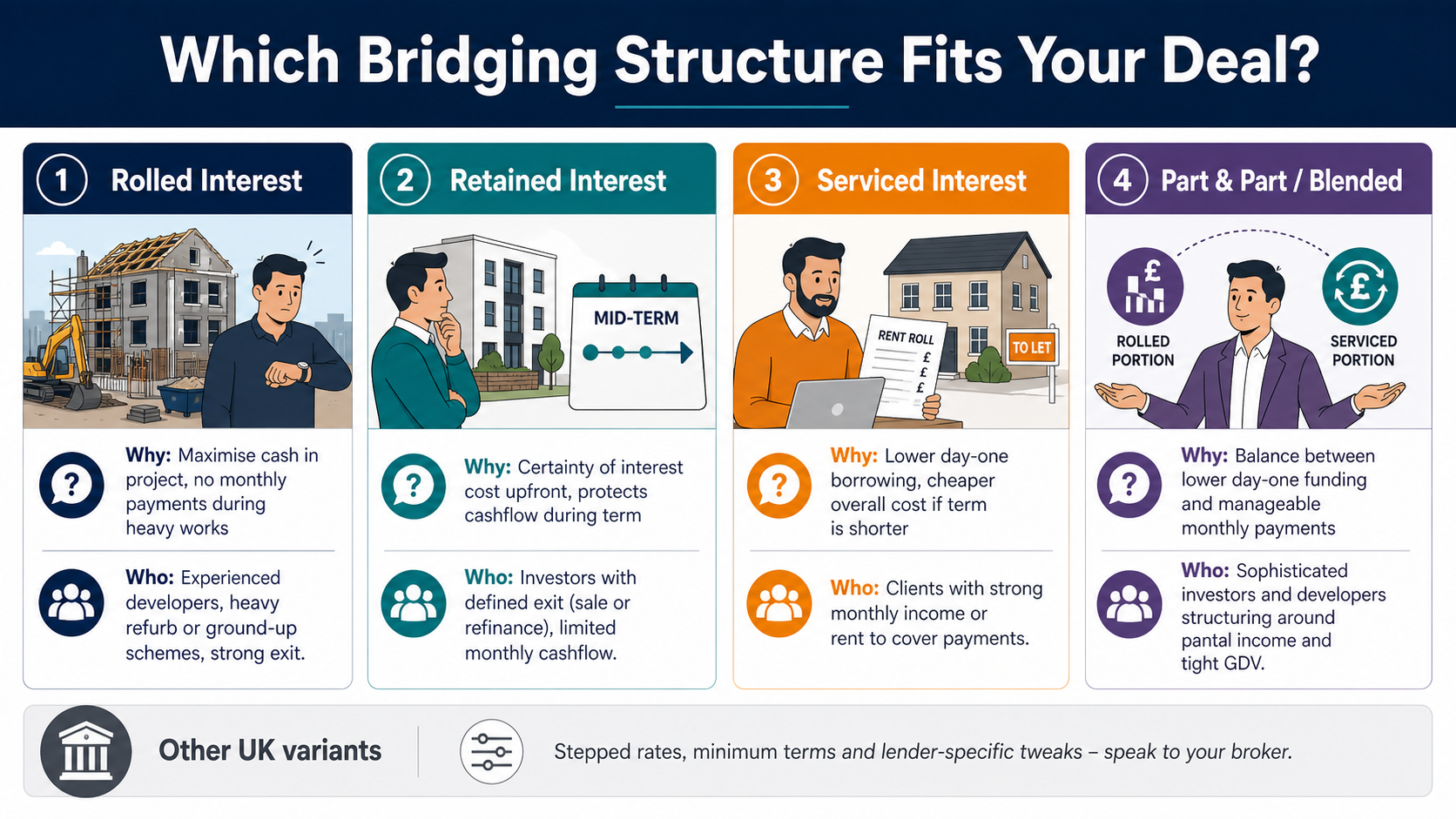
Start with our development finance or commercial mortgage pages, or get in touch through our website to discuss your deal.
FAQ
What is a good level of covenant headroom?
There is no single figure. It depends on how volatile your income and valuation are, how often the covenant is tested and how the lender defines it. A sound approach is to model a realistic downside and make sure every covenant still passes, then negotiate the terms to match.
Can covenant headroom change after I sign?
Yes. A lower valuation, a void, a rate rise or additional drawdowns can all reduce it. On LTV covenants the agreement usually says how often the lender can request a new valuation, so your headroom can move even when your own performance is steady.
Does a covenant breach mean the lender will call in the loan?
Not automatically. A breach is typically an event of default, which can allow the lender to demand repayment, but many agreements give you cure rights first. Lenders often prefer a workable solution such as a waiver, covenant relaxation or term extension when they can see a credible plan.
What are the usual ways to cure a breach?
Common routes are providing additional security, making a partial prepayment, or injecting funds, depending on what your facility allows. Where there is no cure right, a lender may consider a conditional waiver or amendment. Check the exact wording in your agreement with your solicitor.
How is LTV headroom calculated?
Divide your current LTV by the maximum permitted LTV, then subtract the result from 1. A 60% LTV against a 70% limit gives about 14.3%, which is the fall in value you can absorb before the limit is reached.
Sources
- Azets: Debt, funding and lender terminology explained
- Hamlins LLP: Financial covenants in property investment loan agreements
- LexisNexis: Real estate finance, financial covenants
- Fladgate: Concerns over breach of loan to value covenants
- Herrington Carmichael: Financial covenants in facility agreements
- Matchpoint Partners: The Covenant Control Room
- Kreston Reeves: Lending covenants on property loans
Recommended
You must keep up your repayments to avoid repossession. We are not a lender. James William & Co Capital Ltd is an Appointed Representative of Flexi Network Ltd, FRN: 1060247. Flexi Network Ltd is authorised and regulated by the Financial Conduct Authority, FRN: 948658. Flexi Network Ltd is an authorised credit broker and not a lender. You can verify both on the Financial Services Register at register.fca.org.uk.
Related Topics
Speak to a specialist
Discuss your finance with James directly
Whole-of-market specialist finance — bridging, development, commercial and residential. No call centres, no obligation. James reviews every enquiry personally.
New to specialist finance? How unbiased broker advice works · Deals we have completed
Explore Related Finance