
Published · Updated
bullet vs amortising loanBullet vs Amortising Loans in UK Property Finance: Plan the Exit First
By James Dawes, CeMAP, Founder, James William & Co Capital

A bullet loan keeps your monthly cost low and repays the whole principal at maturity. An amortising loan costs more each month but reduces your debt as you go. The trade-off is refinancing risk against serviceability, and both shape covenants and FRS 102 reporting. We structure these facilities at James William & Co Capital.
TL;DR:
- In the illustrative example, a £1 million bullet held for five years costs £400,000 in interest, versus about £252,285 for equal annual amortising payments.
- Lenders test interest cover first, where bullets often fare better; amortising debt faces a tougher initial DSCR test but lowers loan to value over time.
- Borrowers should document a credible sale, agreed term finance, or valuation range, start lender talks early, and prepare an extension or staged repayment fallback.
- Under FRS 102, fees can raise a bullet’s carrying amount toward repayment; substantial modifications may require new recognition, with 10% serving as a guide.
Table of Contents
- What are the key differences at a glance?
- How do the repayment schedules actually work?
- How does each structure move DSCR, LTV and ICR?
- What is the refinancing wall, and how do lenders respond?
- How do the two structures appear in the accounts?
- When should you choose a bullet and when an amortising loan?
- What does the difference look like in numbers?
- Why do we plan the exit before the structure?
- How can we help you structure the right facility?
- FAQ
- Sources
What are the key differences at a glance?
Here is how the two structures compare on the points lenders and credit committees test first:
- Repayment timing: a bullet loan repays principal in one lump sum at maturity, so the borrower carries the capital risk until then. An amortising loan repays principal in scheduled instalments.
- Monthly cost: bullet payments cover interest only, so affordability is easier in the short term. Amortising payments are higher and steadier.
- Balance path: the bullet balance stays flat until the end. The amortising balance steps down every period.
- Refinancing exposure: bullet debt concentrates it at maturity. Amortising debt spreads it away.
- Typical use: bullets suit bridging, development and exit-led deals. Amortising suits buy-and-hold property and corporate lending.
How do the repayment schedules actually work?
Under a bullet or interest-only loan, you pay interest through the term and repay the whole principal at maturity. With an amortising loan, scheduled principal reductions shrink the outstanding debt over time.
Small modelling choices move the numbers more than people expect:
- Day count and payment dates: actual/365 and 30/360 conventions, and whether interest is paid monthly, quarterly or rolled up, change the cash cost of an otherwise identical loan.
- Availability and grace periods: these flags control when drawn balances start accruing and when repayments begin.
- Repayment period: in a multi-facility model, we usually key all timing flags to the senior facility so nothing is double-counted.
Pro Tip: Build one timing switch per facility and test the model with the grace period turned off. If your covenants only pass because of the grace period, your lender will notice.
How does each structure move DSCR, LTV and ICR?
Amortising debt lowers forward loan-to-value as principal is repaid, and over time it improves solvency. Bullet debt keeps gearing high but frees up cash flow now. Bank of England and FCA analysis points to refinancing risk as the differentiator between the two.
Underwriters usually work through the metrics in this order:
- Interest cover (ICR): tested first because it shows whether near-term income covers the interest bill. Bullets generally pass this more easily.
- Debt service cover (DSCR): includes principal, so amortising loans face a tougher test on day one but a stronger position later.
- Loan-to-value (LTV): falls steadily on amortising debt, while a bullet relies on the asset value holding up at exit.
- Stress tests: lenders flex refinance pricing, sale proceeds and rental growth to see whether the exit still works.
Bullet loans carry significant concentration risk because the entire principal matures at once, whereas amortising structures provide a natural buffer through progressive deleveraging.
What is the refinancing wall, and how do lenders respond?
The refinancing wall is the point where a large bullet falls due and the borrower must replace it. If many loans mature when credit is tight, exits fail together. The Bank of England’s commercial property analysis notes that loans funded through market structures such as CMBS have limited forbearance options, which can make foreclosure more likely in a tight market.
What to prepare before maturity:
- Evidence of the exit: a live sale process, agreed term finance or a realistic valuation range.
- A lender conversation started early: bank-retained loans usually allow more flexibility than securitised ones.
- A fallback: extension terms, a second charge or staged repayment if the primary exit slips.
Regulators expect the same discipline. The FCA’s FG13/7 guidance asks firms to engage early with interest-only borrowers and keep repayment plans credible, and its industry working group found that some borrowers overestimate their ability to repay. Adviser commentary on FCA rules and interest-only mortgages covers the consumer side in more detail.
How do the two structures appear in the accounts?
Under FRS 102, loans are normally measured at amortised cost using the effective interest method. ICAEW’s amortised cost calculator shows how to apply it from the borrower’s side.
- Bullet loans: the carrying amount accretes towards the repayable sum if fees or discounts exist, so the finance cost can exceed the cash coupon.
- Amortising loans: the carrying amount falls with each repayment, and interest is recalculated on the lower balance.
- Modifications: FRS 102 guidance on renegotiated loans says a substantial change can mean derecognising the old loan and recognising a new one. Practitioners often use a 10% benchmark as a guide.
- Documentation: if you move from a bullet to an amortising profile, record your judgement on whether the change is substantial.
When should you choose a bullet and when an amortising loan?
Work through this checklist before committing:
- Exit certainty: the clearer and nearer the exit, the better a bullet fits.
- Project duration: short, event-driven projects suit bullets, while long holds suit amortising.
- Cash-flow volatility: lumpy income favours the lower periodic cost of interest only.
- Covenant tolerance: can you absorb a higher DSCR hurdle from day one?
- Investor expectations and tax: check how each structure affects equity returns and your accountant’s view.
Bridging and short-term development finance commonly use bullets, which our guide on arranging bridging finance covers. Our overview of real estate funding sources shows where each facility sits in a capital stack.
Pro Tip: Ask every lender for covenant testing frequency, break costs and remediation options in writing before you compare headline rates.
What does the difference look like in numbers?
These figures are illustrative assumptions, not market data.
- Bullet payments: £80,000 of interest each year, with the full £1,000,000 repaid in year 5.
- Bullet balance: £1,000,000 at every year end until the final repayment.
- Amortising payments: equal annual instalments of about £250,457, covering interest and principal.
- Amortising balance: roughly £829,543 after year 1 and £0 after year 5.
- Total interest: £400,000 on the bullet against about £252,285 on the amortising loan.
The bullet’s lower cash cost buys you headroom now, but you owe the full sum at the end. Change the rate, term or payment frequency in your own model and watch DSCR and refinancing headroom move.
Why do we plan the exit before the structure?

We start with the exit, not the rate. A bullet is only as good as the evidence behind how it gets repaid, so we test that first. From there we choose the lender panel and design the covenants around the project’s real cash-flow path.
In practice, we use options such as staged refinancing, bridging into term debt, mezzanine layering and covenant glidepaths that tighten as the project matures. Each suits different deals, and none is a universal answer. If your case is complex, we are happy to run a structuring review with you.
— James William Dawes
How can we help you structure the right facility?
We arrange bridging finance, development finance, commercial mortgages and bespoke debt structuring for UK property developers, investors and business owners. Whether your deal needs interest-only flexibility now or amortising discipline for the long term, we shape the structure around your exit and your covenants.
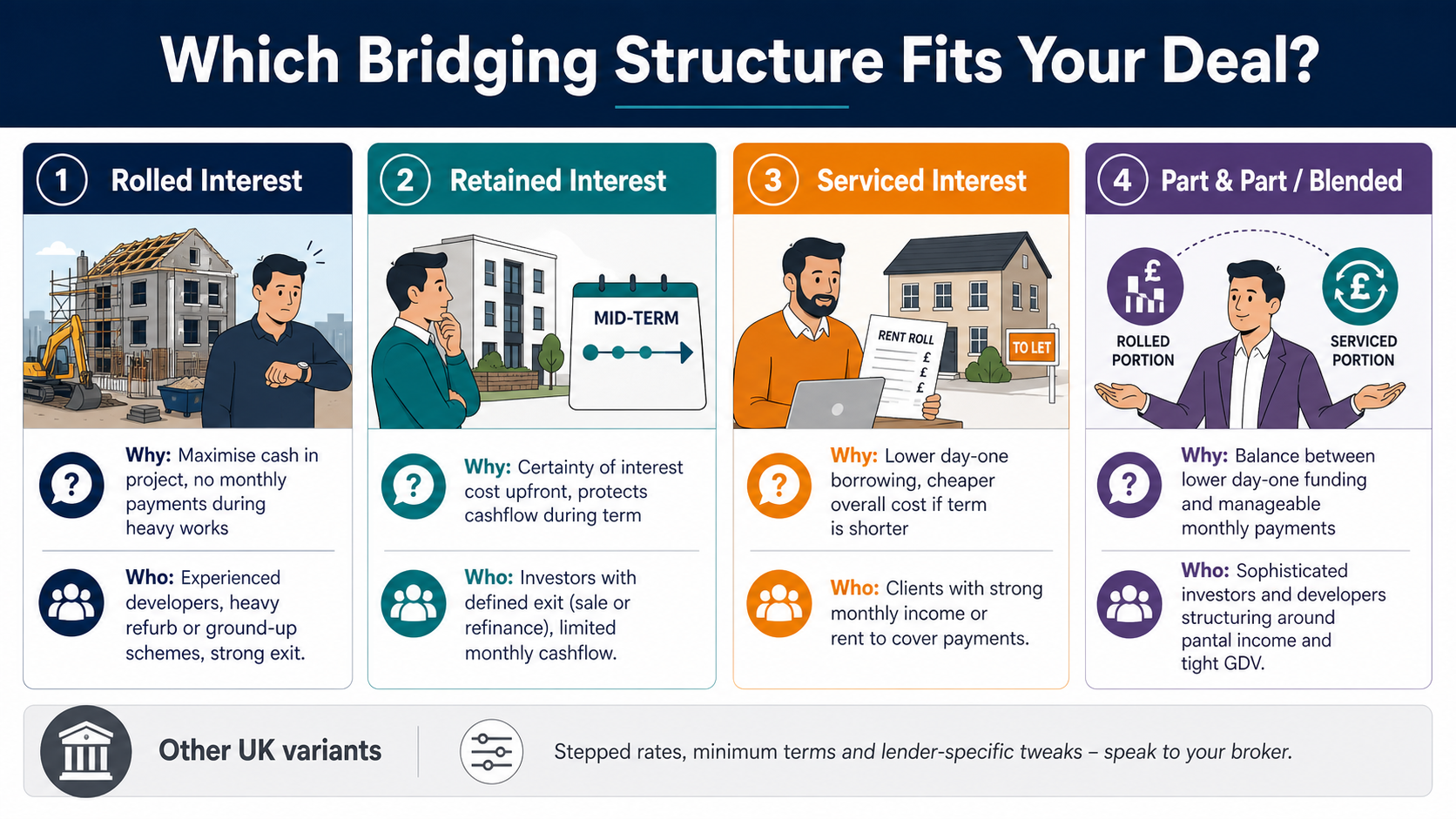
Request a case review through our bridging finance service and we will take you through the options. Current pricing details are on our website.
This article is general information, not a substitute for advice from a qualified financial advisor. Consult a qualified financial professional about your own circumstances before acting on anything here.
FAQ
What is the difference between interest-only and amortising loans?
An interest-only loan charges interest during the term and repays the principal at the end. An amortising loan repays both interest and principal in scheduled instalments, so the balance falls over time, as Oxford Reference describes.
What is bullet repayment?
Bullet repayment means the borrower repays the full principal in one lump sum at maturity. Until then, payments usually cover interest only, which keeps periodic cost low but concentrates the repayment risk at the end.
Is a balloon loan good or bad?
It depends on exit certainty. A balloon structure works when you have a credible sale or refinance plan, and it becomes risky when you rely on market conditions you cannot control.
What is an amortising bond?
An amortising bond repays part of its principal with each coupon rather than all at maturity. It follows the same logic as an amortising loan, with debt shrinking progressively.
Sources
- Oxfordreference
- Accaglobal
- FG13/7 - Dealing fairly with interest-only mortgage customers who risk being unable to repay their loan | FCA
- Bank of England Quarterly Bulletin 2013 Q1
Recommended
Related Topics
Speak to a specialist
Discuss your finance with James directly
Whole-of-market specialist finance — bridging, development, commercial and residential. No call centres, no obligation. James reviews every enquiry personally.
New to specialist finance? How unbiased broker advice works · Deals we have completed
Explore Related Finance