
Published · Updated
refinance maturing bridging loanEngland Developers: Refinance a Maturing Bridge 8 Weeks Early
By James Dawes, CeMAP, Founder, James William & Co Capital

Yes, refinancing a maturing bridging loan is usually possible, but every lender treats it as a brand-new application rather than a simple rollover. The fastest first step is to request your exact redemption figure from your current lender and start assembling exit evidence, recent comparables, a mortgage offer in principle, or a signed sale contract, before your maturity date arrives.
TL;DR:
- Start at least 8 weeks before maturity to compare lenders; with 3 to 8 weeks left, prepare a rebridge because term finance may not finish.
- A new lender reassesses the case from scratch, requiring a fresh valuation, credible exit evidence, a redemption statement, and updated affordability checks for regulated loans.
- Interest added to the balance, along with fees, raises total debt; a second charge can push combined borrowing beyond the replacement lender’s loan to value limit.
- Stress test refinancing against a valuation 5% to 10% below expectation and include two to three months of extra interest in the redemption estimate.
- If a second charge exists, obtain the senior lender’s written consent and deed of priority early, since delays can block refinancing even after a new offer.
Table of Contents
- What re-bridging means and how lenders assess it
- Why borrowers end up refinancing a maturing bridge
- When to act: timing windows from 8 weeks out to default
- Eligibility and the checks a re-bridge application faces
- What a re-bridge actually costs
- Exit strategies and where they commonly go wrong
- FCA rules on extending or replacing a bridging loan
- How a specialist broker handles a time-critical re-bridge
- Key documentation you will need to assemble
- Common challenges and how borrowers resolve them
- How a change in valuation affects your refinancing options
- Tax points to consider when refinancing a bridging loan
- Why waiting rarely pays off on a maturing bridge
- Getting your re-bridge moving with James William & Co Capital
- FAQ
- Sources
What re-bridging means and how lenders assess it
A “re-bridge” is a second short-term loan used to redeem the first one when the original exit, a sale or a move to term finance, has not completed in time. It is not an extension in the administrative sense: most lenders close the old facility and underwrite the new one from scratch.
That means a fresh valuation, new legal searches and a full reassessment of your exit strategy, even if nothing else about the property has changed. Lenders increasingly expect evidence rather than intention: a stated plan to sell or remortgage is no longer enough on its own.
Whether your loan is regulated or unregulated also shapes the process:
- Regulated bridging loans, typically secured against a borrower’s main residence, fall under FCA supervision with stricter affordability rules.
- Unregulated bridges, common for investment property and most business borrowing, rely on exemptions that apply to second-charge and business lending.
- A re-bridge on a regulated loan will usually need the same affordability evidence as the original application, not a lighter version of it.
Knowing which category your loan sits in before you apply saves time, because it determines which documents a lender will ask for first.
Why borrowers end up refinancing a maturing bridge
Most re-bridge applications follow one of a small number of predictable patterns.
- A sale has fallen through or a conveyancing chain has stalled, leaving no completed transaction to redeem the loan.
- A refurbishment has overrun its schedule or budget, so the property is not yet in a saleable or mortgageable state.
- A mortgage offer intended as the exit route has expired, often because term lenders tightened their affordability tests partway through the project.
- The borrower needs more time to reach the planned exit value, whether that is a higher sale price or a valuation that supports a term remortgage.
Each of these points to a different fix. A stalled sale might only need a short extension while a new buyer is found, whereas an expired mortgage offer usually means reapplying to a term lender with updated income or rental evidence. A refurbishment overrun often calls for a slightly larger facility to cover the final works, rather than simply more time at the same loan amount. Separating the cause from the symptom matters, because a lender assessing a re-bridge application will want to see that you understand why the first exit failed and what is different this time.
When to act: timing windows from 8 weeks out to default
How much choice you have depends almost entirely on how early you start.
With 8 or more weeks to maturity, you still have room to compare options properly. Use this window to request updated valuations, speak to potential term lenders about an agreement in principle, and confirm your exact redemption figure in writing.
Between 3 and 8 weeks, your focus should shift to preparing a re-bridge as the likely route, since most term lenders cannot complete in this timeframe. Instruct a broker at this point if you have not already, gather contractor invoices or completion photos if refurbishment is involved, and confirm whether your current lender requires formal notice of a change in exit strategy.
Under 3 weeks, or if you have already missed the maturity date, you are in urgent territory.
- Contact your current lender immediately to ask about a short formal extension rather than letting the loan fall into default.
- Prepare a decision-in-principle pack that a specialist lender can assess within a day, including your redemption statement and evidence of the new exit.
- Expect to pay a higher monthly rate for speed; most lenders price emergency re-bridges above their standard range.
Pro Tip: Ask your existing lender for your redemption figure the moment you suspect a delay, not the week before maturity. A current figure is the one document every new lender will ask for first.
Eligibility and the checks a re-bridge application faces
A new lender underwriting a re-bridge runs through broadly the same checks as any other bridging application, with extra scrutiny on why the first loan did not complete on schedule.
- An up-to-date valuation, supported by recent comparable sales if the exit is a disposal rather than a refinance.
- Evidence of refurbishment progress where relevant, including contractor contracts, paid invoices and photographs of completed works.
- A full redemption statement from the existing lender, plus a deed of priority and written consent from any senior lender if the loan sits behind another charge.
- Affordability evidence appropriate to the borrower type: income and expenditure for regulated bridges, or company accounts and trading history for business borrowers.
- A credit file check and a review of how the current facility has been conducted, including whether payments or interest have been met on time.
Lenders respond fastest to a single, complete pack rather than documents sent piecemeal, so it is worth assembling everything before approaching a new lender rather than during the application.
What a re-bridge actually costs
Pricing on a second bridging loan reflects both the short-term nature of the facility and the slightly higher risk lenders attach to a loan that has already missed one exit.
A re-bridge adds a second layer of interest, fees and legal costs on top of whatever remains unpaid from the first loan. Non-regulated bridging rates typically sit in a monthly band, with regulated bridges often priced a little higher to reflect the stricter affordability requirements set out in FCA MCOB rules. On top of the rate, expect an arrangement fee, a valuation fee, legal costs for both sides, and potentially an exit fee or early repayment charge on the facility being redeemed.
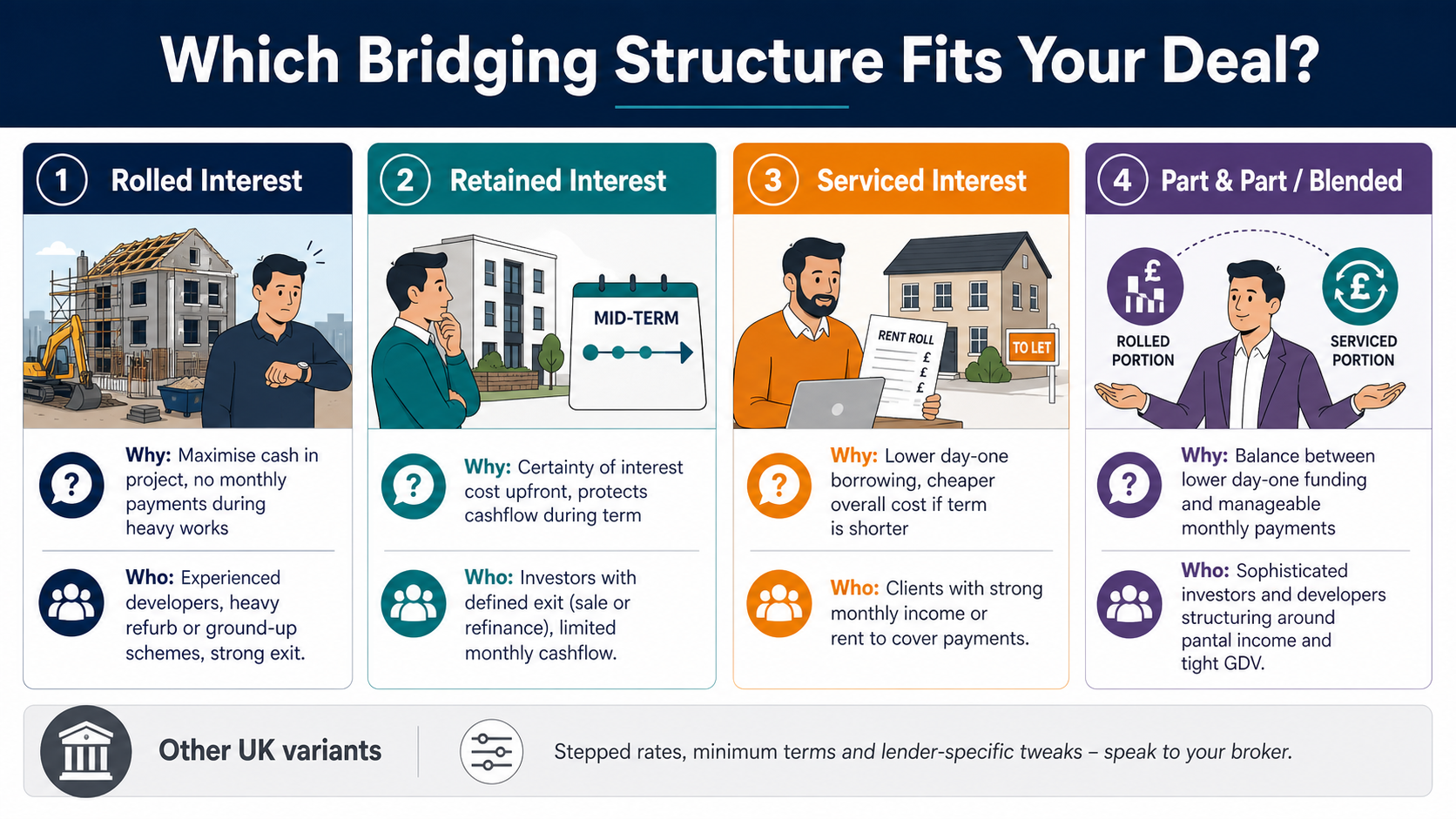
Because interest is usually rolled up rather than paid monthly, the total amount owed at the end of a re-bridge is higher than the amount drawn down. Say a borrower owes a balance on a maturing bridge and takes a new facility to redeem it: by the time arrangement fees, legal costs and several months of rolled-up interest are added, the total secured debt at the end of the new term can be noticeably higher than the original amount borrowed, which in turn changes the loan-to-value position against the property. That shift matters most when a second charge is involved, because combining rolled-up interest from both loans can push the total secured position beyond what a subsequent lender will accept. For a fuller breakdown of fee components, our article on bridging loan costs sets out typical fee ranges in detail.
Exit strategies and where they commonly go wrong
The two realistic exits from a maturing bridge are refinancing onto a term mortgage and selling the property. Both carry pitfalls that are easy to underestimate.
A full refinance to a term mortgage usually requires the incoming lender to redeem the entire secured position, not just the original bridging loan. If a second charge sits behind the first, the new lender typically needs to support both debts together, which can fail if the combined figure exceeds standard loan-to-value limits even when the underlying property value is sound.
- Run a valuation sensitivity check before relying on a single exit route: test what happens to your loan-to-value if the valuation comes in 5% to 10% below expectation.
- Add a buffer of two to three months’ extra interest to any redemption calculation, since delays are the norm rather than the exception on time-pressured exits.
- Where a second charge exists, approach the senior lender early for a deed of priority and written consent, as this can take weeks to arrange and will stall any refinance without it.
- Build contingency into the plan itself: a small injection of additional equity, a staged refinance that redeems part of the debt first, or a partial sale of part of a larger site can all keep an exit alive when the primary route falters.
Borrowers who test these scenarios before they become urgent tend to have far more refinancing options than those who wait for a lender to raise the problem first.
FCA rules on extending or replacing a bridging loan
Bridging loans secured against a borrower’s home fall within FCA regulation, and the rules that govern extensions are specific rather than discretionary.
- Under MCOB, lenders must reassess affordability whenever a regulated bridging loan is extended, rather than assuming the original assessment still holds.
- A lender extending a regulated bridge must be satisfied that a mainstream mortgage lender would be willing to offer a replacement regulated mortgage contract if that is the stated exit route, which usually means seeing a firm offer or a credible agreement in principle rather than a general statement of intent.
- Lenders are also required to document that the borrower has made a positive, informed choice to extend, which is why extension packs increasingly include written confirmation from the borrower alongside the updated affordability evidence.
These requirements apply differently to interest-roll-up facilities and to high-net-worth borrowers, where income evidence can be drawn from a wider range of sources, but the underlying obligation to reassess affordability does not disappear simply because the loan is being extended rather than newly drawn.
How a specialist broker handles a time-critical re-bridge
Our approach to a maturing bridge is built around acting as a single point of contact across the whole process, rather than leaving a borrower to coordinate valuers, solicitors and lenders separately under time pressure.
- We approach private credit funds and specialist lenders beyond the mainstream high street, giving access to facilities that can be assessed and offered within days rather than weeks.
- We assemble the redemption pack on a client’s behalf, including the outstanding balance, valuation evidence and exit documentation, before approaching new lenders.
- We negotiate directly with senior lenders where a deed of priority or consent is needed, which often removes the single biggest delay in a second-charge refinance.
- We structure multi-layered exits, combining a re-bridge with staged refinancing or partial equity release, when a single facility cannot cover the full secured position.
Acting early gives the widest set of options; acting in the final days before maturity narrows the field to lenders who specialise in same-week decisions, which is exactly the gap a broker relationship is built to close.
Key documentation you will need to assemble
Lenders underwriting a re-bridge work faster when a complete evidence pack arrives in one submission, so it is worth gathering the following before making contact.
- A current redemption statement from the existing lender, showing the outstanding balance, accrued interest and any exit fees.
- Proof of identity and proof of address for every borrower or director, in line with standard anti-money-laundering checks.
- Evidence of the exit strategy itself: a signed sale contract, an agreed sale memorandum, or a decision in principle from a term lender.
- A recent valuation or, where the property has changed since the last one, evidence to support an updated figure, such as comparable sales or a schedule of completed works.
- For refurbishment projects, contractor invoices, a schedule of works completed to date, and photographs showing the property’s current condition.
- Company accounts, trading history or a business plan where the borrower is a limited company or the loan supports a business purpose.
- A deed of priority and written consent from any senior lender, where the facility being refinanced sits behind another charge.
Assembling this pack before approaching a new lender, rather than during the application, is often the single biggest factor in whether a re-bridge completes before maturity.
Common challenges and how borrowers resolve them
The most frequent obstacle on a re-bridge is a valuation that comes in lower than expected, which immediately tightens the loan-to-value a new lender can offer against. Borrowers typically resolve this by introducing a small amount of additional equity, accepting a slightly smaller facility and making up the shortfall from savings or a related funding line, or revisiting the exit timetable to allow for a sale at a more realistic price.
A second common issue is delay in obtaining senior lender consent where a second charge is involved. This is rarely a refusal outright, more often a slow administrative process, so starting the conversation with the senior lender as soon as a re-bridge becomes likely, rather than waiting until a new facility is agreed, avoids the problem becoming a last-minute blocker.
A third challenge is an exit route that looked solid on paper but weakens under scrutiny, such as a mortgage offer in principle that a term lender later declines to convert into a formal offer. Building a second, independent exit option alongside the primary one, whether that is a different term lender or a fallback sale, gives a re-bridge application something to point to if the first route stalls partway through underwriting.

How a change in valuation affects your refinancing options
A property’s valuation at the point of refinancing has a direct effect on every option available afterwards, because loan-to-value limits are fixed by lenders, not negotiable on a case-by-case basis once an offer is issued.
A lower valuation than expected reduces the maximum loan a new lender can offer, which can leave a shortfall between the redemption figure owed and the funds a replacement facility will provide. Where a second charge sits behind the first, this effect compounds, since the combined secured position has to fit within the new lender’s limits, not just the bridge balance alone.
A higher valuation than at the outset, by contrast, can open up options that were not available originally, including a lower-rate term mortgage or a larger facility that covers both redemption and further works. This is why running a valuation sensitivity check early, rather than relying on the figure from months earlier, shapes which refinancing route is realistic and which is not.
Tax points to consider when refinancing a bridging loan
Refinancing a bridging loan is not in itself a taxable event in the way that a sale is, but it can affect the tax position around the transaction in a few specific ways.
Interest on a bridging loan used for a rental property or a development intended for sale may be deductible against rental income or treated as a cost of the development, depending on how the property is held and the borrower’s own tax position; the rules differ for individuals and companies, and for properties held personally versus through a limited company. Where a re-bridge increases the total amount of interest rolled up and later repaid, that figure may need to be reflected in the eventual tax calculation on sale or on rental profits.
Stamp Duty Land Tax does not generally apply to refinancing an existing property, since no new acquisition takes place, but it remains relevant if a re-bridge is tied to acquiring an additional property as part of the same transaction. Given how much these outcomes depend on individual circumstances and structure, borrowers should treat this as a prompt to speak to an accountant or tax adviser alongside their broker, rather than as a substitute for that advice.
Why waiting rarely pays off on a maturing bridge
Most borrowers facing a maturing bridge default to hoping the original exit completes a little late rather than acting on a second plan. That instinct is understandable, but it is usually the wrong one.
The evidence from the current lending market is that exits are taking longer and refinancing tests are getting tougher, not easier, which means a passive approach costs real money in extra interest and lost options. The borrowers who come out ahead are the ones who treat a maturing bridge as a live risk from the eight-week mark onwards: they get a redemption figure in writing, they test their exit against a lower valuation before a lender forces the question, and they keep a lender relationship open rather than going silent until the deadline.
Active management beats waiting almost every time, because the number of lenders willing to act quickly shrinks the closer you get to default.
— James William Dawes
Getting your re-bridge moving with James William & Co Capital
We work as a single point of contact for borrowers facing a maturing bridge, with direct access to private credit funds and specialist lenders beyond the mainstream high street. That reach matters most when a standard bank process would simply take too long.
Our team structures the full range of short-term and longer-term finance a re-bridge can need, from the bridging facility itself through to development finance, joint venture equity and mezzanine finance where a project needs a staged exit rather than a single refinance. We also arrange buy-to-let mortgages and residential mortgages for borrowers moving from a bridge onto term finance, and for readers comparing mainstream buy-to-let lending criteria, Haven Mark Advisers set out practical lender thresholds worth reviewing alongside a bridging exit plan. When engaged, a broker can assemble your redemption pack, approach lenders who can assess your case quickly, and negotiate senior lender consent where a second charge is involved. Get in touch through our bridging finance page to talk through your timeline and options.
FAQ
Can I refinance my bridging loan?
Yes, refinancing a bridging loan, often called a re-bridge, is a routine option when the original exit has not completed in time. Most lenders treat it as a new application, requiring a fresh valuation and updated exit evidence rather than a simple rollover of the existing terms.
What is the 2% rule for refinancing?
Rather than relying on an informal rule of thumb, borrowers are better served checking the specific rate, fees and loan-to-value criteria quoted by their own lender for the exact facility in question.
What does Martin Lewis say about bridging loans?
We have not identified a specific, sourced position from Martin Lewis on bridging loans that we can accurately attribute here. For general guidance on bridging finance, borrowers are better served checking FCA guidance on regulated bridging loans or speaking directly with a specialist broker.
How much would a £200,000 bridging loan cost?
The total cost depends on the monthly rate, arrangement fee, legal and valuation costs, and how long the loan runs, since interest is typically rolled up rather than paid monthly. Fees and several months of rolled-up interest can add a meaningful amount to the balance owed by the time the loan is redeemed, which is why a worked quote from a lender or broker is the only reliable way to confirm the figure for a specific case.
Sources
- Delayed exits, higher stakes: Choosing the right bridging partner | Bridging & Commercial
- FCA handbook - MCOB 11.6 Responsible lending and financing
- Understanding regulated bridging loans | Solegal
Recommended
Related Topics
Speak to a specialist
Discuss your finance with James directly
Whole-of-market specialist finance — bridging, development, commercial and residential. No call centres, no obligation. James reviews every enquiry personally.
New to specialist finance? How unbiased broker advice works · Deals we have completed
Explore Related Finance