
Published · Updated
land bridging financeLand Bridging Finance: Rates, LTVs and How It Works
By James Dawes, CeMAP, Founder, James William & Co Capital

Land bridging finance is a short-term, asset-backed loan that lets UK developers and investors secure land quickly without waiting for a mortgage-style underwriting process. Terms typically run from several months up to around two years, and the loan is usually repaid through one of three exits: sale of the land, refinancing onto development finance, or refinancing onto a term mortgage once the asset’s status improves.
If you’re weighing this up, the honest verdict is: it suits anyone who needs to move faster than a bank can process a standard facility, particularly at auction or when a vendor wants a quick, unconditional completion. It suits you less well if your numbers only work at the top end of the LTV range on a site with no planning history at all.
Before approaching a lender, have three things ready:
- A recent title check or Land Registry extract confirming ownership and any restrictions.
- Evidence of your exit, whether that’s a sales agent’s appraisal, a development finance decision in principle, or heads of terms with a buyer.
- Any planning correspondence, even informal pre-application feedback, since it materially changes what a lender will offer.
Pro Tip: Get a RICS valuation instructed on day one, even before you’ve fully agreed terms with the seller. Valuation delays are the single biggest cause of slipped completion dates on land bridging cases.
Key Takeaways
Land bridging finance works best when planning evidence and a documented exit strategy are prepared before a lender is approached, not after.
| Point | Details |
|---|---|
| Rates track planning risk | Monthly rates typically range from under one percent to around one and a half percent, with unconsented land attracting rates towards the higher end. |
| LTV follows consent status | Unconsented land typically attracts lower LTV ratios, while fully consented sites can qualify for higher LTVs. |
| Exit evidence beats narrative | Heads of terms, a development finance decision in principle, or agent appraisals convert a hopeful exit into a fundable one. |
| Delays compound cost | Extension fees and rolled-up interest mean a slipped timetable costs more than the extra weeks alone. |
| Broker access speeds approval | James William & Co Capital structures cases across multiple lender channels to match planning status and exit strategy to live appetite. |
Table of Contents
- What is land bridging finance and how does it differ from development finance?
- Land bridging finance rates, fees and LTV benchmarks
- How planning status changes lender appetite
- Exit strategies lenders will actually accept
- What documentation speeds up approval
- Common scenarios: auctions, unconsented land and refinancing
- Timelines, delays and what they cost you
- How James William & Co Capital structures land bridging cases
- A broker’s honest read on land bridging finance
- Get land bridging finance structured properly from the outset
- Sources
- FAQ
What is land bridging finance and how does it differ from development finance?
Land bridging finance is a short-term loan secured against a plot of land, structured to be repaid within months rather than years. Interest is usually rolled up or retained rather than paid monthly, which matters if you’re buying land that generates no income while you sort out planning or a sale. The loan is asset-backed, meaning the lender’s primary security is the land itself, not your trading history or personal income, which is why speed of approval tends to beat almost any other form of property finance.
The critical distinction from development finance is scope. Land bridging typically funds the purchase price of the land alone, sometimes with a modest allowance for professional fees. Development finance, by contrast, funds the land and the build costs and the associated fees, released in stages as construction progresses. Confusing the two is a common and costly mistake: developers sometimes approach a bridging lender expecting build-cost cover and find the facility only ever covered acquisition.
Three groups use land bridging most often:
- Auction buyers who need to complete within 28 days and cannot wait for a conventional mortgage offer.
- Developers acquiring land ahead of planning, where the opportunity to secure a site cheaply outweighs the risk of not yet having consent.
- Investors refinancing existing land holdings, either to release equity or to buy time while a planning application or sale process runs its course.
If your plan involves any construction spend within the loan term, read our guide on types of property finance for UK developers before committing to a bridge that won’t stretch to cover it.
Land bridging finance rates, fees and LTV benchmarks
Pricing on land bridging finance moves more than most borrowers expect, and the swing is driven almost entirely by planning risk and loan-to-value. Title defects, access disputes, or a short remaining lease on adjoining land all push pricing towards the top of that range, sometimes beyond it.
Beyond the headline rate, expect a fee stack that adds up quickly:
- Arrangement fee: typically 1% to 2% of the loan, often added to the facility rather than paid upfront.
- Valuation fee: varies by site complexity and value, payable directly to the RICS-accredited surveyor.
- Legal fees: both your solicitor’s costs and the lender’s legal fees, which you usually cover.
- Broker fee: where applicable, for sourcing and structuring the deal.
- Exit fee: some lenders charge a small percentage on redemption, others don’t; always check before signing.
LTV brackets tend to map fairly predictably to planning status. Unconsented land, sometimes called “hope value” land, typically attracts 40% to 50% LTV because the lender is pricing genuine uncertainty. Land with a positive pre-application response or an outline consent can move into the 50% to 60% band. Fully consented land with a clean condition schedule can reach 65% to 70% LTV with some specialist lenders, occasionally higher on exceptional sites.
Scale that to a £1 million site at the same terms and you’re looking at £600,000 borrowed, monthly interest near £6,000, and an arrangement fee close to £9,000. Add valuation, legal and broker costs on top, and the total cost of a six-month bridge on the larger deal often lands somewhere between £45,000 and £60,000 once every fee is accounted for. Run your own numbers through a tool like the Real Estate Investor Toolkit’s mortgage calculator before you commit, since even small rate differences compound meaningfully over a 12-month term.

How planning status changes lender appetite
Planning status is arguably the single biggest variable in how a lender prices and structures a land bridging case, and the scrutiny points lenders apply to land shift markedly at each stage. Broadly, land moves through five positions, and each one changes both the valuation approach and how much a lender will advance.
Unconsented land carries the most uncertainty. Lenders will typically value it close to existing use, discounting almost all of the “hope value” a developer might attach to future planning gain. Pre-application feedback, even informal written comments from a planning officer, nudges lenders towards a slightly more generous view, because it signals the local authority’s likely direction of travel. Outline consent confirms the principle of development is accepted, which materially de-risks the site and typically unlocks higher LTV. Full consent goes further still, giving the lender near-certainty on unit numbers and use class. But full consent loaded with onerous pre-commencement conditions can actually undermine value, since underwriters often treat a heavily conditioned consent as less attractive than a cleaner outline permission, because those conditions cost time and money to discharge before a spade goes in the ground.
Lenders anchor valuation using one of two methods: existing use value, or net residual value once build costs, professional fees and developer profit are stripped out of the projected end value. The temptation to model against an optimistic “hope value” figure, rather than a properly worked residual calculation, is one of the most common reasons applications stall or get re-priced mid-process.
Watch for these red flags before you apply:
- Restricted or shared access that hasn’t been formally secured by right of way.
- A Section 106 agreement with obligations that haven’t been costed into your appraisal.
- Pre-commencement conditions relating to ecology, drainage or highways that remain undischarged.
- Utilities that require new connections rather than simple upgrades.
Pro Tip: Commission a short feasibility study from a planning consultant before you approach a lender, even on a site you believe is straightforward. A two-page professional opinion on deliverability often does more to move a lender’s risk appetite than any amount of verbal reassurance.
Exit strategies lenders will actually accept
Every land bridging application lives or dies on the credibility of its exit, and lenders will interrogate this harder than almost any other part of your submission. There are three principal routes.
- Sale of the land, either with or without planning consent attached, evidenced by agent appraisals, marketing history, or ideally a buyer already circling.
- Refinance onto development finance, where the bridge covers acquisition and a subsequent facility funds the build, evidenced by a decision in principle from a development lender.
- Refinance onto a term mortgage or sale of other assets, more common where the borrower is using the land as part of a wider portfolio strategy rather than a standalone play.
Modelling net residual value correctly matters more than most borrowers appreciate. That means taking a realistic gross development value, deducting build costs, professional fees, finance costs and developer profit, then working backwards to what the land is genuinely worth today, not what you paid for it or what you hope it will be worth once consent lands. Comparable evidence should come from genuinely similar sites; Statista’s data on annual land value growth by type is a useful sense check against inflated comparables that don’t reflect current market movement.
The strongest applications carry documentary proof of the exit, not just a narrative. Heads of terms with a buyer, a development finance decision in principle, or a signed agent instruction all convert a hopeful story into underwritable evidence. Build a contingency of at least one to two months into your timetable beyond the point you expect to complete, because planning determinations, legal searches and valuation instructions all routinely run longer than first quoted.
What documentation speeds up approval
Lenders want to see a near-complete picture before they’ll commit terms, and gaps in your paperwork are the most common reason offers slip or get re-priced. Preparing a tight submission before you approach a lender, rather than scrambling to answer questions afterwards, is what separates a two-week completion from a two-month one.
At minimum, expect to provide:
- Title deeds and a Land Registry extract, confirming ownership, boundaries and any restrictive covenants.
- A RICS-accredited valuation, instructed early since this is usually the longest lead-time item.
- Planning evidence, including any decision notices, pre-application correspondence, and the status of reserved matters if outline consent has been granted.
- Technical reports where relevant, such as utilities feasibility, ecological surveys or contamination assessments on brownfield sites.
- Borrower evidence, including a developer CV or track record, proof of source of funds, and details of any corporate structure involved in the purchase.
Lenders and brokers handling your financial information must also follow data protection obligations when processing credit checks, something the ICO’s guidance on credit information sets out clearly if you want to understand what checks are being run on you.
Pro Tip: Instruct your solicitor before you have a lender’s formal offer, not after. Having your legal team already reviewing title and raising enquiries in parallel with underwriting can shave a fortnight off completion.
Common scenarios: auctions, unconsented land and refinancing
Auction purchases are the clearest use case for land bridging finance, since the 28-day completion deadline rules out conventional mortgage timelines entirely. Lenders will want your legal pack reviewed and a valuation instructed before the hammer falls, ideally with an agreement in principle already secured so drawdown can happen the moment contracts exchange.
Acquiring land without planning is the trickiest scenario to fund, but far from impossible. The evidence that moves a lender from conservative to flexible pricing is almost always a credible planning strategy rather than the physical attributes of the site itself. A pre-application response, a supportive local plan allocation, or a planning consultant’s written opinion on deliverability all shift a lender’s comfort noticeably.
Serviced or near-complete plots, meaning land with utilities already connected and reserved matters largely discharged, tend to attract the higher end of LTV ranges because so much of the delivery risk has already been removed.
Refinance scenarios arise when a borrower already owns land and needs to release equity, extend a maturing facility, or simply buy time while a slower process, such as a planning appeal, runs its course. A bridge makes sense here specifically because it’s a stopgap, not a permanent capital structure; the moment you have a clear route to development finance or a term facility, that’s when you should be actively negotiating the next stage rather than rolling the bridge indefinitely.
Timelines, delays and what they cost you
A straightforward land bridging case, where title is clean, planning status is clear, and the borrower’s paperwork is ready, can complete in as little as one to two weeks from application. Complex cases involving multiple title issues, unresolved planning conditions, or a corporate ownership structure that needs untangling can easily stretch beyond six weeks.
Because monthly rates typically compound on the outstanding balance rather than resetting, a delay doesn’t just cost you the extra interest for the additional weeks, it also delays your exit and can push you into extension fee territory. Most lenders charge an extension fee, often similar in scale to the original arrangement fee, if the loan runs past its agreed term.
Budget for these cost drivers before they surprise you:
- Extension fees if completion or exit slips beyond the agreed term.
- Additional legal costs where title defects, ransom strips or access disputes surface late in the process.
- Contamination or ecological survey costs on sites with any history of industrial or agricultural use.
- Planning consultancy fees if a pre-application review becomes necessary mid-transaction.
Government-set planning application fees are worth checking directly on gov.uk before you finalise your budget, since these are statutory charges that vary by application type and can shift the economics of a marginal deal.
How James William & Co Capital structures land bridging cases
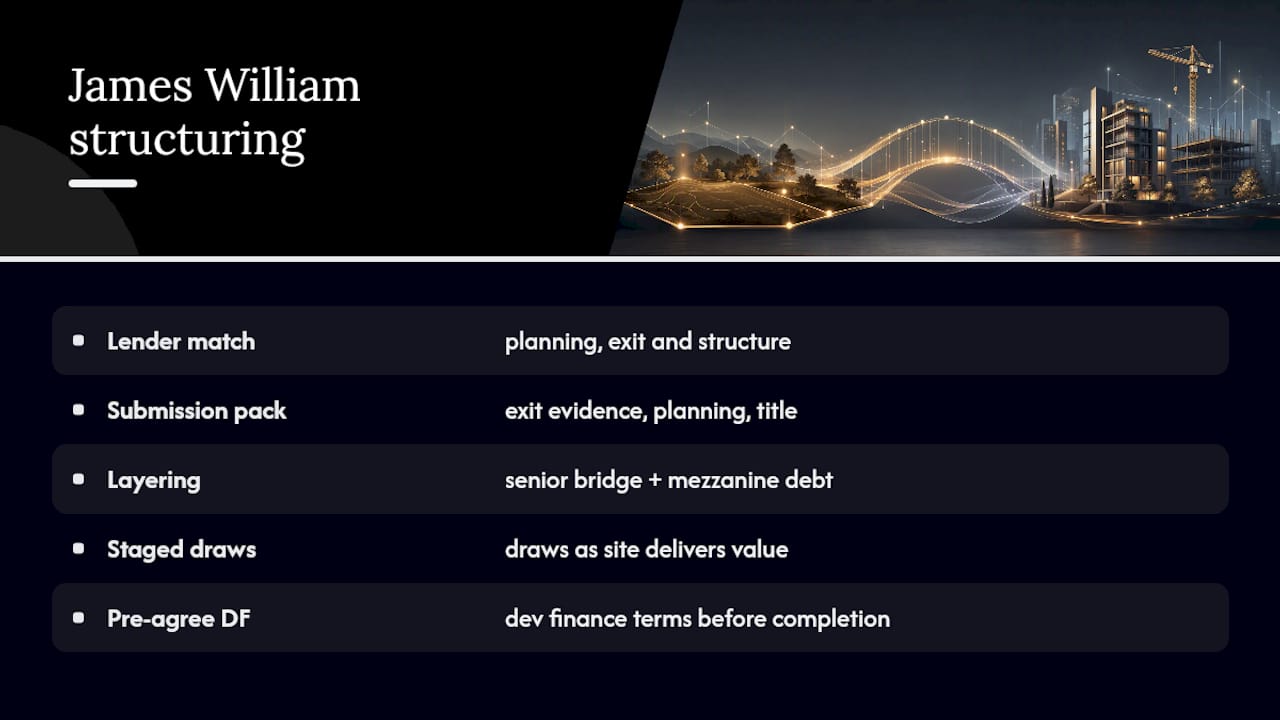
Accessing the right lender for a land bridging case is less about finding “a bridging lender” and more about matching your specific planning status, exit strategy and structure to the handful of lenders who actually have appetite for it that month. A capital-concierge broker works across family offices, private credit funds and specialist lenders simultaneously, which matters because appetite in this space shifts quickly and the lender who was competitive on unconsented land three months ago may have tightened criteria entirely.
James William & Co Capital packages exit evidence, planning correspondence and title information into a submission that lenders can underwrite quickly, rather than leaving gaps for a credit committee to query. Common structuring techniques include layering a senior bridge with mezzanine debt to stretch effective leverage, arranging staged draws where a site delivers value in phases, and pre-agreeing development finance heads of terms before the bridge even completes, so the refinance exit is contractually credible rather than aspirational.
A credible exit isn’t a sentence in an application form, it’s a stack of evidence: a buyer’s heads of terms, a lender’s decision in principle, or a planning consultant’s signed feasibility note. That’s what separates a fundable case from a hopeful one.
If you’re structuring a land purchase and want a broker who can move across multiple lender relationships rather than a single product shelf, our team at James William & Co Capital can talk through your site and exit before you commit to a formal application.
A broker’s honest read on land bridging finance
Most guidance on land bridging finance treats it as a commodity product: quote a rate, quote an LTV, move on. That misses the point entirely. The rate you’re offered is a symptom, not the deal. What actually determines whether a case gets funded, and at what price, is the quality of your exit evidence and how well you’ve costed planning risk into your own numbers before a lender ever sees them.
The conventional advice to “shop around for the best rate” undersells how much pricing moves once a lender trusts your exit. I’ve seen sites price a full percentage point tighter simply because the borrower turned up with a planning consultant’s feasibility note and a buyer’s heads of terms already in hand, rather than a bare site and a hopeful narrative.
If you take one thing from this: prioritise your exit evidence before your rate shopping. A weaker site with a bulletproof exit will outprice a stronger site with a vague one, every time.
Get land bridging finance structured properly from the outset
Most developers approach land bridging finance by ringing round individual lenders one at a time, comparing headline rates without knowing which of those lenders actually has appetite for their specific planning status this month. James William & Co Capital works differently: as a capital-concierge broker, we hold live relationships across family offices, private credit funds and specialist lenders, so your case gets placed with whoever genuinely wants it, not whoever answers the phone first.
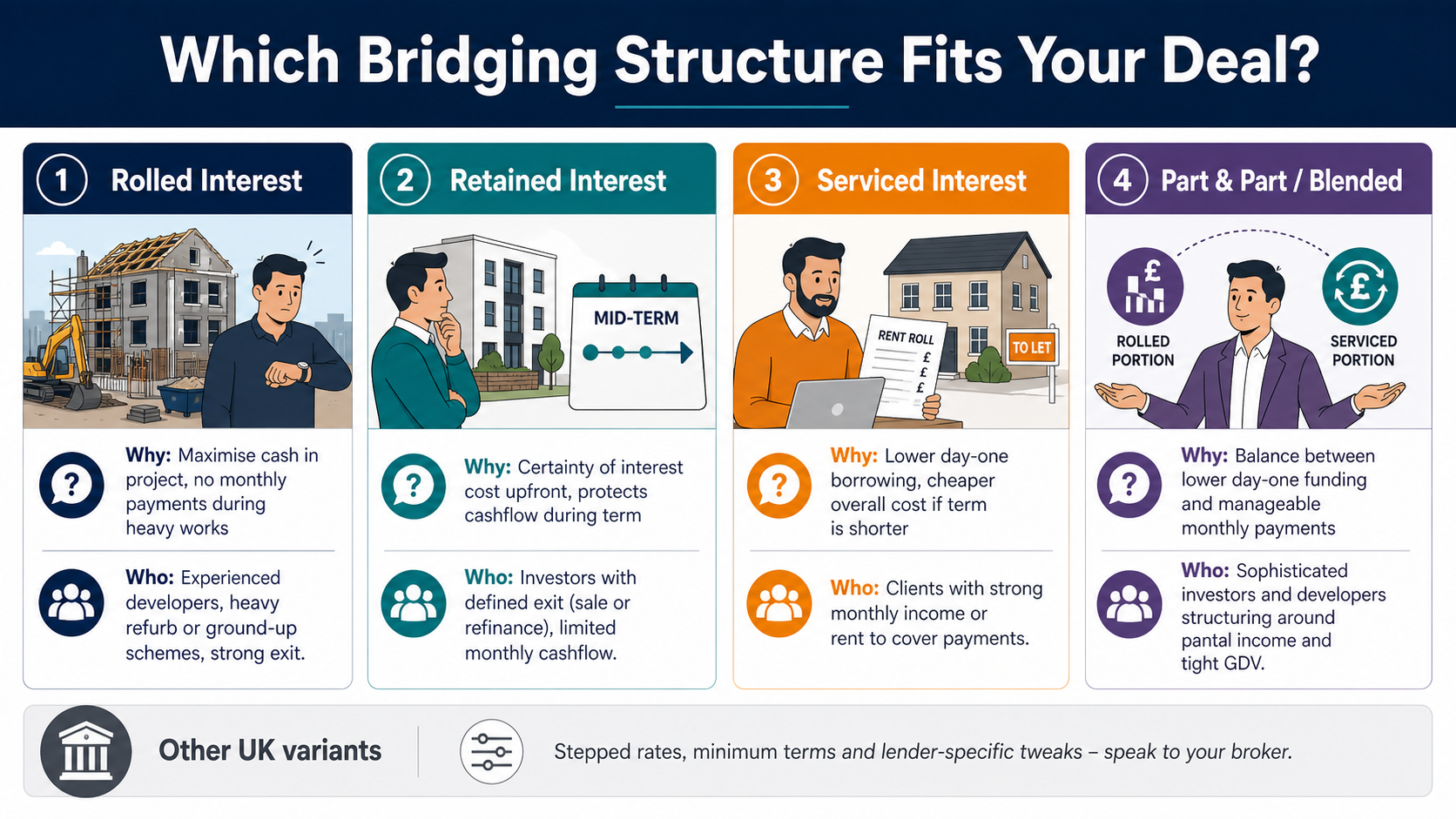
That matters most when your site sits somewhere awkward, unconsented land, a messy title, or a deal that needs a senior bridge layered with mezzanine debt to stack up. We package your title, planning evidence and exit documentation into a submission lenders can underwrite fast, and where useful, pre-negotiate development finance heads of terms so your refinance exit is contractual rather than hopeful. Browse examples of how we’ve structured comparable deals on our case studies page, then get in touch with our specialist property finance team to talk through your site and timetable before you approach a lender directly.
This article is general information, not a substitute for advice from a qualified financial advisor. Consult a qualified financial professional about your own circumstances before acting on anything here.
Sources
For planning fees, check gov.uk’s planning application guidance directly rather than relying on third-party estimates. Confirm any lender or broker’s regulatory status on the FCA register before signing terms. For valuation comparables, Statista’s UK land value data and RICS professional standards both underpin the figures and benchmarks used throughout this article.
- Gov
- Annual growth of land value in the UK, by type | Statista
- Bridging finance for land: what lenders scrutinise | Squared Money
FAQ
How much would a £200,000 bridging loan cost?
Can you still get bridging loans in the UK?
Yes, land bridging finance remains widely available through specialist lenders, family offices and private credit funds, though appetite and pricing shift based on planning status, LTV requested and the strength of your exit evidence.
Who are the best bridging lenders in the UK?
There’s no single “best” lender since appetite varies month to month by planning status, site type and exit strategy; a broker such as James William & Co Capital can match your specific case to whichever lenders currently have live appetite for it, and you can always confirm any lender’s regulatory status on the FCA register.
What does Martin Lewis say about bridging loans?
Martin Lewis’s consumer guidance generally flags bridging finance as an expensive, short-term option that should only be used with a clear, credible repayment plan already in place, a principle that applies directly to land bridging given its rolled-up interest structure.
How does planning status affect the loan-to-value I can get?
Recommended
Related Topics
Speak to a specialist
Discuss your finance with James directly
Whole-of-market specialist finance — bridging, development, commercial and residential. No call centres, no obligation. James reviews every enquiry personally.
New to specialist finance? How unbiased broker advice works · Deals we have completed
Explore Related Finance