
Published · Updated
bridge to letBridge to let: a UK investor's guide to the two-stage strategy
By James Dawes, CeMAP, Founder, James William & Co Capital

Bridge to let is a short-term bridging loan used to buy or refurbish a property that will later refinance onto a buy-to-let mortgage. It suits auction purchases, unmortgageable properties, and investors who need speed a standard lender cannot match. Lenders typically advance a high loan-to-value amount, with the Financial Conduct Authority regulating certain bridging products where a borrower’s home is involved. James William & Co Capital structures these deals for professional investors who need the exit sized correctly from day one.
- Buying at auction with a 28 day completion deadline
- Acquiring a property that fails standard mortgage criteria (no kitchen, short lease, structural issue)
- Raising capital fast to fund refurbishment before refinancing to a buy-to-let mortgage
Key Takeaways
Bridge to let works when a credible, evidenced refinance exit is validated before completion, not arranged as an afterthought once the bridge is already running.
| Point | Details |
|---|---|
| Two-stage structure | A bridging loan funds purchase and works; refinancing to a buy-to-let mortgage is the planned exit. |
| Size the net, not the gross | Retained interest and fees reduce actual funds released, so budget with contingency built in. |
| Typical LTV range | Lenders commonly advance 70–75% loan-to-value during the bridging phase. |
| Validate the exit early | Rental appraisals and lender pre-approval before completion prevent refinance refusal. |
| Use a specialist broker | James William & Co Capital pre-validates exits and sizes facilities correctly for complex bridge-to-let cases. |
Table of Contents
- What is a bridge to let strategy?
- When does bridge to let make sense for investors?
- What does bridge to let actually cost?
- How much can you actually borrow?
- What are the exit strategies and realistic timelines?
- What legal steps and documents does a bridge to let require?
- What are the main risks and how do you manage them?
- How do you apply and what does a broker add?
- How James William & Co Capital structures your bridge to let
- Sources
- FAQ
What is a bridge to let strategy?
Bridge to let isn’t a single financial product. It’s a two-stage strategy: a bridging loan funds the purchase and any works, then that debt gets repaid by refinancing onto a standard buy-to-let mortgage once the property qualifies. The bridge buys you time and capital; the refinance is what actually makes the numbers work long-term.
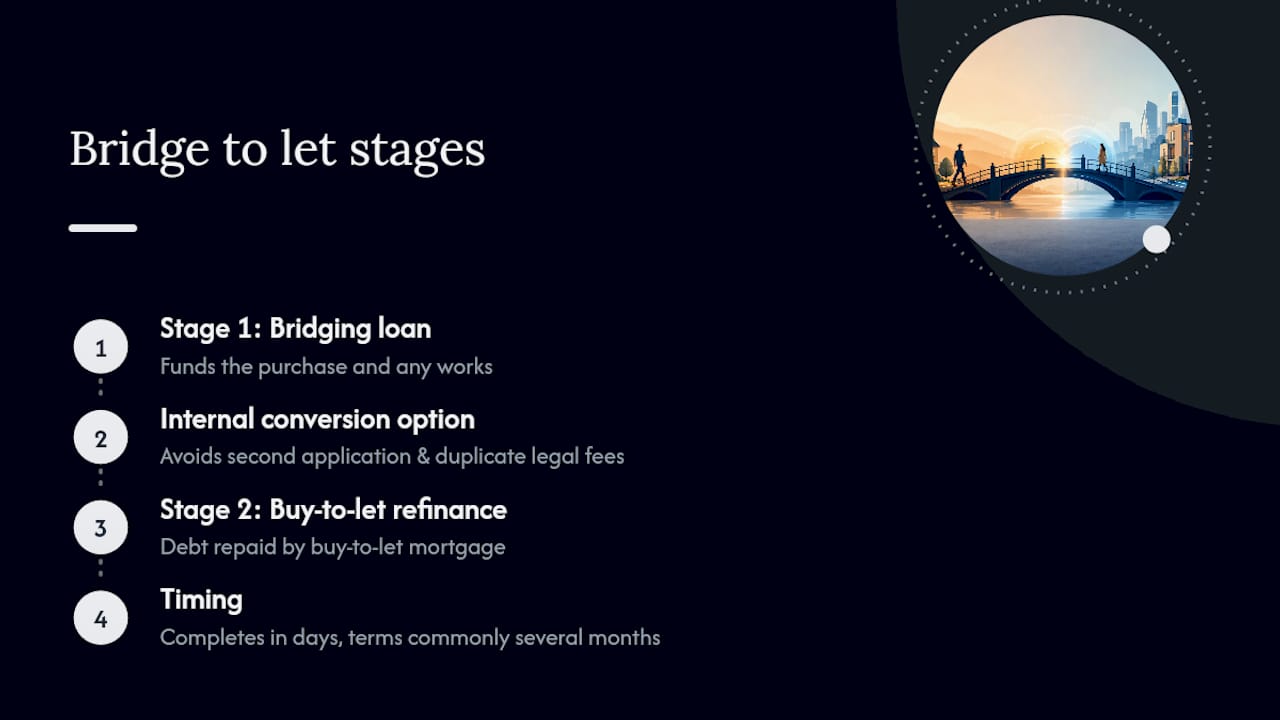
Some lenders offer a dedicated bridge-to-let product that underwrites both phases together, converting the facility internally once the property meets standard, avoiding a second full application and duplicate legal fees. Others require you to arrange a standalone bridge with an explicit, evidenced refinance plan presented separately to a buy-to-let lender.
Speed is the whole point. A bridge can complete in days rather than weeks, with terms commonly running for several months, occasionally stretching longer depending on the lender and the complexity of the works involved.
When does bridge to let make sense for investors?
Five recurring situations fund well under this structure. Auction purchases are the obvious one: you exchange with a hard completion deadline and no time to wait for a conventional mortgage offer. A property with no working kitchen or bathroom, unmortgageable under standard criteria, is another classic case where a bridge fills the gap until refurbishment brings it up to lettable standard.
Title issues and short leases can also block standard finance for months while solicitors resolve them, and a bridge lets you complete now and fix the legal position afterwards. Broken chains and rapid portfolio expansion round out the list, where an investor needs to move faster than a mortgage timetable allows.
- Auction case: A three-bed terrace needing a new roof completes in 28 days via bridge, refinances to BTL six months later once repaired.
- Heavy refurb case: An HMO conversion draws bridging funds for internal works, then exits to a specialist BTL/HMO mortgage.
- Title delay case: A leasehold flat with an unresolved service charge dispute bridges through completion while solicitors clear the title.
Before committing, ask two questions: is there a credible, evidenced refinance route, and will the property realistically meet buy-to-let lending criteria once the works are done?
What does bridge to let actually cost?
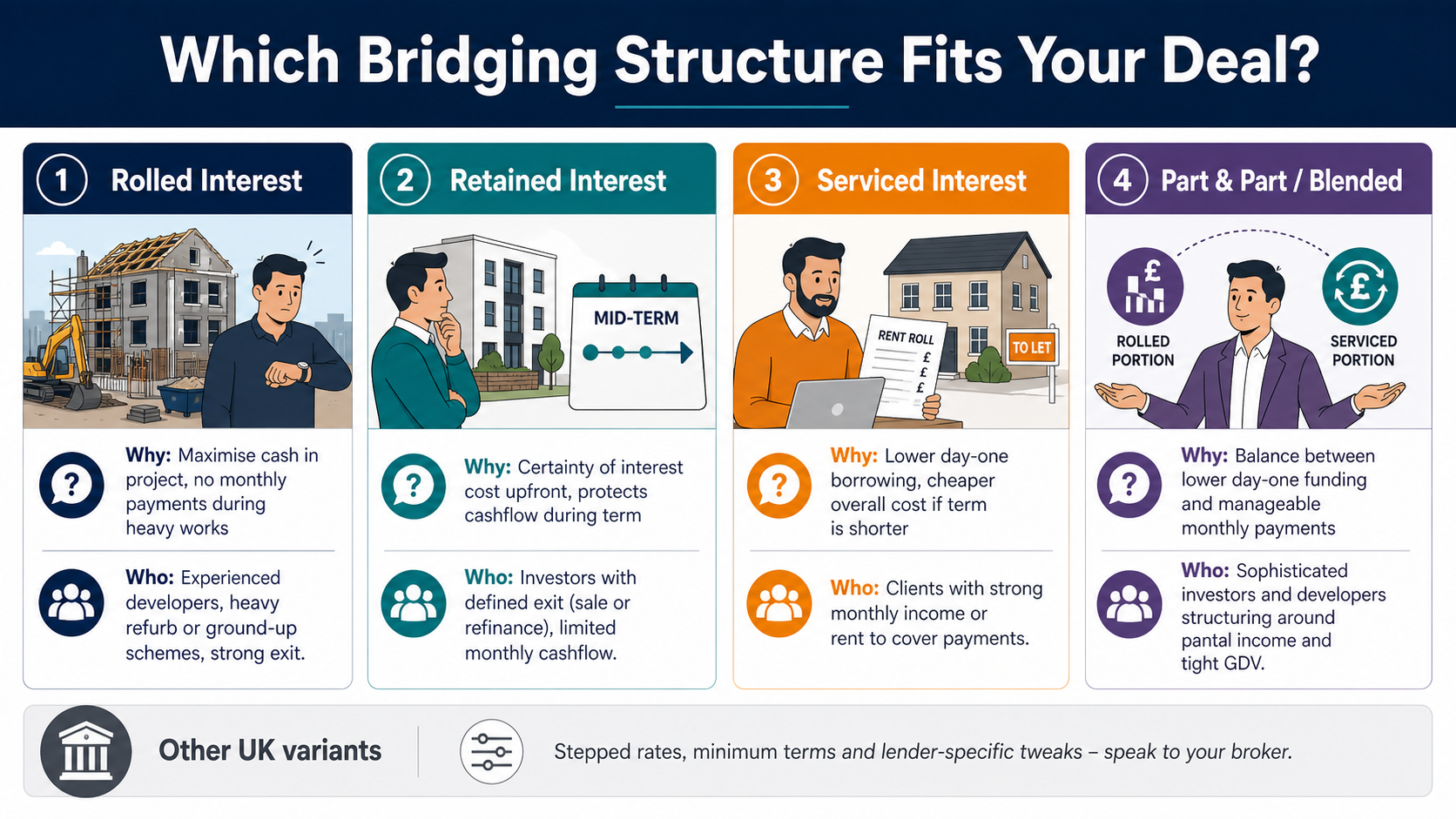
Bridge-to-let costs break into five components: monthly interest, arrangement fees, valuation and survey costs, legal fees, and exit or refinance fees. Interest is typically charged monthly and, crucially, often rolled up or retained rather than paid as you go, meaning the lender deducts it from the facility at completion rather than billing you throughout the term.
That retained interest reduces the net funds you actually receive, so sizing the gross facility correctly matters more than most first-time bridge borrowers expect. Get this wrong and you find yourself short on completion day, scrambling for a top-up.
- Monthly interest (often retained, not paid monthly out of pocket)
- Arrangement fee (typically a percentage of the gross loan)
- Valuation and survey fees
- Legal fees, including the lender’s solicitor costs
- Exit or refinance fee on repayment
Statistic Callout: Rental cover ratios on the exit refinance often sit between 125% and 145% of the interest cost at a lender’s stressed rate, which is worth modelling before you commit to a purchase price.
Net funds released at completion could be closer to £174,000, not £200,000.
Pro Tip: Build in a contingency of at least 10% above your projected refurbishment cost before sizing the facility. Slippage on completion timescales is the single most common reason bridge borrowers run short of net funds.

How much can you actually borrow?
Lenders typically advance up to a high loan-to-value percentage during the bridging phase, calculated against either purchase price or open market value, whichever is lower. Post-works, the buy-to-let refinance LTV may sit at a similar level or slightly higher depending on the revised valuation once refurbishment is complete.
Three things drive the offer beyond the headline LTV:
- Projected rental income and the rental cover ratio, stress-tested at a rate above the pay rate to check the numbers still work if rates rise
- The strength and size of your existing portfolio, since lenders view multi-property investors differently to first-time landlords
- Your track record on previous bridging or development deals, which shapes both appetite and pricing
A borrower with three tenanted properties and no history of late refinances will typically see better terms than someone bridging for the first time on a single unit.
What are the exit strategies and realistic timelines?
The exit is the part that actually determines whether a bridge-to-let deal works. Three routes dominate: refinancing onto a standard buy-to-let mortgage once the property meets lending criteria, selling on the open market, or repaying from other finance already available within a wider portfolio.
Lenders want evidence the exit is real, not aspirational, both at application and again as completion approaches:
- A post-works valuation confirming the property now meets standard BTL criteria
- A rental appraisal or signed tenancy agreement demonstrating achievable rent
- Confirmation the property is in lettable condition, sometimes via a building control sign-off
A vague or unevidenced exit strategy is the most common cause of refusal at the refinance stage. Sensible practice is to start validating the exit lender in parallel with the works, not after completion. That typically means:
- Speaking to a refinance lender or broker before the bridge even completes
- Getting an indicative rental valuation early
- Building the refurbishment timetable around the refinance application, not the other way round
What legal steps and documents does a bridge to let require?
A bridging loan solicitor is normally required on both sides of the transaction. They review the loan terms, run property searches, and register the lender’s charge with the Land Registry, work that has to happen fast given how quickly bridges are meant to complete.
Legal advice at the earliest possible stage avoids costly problems mid-transaction. Bridging finance moves quickly, and a solicitor who understands the structure can flag title, lease, or planning issues before they derail a completion date.
Have this ready before you approach a lender:
- Proof of funds for any deposit or contribution
- A schedule of your existing property portfolio
- Evidence of the exit plan: rental appraisal, agreed sale, or refinance agreement in principle
- Planning permission or building control documents, if the works require them
- ID documents, and company accounts or structure if borrowing through a limited company
Some bridging products fall under FCA regulation, particularly where the borrower’s main residence is involved, so confirm the regulatory status of your specific loan with your broker or solicitor.
What are the main risks and how do you manage them?
Bridge to let carries real risk if the exit doesn’t materialise on schedule. Cost is the obvious one: bridging finance is more expensive than a standard mortgage, and every month the bridge runs on eats into your margin. Valuation shortfall on the post-works survey can leave a gap between what you owe and what you can refinance. Overstretching across multiple projects simultaneously, and simple timing slippage on the build, are the other two recurring problems.
Sensible mitigations map directly onto each risk:
- Cost overrun: budget a conservative timetable and add contingency of 10% or more on both time and money
- Valuation shortfall: pre-validate the likely post-works value with a local surveyor before committing to a purchase price
- Overstretching: cap your exposure per project and avoid running several unfinished bridges at once
- Refinance failure: engage a specialist broker to pre-validate the exit lender’s appetite before you exchange
How do you apply and what does a broker add?
The practical sequence runs: initial appraisal of the deal, assembling your documentation pack, selecting a lender panel, instructing valuation and solicitors, then working to a completion timetable.
- Initial appraisal: broker reviews the property, exit plan, and your portfolio
- Documentation: proof of funds, exit evidence, contractor costs where relevant
- Lender selection and terms negotiation
- Valuation and solicitor instruction run in parallel
- Completion, followed by the exit refinance process once works finish
A specialist broker earns its fee by lining up lenders suited to the specific case, pre-validating the refinance exit before you commit, and correctly sizing the gross facility against net funds required.
- Broker fees are typically justified when the deal involves multiple lenders, a non-standard property, or a tight completion deadline
- Choose a broker with a genuine lender panel and a track record structuring bridge-to-let specifically, not generic mortgage advice
Why exit discipline decides these deals
Correctly classifying a project as heavy refurbishment rather than development finance can materially widen lender appetite and lower cost. Lender relationships and pre-validated exits matter more than headline rate in time-sensitive deals. Always factor stamp duty on the additional property surcharge into your refinance numbers before you commit.
How James William & Co Capital structures your bridge to let
Getting the gross facility, the exit lender, and the timetable aligned before you exchange is where most bridge-to-let deals succeed or fail. James William & Co Capital works as a capital-concierge for property investors, arranging bridging and development finance, structuring bridge-to-let facilities, and pre-validating buy-to-let refinance exits before completion rather than after.
Operating from London with a network of specialist lenders, family offices and private credit funds, the firm handles the deal structuring end to end: sizing gross against net facility, negotiating fees and timescales, and confirming your refinance lender will actually accept the exit. The how to arrange bridging finance guide sets out the documentation pack worth preparing before that first conversation.
If you’ve got a deal in mind, whether an auction lot, a refurbishment project, or a portfolio move requiring speed, bring the property details, your exit plan, and a rough budget to a deal appraisal with James William & Co Capital. Enquiries are handled in confidence and appraised quickly, so you know within days whether the numbers stack up.
Sources
For a deeper dive into documentation and process, the bridging finance arrangement guide from James William & Co Capital sets out the checklist in full. For comparing finance routes more broadly, the property finance types overview is useful background reading. Third-party consumer guidance on bridging loan costs and the bridge-to-let mechanics explained are worth reading alongside the firm’s own resources.
This article is general information, not a substitute for advice from a qualified financial advisor. Consult a qualified financial professional about your own circumstances before acting on anything here.
FAQ
What is the difference between bridging and bridge to let?
A standard bridge is just short-term finance with any exit; bridge to let specifically plans a buy-to-let mortgage refinance as the exit from the outset.
How much deposit do I need for a bridge to let?
Can I get a bridge to let on an unmortgageable property?
Yes, this is one of the most common use cases: a bridge funds the purchase and repair, and the buy-to-let refinance follows once the property meets standard lending criteria.
How long does a bridge to let take to arrange?
Bridging finance can complete in days for straightforward cases, with terms commonly running for several months before the refinance exit.
Do I need a solicitor for a bridge to let deal?
Yes, a bridging loan solicitor reviews terms, runs searches, and registers the lender’s charge with the Land Registry, and is normally required by the lender.
Recommended
Related Topics
Speak to a specialist
Discuss your finance with James directly
Whole-of-market specialist finance — bridging, development, commercial and residential. No call centres, no obligation. James reviews every enquiry personally.
New to specialist finance? How unbiased broker advice works · Deals we have completed
Explore Related Finance