
Published · Updated
bridging loan costsBridging loan costs: what UK property buyers need to know
By James Dawes, CeMAP, Founder, James William & Co Capital

Monthly rates usually run from about 0.5% to 2.0%, with a market average around 0.82% a month, but the headline rate tells you very little on its own.
The real number that matters is the net advance: what actually lands in your account after fees are deducted, versus the gross facility you’re being quoted against. Two lenders can quote the same monthly rate and produce wildly different total costs once arrangement fees, retained interest and exit charges are stacked in.
Your next move should be simple:
- Ask every lender for the net advance, not just the gross loan amount
- Request a total cost illustration covering your actual expected term, not a generic 12-month example
- Confirm whether interest is retained, rolled-up or serviced, because that single choice changes your cash flow more than a 0.2% rate difference ever will
Pro Tip: Never compare bridging quotes on rate alone. Ask for the total redemption figure at your expected exit date, then work backwards.
Key Takeaways
| Point | Details |
|---|---|
| Compare net advance, not gross loan | Ask every lender what actually lands in your account after fees and retained interest are deducted. |
| Interest structure changes everything | Rolled-up compounds to the largest redemption figure; serviced is usually cheapest but needs proven affordability. |
| Watch the compounding fee effect | Arrangement fees added to the loan attract interest for the full term, inflating the real cost. |
| Total cost beats headline rate | A lower monthly rate with high fees can cost more over a short term than a higher rate with low fees. |
| Get broker-grade structuring | James William & Co Capital builds total-cost illustrations and negotiates fee structures for complex or time-pressured bridging deals. |
Table of Contents
- What is a bridging loan and when do UK buyers use one?
- How bridging loan costs actually work
- The full cost breakdown: fees you’ll actually pay
- Worked examples: turning headline rates into real numbers
- How to choose a deal and cut your bridging costs
- Risks, tax and regulation borrowers shouldn’t ignore
- How a specialist broker structures a bridging deal
- Does your credit score affect bridging loan cost?
- What the numbers actually tell borrowers
- Get a proper total-cost illustration before you commit
- Sources
- FAQ
What is a bridging loan and when do UK buyers use one?
A bridging loan is short-term, secured finance designed to cover a gap. Usually the gap between buying one property and selling another, or between winning an auction lot and arranging a longer-term mortgage.
The common uses fall into a fairly predictable pattern:
- Chain-breaking — you’ve found your next home but your current one hasn’t sold yet
- Auction purchases — most auction houses demand completion within 28 days, which conventional mortgages can’t match
- Refurbishment finance — funding works on an unmortgageable property before refinancing onto a standard buy-to-let or residential product
- Development exit and short-term acquisition — buying land or stock quickly, then refinancing once planning or letting is secured
Where bridging tends to go wrong isn’t the borrowing itself. It’s borrowers who don’t have a credible exit route mapped out before they draw down. Lenders price risk into that uncertainty, and so should you.
How bridging loan costs actually work
Three separate mechanics drive what you’ll pay: how interest is calculated, whether fees sit inside or outside the loan, and where your deal sits on the loan-to-value scale. Get any one of these wrong when comparing quotes and you’ll misjudge the real cost by thousands of pounds.
Rolled-up, retained or serviced: the choice that changes everything
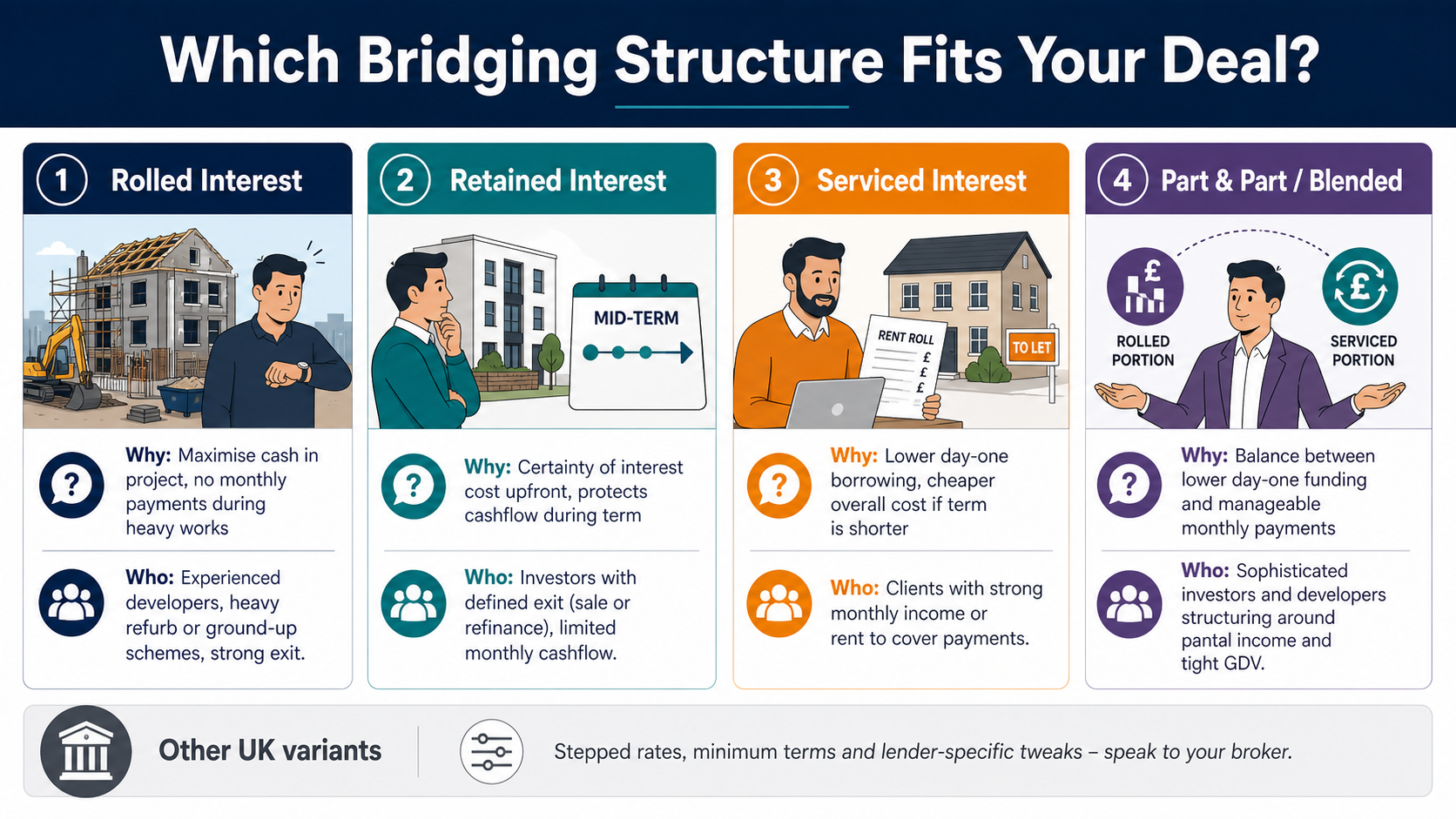
Lenders offer interest on a bridging facility in three distinct structures, and each one produces a different net advance and a different redemption figure.
Rolled-up interest compounds monthly and is repaid in full at the end of the term. Nothing is paid during the loan, which maximises the cash you have on day one, but the redemption figure grows every month because you’re paying interest on interest. Developers often choose this route deliberately, to preserve working capital for build costs even though it produces the largest final bill.
Retained interest sees the lender deduct an estimated block of interest from the loan up front, effectively pre-paying your monthly instalments out of the facility itself. This reduces the funds you actually receive at drawdown. Some lenders refund unused retained interest if you redeem early, but policies vary significantly and this is worth checking before you sign anything.
Serviced interest means you pay monthly, like a standard mortgage. This is usually the cheapest structure overall because there’s no compounding, but lenders will want evidence you can actually afford the monthly payment alongside your existing commitments, which rules it out for some borrowers.
Gross facility versus net advance
Here’s where a lot of borrowers get caught out. Add three months of retained interest and your net advance, the money you can actually spend, could be £15,000 to £20,000 lower than the headline loan amount. Always ask for the net figure before comparing anything.

LTV bands and first versus second charge pricing
Pricing moves in fairly predictable bands. Prime, low-LTV first-charge deals (typically under 50% LTV) often price from around 0.55% to 0.83% per month, mainstream deals in the 50 to 65% LTV range commonly sit at 0.65% to 1.25% per month, and higher-LTV or second-charge facilities push up to 1.25% to 1.5% or more per month. Second charges price higher because the lender sits behind an existing mortgage, taking on more risk if things go wrong.
Lenders also underwrite the exit route itself. If you’re relying on a property sale, they’ll want evidence of realistic market value and demand. If you’re refinancing onto a term mortgage, they’ll check that affordability stacks up on the exit product too, not just the bridge.
Pro Tip: If your cash flow is tight during the loan term, serviced interest is usually the cheaper route on paper. But only take it if you can prove affordability comfortably, because a failed payment on a serviced bridge is a far bigger problem than a slightly larger redemption figure on a rolled-up one.
The full cost breakdown: fees you’ll actually pay
Interest is only one line on the invoice. The fees around it often decide whether a deal is genuinely competitive or quietly expensive.

| Fee type | Typical UK range | Usually paid |
|---|---|---|
| Monthly interest | 0.5%–2.0% per month | Deducted, rolled-up or paid monthly |
| Arrangement/facility fee | 1%–2% of gross loan (0.5%–3% at the extremes) | Usually added to the loan |
| Valuation fee | £300–£2,500+ depending on property type | Paid upfront, separately |
| Legal fees (lender’s and borrower’s) | Often £1,500–£3,500 combined on straightforward residential bridges | Paid separately, sometimes at completion |
| Broker fee | Varies by broker and deal complexity | Often paid on completion |
| Exit/redemption fee | 0%–1% (some lenders still charge more) | Deducted at redemption |
| Extension fees | Typically 1% per extension period | Charged if the term overruns |
The arrangement fee deserves particular attention because of how it’s usually handled. On a larger facility, this compounding effect becomes material in cash terms, even though the percentage never changes.
Fixed costs, valuation and legal fees in particular, hit smaller loans disproportionately hard. A £2,000 legal and valuation bill is a rounding error on a £2 million facility. If you’re borrowing a smaller amount, factor this in before assuming a headline rate tells you the whole story.
Put it all together across a typical six to twelve month term, and total cost commonly lands between 7% and 15% of the loan amount, where you sit in that range depends mostly on LTV, term length, and whether fees are stacked into the loan or kept separate.
Worked examples: turning headline rates into real numbers
Numbers make this concrete faster than any explanation. Here are three realistic scenarios.
- Residential purchase, 60% LTV, six-month term, serviced interest. Loan of £250,000 at 0.75% per month. Monthly interest paid separately: £1,875 x 6 = £11,250. Arrangement fee at 1.5% added to loan: £3,750. Valuation and legal: roughly £2,000. Total cost: approximately £17,000, around 6.8% of the loan.
- Refurbishment case, 70% LTV, nine-month term, rolled-up interest. Loan of £180,000 at 1.1% per month, compounding. Rolled-up interest over nine months compounds to roughly £19,300, notably higher than a simple multiplication would suggest. Arrangement fee at 2%: £3,600. Valuation and legal: £2,200. Total cost: approximately £25,100, around 14% of the loan, reflecting both the longer term and the compounding structure.
- Second-charge case, 75% LTV, twelve-month term, retained interest. Loan of £120,000 at 1.4% per month. Twelve months retained upfront: £20,160 deducted from the advance at drawdown. Arrangement fee at 2.5% (higher-risk second charge): £3,000. Legal and valuation: £2,500. Total cost: approximately £25,660, around 21% of the loan, illustrating why second-charge pricing needs careful scrutiny.
Run these numbers through a bridging calculator before you commit, and stress-test them against term length, arrangement fee percentage, and whether fees sit inside or outside the loan. When you’re gathering quotes, ask each lender for the same four figures every time: the gross facility, the arrangement fee percentage, whether interest is retained or rolled-up, and any exit or extension fees.
The crossover trap catches more borrowers than you’d expect. A lower headline rate with high fees can cost more over a short term than a slightly higher rate with minimal fees attached. Do the maths before you assume the cheaper-sounding rate wins.
How to choose a deal and cut your bridging costs
Small negotiations move the total cost more than most borrowers realise. A few habits are worth building into every quote you request.
- Ask about refunds on retained interest. If you redeem early, some lenders refund the unused portion, others don’t. This should be confirmed in writing before drawdown, not assumed.
- Push for the arrangement fee to sit outside the loan where possible. Paying it separately, if you have the cash, avoids paying interest on the fee itself for the whole term.
- Check exit-fee conditions carefully. Some lenders waive exit fees for early redemption; others charge them regardless of how quickly you repay.
- Shorten the term where realistically possible. Every extra month on a rolled-up facility compounds the redemption figure, so only borrow the term you genuinely need.
- Firm up your exit route before you apply. A confirmed sale or a pre-agreed refinance offer often unlocks better pricing than a vague “we’ll sell it eventually” plan.
Watch for red flags before signing anything: vague wording around retained interest refunds, non-refundable application or valuation fees charged before any offer is made, and extension terms left deliberately unclear in the offer letter. If a lender can’t give you a straight answer on what happens if your term overruns by a month, ask how bridging finance is typically arranged through a broker who can push back on those terms before you commit.
Before accepting any offer, run through this checklist out loud: confirm the net advance figure, confirm the interest structure, confirm whether fees are inside or outside the loan, confirm the exit-fee and extension-fee terms, and confirm your exit route can realistically complete within the agreed term plus a reasonable buffer.
Risks, tax and regulation borrowers shouldn’t ignore
The single biggest risk in bridging finance isn’t the interest rate. It’s rollover risk: your exit route falls through, the term expires, and you’re forced into an expensive extension or, worse, a forced sale. Rolled-up interest makes this sharper because every extra month compounds the debt you owe, rather than simply adding a flat fee.
Development and refurbishment bridges carry an added layer of risk. Cost overruns on the works eat into the margin you were relying on to repay the loan at exit, and a delayed refinance can push you past your agreed term before the property is even ready to value.
On the regulatory side, bridging loans secured against a borrower’s own home typically fall under FCA regulation, while pure investment or commercial bridges often don’t. Either way, check that your lender and broker are operating with proper authorisation and disclosure.
Interest costs and fees on a bridging facility can sometimes be capitalised into a development project’s overall costs, and treatment for tax purposes depends on your structure and intended use of the property. This is a question for a qualified accountant, not a generic guide, and the right answer changes depending on whether you’re an individual investor or operating through a company.
Speak to your accountant before you assume how bridging costs will be treated, and check FCA guidance directly if you’re unsure whether your deal falls under regulated lending.
How a specialist broker structures a bridging deal
A specialist broker’s job is to turn a headline rate into a total-cost illustration you can actually trust, then negotiate the fee structure before you’re committed to anything. That means comparing net advance figures across multiple lenders, not just the loan amount each one quotes, and structuring the deal around your actual exit plan rather than a generic template.
Brokers earn their fee on complexity and speed. If you’re dealing with multiple securities, an unusual title, an offshore structure, or a transaction that needs to complete in days rather than weeks, direct-to-lender applications often struggle to move fast enough.
What a good broker should deliver:
- A clear total-cost illustration covering your specific expected term, not a generic twelve-month example
- Help negotiating arrangement fees and exit terms rather than accepting the first quote
- Support building a credible exit narrative that gets you better pricing, not just approval
- A single point of contact managing lender communication, valuation instructions and legal completion in parallel
James William & Co Capital works across exactly this kind of structuring for developers, investors and high-net-worth clients, often layering bridging alongside mezzanine debt or JV equity on larger acquisitions.
Does your credit score affect bridging loan cost?
Credit history matters less in bridging finance than it does for a standard mortgage, because lenders are primarily underwriting the security and the exit route rather than your income profile. That said, it isn’t irrelevant.
Borrower profile matters more broadly than the credit score alone. Experienced developers with a track record of successful exits, ordinarily get sharper pricing than first-time bridging borrowers, because lenders have less to underwrite when they can see a history of completed projects. Company borrowers with strong balance sheets can also access better terms than individuals, particularly on larger facilities.
What consistently moves pricing more than a credit score is the strength of your exit. A confirmed buyer, a signed refinance offer, or a clear letting strategy with realistic rental projections will usually do more to secure a competitive rate than a marginally better credit file. If your credit history is patchy, focus your energy on making the exit plan as watertight as possible. That’s the lever lenders actually pull pricing on.
What the numbers actually tell borrowers
Most bridging guides fixate on the monthly rate because it’s the easiest number to advertise. That’s backwards. The rate is the least useful figure for deciding whether a deal is competitive, because it ignores everything that actually moves the total cost: fee structure, whether charges sit inside or outside the loan, and how compounding behaves over your specific term.
The conventional advice, shop around for the lowest rate, actively misleads borrowers on shorter terms, where fixed fees make up a larger share of total cost than interest does.
What should come first is the exit plan. Every cost lever in this article, the interest structure you choose, the LTV band you sit in, the pricing a lender offers, flows from how confident that lender is in how you’ll repay. Fix the exit story before you shop for rate, and the pricing conversation gets considerably easier.
Get a proper total-cost illustration before you commit
Most bridging quotes you’ll find online show you a monthly rate and little else, leaving you to work out the net advance and total redemption figure yourself. James William & Co Capital does that calculation for you before you sign anything, comparing lenders on total cost rather than headline rate, and negotiating arrangement fees and exit terms on your behalf.
This matters most on complex deals: multiple securities, tight completion timescales, or facilities layered alongside development finance or mezzanine debt. As a specialist broker acting as a single point of contact, James William & Co Capital structures the deal, negotiates lender terms, and builds the exit narrative that gets you sharper pricing, rather than leaving you to compare gross loan amounts across five different offer letters.
If you’re weighing up a bridging facility for a chain-break, auction purchase or refurbishment project, get in touch through the London office for a total-cost illustration on your specific deal before you approach a lender directly.
This article is general information, not a substitute for advice from a qualified financial advisor. Consult a qualified financial professional about your own circumstances before acting on anything here.
Sources
- What Does a Bridging Loan Cost in 2026? Fees, Rates & Worked Example
- Compare Best Bridging Loan Rates in 2026
- Bridging loan costs explained: Interest, fees and total borrowing costs
- How Bridging Loan Interest Is Calculated | Squared Money
FAQ
What does Martin Lewis say about bridging loans?
Martin Lewis’s consumer guidance generally warns that bridging loans are expensive short-term finance that should only be used when a clear, realistic exit route is already in place, not as a long-term borrowing solution.
How much does a bridging loan cost you?
Total cost typically falls between 7% and 15% of the loan amount for a six to twelve month term, once monthly interest, arrangement fees, valuation and legal costs are all included.
How much is a £300,000 bridging loan?
Can I get a 90% bridging loan?
Is a bridging loan cheaper than a personal loan or overdraft?
Not usually on a like-for-like rate, but bridging loans allow far larger sums secured against property, while personal loans and overdrafts are unsecured, capped at lower amounts, and unsuitable for property transactions of any real size.
Recommended
Related Topics
Speak to a specialist
Discuss your finance with James directly
Whole-of-market specialist finance — bridging, development, commercial and residential. No call centres, no obligation. James reviews every enquiry personally.
New to specialist finance? How unbiased broker advice works · Deals we have completed
Explore Related Finance