
Published · Updated
commercial mortgage refinancing strategy12 Month Commercial Mortgage Refinancing Plan for England Owners
By James Dawes, CeMAP, Founder, James William & Co Capital

Refinancing a commercial mortgage is usually worth exploring if your fixed rate is ending within 12 months, your property has gained value, or your current covenants are under pressure. The first two things to do are checking your existing loan for early repayment charges and arranging a RICS valuation or broker pre-appraisal, since both determine whether a switch actually saves money once costs are counted.
TL;DR:
- Compare offers by total cost over your expected hold period, subtracting arrangement, valuation, legal, monitoring, and early repayment charges from projected interest savings.
- Lenders rely on a RICS valuation, not the asking price; development projects often call for market comparison plus residual or discounted cash flow methods.
- Start valuation and document preparation early; unresolved tenant disputes, title issues, or covenant breaches can delay underwriting, and bridging can cover a maturity gap.
- High street banks generally offer lower headline rates but impose stricter covenants and slower underwriting; specialist lenders may accept weaker interest cover at higher fees.
Table of Contents
- When to consider refinancing a commercial mortgage: key triggers and decision tests
- The refinancing process step by step: valuation, application, underwriting and completion
- Costs, pricing mechanics and how to compare offers
- Valuation and due diligence expectations: RICS standards and what lenders expect from reports
- Which lenders to approach in England and when to use a specialist broker
- How a specialist broker supports complex refinances
- Author perspective: action priorities for commercial owners in England right now
- How we can help you refinance your commercial mortgage
- FAQ
- Sources
When to consider refinancing a commercial mortgage: key triggers and decision tests
The clearest trigger is a fixed-rate period approaching its end. Lenders typically price new facilities against the prevailing Bank Rate, which sat at 3.75% following the September 2026 MPC decision, so a loan taken out when rates were higher may now refinance onto better terms, while one fixed when rates were lower could face a jump at renewal.
A second trigger is a change in property value. If your asset has appreciated since the original loan, refinancing can release equity for further acquisitions or working capital, provided the loan-to-value and interest cover ratio still satisfy the new lender’s underwriting.
Several business conditions also point towards refinancing:
- A fixed or tracker term expiring within six to twelve months, which gives you time to shop the market before falling onto a lender’s reversion rate.
- Covenant pressure, such as a loan-to-value or interest cover ratio breach that threatens default under the existing facility.
- A liquidity need, where releasing equity funds a tax bill, a refurbishment or an acquisition deposit.
- A development or acquisition opportunity that requires additional secured borrowing beyond what the current lender will extend.
Before committing, run a simple net present value check: subtract arrangement fees, valuation costs, legal fees and any early repayment charge from the expected interest saving over your likely hold period. Timing also matters against lease expiries and planning milestones. Refinancing just before a major lease break or a planning decision can leave a lender nervous about future income, so many borrowers prefer to wait until those events clear.
Pro Tip: Request your current lender’s redemption statement early. It shows the exact early repayment charge and gives you a real number to weigh against any new offer.
The refinancing process step by step: valuation, application, underwriting and completion
A commercial refinance typically runs through five stages, each with its own bottlenecks.
- Instruction and initial appraisal. You or your broker approach lenders with headline figures: loan amount, property type, income and exit strategy.
- RICS valuation. An independent valuer inspects the property and produces a report compliant with RICS standards, which most lenders treat as a condition precedent to any offer.
- Underwriting. The lender reviews accounts, leases, rent rolls, management agreements and, for development-linked refinances, a business plan or appraisal, before stress-testing income against the proposed debt.
- Legal completion. Solicitors exchange contracts, redeem the existing charge and register the new one, a stage that can stall if title issues or tenant consents are outstanding.
- Drawdown. Funds release, the old facility is repaid, and any early repayment charge is settled from proceeds.
The most common causes of delay are slow valuations, unresolved tenant disputes and covenant breaches that surface during underwriting. Instructing the valuer early, keeping rent rolls current and flagging any covenant issue to your broker before application all shorten the timeline materially.
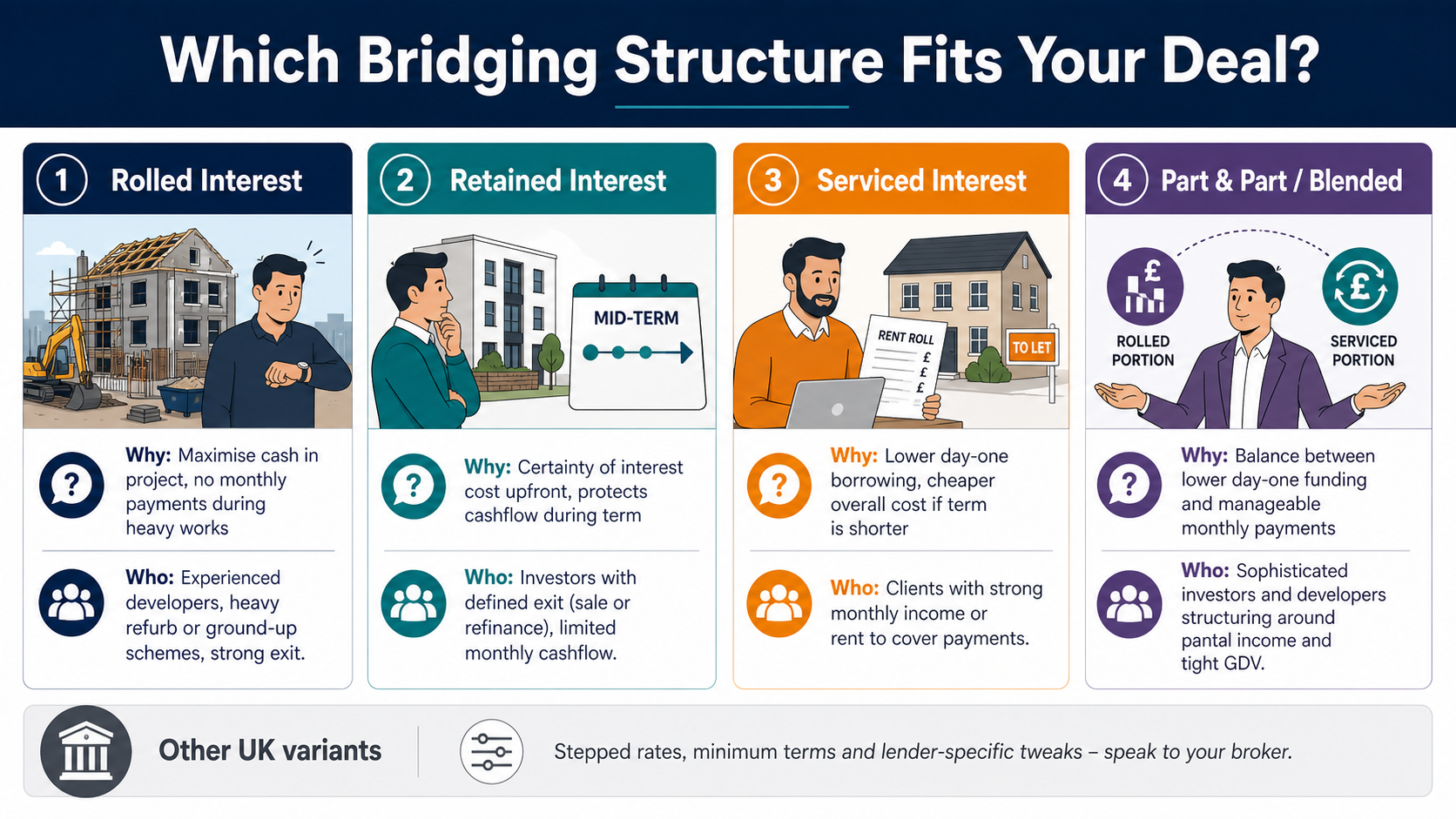
Where a maturity date is close and a full refinance will not complete in time, a bridging facility can cover the gap, repaying the maturing loan and buying weeks or months to complete the permanent refinance without breaching the existing lender’s terms. You can read more about how bridging and stacked finance options work alongside longer-term facilities.
Costs, pricing mechanics and how to compare offers
The headline interest rate is only one part of the true cost of refinancing. A full comparison needs to account for:
- The arrangement fee, usually charged as a percentage of the loan and added to the balance or paid upfront.
- Exit or early repayment charges on the facility you are leaving.
- The valuation fee, which varies with property complexity and whether multiple valuation methods are required.
- Legal fees for both lender and borrower solicitors.
- Ongoing monitoring costs, relevant mainly to development or staged-drawdown facilities.
Specialist lenders have become more important since rates rose, and they often substitute a lower headline interest rate with higher upfront fees to make a deal viable, according to a Bank of England working paper on fee substitution. That trade-off changes the effective cost over the loan term and can flatter the interest cover ratio at the point of underwriting while adding real cost elsewhere.
Lenders typically stress-test interest cover using a rate well above the contractual rate, and the same working paper notes that specialist lenders often apply less stringent stress assumptions than mainstream banks, which can be the difference between an application clearing underwriting or not.
Consider two illustrative offers on a seven-figure loan over several years. The annual interest difference favours Offer B, but the extra upfront fees take several years to recoup, meaning Offer A is cheaper if you expect to refinance again, or sell, within that window. Modelling total cost over your realistic hold period, not just the headline rate, is the only reliable way to compare the two.
Valuation and due diligence expectations: RICS standards and what lenders expect from reports
Lenders lend against the valuation, not the asking price, so the quality of that report shapes both the offer and the timeline. RICS Valuation Global Standards set the basis of value and reporting expectations that UK lenders rely on for secured lending decisions.
Common deficiencies that slow underwriting include:
- Missing or thin local market commentary, leaving the lender unable to cross-check the valuer’s conclusions.
- An executive summary that does not match the detail in the body of the report.
- A single valuation method used where the asset or purpose calls for more than one.
- Assumptions on rental growth or yield that are not evidenced against comparable transactions.
For development-linked refinances, lenders commonly expect at least two valuation approaches, typically a market comparison alongside a residual or discounted cash flow method, together with sensitivity analysis on costs and sales values. Aligning the valuer’s instruction letter with the lender’s specific requirements before the inspection avoids a second round of queries later.
Pro Tip: Share the lender’s valuation instruction template with your valuer before the site visit. It is the single easiest way to avoid a report being sent back for amendment.

Which lenders to approach in England and when to use a specialist broker
Lenders broadly split into high-street banks, challenger and specialist lenders, and private credit or bridging providers, each with a different appetite.
- High-street banks tend to offer the lowest headline rates but the strictest covenants and longest underwriting timescales.
- Challenger and specialist lenders move faster and will consider lower interest cover ratios or unusual income streams, often at a higher fee.
- Private credit funds and bridging providers step in where speed, complexity or a layered debt structure rules out a conventional bank.
Market access has become more segmented since rates rose, with specialist lenders and private credit funds playing a larger role for complex or larger commercial borrowers who no longer fit a standard bank template.
The trade-offs are consistent: banks offer price, specialists offer flexibility and speed, and private credit offers certainty of execution on complex deals at a higher cost. A broker who works across all three segments can run a single valuation and legal process while placing the mandate with whichever lender actually fits the covenant and timeline, rather than restarting the process with each new approach.
How a specialist broker supports complex refinances
We have structured a £600,000 revolving credit facility secured against a five million pound property portfolio, giving the owner flexible access to capital without refinancing the entire portfolio at once. In other cases, refinancing maturing commercial term loans to specialist lenders within weeks of expiry can help avoid costly reversion rates.
Our approach covers sourcing specialist lenders and private credit funds, structuring layered debt where one facility alone will not stretch far enough, negotiating fee and covenant terms, and coordinating valuers and solicitors so the process runs on one timeline rather than several.
Author perspective: action priorities for commercial owners in England right now
Our priority order for 2026 is liquidity first, covenants second, cost reduction third. With Bank Rate at 3.75% and specialist lenders filling gaps that banks now avoid, borrowers with a fixed term ending inside twelve months or a rental reversion approaching should move early rather than wait for a clearer rate picture. Everyone else can afford to watch the market a little longer before committing.
— James William Dawes
How we can help you refinance your commercial mortgage
We arrange commercial mortgages, bridging finance and development finance for property owners and investors, structuring these as layered debt stacks when a single lender cannot meet the full requirement. An initial conversation with us covers a review of your existing facility, indicative terms from across our lender network, and, where it makes sense to proceed, a mandate to execute the refinance end to end.
What to expect from working with us:
- A review of your current loan, covenants and redemption position before we approach any lender.
- Indicative terms gathered from high-street, specialist and private credit sources in parallel.
- Coordination of valuation and legal work so completion happens on one timeline, not several.
If your fixed term is ending soon or your covenants are under pressure, get in touch through our commercial mortgages page to start a review, or explore our bridging finance option if you need to cover a gap before a full refinance completes.
This article is general information, not a substitute for advice from a qualified financial advisor. Consult a qualified financial professional about your own circumstances before acting on anything here.
FAQ
What is the 2% rule for refinancing?
For commercial refinancing, the more reliable test is calculating total cost, including fees and any early repayment charge, against your expected hold period rather than relying on a fixed percentage gap.
What is the 4.5 rule for mortgages?
There is no standard recognised “4.5 rule” in UK commercial mortgage underwriting; commercial lenders instead assess affordability through interest cover ratio and loan-to-value, stress-tested at a rate above the contractual one. If you have seen this figure applied to income multiples, it relates to residential lending criteria rather than commercial property finance.
How do I remortgage a commercial property?
Remortgaging, or refinancing, a commercial property involves instructing a RICS valuation, applying to a new lender with accounts, leases and rent roll information, passing underwriting, and completing legally before the new loan repays the old one. Checking your existing facility for early repayment charges before you start is essential, since these can outweigh any rate saving.
What is Martin Lewis’ mortgage advice for 2026?
We have not seen commentary from this source specific to commercial mortgage refinancing in 2026, and his guidance typically addresses residential and buy-to-let borrowers rather than commercial property owners. For commercial refinancing decisions, your redemption terms, current valuation and lender covenant requirements are the factors that matter most.
What costs should I expect when refinancing a commercial mortgage?
Expect an arrangement fee, a valuation fee, legal costs on both sides, and any early repayment charge from your existing lender, alongside the ongoing interest rate itself. Specialist lenders may offer a lower headline rate alongside higher upfront fees, so comparing total cost over your expected hold period gives a more accurate picture than the rate alone, as outlined in Bank of England research on fee substitution.
Sources
- Monetary Policy summary and minutes — September 2026
- RICS Valuation – Global Standards: UK national supplement
Recommended
Related Topics
Speak to a specialist
Discuss your finance with James directly
Whole-of-market specialist finance — bridging, development, commercial and residential. No call centres, no obligation. James reviews every enquiry personally.
New to specialist finance? How unbiased broker advice works · Deals we have completed
Explore Related Finance