
Published · Updated
stamp duty commercial propertyAvoid a Five Figure SDLT Surprise on Commercial Property in England
By James Dawes, CeMAP, Founder, James William & Co Capital

SDLT applies to almost every commercial freehold purchase and to most new or assigned leases in England, calculated on a slice basis with rates that start at 0% for lower portions, 2% on the next portion, and 5% on amounts above the higher threshold according to official bands. Lease premiums follow the same bands, while rent is taxed separately using the net present value of payments due. Returns and payment are due within 14 days of completion, and mixed-use property is often taxed at the lower commercial rates rather than residential ones.
TL;DR:
- SDLT uses a slice system with rates starting at 0% for the first threshold, then 2% and 5% on higher portions, simplifying tax calculations on commercial property.
- Lease premiums and rent are taxed separately, with rent using a net present value calculation, and linked leases requiring aggregation of NPVs before applying rates.
- Reliefs like group relief and sale and leaseback can eliminate or reduce SDLT liability if the correct relief codes and documentation are provided.
- The 14-day filing deadline is strict; late submissions incur penalties, and the buyer is legally responsible regardless of conveyancer actions.
- Recent changes include the abolition of Multiple Dwellings Relief in 2024, with stable core rates but tighter enforcement around relief claims and classification.
Table of Contents
- How does SDLT on commercial property actually work?
- How is SDLT calculated on a new commercial lease?
- What reliefs reduce commercial SDLT, and where’s the risk?
- What’s the SDLT filing deadline and who pays the penalty?
- Practical pitfalls a specialist broker sees repeatedly
- How does SDLT interact with VAT and other property taxes?
- How do you calculate the NPV of rent step by step?
- Have SDLT rates or rules changed recently?
- Do connected or associated companies pay SDLT differently?
- Author perspective: why timing decides your SDLT outcome
- How James William & Co Capital supports SDLT-sensitive purchases
- Where to check the official rates and rules
- Sources
- FAQ
How does SDLT on commercial property actually work?
Stamp Duty Land Tax on non-residential property is charged using a slice system, not the old slab method that taxed the whole price at one rate. Each portion of the purchase price sits in its own band, and only that portion is taxed at the corresponding rate. This matters because it stops small increases in price from pushing the entire transaction into a higher bracket.
The current commercial and mixed-use bands apply progressive rates beginning at 0% on the initial portion up to a certain threshold, then 2% on the next band, and 5% on amounts above that higher threshold, as detailed in official guidance.
Take a straightforward £500,000 freehold purchase of an office or retail unit. The first £150,000 is tax free. The next £100,000 (taking the price to £250,000) is charged at 2%, adding £2,000. The remaining £250,000 is charged at 5%, adding £12,500. Total SDLT payable: £14,500.

That’s a meaningful contrast with residential purchases, where higher rates and surcharges (the additional dwelling surcharge and the non-UK resident surcharge) can push effective rates well above 5%. Commercial property carries none of those surcharges, which is one reason institutional investors and overseas buyers often prefer commercial or mixed-use classification wherever it genuinely applies.
How is SDLT calculated on a new commercial lease?
Leases are where most buyers get caught out, because SDLT charges two separate things: any premium paid up front, and the rent payable over the term. The premium is taxed using the same 0%/2%/5% commercial bands as a freehold purchase. The rent is taxed differently, using the net present value (NPV) of everything due over the life of the lease.
For the rent element, the bands are:
- 0% on the NPV up to £150,000
- 1% on any NPV above £150,000
Where a lease has both a premium and rent above the threshold, both elements are calculated and added together. An assigned lease (one bought from an existing tenant rather than granted fresh by the landlord) is usually taxed only on the price paid for the assignment, not on the rent, because the rent liability was already dealt with when the original lease was granted. Linked leases on the same or connected transactions must have their NPVs aggregated, so check for linked deals before relying on a single calculation. HMRC’s online NPV calculator handles the discounting automatically and is worth running before exchange, not after.
What reliefs reduce commercial SDLT, and where’s the risk?
Group relief and sale and leaseback relief are the two reliefs that most often make a real difference to a commercial SDLT bill, and both can reduce liability to nil in the right circumstances.
- Group relief applies to transfers between companies in the same corporate group, using relief code 12 on the return.
- Sale and leaseback relief, under Section 57A of the Finance Act 2003, can exempt the leaseback element when a business sells its premises and immediately leases them back.
- Even where relief brings the tax to zero, a return must still be filed with the correct relief code, and HMRC does query mismatched or missing codes.
Mixed-use classification is another area worth scrutinising closely. A building combining a ground-floor shop with a flat above is typically taxed at the lower commercial rates across the whole price rather than at residential rates, which can save tens of thousands of pounds on a mid-value purchase. HMRC expects clear evidence that the non-residential element is genuine and substantial, not a nominal add-on to dodge residential rates. Investors buying six or more dwellings in one transaction can also elect into the non-residential rates under a specific rule, though this needs careful handling alongside the abolition of Multiple Dwellings Relief in 2024, which changed how many portfolio purchases are structured.
Pro Tip: Keep dated photographs, tenancy agreements, or planning documents showing genuine commercial use at the point of completion. HMRC can claw back relief within three years if the qualifying use changes or turns out to have been overstated.
What’s the SDLT filing deadline and who pays the penalty?
The deadline is 14 days from the effective date of the transaction, and missing it triggers escalating penalties regardless of how good the excuse is.
- Identify the effective date, which is usually completion but can be earlier if you take possession or start paying rent before completion (this counts as “substantial performance”).
- File the return through the HMRC online SDLT service or via your conveyancer, pay by bank transfer or the payment method your solicitor arranges, and obtain the SDLT5 certificate needed to register the transaction at the Land Registry.
- Pay on time. Late filing brings a fixed penalty, rising to tax-geared penalties and interest the longer the delay continues, under HMRC’s SDLT rules.
Crucially, the legal liability for filing and paying sits with the buyer, not the conveyancer. If your solicitor misses the deadline, HMRC pursues you, not them, so it pays to ask directly for written confirmation that the return has gone in.
Practical pitfalls a specialist broker sees repeatedly
Two issues catch out buyers again and again, and neither shows up clearly until it’s too late to fix cheaply.
- VAT status. If the seller has opted to tax the property, SDLT is calculated on the VAT-inclusive price, not the net figure, which can add a fifth to the tax base overnight.
- Substantial performance. Moving in early, starting fit-out works, or paying a large chunk of rent before legal completion can trigger an earlier effective date than the one everyone assumed, shortening the 14-day window without anyone noticing.
Pro Tip: Before exchange, ask your conveyancer to confirm in writing the seller’s VAT election, the expected effective date, and any evidence supporting a mixed-use or relief claim. It’s a five-minute email that avoids a five-figure surprise.
How does SDLT interact with VAT and other property taxes?
SDLT does not exist in isolation. It sits alongside VAT, and increasingly alongside corporate tax planning around who holds the asset.
Where a commercial property carries a VAT election (the seller has opted to tax), the buyer pays VAT on top of the price, and SDLT is then charged on that VAT-inclusive figure. A £1 million property with VAT added becomes a £1.2 million SDLT base, pushing thousands more onto the bill. Buyers who can recover VAT (because they’re VAT-registered and using the property for taxable business purposes) get that cost back eventually, but the SDLT calculated on the gross figure is never refunded. This is one of the most commonly missed costs in commercial property transaction budgets.
There’s also an income tax and corporation tax dimension once the deal completes. Rental income from commercial property is taxed as property business profits, whether the owner is an individual paying income tax or a company paying corporation tax, and SDLT paid on acquisition is treated as a capital cost added to the base value rather than an expense deducted from rental profits. That distinction matters when working out capital gains or corporation tax on eventual disposal.
How do you calculate the NPV of rent step by step?
The net present value calculation looks intimidating on paper but follows a fixed, mechanical process once you understand the inputs.
Start with the total rent payable across the term of the lease, year by year, including any agreed rent reviews. Add up all the discounted figures across every year of the lease to get the total NPV.
A 15-year lease at £60,000 a year with no rent reviews, for instance, produces an NPV somewhere in the region of £680,000 once discounted, meaning roughly £530,000 sits above the threshold and around £5,300 becomes payable in SDLT on the rent alone.
Two details commonly trip people up. First, rent-free periods and stepped rents both change the discounting maths, so a lease with a six-month rent holiday isn’t simply “rent times years.” Second, linked leases between the same parties or connected companies must have their NPVs added together before applying the bands, which can push a series of small leases into a materially higher tax position than any single lease would suggest. HMRC’s online NPV calculator does the discounting arithmetic correctly and is the sensible starting point before instructing solicitors to draft anything.
Have SDLT rates or rules changed recently?
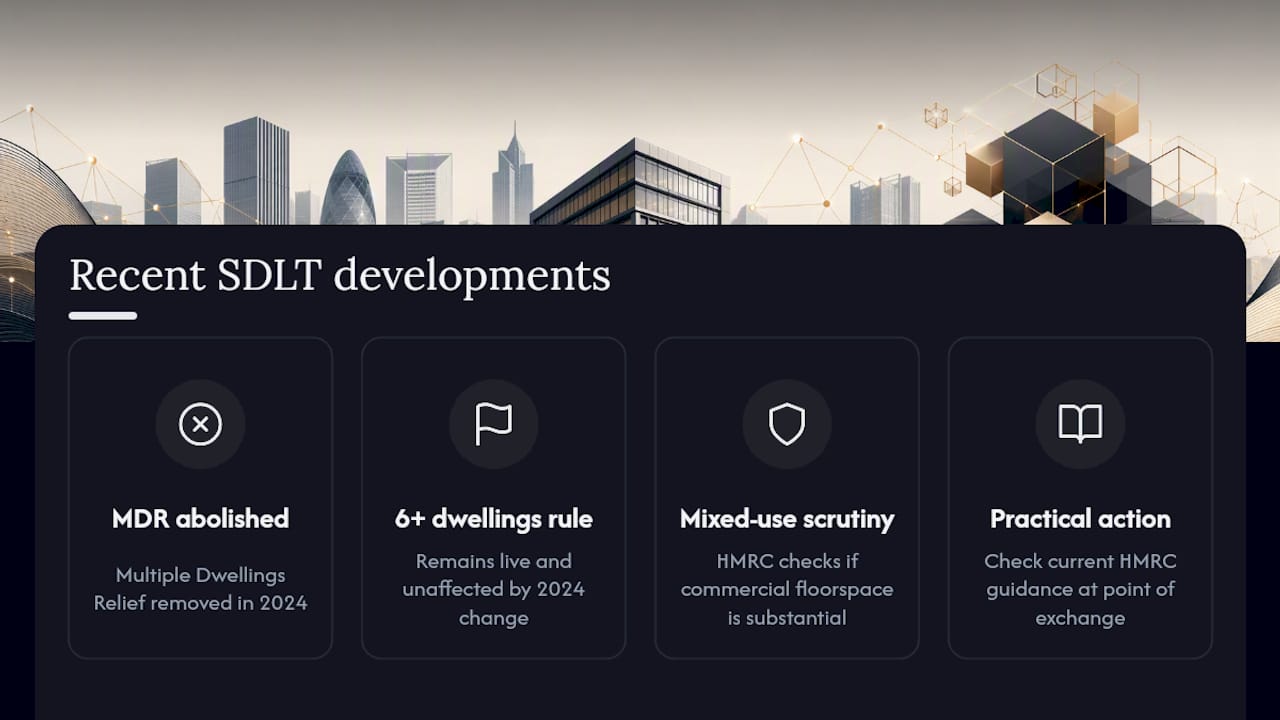
The most significant recent change wasn’t to the commercial rates themselves but to a relief that shaped how many commercial-adjacent deals were structured. Multiple Dwellings Relief was abolished in 2024, removing a route that many portfolio investors previously used to reduce SDLT on bulk residential purchases bought alongside commercial elements.
That abolition pushed more attention onto the 6+ dwellings rule and onto genuine mixed-use classification, both of which remain live and unaffected by the 2024 change. Investors who previously relied on MDR are now looking harder at whether a scheme’s commercial floorspace is substantial enough to justify non-residential rates on the whole transaction, which is exactly the kind of claim HMRC scrutinises most closely.
That stability is worth building financial models around, but it doesn’t mean the surrounding rules are static. Reliefs, linked-transaction rules, and evidence requirements for mixed-use claims have all tightened in enforcement practice even where the headline rates haven’t moved. Anyone structuring a transaction that leans on a relief or a borderline classification should check current HMRC guidance at the point of exchange rather than relying on rates quoted in an older article or a previous deal.
Do connected or associated companies pay SDLT differently?
Transactions between connected companies attract specific anti-avoidance rules precisely because a related-party sale creates an obvious incentive to under-price the transaction and understate the tax due.
Where a company transfers property to or from a connected company (broadly, one under common control, or where one holds a significant stake in the other), SDLT is charged not on the price actually paid but on the market value of the property, even if no money changes hands at all. This closes the obvious loophole of transferring an asset for £1 between group entities to avoid tax on the real value.
Group relief, discussed earlier, is the main mechanism that softens this for genuine group reorganisations, provided the transferee remains within the same corporate group for at least three years afterwards. Sell the property outside the group, or the group structure changes, within that three-year window, and HMRC can claw back the relief in full, treating it as if the relief was never given. This clawback rule is one of the more commonly missed compliance points in group restructurings, particularly where a holding company is later sold to a third party without anyone checking whether an underlying property still sits inside its three-year relief window. Any transaction involving connected companies should be flagged early to whoever is preparing the SDLT return, because the valuation and relief position both need proper documentation from day one.
Author perspective: why timing decides your SDLT outcome
The deals that go wrong on SDLT are rarely the straightforward ones. It’s the lease renegotiation with a rent-free period, the sale and leaseback structured under time pressure, the mixed-use scheme where the commercial floorspace turns out thinner than the pitch deck suggested. The NPV maths and the relief conditions are unforgiving of vague timing.
Bringing lender and structuring conversations forward, before exchange rather than after, gives you room to fix a classification issue or confirm VAT treatment while it still costs nothing to change. Once completion has happened, your options narrow fast. If your transaction is SDLT-sensitive, it’s worth talking to a specialist before terms are agreed, not after.
— James William Dawes
How James William & Co Capital supports SDLT-sensitive purchases
James William & Co Capital arranges specialist commercial mortgages, bridging finance, development finance and bespoke debt structuring for property developers, investors and business owners across England. The real advantage for an SDLT-sensitive purchase is timing: we work through the funding structure and lender documentation early enough that completion dates, VAT elections and effective-date questions are settled before exchange, not scrambled afterwards when the 14-day clock is already running.

Getting lender-ready documentation sorted in advance means fewer last-minute completion date shifts, and fewer surprise SDLT effective-date problems. Whether you’re funding a freehold acquisition, a sale and leaseback, or a portfolio purchase relying on mixed-use classification, coordinating the finance and the tax timing together avoids the gap where deals usually go wrong. If you’re arranging finance for a commercial purchase in the West Country, our commercial mortgage broking service in Bristol can start that conversation now, well before you’re anywhere near exchange.
Where to check the official rates and rules
- Gov, for current bands and the official calculator
- Gov, for premium and NPV rent rules
- Gov, for group relief and sale and leaseback conditions
- Finance Act 2003, Schedule 5, the statutory basis for rent NPV calculations
- Gov, for filing channels and the SDLT5 certificate
Sources
- Gov
- Gov
- Legislation
- Gov
- VAT and SDLT on commercial property: opting to tax, TOGC and reliefs explained - Athi Law
FAQ
Do you pay stamp duty when buying commercial property?
Yes. Commercial freehold purchases are taxed on the 0%/2%/5% slice bands, and new leases are taxed on both any premium and the net present value of the rent.
How can you legitimately reduce SDLT on a commercial purchase?
Group relief, sale and leaseback relief, and genuine mixed-use classification can all reduce or remove liability, but each requires a return to be filed with the correct relief code and solid documentary evidence.
Are SDLT rules changing in 2026?
The core commercial bands remain stable heading into the 2026/27 tax year, though Multiple Dwellings Relief was abolished in 2024, which changed how many portfolio and mixed-use transactions get structured.
Does SDLT apply to a commercial lease as well as a purchase?
Yes.
What happens if you miss the SDLT filing deadline?
You have 14 days from the effective date to file and pay; missing it brings fixed penalties, tax-geared penalties, and interest, and the buyer remains liable even if a solicitor handled the filing.
Related Topics
Speak to a specialist
Discuss your finance with James directly
Whole-of-market specialist finance — bridging, development, commercial and residential. No call centres, no obligation. James reviews every enquiry personally.
New to specialist finance? How unbiased broker advice works · Deals we have completed
Explore Related Finance