
Published · Updated
gp surgery mortgage ukGP Surgery Mortgages in England: SDLT Costs Partners Can Miss
By James Dawes, CeMAP, Founder, James William & Co Capital

Yes, GP practices in England can get commercial mortgages, bridging loans and development finance for surgery premises. The sensible order of operations is to check serviceability using adjusted profit and notional rent, confirm whether the building is freehold or leasehold and whether any commissioner consents apply, then choose between a fast bridging facility and a long-term mortgage depending on timing. Speak to a specialist broker early, before you commit to a valuation date or exchange, so SDLT timing and any NHS grant interactions are factored in from the outset.
TL;DR:
- Specialist lenders often look for adjusted profit to cover repayments by 25% to 40%, but partner equity and notional rent affect the calculation.
- A £600,000 freehold purchase incurs £27,500 in SDLT; leasehold deals can also incur tax on the rent’s net present value.
- Practices may qualify for mortgage redemption or deficit grants, but missed repayments are excluded; formal leases and early commissioner contact support applications.
- Bridging can close in days to weeks, while commercial mortgages take several weeks or longer; development loans release funds in stages after sign off.
Table of Contents
- Which finance options do GP practices commonly use?
- What do lenders look for when underwriting a surgery mortgage?
- What will SDLT and transaction costs add to the purchase?
- How do NHS grants and capital funding reduce the borrowing need?
- How do you prepare a funding application, and what is the timetable?
- What partnership and ownership issues should you consider?
- A broker’s view on timing and preparation
- How we can help with GP surgery premises finance
- FAQ
- Sources
Which finance options do GP practices commonly use?
Most GP partners choose from several tools, and the right one depends on what you are buying, how quickly you need the money and how long you plan to hold the asset.
A commercial mortgage is the default route for buying a freehold surgery or refinancing an existing one. These are long-term facilities, typically repaid over 15 to 25 years, priced with a lower margin than short-term lending because the lender is taking a long view on the covenant and the property. They suit partners buying into an established practice building or refinancing away from a maturing deal.
Bridging finance fills the gap when speed matters more than rate. A bridging loan can complete quickly, which makes it useful when a practice needs to move fast on an adjoining property, cover a chain break, or complete before a lease expires. The common pattern is bridge-to-mortgage: use bridging to secure the asset, then refinance onto a standard commercial mortgage once valuations, accounts or planning consents are in order. Our own guidance on arranging bridging finance for property deals covers the mechanics of that handover in more detail.
Development finance applies where a practice is building new premises or carrying out a substantial refurbishment rather than buying an existing building. For larger schemes, particularly where a developer partner or third party is involved, joint venture equity or mezzanine finance can sit alongside senior debt to close a funding gap without diluting the practice’s own capital further.
Business finance, separate from property lending, covers situations where the need is working capital or a partner buy-in rather than bricks and mortar. A background read on funding sources for UK developers is useful context for how these debt types interact on larger or mixed-use schemes.
- Commercial mortgage: long-term purchase or refinance of freehold or long-leasehold premises.
- Bridging loan: speed, chain breaks, or a short gap before refinancing onto a mortgage.
- Development finance: new build or major refurbishment, often stage-released.
- Business finance: working capital or partner buy-ins where property is not the focus.
What do lenders look for when underwriting a surgery mortgage?
Specialist healthcare lenders underwrite GP surgery mortgages differently from a standard commercial property loan because the income behind the deal is a mix of partnership profit, notional rent and, in some cases, NHS reimbursement. Serviceability is the first test: lenders want to see that the practice’s adjusted profit, profit after adding back partner drawings and non-recurring costs, comfortably exceeds the proposed loan repayments. Specialist guidance commonly cited in the sector points to adjusted profit covering loan payments by 25 to 40% cover, though the exact figure a lender applies depends on the practice, the partners’ individual equity positions and how much of the income is notional rent versus drawings.
Notional rent matters because it is often the figure partners compare directly against mortgage repayments, but that comparison alone is incomplete. Practitioner guidance warns that notional rent may now sit close to, or below, the monthly cost of a mortgage for partners who need to borrow to buy into the premises, and that each partner’s position differs depending on when they bought in and how much equity they have already built up, so cashflow modelling needs to go deeper than a rent-versus-repayment comparison. A separate investigation into GP property arrangements made the same point from a different angle, noting that one partner’s drawings may comfortably cover a shortfall while another’s cannot, so relying on rent versus repayment figures alone can mislead a partner deciding whether to buy in.
Loan-to-value guidance for GP premises tends to be more generous than for speculative commercial property, reflecting the relative stability of healthcare income, though lenders still expect a meaningful equity contribution from incoming partners. In rare cases involving linked healthcare businesses, such as a dental practice operating alongside a surgery, goodwill can factor into the lending decision, though this is the exception rather than the rule for a standard GP mortgage.
Lenders will typically request:
- Partnership accounts and recent management accounts.
- The partnership deed and details of each partner’s capital account.
- The lease or title documents for the premises.
- Evidence of commissioner support where the application depends on NHS funding or lease changes.
- Confirmation of each partner’s GMC registration and time in practice.
Pro Tip: Run your own adjusted profit calculation before you approach a lender, using your available accounts, so you know your serviceability position before anyone else sees the numbers.
What will SDLT and transaction costs add to the purchase?
Stamp Duty Land Tax is charged on non-residential property in England using banded rates, and a surgery premises purchase falls into this non-residential category. The current bands are 0% on the first £150,000, 2% on the portion between £150,001 and £250,000, and 5% on anything above £250,000.
A £600,000 freehold surgery purchase in England carries SDLT of £27,500 under these non-residential bands: nothing on the first £150,000, £2,000 on the next £100,000 at 2%, and £17,500 on the remaining £350,000 at 5%. Getting this figure wrong at the budgeting stage is one of the more common reasons a deal runs short of cash at completion.

Where the premises are leasehold rather than freehold, SDLT is also charged on the net present value of the rent payable over the lease term, using separate bands of 0% up to £150,000, 1% up to £5,000,000 and 2% above that threshold. This catches out partners who assume a lease purchase avoids SDLT altogether; it often doesn’t, it simply calculates the charge differently.
Beyond SDLT, budget for:
- Lender arrangement fees, usually a percentage of the loan, paid by the borrower.
- A commercial valuation, instructed by the lender but paid by the borrower.
- Legal fees on both sides, since the lender’s solicitor’s costs are usually passed on.
- Broker fees, where applicable, agreed before instruction.
- Any measured survey or structural report a lender requires before releasing funds, plus VAT on works where refurbishment is involved.
Because SDLT and fees are due before or at completion rather than spread over the loan term, some buyers roll these costs into a bridging facility rather than finding the cash separately, repaying them once the long-term mortgage completes.
How do NHS grants and capital funding reduce the borrowing need?
NHS England funding can reduce how much a practice needs to borrow, but the support is conditional and worth checking before you finalise a loan amount. Under the Premises Costs Directions 2024, GP contractors can apply to NHS England for a mortgage redemption or deficit grant in defined circumstances, though the directions set exclusions, for example they will not fund a deficit that has arisen because repayments were simply left unpaid.
Separately, the Primary Care Utilisation and Modernisation Fund 2025 to 2026 provides £102 million of new capital funding to improve the primary care estate, with integrated care boards prioritising which schemes get funded. This sits alongside wider government capital announcements aimed at surgery refurbishment to expand appointment capacity across England.
NHS England has also been encouraging practices to move towards formal leases rather than informal tenancy arrangements, because a documented lease supports rent reimbursement claims and strengthens a grant application; a full lease is generally preferred evidence of security of tenure when capital funding is being considered. Where a scheme involves a Primary Care Network or additional space, commissioners typically need to be involved early, and applications may draw in the District Valuer for formal due diligence before funding is confirmed.
- Check whether a mortgage redemption or deficit grant applies to your circumstances before assuming full borrowing is needed.
- Confirm your lease status, since an informal arrangement can delay or block NHS support.
- Approach your integrated care board early if a refurbishment or capacity scheme might qualify for capital funding, since timing affects how much you need to borrow in the interim.
How do you prepare a funding application, and what is the timetable?
A GP surgery funding application moves faster when the groundwork is done before you approach a lender, rather than during underwriting.
- Run initial viability modelling using adjusted profit, notional rent and each partner’s equity position.
- Instruct a valuation and any structural or measured survey the lender is likely to require; a topographic or measured building survey from a specialist such as SGS Surveys can speed this stage if refurbishment work is part of the plan.
- Assemble the available partnership accounts, the partnership deed and current management accounts.
- Obtain commissioner confirmation where the deal depends on lease changes or NHS funding.
- Select a lender or instruct a broker to run the whole market rather than a single relationship bank.
- Agree the exchange and completion timetable against the product chosen.
Timings vary sharply by product. A bridging loan can complete in days to a few weeks once title and valuation are in order. A standard commercial mortgage can take several weeks or longer from application to completion, depending on how quickly accounts and legal searches come back. Development finance runs longer still, because funds are released in stages against build progress rather than in one lump sum, and each stage requires its own sign-off.
Fees are usually split in a predictable way: the borrower pays the lender’s arrangement fee and valuation cost, each side pays its own legal fees, and any broker fee is agreed upfront. Build in a contingency of a few weeks for legal delays and valuation queries, since these are the two stages most likely to slip.
Pro Tip: Instruct your valuation and survey work in parallel with assembling your accounts, not after, since the valuation is usually the longest single item on the critical path.
What partnership and ownership issues should you consider?
Partners who bought into a surgery years ago, when property values and interest rates were different, are often in a materially different financial position from a partner buying in today. That gap matters because notional rent, which is meant to reflect a fair market return on the property, can leave a shortfall against the actual mortgage repayment a newer, more leveraged partner is carrying.
Several ownership structures are common in practice: the partnership holding the freehold directly, a separate company or SPV holding the property and leasing it back to the partnership, and individual partners owning shares of the building personally and leasing to the practice. Each has different implications for lending, since a lender needs to understand exactly whose name is on the title and whose income is being assessed, and each carries different SDLT and Capital Gains Tax consequences when a partner buys in, retires or sells their share.
- Get an independent valuation of the premises before agreeing buy-in terms with a new or retiring partner.
- Set out buy-in and exit terms clearly in the partnership deed, including how notional rent is calculated and reviewed.
- Notify your lender of any change in partnership structure, since most commercial mortgages carry conditions on ownership changes.
- Take tax and legal advice early, since SDLT and Capital Gains Tax can both be triggered by a change in ownership share.
A broker’s view on timing and preparation
The practices that move fastest are the ones that bring a broker in before they commit to a valuation date, not after a lender has already flagged a serviceability concern. Early involvement means SDLT timing, lease status and any NHS grant interaction get checked against the numbers before anyone is under pressure to complete.
The cases we see most often include practices that need to bridge quickly to secure a building before refinancing onto a long-term mortgage, and partnership buy-ins that need a bespoke covenant structure because the partners’ equity positions differ sharply. Before contacting a broker, have your last two years of accounts, your partnership deed and a rough idea of your target completion date ready. That can help make the first conversation more focused.
— James William Dawes
How we can help with GP surgery premises finance
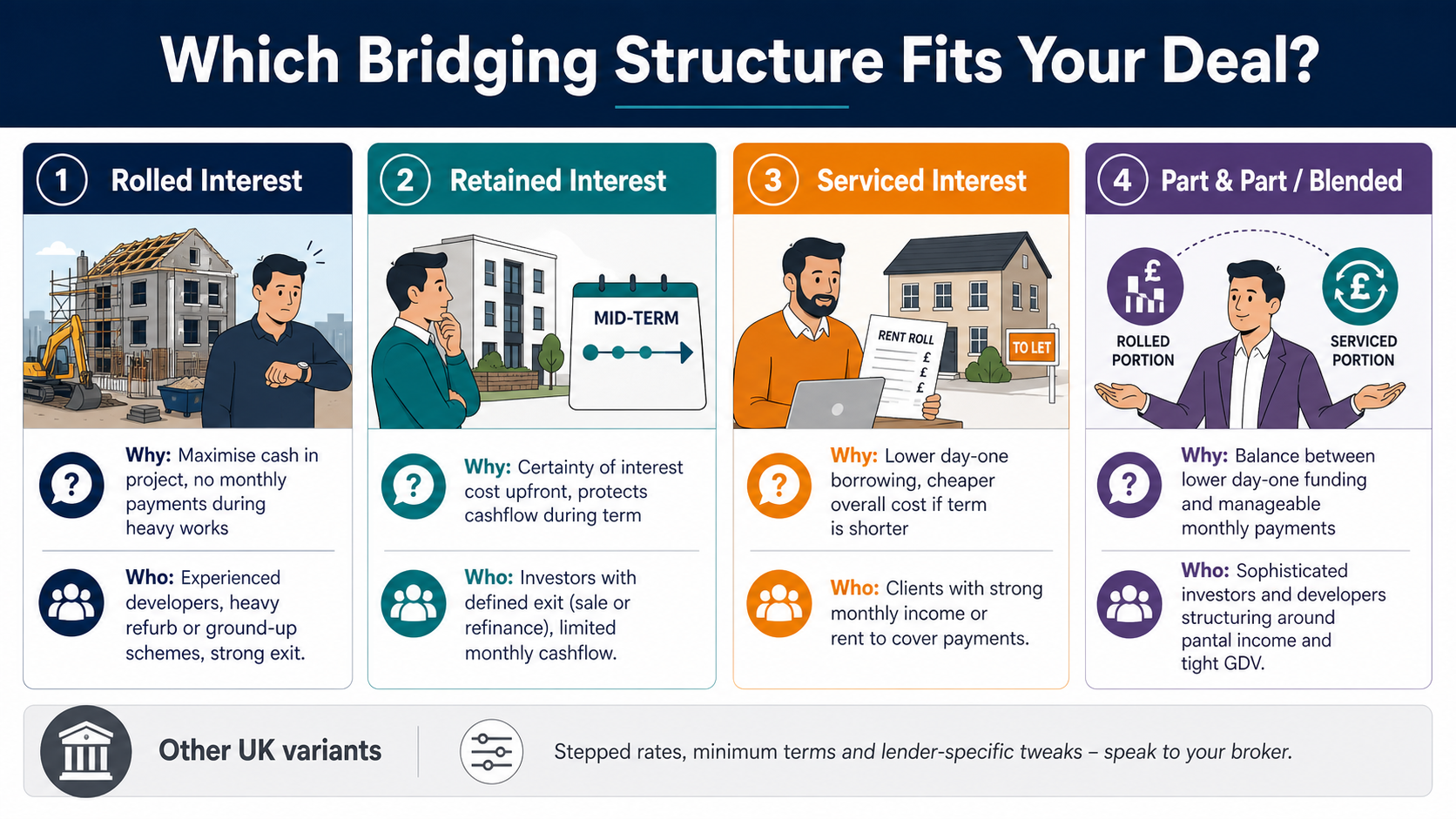
We arrange commercial mortgages, bridging finance, development finance and mezzanine debt for practice owners and property owners across England, and we structure each deal around the partnership’s actual serviceability position rather than a generic lending template. Where a partnership buy-in needs a bespoke covenant package, or a practice needs to bridge quickly before refinancing, our access to specialist lenders and private credit funds beyond the mainstream banks lets us put together a tailored structure.
- Commercial mortgages for freehold or long-leasehold surgery purchase and refinance.
- Bridging finance for time-pressured completions or chain breaks.
- Development finance, joint venture equity and mezzanine debt for new build or large refurbishment schemes.
- Business finance for partner buy-ins or working capital needs separate from the property itself.
If you are weighing up a purchase, a refinance or a partner buy-in, get in touch through our business owner enquiry page or go straight to our commercial mortgages page to see how the numbers might work for your practice.
FAQ
Can a GP surgery change ownership or location in England?
Yes, a GP surgery can relocate or change hands, though any change to premises or ownership structure that affects NHS contract terms generally needs commissioner involvement. Lease or title changes should also be notified to any existing lender before the change takes effect.
Can I get a £200,000 mortgage on a £40,000 salary?
For a GP partner, mortgage affordability is assessed against adjusted partnership profit and notional rent, not a single salary figure, so the usual retail mortgage income multiples do not apply in the same way. A specialist lender will model your actual adjusted profit position, which can support a larger loan than a standard income multiple would suggest.
How are hospitals and GP surgeries funded in England?
Hospitals are funded directly through NHS budgets, while GP surgery premises are typically owned or leased by the partnership itself, with capital costs met through commercial mortgages, partner contributions or NHS capital grants such as the Primary Care Utilisation and Modernisation Fund. Day-to-day running costs are covered by NHS contract payments rather than by the premises finance itself.
Can disability benefits be used as income for a mortgage?
Some lenders will include disability-related benefit income as part of an affordability assessment, though this applies to personal residential mortgages rather than to a GP surgery’s commercial borrowing, which is assessed on partnership profit. Speak to a broker about your specific circumstances, since acceptance varies by lender and benefit type.
What documents do lenders need for a GP surgery mortgage?
Lenders typically ask for partnership accounts, recent management accounts, the partnership deed, lease or title documents and evidence of commissioner support where NHS funding is involved. Having these ready before applying is one of the main things that shortens the time from instruction to completion.
Recommended
Related Topics
Speak to a specialist
Discuss your finance with James directly
Whole-of-market specialist finance — bridging, development, commercial and residential. No call centres, no obligation. James reviews every enquiry personally.
New to specialist finance? How unbiased broker advice works · Deals we have completed
Explore Related Finance