
Published · Updated
expat buy to let mortgagesExpat buy-to-let mortgages: your route to UK property finance
By James Dawes, CeMAP, Founder, James William & Co Capital

Yes, UK nationals living abroad can get a buy-to-let mortgage, and the fastest route to completion is a specialist lender accessed through a broker who places expat cases every week. Expect to put down between 25% and 40%, satisfy an Interest Coverage Ratio of at least 125% to 145%, and budget 10 to 14 weeks from offer to completion, according to figures from Expatica. High-street banks routinely decline expat applications simply because they lack the underwriting process for overseas income and addresses. Specialist lenders exist precisely to fill that gap.
Two things to do this week if you’re serious about buying:
- Pull together three to six months of bank statements and proof of your overseas income now, before you approach any lender.
- Speak to a broker who works expat cases specifically, rather than starting with your existing high-street bank.
TL;DR:
- Expats in countries like the UAE, Singapore, or North America face wider lender options compared to those in jurisdictions with weaker banking transparency or currency controls.
- The typical deposit requirement ranges from 25% to 40%, with an Interest Coverage Ratio of at least 125% to 145% to qualify for a buy-to-let mortgage.
- Accurate, comprehensive documentation, including bank statements, income proof, and translations if needed, is crucial to avoid application delays or refusals.
- Most expat mortgages are interest-only and structured in personal name or through an SPV, with tax and legal implications differing based on ownership type.
- Timing and proper case packaging with a specialist broker significantly influence the speed and success of the mortgage process, especially across time zones.
Table of Contents
- Can expats get buy-to-let mortgages? Which lenders accept
- What deposit, LTV and ICR do lenders expect?
- Getting your documents right the first time
- Interest-only, SPV or personal name: which structure fits?
- Property types that trigger declines
- From decision in principle to completion: what to expect
- How a specialist broker packages an expat case
- How exchange rates affect your repayments abroad
- Does your credit history abroad even count?
- What UK law means for you as a landlord abroad
- Insurance you’ll need beyond a standard homeowner policy
- Reporting rental income where you actually live
- Key Takeaways
- Authoritative resources and further guidance
- Why the standard mortgage advice fails expat landlords
- Structuring your expat purchase with the right broker
- Sources
- FAQ
Can expats get buy-to-let mortgages? Which lenders accept
Lenders don’t treat all expat applicants the same way, and the difference between an easy placement and a declined case usually comes down to three things: where you live, how you earn, and what UK footprint you already have.
Jurisdiction matters more than most applicants expect. Lenders maintain informal “acceptable country” lists, and these shift with anti-money-laundering rules and currency stability. Expats in the UAE, Singapore, Hong Kong, the EU and North America tend to find the widest lender choice. Applicants based in countries with weaker banking transparency or currency controls often face a narrower panel, sometimes just two or three lenders willing to look at the case at all.
Employment status changes the evidence trail lenders want to see:
- Salaried employees with a stable overseas employer usually need payslips, an employment contract and a reference letter, and are the easiest expat profile to place.
- Contractors typically need to show a consistent contract history, often two years’ worth, plus evidence of day rate and utilisation.
- Self-employed applicants face the heaviest scrutiny, generally needing two to three years of certified accounts, sometimes translated and notarised depending on the jurisdiction.
A UK footprint helps enormously. Holding a UK bank account, owning another UK property, or already running a small portfolio all signal to underwriters that you understand the market and have a track record here. Applicants with none of these are not excluded, but they should expect more paperwork and a longer path to a decision in principle. Treating an expat file as a bespoke case from day one, rather than trying to force it through a standard template built for UK residents, avoids wasted applications and the credit footprint they leave behind, a point Expatica makes clearly in its guidance for overseas buyers.
What deposit, LTV and ICR do lenders expect?
Model your numbers before you fall in love with a property. Deposit expectations for expat buy-to-let sit between 25% and 40% of purchase price, translating to a maximum loan-to-value of roughly 60% to 75% depending on the lender, property type and your income currency, according to Knox Mortgages.
Deposit and coverage at a glance: most lenders want 25 to 40% down, an Interest Coverage Ratio of 125% to 145%, and rental income stress-tested at a notional rate well above the pay rate, according to Expatica and Knox Mortgages.
The Interest Coverage Ratio is the core affordability test for any buy-to-let mortgage, expat or otherwise. Lenders divide expected monthly rental income by the monthly mortgage payment calculated at a stress rate, not the actual pay rate, and want the result to clear 125% at minimum. Some lenders push that threshold to 145% for expat cases specifically, treating the overseas element as added risk.
A worked example: on a £300,000 loan stressed at 7.5%, the notional monthly interest cost is roughly £1,875. To hit a 145% ICR, the property needs to generate around £2,720 in monthly rent. That gap between stress rate and pay rate catches out applicants who model affordability using today’s mortgage rate rather than the lender’s stress assumption.
Foreign income doesn’t always convert pound for pound either:
- Major stable currencies (USD, EUR, AUD, SGD) typically face haircuts of around 20% to 30% when lenders assess affordability.
- GBP income, including UK pension income or existing UK rental income, is usually accepted without any haircut applied.
- Some lenders apply steeper discounts, or decline the case outright, for currencies they consider volatile or difficult to verify.
Getting your documents right the first time
Expat cases stall for one reason more than any other: incomplete or unverifiable paperwork. Pull this together before you make an application.
- Valid passport and proof of your current overseas address, usually a recent utility bill or bank statement.
- Three to six months of bank statements covering the account your income lands in.
- Payslips for salaried applicants, or two to three years of certified accounts for the self-employed.
- Proof of deposit source, showing the money’s origin clearly enough to satisfy anti-money-laundering checks.
- Landlord references if you’re already renting a UK or overseas property, and existing tenancy agreements if you hold other buy-to-lets.
- A reference letter from your employer confirming role, salary and contract length.
Overseas accounts and documents often need extra handling. Bank statements in a foreign language should come with a certified translation, and currency conversions on income evidence should be calculated at a stated, consistent exchange rate rather than left for the underwriter to guess. Some jurisdictions require notarisation of accounts before a UK lender will accept them.
Pro Tip: Build one labelled digital dossier, PDF by PDF, in the order a lender expects to see them (identity, address, income, deposit, references), and upload it to a single secure shared folder before you approach anyone. Brokers and solicitors move faster when they’re not chasing five separate email threads across three time zones.
Interest-only, SPV or personal name: which structure fits?
Most expat buy-to-let mortgages default to interest-only, and there’s a straightforward reason: it keeps monthly payments lower against a stress-tested ICR, which matters when foreign income is already facing a currency haircut. Repayment mortgages are occasionally required by specific lenders or for certain property types, but interest-only remains the standard shape for a rental investment where the exit is sale or refinance rather than full capital repayment.
The bigger structural decision is personal name versus a Special Purpose Vehicle. A growing share of portfolio landlords now buy through an SPV, largely for tax efficiency and to keep each property’s borrowing ring-fenced from personal finances, a shift confirmed in Skybound Wealth’s 2026 analysis of the expat market.
- Personal name is simpler to set up and often cheaper upfront, but rental profit is taxed at your personal income tax rate and mortgage interest relief is restricted.
- SPV ownership requires a UK-registered company, a registered office address, and annual company accounts, but can offer more favourable tax treatment on interest and easier portfolio expansion.
- Lenders are also weighing 2-year fixes against 5-year fixes differently for expats, with longer fixes sometimes easing the affordability stress test because rates assumed further out are lower.
Whichever structure you’re leaning towards, take specialist UK tax advice before you commit. The right answer depends on your total income, your country of residence, and how you plan to exit the investment, and it’s not a decision to make from generic guidance alone.
Property types that trigger declines
Not every property that looks like a sound investment will pass underwriting, and expat applicants have less room to negotiate around a problem property because the case already carries extra scrutiny.
Leasehold flats are the most common trap. Short leases, typically under 70 years, and clauses with doubling ground rent every 10 to 25 years can make a property effectively unmortgageable, a pattern flagged repeatedly by The Property Daily as one of the most avoidable reasons purchases collapse late in the process.
Other red flags worth knowing before you view a property:
- A poor Energy Performance Certificate rating can breach minimum energy efficiency standards for rented property, and lenders check this before releasing funds, per Gov.
- Certain new-build flats, particularly those above four storeys with cladding uncertainty, need extra fire safety evidence.
- Very small flats (often under 30 square metres) and HMOs typically need specialist lenders rather than standard buy-to-let products.
Pro Tip: Instruct a solicitor to review the lease and title before you exchange, not after. A £300 legal review can save you a £3,000 aborted purchase and a wasted mortgage application.
From decision in principle to completion: what to expect
A Decision in Principle typically comes back within a few days once your documents are in order, but the full purchase runs longer for expats than for UK residents, largely because overseas documents need independent verification. Budget 10 to 14 weeks from accepted offer to completion, a realistic window confirmed by Manor Mortgages Direct for expat purchases specifically.
Four people need to move in sync to hit that window:
- Your broker packages the case and matches it to the right lender panel before submission, not after a decline.
- A valuer inspects the property and confirms it meets the lender’s criteria, including EPC and lease length.
- A solicitor handles conveyancing, ideally one experienced with overseas clients who can work around time-zone gaps.
- A UK-based letting agent lines up tenancy referencing so the property can be let the moment completion happens.
Having a UK bank account ready before you apply removes one common bottleneck, since some lenders won’t release funds to an overseas account. Agree fixed check-in windows with your broker and solicitor that work across the time difference, rather than relying on ad hoc emails that sit unanswered overnight.
How a specialist broker packages an expat case
Placing an expat buy-to-let case well is less about finding a lender who says yes and more about presenting a file that never needs a second look. That’s the practical difference a capital concierge approach makes: one point of contact who maps your case against a panel of lenders that actually accept your country of residence and income type, then structures the submission so underwriters see a complete picture on the first pass.
Industry reporting on the expat mortgage market notes that many mainstream lenders simply lack the process to handle overseas income and address verification, while specialist brokers with the right lender relationships convert enquiries more reliably and move faster to completion, according to MPA’s coverage of the expat buy-to-let market.
James William & Co Capital works this way for property investors structuring UK acquisitions from abroad, treating each case as a distinct debt-structuring exercise rather than a standard application.
Ask your broker to prepare, before submission:
- Documents ordered exactly as the target lender expects them, not just collected in one folder.
- Certified translations for any non-English accounts or contracts.
- Corporate documents ready in advance if you’re buying through an SPV, including registered office confirmation.
Readers considering how a wider funding structure might apply to a portfolio purchase can see how these principles extend to development and acquisition finance in this guide to UK real estate funding sources.
How exchange rates affect your repayments abroad
Your mortgage is in pounds sterling regardless of where you live, and that has a direct effect on your real-world cost if your income arrives in another currency. A weakening of your local currency against sterling means more of your home currency is needed to cover the same GBP mortgage payment each month, even though the mortgage itself hasn’t changed.
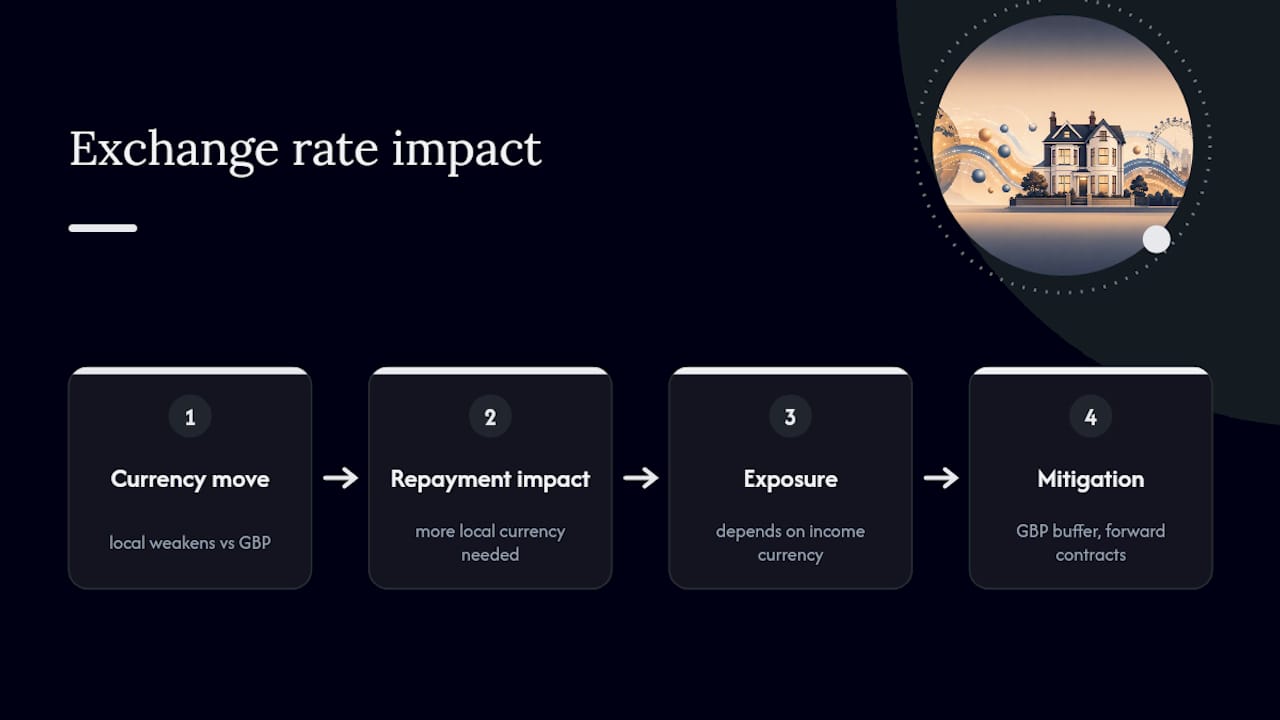
This works against you when your currency weakens and in your favour when it strengthens, but most expat landlords never model the downside scenario before they buy. If your rental income is also collected in GBP, as most UK buy-to-let income is, the exchange rate risk sits mainly on the gap between your personal income (used to satisfy affordability) and your mortgage payment, rather than on the rental cash flow itself.
A practical way to manage this is to keep a buffer of several months’ mortgage payments in GBP, held in a UK account, so a sudden currency swing doesn’t force you to convert funds at a poor rate under time pressure. Some expats also use forward currency contracts to lock in an exchange rate for a fixed period, smoothing out short-term volatility, though this adds a cost and needs its own advice separate from the mortgage itself.
Lenders that apply a haircut to foreign income at application stage are, in effect, already pricing in some of this volatility. That’s one more reason GBP-denominated income, where you have it, tends to face a smoother underwriting path than income in a currency prone to swings.
Does your credit history abroad even count?
UK lenders assess buy-to-let applications primarily against your UK credit file, and this is where many expats hit an unexpected snag: years abroad with no UK borrowing activity can leave a thin or dormant credit file, even if you’ve never missed a payment anywhere.
A thin UK file isn’t the same as a bad one, but it gives underwriters less to work with. Overseas credit history, built up in the country you live in now, generally doesn’t transfer into a UK credit score at all, since credit reference agencies operate on a national basis.
A few practical steps help rebuild or maintain a usable UK footprint:
- Keep at least one UK bank account or credit card active, even with light use, rather than closing everything down when you move abroad.
- Stay on the electoral roll at a UK address if you have one, such as a family member’s property, since this supports address verification.
- Settle any old UK debts or defaults before applying, since these show up regardless of how long you’ve lived overseas.
Specialist expat lenders are generally more comfortable underwriting a thin UK file than high-street banks are, provided the rest of the application, income evidence, deposit source, and property, is strong. This is another reason a broker who knows which lenders tolerate a lighter credit history matters more for expats than for UK resident applicants.
What UK law means for you as a landlord abroad
Owning UK rental property from overseas doesn’t exempt you from UK landlord law, and the obligations are identical to those facing a landlord living down the road from the property. You still need a valid EPC, a gas safety certificate where applicable, and you must protect any deposit in a government-approved scheme within the statutory window.
Most buy-to-let lending for expats is treated as investment or commercial lending rather than consumer credit, and whether FCA consumer protections apply depends on the specific loan purpose and structure, a distinction Expatica sets out clearly for overseas buyers. That’s worth understanding before you sign anything, since it affects what recourse you have if a dispute arises.
Practical points that catch expat landlords out:
- You need a UK-based agent or a clear self-managing arrangement, since you can’t realistically handle a burst pipe or a tenant dispute from another continent.
- Right to Rent checks remain your legal responsibility even if a letting agent manages the property day to day.
- If you’re a non-resident landlord, HMRC’s Non-Resident Landlord Scheme normally applies, which affects how rental income is taxed at source unless you apply for approval to receive rent gross.
None of this is a reason not to buy. It’s a reason to have a UK letting agent and, ideally, a solicitor lined up before completion, not after the first tenant moves in.
Insurance you’ll need beyond a standard homeowner policy
A standard buildings and contents policy, the kind designed for owner-occupiers, generally won’t cover a rented property properly, and some policies are void outright if the insurer discovers the property is let without being told.
Landlord insurance is the baseline requirement, and most buy-to-let lenders make it a condition of the mortgage offer. It typically covers buildings, and contents if the property is let furnished, alongside landlord-specific risks a standard policy excludes.
A few additions are worth considering, and some lenders will ask for at least one of them directly:
- Loss of rent cover, which protects your income if the property becomes uninhabitable, say after a fire, and you can’t let it while repairs happen.
- Rent guarantee insurance, which covers missed rent if a tenant stops paying, something that matters more when you can’t easily chase the issue from abroad.
- Landlord liability cover, protecting you if a tenant or visitor is injured on the property and holds you responsible.
As an expat, check specifically whether your policy has any exclusion or additional premium tied to your overseas residency status. Some insurers price this in without flagging it clearly, and it’s a detail worth confirming before, not after, you need to claim.
Reporting rental income where you actually live
UK rental income is taxable in the UK regardless of where you live, but that’s rarely the end of the story. Most countries also tax residents on worldwide income, which means the same rental profit can, in principle, be taxed twice unless a double taxation agreement between the UK and your country of residence prevents it.
The UK has double taxation treaties with a wide range of countries, and these generally allow you to offset UK tax paid against what you’d otherwise owe locally, but the mechanics vary significantly by country and by how your local tax authority treats foreign property income. Some countries require you to declare the UK property itself, not just the rental income, particularly where wealth taxes apply.
This is not a section to treat as a formality. The reporting requirement in your country of residence, the exchange rate used to convert rental income for local tax purposes, and any local wealth or capital gains implications differ enough from one jurisdiction to another that generic advice genuinely isn’t reliable here. A UK tax adviser who works specifically with non-resident landlords, ideally alongside an adviser in your country of residence, is the only way to get this right rather than guessing and hoping HMRC and your local tax office agree with each other.
Key Takeaways
Expat buy-to-let mortgages are readily available through specialist lenders, provided you can meet deposit, ICR and documentation requirements that mainstream UK banks are rarely equipped to assess.
| Point | Details |
|---|---|
| Deposit and LTV | Budget a substantial deposit down, resulting in a maximum loan-to-value ratio that typically ranges from low to high depending on lender and currency. |
| ICR is the real test | Rental income must cover mortgage payments at a stressed rate with a coverage ratio around 125% to 145%, rather than at the current pay rate. |
| Documents decide speed | Adequate documentation including multiple months of bank statements and certified translations can prevent delays common in expat cases. |
| Structure affects tax | SPV ownership can be advantageous for larger portfolios, whereas personal name ownership is simpler but may involve less favourable tax treatment. |
| Specialist packaging matters | James William & Co Capital structures expat cases against a lender panel mapped to your country and income type before submission. |
Authoritative resources and further guidance
- Gov
- Buy-to-let mortgages (Expatica)
- UK expat buy-to-let mortgages 2026 (Skybound Wealth)
- Expat buy-to-let: a growing market hiding in plain sight (MPA)
Why the standard mortgage advice fails expat landlords
Most guidance written on buy-to-let mortgages assumes a UK resident applicant, then bolts on a paragraph about expats as an afterthought. That’s backwards. An expat case isn’t a standard application with one extra document; it’s a fundamentally different underwriting exercise, and treating it otherwise is exactly what produces declined applications and damaged credit files.
The overlooked point is timing, not eligibility. Most expats who struggle aren’t unmortgageable, they’re mismatched to the wrong lender at the wrong stage, having submitted a file built for a high-street template. The evidence on lender panels and ICR thresholds is clear enough: the numbers are knowable in advance. What decides whether a case completes in ten weeks or drags into six months is whether the file was packaged correctly before a lender ever saw it.
If you take one thing from this, prioritise the document dossier over the property search. A well-packaged expat with a modest flat will complete faster than an unprepared applicant with a dream property. Get your evidence right first, then go shopping.
— James William Dawes
Structuring your expat purchase with the right broker
There are other paths into UK buy-to-let as an expat: going direct to a specialist lender yourself, or working through a general mortgage broker who handles the odd overseas case alongside standard UK applications. Both can work. Neither gives you what a dedicated debt-structuring relationship does when your income sits in three currencies, your deposit is coming from an offshore account, or you’re weighing SPV ownership against personal name.
James William & Co Capital works UK property finance as its core discipline, not a side line, mapping each expat case against a panel of lenders that actually understand overseas income and structuring the file so it completes in one pass rather than three. That single point of contact matters most when you’re managing a purchase across time zones and can’t afford a lender bouncing your application back for missing paperwork.
If you’re planning a UK buy-to-let purchase from abroad, whether as a first rental property or the next addition to a portfolio, get in touch with James William & Co Capital’s specialist property finance team to discuss your case and see which lenders on the panel fit your income and country of residence.
This article is general information, not a substitute for advice from a qualified financial advisor. Consult a qualified financial professional about your own circumstances before acting on anything here.
Sources
FAQ
Can I get a buy-to-let mortgage as an expat in the UK?
Yes. Specialist lenders accept UK expat applications regularly, typically requiring a 25% to 40% deposit and rental income that clears an Interest Coverage Ratio of 125% to 145%, according to Expatica.
What are the current buy-to-let mortgage rates for expats in the UK?
Rates vary by lender, deposit size and whether you choose a 2-year or 5-year fix, with longer fixes sometimes easing affordability stress tests, per Skybound Wealth’s 2026 guide. A specialist broker can quote current rates against your specific profile.
Can I get a mortgage in the UK as an expat?
Yes, both for buy-to-let and, with more restrictions, for a UK residential purchase, though buy-to-let is generally the more accessible route since it’s assessed on rental income rather than UK-based employment.
Which UK banks offer expat mortgages?
Most mainstream high-street banks avoid expat cases because they lack the process for overseas income verification. Specialist and private lenders fill this gap, which is why working with a broker such as James William & Co Capital, who maps applications to the right lender panel, matters more than approaching a familiar high-street name first.
Recommended
Related Topics
Speak to a specialist
Discuss your finance with James directly
Whole-of-market specialist finance — bridging, development, commercial and residential. No call centres, no obligation. James reviews every enquiry personally.
New to specialist finance? How unbiased broker advice works · Deals we have completed
Explore Related Finance