
Published · Updated
bridge extension feesBridge Extension Fees: Stop Compounding Costs on UK Developer Loans
By James Dawes, CeMAP, Founder, James William & Co Capital

Bridge extension fees are the charges a lender applies to prolong a bridging loan beyond its original term, typically structured as a flat fee, a percentage of the loan, or interest added to the balance. Your first step should always be to request the lender’s tariff and a full written breakdown of the extension cost and payment options before you agree to anything. Under FCA rules, many extensions count as a new loan, which means affordability checks and documented consent are required, not optional extras.
TL;DR:
- Capitalising an extension fee adds it to the balance, so interest accrues on the charge; also check for valuation, legal, underwriting, and arrangement costs.
- For regulated loans, lenders often must reassess affordability, record your positive choice, and document why you need the extension, its costs, and your repayment strategy.
- Before agreeing, request the tariff and itemized calculations; challenge charges applied before your request, unexplained rounding, duplicate arrangement fees, or unverified legal costs.
- Contact the lender 30–60 days before maturity, and support requests for capped terms or discounts with refinance evidence, a solicitor’s update, or an independent valuation.
Table of Contents
- How extension fees are structured and what they do to your numbers
- What FCA rules require when a bridging loan is extended
- Typical extension invoice items and how to verify each one
- Negotiation tactics that limit what you pay
- The extension process step by step, from request to signed paperwork
- When a specialist broker changes the outcome
- How we help with bridge extension fees and what happens next
- FAQ
- Sources
How extension fees are structured and what they do to your numbers
Lenders tend to charge extension fees in one of three ways: a flat administration fee, a percentage of the outstanding loan, or an increase to the ongoing interest rate for the extended period. Some combine two of these. The method matters less than whether the fee is paid upfront or capitalised, because capitalising it, adding it to the loan balance rather than settling it in cash, means you then pay interest on the fee itself for the remainder of the term.

Paid upfront, that’s the full cost.
Several follow-on costs often get missed when borrowers focus only on the headline extension fee:
- A re-valuation fee, if the lender wants updated security evidence.
- Fresh legal costs, since solicitors typically need to review and re-document the facility.
- An additional underwriting or arrangement charge, particularly where the loan structure changes.
Lender tariff examples show extension fees are often listed plainly as an “extension fee” that can be paid upfront or added to the loan, which is why capitalising the charge attracts further interest over the remaining term. For a wider view of what a bridging facility costs from the outset, our article on bridging loan costs sets out the standard fee categories you’ll encounter before you ever reach an extension.
What FCA rules require when a bridging loan is extended
Regulated bridging loans don’t exist in a grey area when it comes to extensions. Under MCOB rules, extending the term is treated as a new loan application in many cases, which triggers a fresh set of obligations on the lender rather than a quiet administrative tweak.
In practice, this means lenders must:
- Carry out an affordability assessment for the extended term, not just rely on the original approval.
- Record your “positive choice” to extend, rather than assuming consent from inaction.
- Document the repayment strategy and the costs involved in the extension.
MCOB 11.6.2 R and MCOB 11.6.55 R set out these obligations specifically for bridging loan extensions, requiring evidence of the reasons for extending, the costs charged, and how you intend to repay. The practical consequence for you as a borrower is straightforward: lenders are entitled to charge legitimate extension costs, but those costs must be disclosed clearly and backed by a paper trail. If a lender can’t produce that paper trail, that’s worth challenging. MCOB guidance also requires firms to act honestly, fairly and professionally when agreeing extensions, which gives you a regulatory hook if a fee feels arbitrary or undocumented.
Typical extension invoice items and how to verify each one
When an extension invoice lands, treat it the way you’d treat any commercial invoice you didn’t raise yourself: check every line before you pay or agree to capitalise it.
- Extension or administration fee: ask for the lender’s published tariff showing this fee was applied correctly for your loan size and term.
- Additional interest: request the calculation showing the new rate, the new period, and how it was applied to the outstanding balance.
- Valuation or re-valuation fee: ask for the valuer’s invoice and the report itself, not just a cost summary.
- Solicitor or legal fees: request the solicitor’s invoice directly, since these are sometimes marked up when passed through the lender.
- Product or arrangement fee: confirm whether this duplicates a fee already charged at the original drawdown.
Pro Tip: Treat any fee applied before you formally requested an extension, or any rounded figure with no supporting calculation, as a red flag worth querying in writing.
Retrospective charges, unexplained rounding, and fees applied without a documented application are the three most common issues borrowers successfully dispute. The Financial Ombudsman Service decision DRN-5097756 shows how these disputes are assessed, and confirms that lenders can pass on reasonable administration costs provided they’re disclosed and the borrower had the chance to agree or query them.
Negotiation tactics that limit what you pay
Timing does most of the work here. Opening the conversation with your lender 30 to 60 days before maturity gives you room to negotiate rather than react, and it avoids the default position of accepting whatever tariff is applied under time pressure.
Specific things worth asking for:
- A capped tariff for a first short extension, often 30 to 90 days, rather than an open-ended percentage.
- Written confirmation of the repayment plan the lender has accepted, so there’s no ambiguity later.
- A discounted fee where you can evidence an active refinance, such as an agreement in principle already in hand.
Pro Tip: An independent valuation obtained early, before the lender commissions its own, can shift the entire conversation if local market movement supports your position on security value.
Evidence carries weight in these discussions: a refinance agreement in principle, a solicitor’s letter confirming progress, or an independent valuation all give you leverage that a verbal request doesn’t. For complex debt stacks involving mezzanine finance or JV equity, bringing in a specialist broker or legal adviser before you negotiate is usually worth the cost, particularly where capitalising a fee could trip a covenant elsewhere in the structure. MoneyHelper guidance echoes this principle more broadly: speaking to your lender early and seeking independent advice tends to produce better outcomes and surfaces fee options you might not be offered by default.
The extension process step by step, from request to signed paperwork
A bridging loan extension follows a reasonably predictable sequence, and knowing the stages helps you avoid last-minute surprises.
- Request the lender’s current tariff and a written cost breakdown for the extension period.
- Confirm your repayment strategy and provide supporting evidence, such as a sale agreement or refinance offer.
- Agree the extension term, typically 30, 60 or 90 days depending on your exit timeline.
- Instruct any required re-valuation and allow time for the valuer’s report.
- Have solicitors review and document the revised facility terms.
- Review the new paperwork carefully, checking the revised interest calculation, the new maturity date, and whether fees are being paid upfront or capitalised.
- Sign the extension and settle or capitalise the agreed fees.
A 30-day extension can often move through this process quickly where no re-valuation is needed, while a 90-day extension involving a fresh valuation and solicitor review typically needs the full runway to avoid a rushed signing. Whatever the length, the extension paperwork directly affects your exit timing and refinance planning, so check the new maturity date against your actual completion or refinance schedule rather than assuming it matches your original plan.
When a specialist broker changes the outcome
Extension negotiations move fastest when someone with direct lender relationships is making the case. Negotiating extension terms benefits from conversations with lenders where there is an established working relationship, often under real time pressure from auction deadlines or disputed fees.
That matters most where a bridging facility sits inside a layered debt stack, alongside mezzanine finance or JV equity, because an extension decision in one facility can affect covenants elsewhere. It also matters when a fee looks wrong and needs challenging quickly, rather than after it’s already been capitalised. Mandating a broker at that point, rather than after the paperwork is signed, is usually the difference between a negotiated outcome and an accepted one.
— James William Dawes
How we help with bridge extension fees and what happens next
Extending a bridging loan on the wrong terms can cost far more than the headline fee suggests, and that’s exactly where our work makes a measurable difference. Specialist brokers structure and renegotiate bridging finance for developers and investors, often drawing on direct access to specialist lenders and private credit funds that sit outside the mainstream banking network.
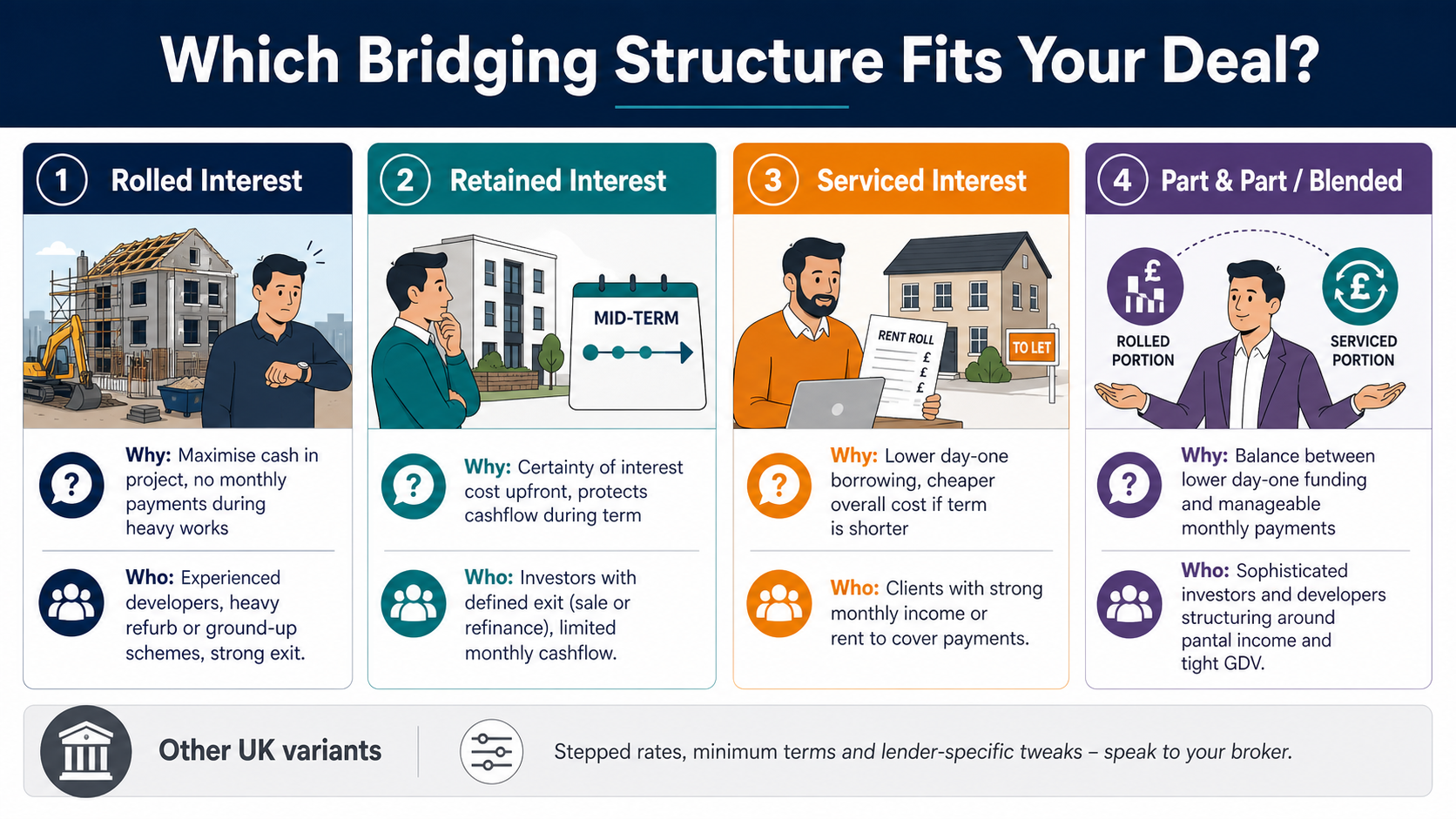
An initial review with us typically covers:
- A check of your current lender’s tariff against the extension fee you’ve been quoted.
- A realistic timescale estimate for your extension based on whether a re-valuation is needed.
- A recommended next action, whether that’s negotiating a cap, preparing refinance evidence, or moving to a new facility entirely.
If your bridging loan sits inside a wider development finance structure, we also handle development finance, mezzanine debt and JV equity as part of the same conversation. Visit our bridging finance page to start a review, or use our compare bridging loans tool to see lender options before your current term expires.
FAQ
What exactly counts as a bridge extension fee?
A bridge extension fee is any charge a lender applies to prolong a bridging loan past its original end date, usually a flat fee, a percentage of the loan, or additional interest. It can be paid upfront or capitalised into the loan balance, and under MCOB rules, extensions are often treated as a new loan requiring fresh affordability checks.
Are bridging lenders allowed to charge whatever they like for an extension?
No. Lenders must disclose extension costs clearly and keep records showing your positive choice to extend, the reasons, and the repayment strategy, as set out in MCOB 11.6. A fee that isn’t documented or disclosed properly can be challenged through the lender’s complaints process or the Financial Ombudsman Service.
How do I dispute an extension fee I think is unfair?
Start by requesting the lender’s tariff and a written calculation for every charge on the invoice, then raise a formal complaint if the figures don’t add up or weren’t disclosed in advance. The Financial Ombudsman Service decision DRN-5097756 shows that reasonable administration costs can be passed on, but only where they were properly evidenced and agreed.
Does capitalising an extension fee cost more than paying it upfront?
Yes, in most cases. Capitalising a fee adds it to your loan balance, which means it then accrues interest for the remainder of the extension period, as shown in typical lender tariff structures. Paying upfront avoids that compounding effect, though it requires available cash at the point of extension.
When should I bring in a broker for a bridging extension?
A broker is worth mandating when your bridging facility sits within a layered debt stack, when an extension fee looks undocumented or excessive, or when auction or completion deadlines leave little room for delay. Specialist brokers with direct lender relationships can often negotiate capped terms faster than a borrower approaching the lender alone.
Sources
- FCA handbook - MCOB 11.6 responsible lending and financing
- Financial Ombudsman Service decision DRN-5097756
- West One bridging tariff of charges (example)
- MoneyHelper – help with the cost of living (mortgage and loan support)
Recommended
Related Topics
Speak to a specialist
Discuss your finance with James directly
Whole-of-market specialist finance — bridging, development, commercial and residential. No call centres, no obligation. James reviews every enquiry personally.
New to specialist finance? How unbiased broker advice works · Deals we have completed
Explore Related Finance