
Published · Updated
early repayment chargesAvoid a £10,000 ERC: Early Repayment Charges in England
By James Dawes, CeMAP, Founder, James William & Co Capital

Early repayment charges normally bite when you remortgage before your fixed or discounted deal ends, overpay beyond your lender’s annual allowance, or redeem the mortgage in full during the tie-in period. The typical cost sits between 1% and 5% of your outstanding balance, usually tapering down each year you stay put. Mortgage Conduct of Business rules force lenders to disclose the exact cash figure in your offer, and if that disclosure was missing or misleading, you have grounds to complain.
TL;DR:
- ERCs typically range from 1% to 5% of the outstanding mortgage balance and usually decrease each year after the first.
- Most ERCs apply when remortgaging during the tie-in period, overpaying beyond allowances, or fully redeeming the mortgage early.
- On a £200,000 balance, the ERC can be as high as £10,000 in year one, tapering to about £2,000 by year five, depending on the lender’s schedule.
- Avoidance strategies include waiting for the tie-in to end, porting the mortgage when moving house, and staying within annual overpayment limits.
- Challenging an ERC successfully requires clear disclosure; complaints often succeed if the lender failed to disclose or misrepresented the charge.
Table of Contents
- What is an early repayment charge (ERC)?
- When lenders charge an ERC (common scenarios and exceptions)
- How much do ERCs cost? Percentages, tapering and numeric examples
- How to avoid or reduce paying an ERC
- Challenging an ERC: complaints, Ombudsman findings and practical next steps
- Quick break-even method: should you pay the ERC to remortgage or capitalise it?
- Comparing ERC policies across different lenders or mortgage types
- When specialist broker support is worth considering
- Optional: how James William & Co Capital can help
- Sources
- FAQ
What is an early repayment charge (ERC)?
An early repayment charge is a contractual fee your lender applies when you exit a mortgage deal before its agreed term ends. It is not a punishment for leaving. Under FCA MCOB 12.3, a regulated mortgage’s ERC must be expressed as a reasonable pre-estimate of the lender’s own costs, covering things like the funding arrangements the lender made to offer you that fixed rate in the first place.
That distinction matters when you’re arguing your case later. Lenders are not allowed to use the old Rule of 78 method, and the same charge can legitimately apply across a whole tranche of similar products rather than being calculated individually for you.
You’ll find the exact figure, or the formula for calculating it, in two places:
- Your original mortgage illustration, issued before you signed anything.
- The offer document, which sets out the maximum cash amount you’d owe at each point in the deal.
Both are worth digging out before you make any decision about moving lenders or overpaying.
When lenders charge an ERC (common scenarios and exceptions)
ERCs generally attach to four situations, though the fine print varies by lender and product.
- Remortgaging elsewhere during your tie-in period, or switching products with the same lender before the term ends.
- Overpaying beyond the annual allowance, commonly around 10%, though this varies and you should check your own contract.
- Redeeming the mortgage in full while still tied in, or porting part of the balance and paying an ERC on the portion left behind.
- Partial porting where the new property or loan amount doesn’t fully match your existing terms.
Buy-to-let and some commercial mortgages sit outside MCOB’s regulated framework entirely. Lenders often mirror the same rules as good practice, but you have weaker legal footing if you try to challenge the charge, so read the loan agreement itself rather than assuming residential norms apply.
How much do ERCs cost? Percentages, tapering and numeric examples
Many lenders taper the charge down year by year rather than charging a flat rate throughout.
Pro Tip: A charge described as “5% reducing to 1%” usually means year one costs the most, and year five the least. Check which year you’re actually in before assuming the worst.
A typical schedule might run:
- Year one: 5% of the balance.
- Year three: 3% of the balance.
- Year five: 1% of the balance, often the final year before the ERC drops away entirely.
On a £200,000 balance, that 5% figure works out at £10,000 in year one, falling to £2,000 by year five, according to Unbiased’s analysis of typical ERC structures. Small differences in timing translate into thousands of pounds either way.
How to avoid or reduce paying an ERC
The cheapest ERC is the one you never trigger, and most avoidance tactics come down to timing and paperwork.
- Wait out the tie-in where possible, even if it means sitting on your lender’s standard variable rate for a month or two before switching.
- Port the mortgage when you move house, checking your lender’s time window and lending criteria first, since some lenders refund the ERC if you complete within a set period, 180 days in Nationwide’s case.
- Stay inside your annual overpayment allowance, commonly around 10% a year, and stagger larger reductions across multiple tax years instead of one lump sum.
- Choose a tracker or SVR product if flexibility matters more than rate certainty. These usually carry no ERC, but you’ll pay a higher rate for that freedom.
- Ask the lender directly about a discretionary waiver, particularly if you can point to financial hardship or evidence that the original advice was flawed.
Pro Tip: Ring your lender’s retentions team before instructing a solicitor. Some will waive or reduce an ERC informally if you’re remortgaging with them rather than leaving entirely.
Challenging an ERC: complaints, Ombudsman findings and practical next steps
Start with your lender’s internal complaints process, and keep every email, offer document, and call log from the day you took out the mortgage. Financial Ombudsman Service decisions consistently show that ERCs are treated as enforceable contractual terms, not penalties, provided the lender disclosed the charge clearly and can demonstrate it was a reasonable pre-estimate of its own costs.
In case after case, the Ombudsman has accepted lenders’ confidential costing methodologies as sufficient evidence, meaning complainants only succeed where they can show the disclosure itself was missing, buried, or wrong, or where the overpayment calculation contained an actual error.
That pattern repeats across multiple decisions, including one involving Lloyds, where the charge was upheld once the lender produced its disclosure paperwork.
A practical escalation path looks like this:
- Gather your mortgage offer, illustration, and any correspondence referencing the ERC terms.
- Submit a formal complaint to your lender and request their final response within eight weeks.
- Escalate to the Financial Ombudsman Service only once you have that final response, or after the eight-week deadline passes.
Quick break-even method: should you pay the ERC to remortgage or capitalise it?
Work out whether the ERC is worth paying by comparing the one-off charge against your annual interest saving from the new deal, multiplied by however many years you’d stay on it. Divide the ERC by the annual saving and you get a rough payback period in years. It’s a simplified heuristic that ignores the time value of money, but it’s a fast, useful filter for most borrowers.

If remortgaging saves you £1,800 a year in interest, the payback period is roughly 3.3 years. Stay in the new deal longer than that and you’re ahead.
Capitalising the ERC, rolling it into your new loan rather than paying it upfront, feels easier at completion but increases your total cost because you now pay interest on that fee for the life of the new mortgage. For balances above roughly £500,000, or where you’re juggling several properties, a proper net present value calculation beats the quick heuristic, and that’s usually where professional modelling earns its fee.
Comparing ERC policies across different lenders or mortgage types
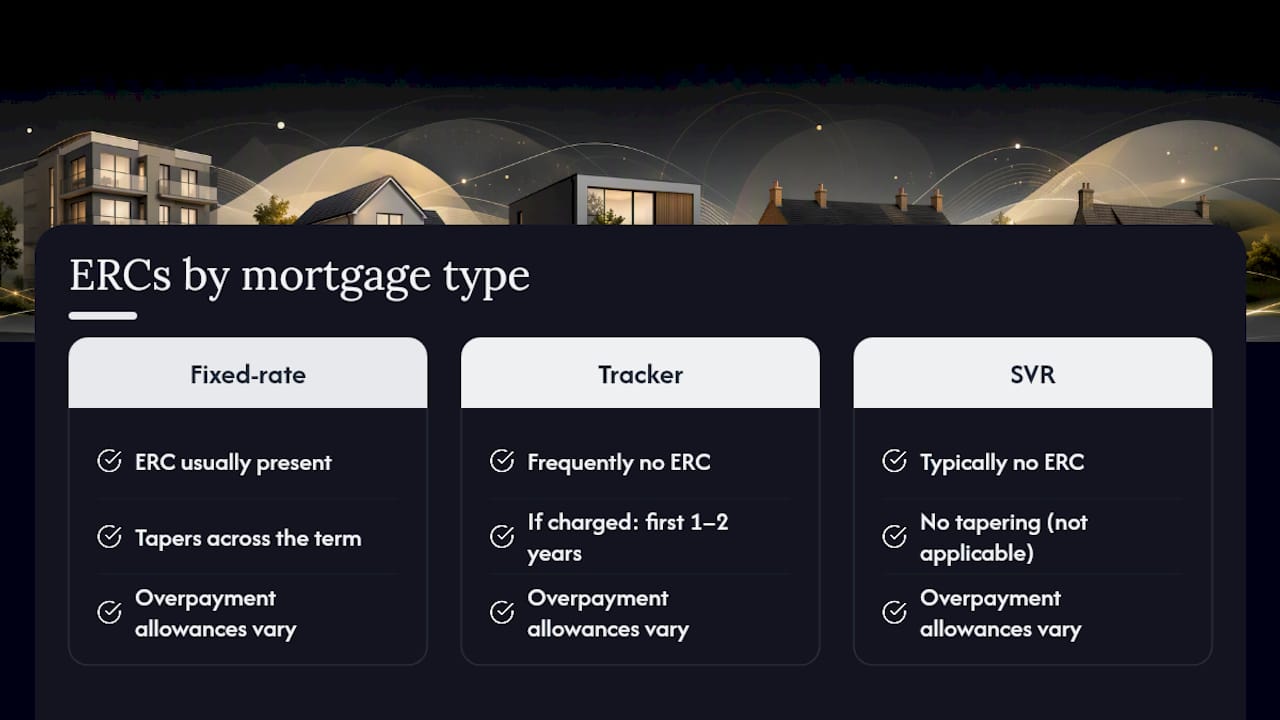
ERC structures vary more than most borrowers expect. Fixed-rate deals almost always carry an ERC, usually tapering across the term. Tracker mortgages frequently drop the charge entirely, or apply it only for the first year or two, trading rate certainty for exit flexibility. Standard variable rate mortgages, where you land once your deal ends, typically have no ERC at all.
Lender behaviour on overpayment allowances also differs sharply.
Buy-to-let and commercial mortgages behave differently again. If you’re comparing two deals, don’t just look at the headline rate. Pull the ERC schedule for each and map it against how long you realistically expect to hold the mortgage. A slightly higher rate with no ERC can beat a cheaper rate locked behind a punishing exit charge, particularly if your plans might change within the next few years.
When specialist broker support is worth considering
Most straightforward remortgages don’t need bespoke broking. Where it earns its cost is high-value portfolios, development finance, or deals involving cross-jurisdictional security and layered covenant packages, where an ERC on one asset can derail refinancing across an entire structure. A capital-concierge broker models the portfolio, negotiates staged solutions, and sources lenders who’ll work around the timing rather than against it.
— James William Dawes
Optional: how James William & Co Capital can help
If your ERC situation involves a single residential remortgage, a broker probably isn’t necessary; the steps above will get you most of the way there. Where it gets genuinely complicated, multiple properties, staged refinancing, or an ERC threatening to derail a development drawdown, that’s where James William & Co Capital becomes worth a conversation.
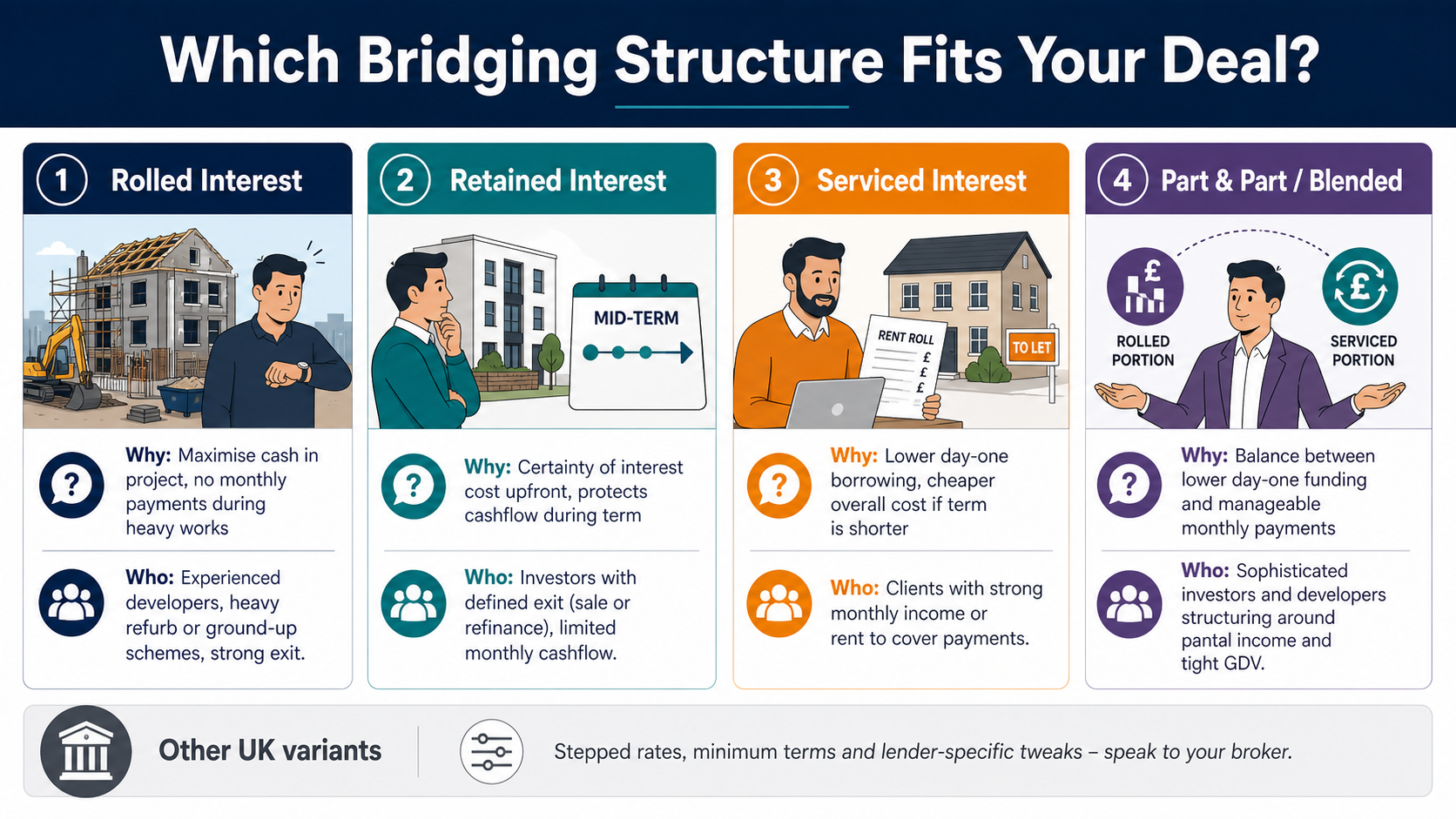
The firm acts as a debt structuring partner for property developers, investors, and high-net-worth clients, arranging bridging finance, development finance, and bespoke refinancing packages that can incorporate an ERC into a broader strategy rather than treating it as a standalone problem. A first conversation usually starts with a quick assessment of your existing debt stack and timing constraints, then moves to lender sourcing and negotiation if the numbers support it. For readers weighing broker advice generally, this comparison of broker and bank advice models is worth a read. If your position looks anything like that, visit the specialist property finance page and get in touch to discuss your options.
Sources
- FCA Handbook — MCOB 12.3 Early repayment charges: regulated mortgage contracts
- FOS decision DRN-4266930 — early repayment charge complaint (Barclays)
- How do early repayment charges work and how can I avoid them? — Unbiased
This article is general information, not a substitute for advice from a qualified financial advisor. Consult a qualified financial professional about your own circumstances before acting on anything here.
FAQ
What are the penalties for paying a mortgage early in the UK?
You’ll typically only face an ERC if you’re still within a fixed or discounted tie-in period; redeeming after that period, or on a standard variable rate, usually carries no penalty.
How can I avoid early repayment charges?
Time your remortgage or redemption to fall after the tie-in ends, port your existing mortgage when moving house, and stay within your lender’s annual overpayment allowance.
Why do banks have early repayment charges?
Lenders use ERCs to recover the costs of funding your fixed or discounted rate, and MCOB rules require the charge to reflect a reasonable pre-estimate of those costs rather than an arbitrary penalty.
Recommended
Related Topics
Speak to a specialist
Discuss your finance with James directly
Whole-of-market specialist finance — bridging, development, commercial and residential. No call centres, no obligation. James reviews every enquiry personally.
New to specialist finance? How unbiased broker advice works · Deals we have completed
Explore Related Finance