
Published · Updated
interest cover ratioAvoid Covenant Breaches: Interest Cover Ratio 1.5–2.5 for UK Loans
By James Dawes, CeMAP, Founder, James William & Co Capital
Interest cover ratio (ICR) is EBIT, or another chosen earnings measure, divided by interest payable. It shows how many times a company’s earnings cover its interest costs. Below 1.0 means a business cannot pay interest from earnings alone. Most lenders want to see 1.5 to 2.5 or higher, though the right threshold shifts with sector, loan type and covenant drafting.
TL;DR:
- Most UK lenders expect an interest cover ratio of at least 1.5 to 2.5; ratios below 1.0 indicate inability to cover interest from earnings.
- Using EBITDA or cash interest figures can inflate ratios, especially in capital-intensive sectors, so exactly which earnings measure the facility specifies is crucial.
- Interest receivable should only be added to earnings if it is a stable, long-term cash source, not just netted against interest payable, according to HMRC guidance.
- Covenant drafting must specify testing periods, interest definitions, and add-back treatments to avoid breaches caused by definitional ambiguities.
- Loan agreements for property financing often interpret interest cover and debt service coverage ratios differently, with DSCR generally being the tougher test.
Table of Contents
- What the interest cover ratio measures and who uses it
- Formula and variants: EBIT, EBITDA and cash interest cover
- How to calculate interest cover ratio: a worked example
- What counts as a good interest cover ratio?
- HMRC guidance and covenant mechanics: what UK lenders actually test
- Interest cover ratio vs debt service coverage ratio in property finance
- Where interest cover ratio calculations go wrong
- How James William & Co Capital approaches covenant negotiation
- Get help structuring finance around your interest cover position
- Sources
- FAQ
What the interest cover ratio measures and who uses it
Interest cover ratio, sometimes shortened to ICR or “interest cover”, measures a borrower’s ability to meet interest payments from operating earnings. It says nothing about whether the business can also repay the principal. That is where the debt service coverage ratio comes in as a separate, stricter test.
The numerator is usually earnings before interest and tax (EBIT), a proxy for the cash a business generates from trading before financing costs bite. The denominator is interest payable on borrowings for the same period, drawn from the profit and loss account or, for cash-based tests, from actual cash interest paid.
Several groups rely on this figure for very different reasons:
- Lenders and credit committees use it to set and monitor loan covenants.
- Credit analysts track it as an early warning signal of deteriorating financial leverage.
- Investors use trend data to judge whether a company is over-borrowed relative to its earnings.
- Covenant administrators test it at defined intervals against the facility agreement’s own definitions.
Formula and variants: EBIT, EBITDA and cash interest cover
The standard formula is straightforward: EBIT ÷ interest payable. Complications arrive the moment you ask which “earnings” figure to use and whether interest should be looked at gross or net.
EBIT includes depreciation and amortisation as costs, which makes it a conservative choice for asset-heavy businesses. EBITDA strips those non-cash charges out, giving a bigger numerator and a flattering ratio, useful for capital-intensive sectors like real estate or infrastructure where depreciation distorts underlying cash generation. Cash interest cover goes a step further, using actual cash interest paid rather than the accrued interest charge, which matters when a facility includes payment-in-kind (PIK) interest or capitalised interest that never leaves the bank account in that period.
- EBIT ÷ interest payable — the default for most commercial lending and covenant packages.
- EBITDA ÷ interest payable — common in leveraged and real estate deals with heavy depreciation.
- Cash interest cover — used when PIK notes, deferred interest, or capitalised interest during a build phase would otherwise flatter the ratio.
Pro Tip: Always check which variant a facility agreement actually specifies before you calculate anything. A borrower quoting an EBITDA-based ratio against a lender’s EBIT-based covenant will produce two different answers from the same accounts, and only one of them is the one that matters legally.
How to calculate interest cover ratio: a worked example
Calculating interest cover ratio properly means working through it in order rather than plugging numbers into a formula blind.
- Select the period and earnings measure. Use the trading period specified in the facility agreement, typically the last twelve months, and confirm whether EBIT or EBITDA applies.
- Identify interest payable. Pull this from the loan schedule or the interest charge line in the accounts, not from cash flow statements alone.
- Calculate the raw ratio. Divide earnings by interest payable.
- Check for interest receivable. Decide whether it can be added to operating profit under the facility’s own rules.
Take a company with adjusted operating profit of £36.2m and interest payable of £7.6m. That gives an interest cover ratio of 4.8, comfortably above most covenant thresholds. HMRC’s own worked example uses these exact figures to show how permitted add-backs to operating profit change the outcome.
Now suppose the company also earns £2m in interest receivable from short-term deposits. Netting that against the £7.6m interest payable would push the effective interest cost down to £5.6m, inflating the ratio to 6.5, a materially different result from adding the £2m to earnings instead, which produces a smaller but still meaningful lift. HMRC’s guidance is explicit that these two treatments are not interchangeable, and choosing the wrong one can overstate coverage by a significant margin depending on the size of the receivable relative to the interest charge.
What counts as a good interest cover ratio?
There is no universal “good” number, but lending practice has settled on rough bands that most credit teams recognise.
- Below 1.0 signals the business cannot service interest from earnings and needs immediate attention.
- Around 1.5 to 2.5 is a common minimum covenant threshold for mid-market commercial lending.
- Above 3.0 to 4.0 is typically viewed as comfortable headroom, though sector context still matters.
An interest-only bridging loan behaves differently to an amortising term loan when it comes to interpreting the same ratio, because interest-only structures carry no principal repayment pressure during the term, so a lender may tolerate a lower ratio short-term while still expecting a clear exit. Cyclical businesses, such as construction or hospitality, often see ICR swing wildly between good and bad years, which is why lenders look at trend data across several periods rather than a single snapshot. In commercial property lending, a healthy interest cover ratio commonly sits above 2.0 to 2.5 depending on asset class, and lenders use it as a quick litmus test at renewal before digging into anything else. Covenant thresholds are typically set with a cushion above the base case forecast, alongside cure rights that let a borrower inject equity or restructure debt within an agreed window if a test is breached.
HMRC guidance and covenant mechanics: what UK lenders actually test
HMRC’s internal manual is unambiguous on one point that trips up a lot of borrowers: interest receivable should not be automatically netted against interest payable when calculating interest cover for thin capitalisation purposes. Interest receivable may only be added to operating profit when it represents a stable, long-term cash source that a lender could genuinely rely on, not a one-off deposit return or a volatile intercompany balance.
Where a company disputes an assessment based on a straightforward interest cover test, the practical question is always whether the interest receivable in question is dependable enough for a third-party lender to have counted on it when the facility was priced. If it isn’t, HMRC’s position is that it stays out of the calculation.
Covenant drafting in UK loan agreements reflects the same caution. Facility agreements define, often in painstaking detail, what counts as “interest payable”, what testing period applies (usually quarterly or semi-annually on a trailing twelve-month basis), and what cure rights exist if a test is missed.
- Testing periods are almost always defined in the facility agreement, never assumed from standard accounting practice.
- Interest disallowed under thin capitalisation rules can restore a breached covenant by reducing the interest charge used in the test.
- Covenant definitions vary by contract, so the same trading performance can produce different ICR outcomes under two different facility agreements.
Interest cover ratio vs debt service coverage ratio in property finance
Interest cover and debt service coverage ratio (DSCR) answer related but different questions in commercial real estate lending. ICR asks whether income covers interest alone; DSCR asks whether it covers interest plus scheduled principal repayments, which is the tougher test on an amortising loan.
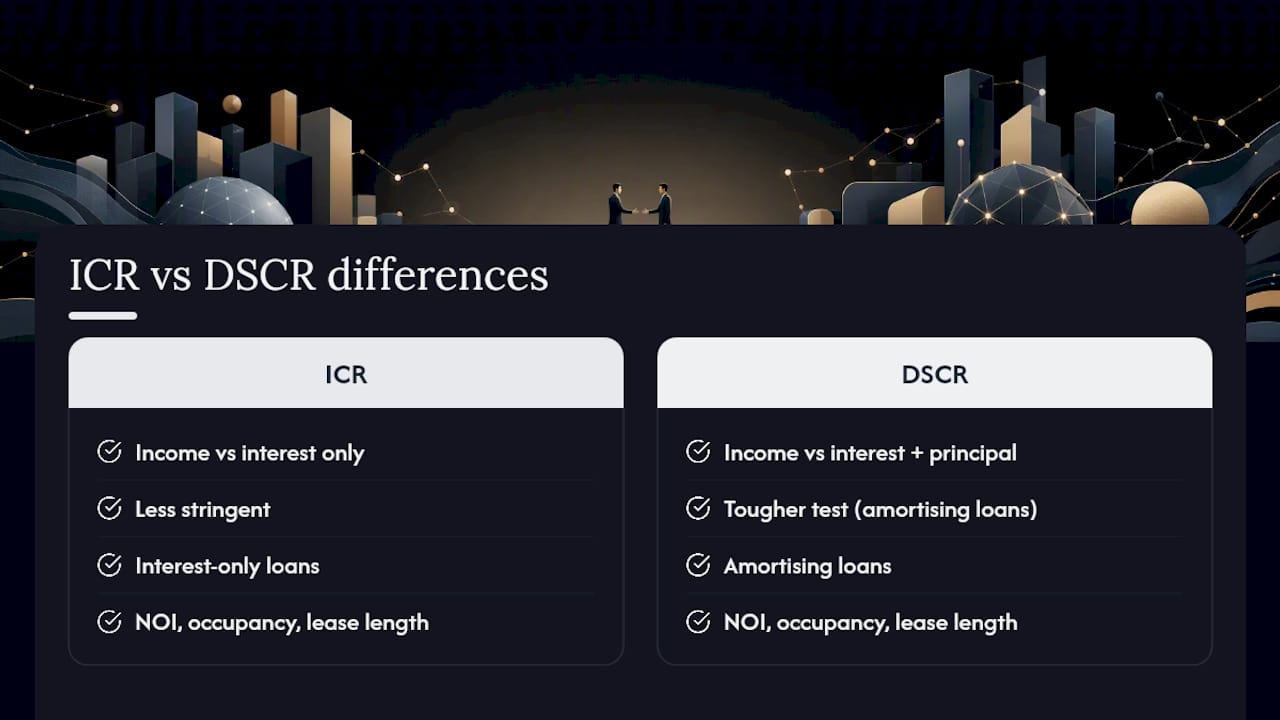
Net operating income (NOI), occupancy levels and lease length all feed directly into both ratios, since a half-empty building or a lease expiring mid-term weakens the earnings side of the equation regardless of which formula is used. Borrowers preparing for a refinance or renewal generally have three real levers: improve NOI through rent reviews or cost control, renegotiate lease terms to extend income certainty, or restructure the debt itself to lower the interest burden.
Where interest cover ratio calculations go wrong
Accounting adjustments rarely match cash reality, and a business can show strong EBIT while struggling to actually pay interest on time because of timing mismatches in receivables or seasonal cash flow. A single snapshot also hides interest-rate sensitivity: a ratio that looks fine at a fixed 4% margin can deteriorate quickly if the facility reprices upward.

Pro Tip: Before relying on any published ICR figure, check three things: which earnings measure was used, whether the testing period matches the facility agreement, and whether any interest receivable was added back or netted. Get any one of those wrong and the ratio tells you very little.
How James William & Co Capital approaches covenant negotiation
Getting the earnings definition and testing period right at the term sheet stage avoids disputes later. When we structure facilities involving layered debt, such as the £600k revolving credit facility secured against a £5m property portfolio, negotiating precise covenant language upfront, including what counts as interest receivable and which cure rights apply, saves clients from breaches triggered by definitional ambiguity rather than genuine underperformance.
— James William Dawes
Get help structuring finance around your interest cover position
Some brokers provide access to specialist lenders and private credit funds beyond mainstream banks, which can be important when a facility’s interest cover definition affects a renewal.

Modelling your own ICR internally works fine for a quick health check, but the moment you’re negotiating covenant definitions, testing periods, or add-back treatment with a lender, having a broker who structures these deals daily changes the outcome. We work across bridging finance, development finance, joint venture equity and mezzanine debt, and commercial mortgages, often involving multi-layered debt stacks where getting the interest cover definition wrong at the outset causes real problems at the first test date. If your renewal or refinance is approaching and you want the covenant package negotiated properly rather than accepted as drafted, consider contacting a specialist broker to discuss your position before you sign anything.
Sources
For the underlying rules referenced throughout this piece, HMRC’s thin capitalisation practical guidance sets out covenant mechanics in full, while LexisNexis’s glossary entry covers how UK and Irish loan agreements typically define the term. Property investors modelling net operating income sensitivity may also find Prop-Pocket’s void cost calculator useful.
This article is general information, not a substitute for advice from a qualified financial advisor. Consult a qualified financial professional about your own circumstances before acting on anything here.
- Gov
- Interest cover meaning in UK Law - Glossary - LexisNexis UK
- Why interest coverage ratios are key in commercial mortgage renewals - Mortgage Broker PRO
FAQ
What is a good interest cover ratio?
Most UK lenders want to see a minimum of 1.5 to 2.5, though commercial property lending often expects above 2.0 to 2.5 depending on asset class. Anything below 1.0 signals the business cannot cover interest from earnings alone.
What is the difference between ICR and DSCR?
Interest cover ratio measures whether earnings cover interest payments only, while debt service coverage ratio measures whether earnings cover interest plus scheduled principal repayments. DSCR is the stricter test and matters most on amortising loans.
Can interest receivable be netted against interest payable for ICR?
Not automatically. HMRC guidance states interest receivable may only be added to operating profit, not netted against interest payable, and only when it’s a stable, long-term cash source a lender could rely on.
How does James William & Co Capital help with interest cover issues?
James William & Co Capital structures facilities and negotiates covenant definitions, testing periods and add-back treatment directly with lenders on the client’s behalf. Current terms and pricing for services like development finance are available on request through the firm’s site.
Why does EBITDA give a different interest cover ratio to EBIT?
EBITDA excludes depreciation and amortisation, which inflates the earnings figure compared with EBIT for asset-heavy businesses. That produces a higher, sometimes more flattering, interest cover ratio, which is why lenders specify which measure applies in the facility agreement.
Recommended
Related Topics
Speak to a specialist
Discuss your finance with James directly
Whole-of-market specialist finance — bridging, development, commercial and residential. No call centres, no obligation. James reviews every enquiry personally.
New to specialist finance? How unbiased broker advice works · Deals we have completed
Explore Related Finance