
Published · Updated
heavy refurbishment financeHeavy refurbishment finance: the funding route for major works
By James Dawes, CeMAP, Founder, James William & Co Capital

If your project involves structural change, a change of use, or leaves a property uninhabitable during the works, heavy refurbishment finance is almost certainly the product you need, not a standard bridging loan. It funds the purchase and the build cost in stages, released as an independent monitoring surveyor confirms work has actually happened on site. Typically, day-one loan-to-value (LTV) is within a moderate range and works themselves may be funded fully in many cases, with interest generally charged monthly and rolled up rather than paid from your own cash flow.
The mechanics matter more than the label. Every tranche after the first depends on evidence: photographs, surveyor sign-off, invoices matched to a cost plan. Miss that evidence and your drawdown stalls, regardless of how far along the contractor says they are.
If you’re at the stage of scoping a project like this, the immediate task is simple:
- Build a detailed cost plan broken into stages, not a single lump sum figure.
- Get a realistic contractor programme with milestones a surveyor can actually verify.
- Speak to a broker who arranges this product regularly, before you exchange, not after.
Key Takeaways
| Point | Details |
|---|---|
| Product boundary | Structural change, conversions or uninhabitability push a project from light refurb into heavy refurbishment finance. |
| Staged drawdown mechanic | Funds release in arrears after a monitoring surveyor confirms each stage of works is complete. |
| Realistic pricing | Monthly rates commonly run 0.5% to 0.95%, with works funded up to 100% and day-one LTV near 65% to 75%. |
| Documentation wins approval | A staged cost plan, contractor evidence and a named exit route speed up underwriting significantly. |
| Specialist broker access | James William & Co Capital structures multi-lender debt stacks for heavy refurbishment projects through its specialist lender network. |
Table of Contents
- What is heavy refurbishment finance and how does it differ from light refurb and bridging?
- How do staged drawdowns and monitoring surveyors work?
- Rates, fees and borrowing limits in the UK market
- Who qualifies for heavy refurbishment finance?
- How to choose the right funding structure and plan your exit
- What’s the realistic timeline from enquiry to completion?
- James William & Co Capital: how we approach heavy refurbishment finance
- Get specialist funding for your next heavy refurbishment
- Sources
- FAQ
What is heavy refurbishment finance and how does it differ from light refurb and bridging?
Heavy refurbishment finance is short-term lending for projects that go beyond decoration and light repair, covering structural alterations, extensions, conversions, or works that require building regulations sign-off and leave the property unmortgageable or uninhabitable in its current state. It sits between a standard bridging loan and full ground-up development finance on the risk spectrum, and lenders treat it as a distinct product with its own underwriting rules.
Light refurbishment covers cosmetic work: new kitchens, bathrooms, flooring, rewiring that doesn’t touch structure. Lenders typically fund this through a standard bridge, releasing the full loan in one advance because there’s little that can go materially wrong that a surveyor needs to check along the way. Heavy refurbishment removes that certainty. You might be underpinning foundations, removing load-bearing walls, converting a house into flats, or adding a storey. The lender’s exposure changes shape entirely, and so does the way they release money.
Five signals typically push a project into heavy refurbishment territory:
- Structural work is involved, such as removing walls, underpinning, or altering the roof structure.
- Change of use applies, for example converting a commercial unit to residential or splitting a single dwelling into multiple units.
- The property is uninhabitable during works, meaning no rental income or occupation is possible.
- Building regulations approval is required for the scope of works, not just planning permission.
- Total works cost exceeds a notable proportion of the property’s current value, a threshold several lenders use informally to distinguish “light” from “heavy” applications.
If two or more of these apply, you’re in heavy refurbishment finance territory, and a standard bridging quote probably won’t reflect what you actually need.
How do staged drawdowns and monitoring surveyors work?
The defining feature of this product is that funds arrive in arrears, tranche by tranche, only after an independent monitoring surveyor confirms the previous stage of work is complete. That single mechanic is what separates heavy refurbishment finance from standard bridging, where the whole loan typically lands in one advance on day one.
The day-one advance covers the purchase (or refinance) and sometimes an initial works allowance. Everything after that follows a cycle: contractor completes a stage, you submit evidence, the surveyor inspects, the lender releases the next tranche. Miss a step and the money doesn’t move.
Lenders generally want to see:
- A cost plan broken into the same stages the surveyor will inspect, not a single total figure.
- Contractor information, including experience and, on larger jobs, a JCT or similar building contract.
- Invoices or valuations matched against the cost plan at each drawdown request.
- A build programme with realistic milestone dates the surveyor can check against.
Pro Tip: Ask your lender for the surveyor’s exact inspection checklist before works start. Aligning your contractor’s stage-completion photos to that checklist, rather than to your own idea of “finished”, cuts drawdown delays significantly.
Rates, fees and borrowing limits in the UK market
Monthly rates for heavy refurbishment finance typically run higher than for a light cosmetic bridge, reflecting the extra underwriting and monitoring costs. Market pricing on refurbishment bridging commonly sits in a range of roughly 0.5% to 0.95% per month, with the better end of that band reserved for lower LTV deals and more experienced borrowers.
Product literature from lenders such as HTB shows works funded up to 100% of cost, with day-one LTV capped at around 65% to 75% net and an overall loan-to-gross-development-value (LTGDV) ceiling applied across the whole facility, as set out in HTB’s heavy refurbishment product terms.
Typical costs and structure include:
- Arrangement fee: commonly a small percentage of the gross loan, charged at completion.
- Monitoring surveyor / asset manager fee: usually charged per inspection or as a fixed retainer across the project, often a few hundred pounds per visit.
- Exit fee: some lenders charge a fee, others none; terms vary and should be checked individually.
- Loan size: specialist lenders typically offer loans starting at moderate sums, with upper limits depending on lender policy, with works caps set proportionally.
- Term: terms generally range within several months to a couple of years, matching build programmes plus exit windows.
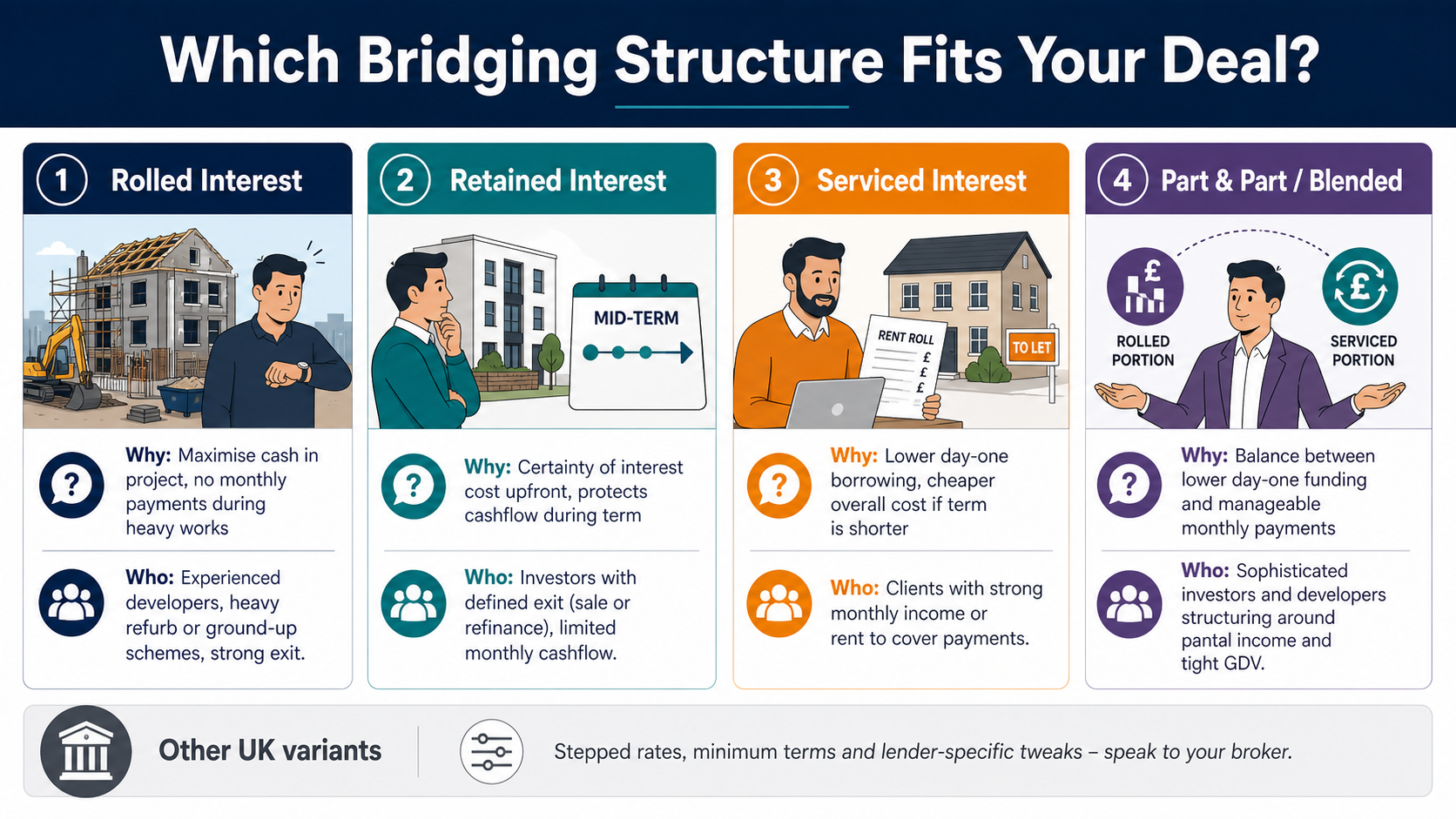
Interest is almost always rolled up rather than serviced monthly, meaning it compounds onto the loan balance and is repaid at exit. On a £500,000 facility at 0.75% per month over 12 months, rolled interest alone adds roughly £45,000 to £47,000 to the redemption figure, before fees. That’s why an accurate exit plan matters as much as the build itself.
Who qualifies for heavy refurbishment finance?
Lenders in this space underwrite the borrower almost as closely as the project. Most want to see relevant experience: previous projects of similar or comparable scale, ideally with evidence you delivered on time and on budget. First-time developers aren’t automatically excluded, but expect a lower LTV, a requirement to bring in an experienced project manager, or both.

Security structures matter too. Many borrowers hold the asset in a special purpose vehicle (SPV), and lenders will usually want personal guarantees from the directors regardless of the corporate wrapper. Underwriters commonly check the SPV against Companies House records to confirm registration and filing history before proceeding.
Documentation lenders typically request includes:
- A detailed cost plan and build programme, staged to match drawdown milestones.
- Contractor CVs or company accreditation, plus a signed building contract for larger schemes.
- Planning permission and building regulations approval (or evidence of imminent approval).
- A credible exit strategy, backed by comparable sales evidence or a named refinance lender.
Expect standard credit and identity checks alongside these, and if you’re working through an intermediary, confirming FCA registration is a reasonable due diligence step before you hand over sensitive financial information.
How to choose the right funding structure and plan your exit
Matching the product to the project avoids two common mistakes: overpaying for development finance you didn’t need, or getting refused on a bridging application because the works were too heavy for that product.
Run through this checklist before applying:
- If the works are purely cosmetic, a standard bridge with a single advance is usually cheaper and faster than a staged facility.
- If structural work or change of use is involved, go straight to heavy refurbishment finance rather than wasting time on a bridging application that will likely get declined at valuation.
- If you’re building from a slab or demolishing entirely, you’re in ground-up development finance territory, a different product with its own drawdown schedule.
- If the works cost exceeds roughly 50% of the end value, lenders will often push you towards development finance regardless of what you call the project.
- If your exit depends on refinancing rather than selling, get an agreement in principle from the refinance lender before drawdown, not after completion.
Lenders want evidence your exit is real, not aspirational. That means comparable sales for a disposal exit, or a named lender and indicative terms for a refinance exit. Applications backed by a documented exit plan tend to move through underwriting faster than those relying on a vague “we’ll sell it” statement.
If your project sits on the boundary, transitional facilities exist that blend bridging pricing with staged release, worth discussing with a broker rather than assuming a straight choice between two products.
What’s the realistic timeline from enquiry to completion?
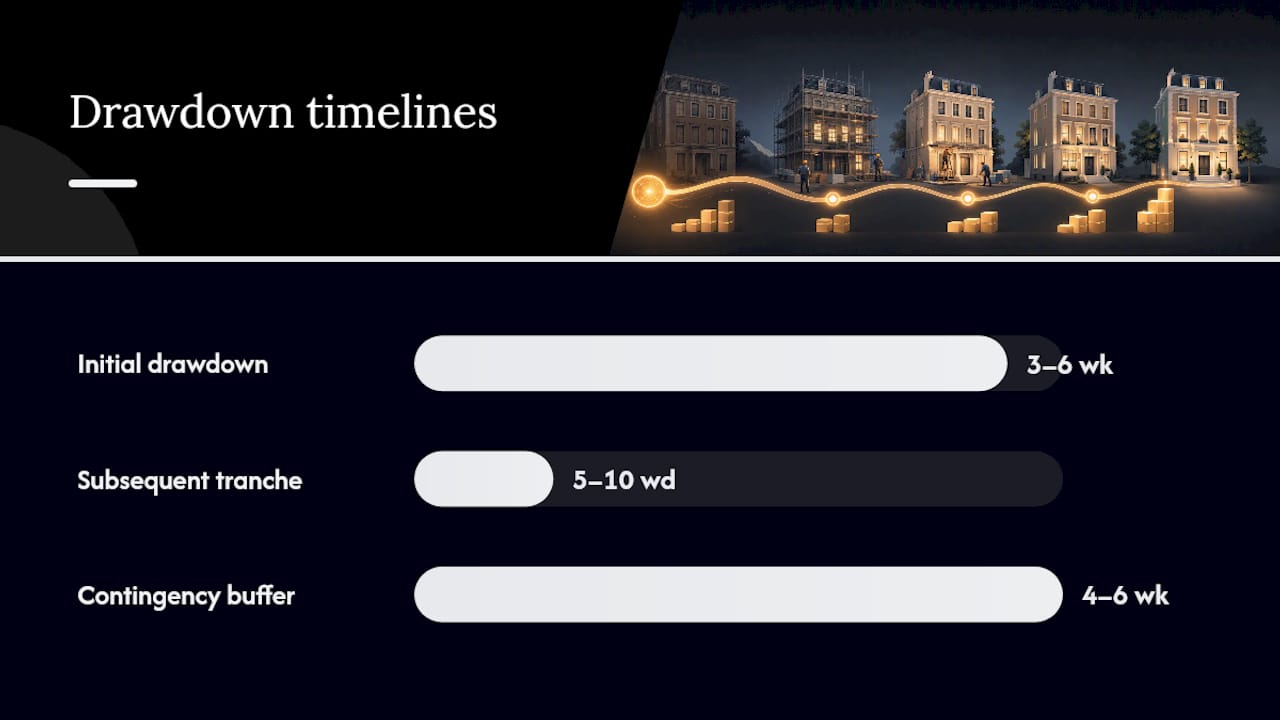
From first enquiry to day-one drawdown typically takes three to six weeks, depending on how complete your cost plan and legal pack are when you apply. Subsequent tranches, once works begin, usually take five to ten working days from inspection request to funds landing, assuming the monitoring surveyor confirms the stage is complete.
- Build a two-week buffer into your programme before each planned drawdown date.
- Notify the surveyor before you expect to need an inspection, not the day work finishes.
- Keep photographic and invoice evidence current throughout, not batched at the end of a stage.
Misalignment between what a contractor claims is finished and what a surveyor actually verifies is one of the most common causes of delay on these facilities, often adding weeks rather than days.
Pro Tip: Price a four to six week contingency into both your build programme and your cost plan. Facilities that run over term attract extension fees, and a buffer built in from day one is far cheaper than negotiating an extension later.
James William & Co Capital: how we approach heavy refurbishment finance
Heavy refurbishment deals rarely fit a single lender’s box neatly, which is why access matters as much as advice. James William & Co Capital works across a network of specialist lenders, private credit funds and family offices, which shortens the time between a term sheet request and an actual offer on complex, staged-funding projects.
Our capital concierge approach means one point of contact structures the full debt stack, whether that’s a single heavy refurbishment facility or a layered arrangement involving mezzanine debt alongside senior lending. That structuring work matters most at the underwriting stage, where a well-prepared cost plan, contractor evidence and exit narrative directly reduce the friction a monitoring surveyor’s sign-off process can otherwise create.
Engaging a specialist earlier in the process, rather than after a lender has already queried your application, tends to be the difference between a smooth drawdown schedule and one that stalls at tranche two.
— James William Dawes
Get specialist funding for your next heavy refurbishment
James William & Co Capital is the alternative to shopping standard bridging lenders one by one for a project that needs staged, monitored funding. Instead of chasing multiple term sheets yourself and hoping one lender understands structural works, one point of contact structures the whole facility, including layered debt where a single lender’s LTV cap isn’t enough to cover your works budget.
That access to private credit funds, family offices and specialist lenders means you’re not limited to whichever high-street bridging desk happens to answer the phone first. Whether you need a straightforward heavy refurbishment facility or a stacked arrangement with mezzanine debt, our specialist property finance team can put together an indicative structure once you share your cost plan and target property. Get in touch with your project details and current cost plan, and we’ll set out realistic terms before you commit to a purchase.
This article is general information, not a substitute for advice from a qualified financial advisor. Consult a qualified financial professional about your own circumstances before acting on anything here.
Sources
- Light vs heavy refurbishment: bridging vs development finance | Squared Money
- Heavy refurbishment finance (HTB product flyer)
- FCA register entry (example)
- Companies House company record
FAQ
Can you get a larger mortgage for renovations in the UK?
Standard residential mortgages rarely stretch to cover heavy renovation costs, which is why professional borrowers use dedicated heavy refurbishment finance instead, funding works separately from the purchase price through staged drawdowns.
How much would a £200,000 bridging loan cost?
Costs depend heavily on rate, term and fees, but at a typical monthly rate band of 0.5% to 0.95% plus a small arrangement fee, a facility over 12 months could realistically add a substantial sum in rolled interest and fees combined, before any exit fee.
Can I get a loan to refurbish my house?
Yes, if the works are light and cosmetic a standard bridging loan usually suffices, but structural changes, conversions or uninhabitability during works point towards heavy refurbishment finance, which releases funds in stages as a monitoring surveyor verifies progress.
Recommended
Related Topics
Speak to a specialist
Discuss your finance with James directly
Whole-of-market specialist finance — bridging, development, commercial and residential. No call centres, no obligation. James reviews every enquiry personally.
New to specialist finance? How unbiased broker advice works · Deals we have completed
Explore Related Finance