
Published · Updated
loan arrangement feesLoan Arrangement Fees: The True Cost for UK Borrowers
By James Dawes, CeMAP, Founder, James William & Co Capital

A loan arrangement fee is the charge a lender levies for setting up a facility, typically running from 0.5% to 2.5% of the loan amount and, for commercial deals, most often landing at 1% to 2%. For companies, FRS 102 requires the fee to be netted off the loan and amortised at cost rather than expensed on day one. Sole traders and partnerships face a different rule again, with relief timing governed by S58/S59 ITTOIA rather than an amortisation schedule.
TL;DR:
- Arrangement fees for commercial loans typically range from 0.5% to 2%, with larger, riskier deals often attracting higher fees within this bracket.
- Under FRS 102, the fee is amortized over the loan’s life by deducting it from the initial loan amount and applying the effective interest rate, not expensed immediately.
- Lenders generally treat the fee as non-refundable once a formal offer is made, so borrowers should verify refund conditions before signing agreements.
- Negotiating the fee separately from valuation and legal costs can reveal potential savings, especially in complex or layered debt transactions.
- Engaging an experienced broker before finalizing terms can lead to fee reductions or lender contributions, particularly for development or multi-layered finance deals.
Table of Contents
- What are loan arrangement fees and what do they cover?
- Typical amounts and what moves the fee
- Accounting treatment under FRS 102: initial recognition and effective interest
- Tax treatment in the UK: companies vs sole traders and partnerships
- Worked example: how the fee changes the effective interest rate
- VAT, other lender charges and common pitfalls
- Practical checklist: negotiate, document and account for arrangement fees
- Publisher perspective: when specialist broker advice changes the fee outcome
- Get specialist help structuring your next facility
- Sources
- FAQ
What are loan arrangement fees and what do they cover?
Lenders use several names for the same thing: arrangement fee, facility fee, procuration fee, sometimes commitment fee, though that last term more properly refers to a separate charge for undrawn funds. Whatever the label, the fee compensates the lender for underwriting, documentation, and internal credit assessment work carried out before the facility completes.
What it typically covers:
- Underwriting and credit risk assessment of the borrower
- Preparation of facility letters and loan documentation
- The lender’s own internal legal review of the deal structure
What it usually excludes, and which arrive as separate line items:
- Independent valuation fees for the security property
- Your own solicitor’s fees for acting on the transaction
- Broker fees, where a broker has arranged the deal
- Early repayment charges, which are a distinct penalty rather than part of setup cost
Refundability varies by lender and deal stage. Many facilities treat the fee as payable and non-refundable once a formal offer is issued, even if the deal later falls through for reasons outside the lender’s control. Always check the facility letter’s refund wording before signing, not after.
Typical amounts and what moves the fee
Residential mortgage arrangement fees sit at the low end, often a flat few hundred pounds. Commercial and property finance deals behave differently: fees commonly range from 0.5% to 2%, with commercial mortgages and development finance frequently clustering at 1% to 2% of the facility.
Pro Tip: Ask for the fee, valuation cost and legal estimate as three separate line items before you compare lenders. Bundled “all-in” quotes often hide a higher effective margin than a broken-down one.
What actually drives the number:
- Loan size: larger facilities often attract a lower percentage, though not always a lower absolute figure
- Loan-to-value: higher leverage usually pushes the fee up, reflecting greater lender risk
- Security quality and covenant strength of the borrower
- Speed required: bridging finance completed in days typically costs more than a facility with a six-week runway
- Product complexity: mezzanine tranches or multi-layered debt stacks carry higher setup costs than a vanilla term loan
On many property transactions, the arrangement fee combined with valuation and legal costs adds 2% to 4% to total transaction cost. Some lenders will agree to capitalise the main fee into the loan to protect the borrower’s cashflow at completion rather than demanding it upfront.
Accounting treatment under FRS 102: initial recognition and effective interest
For any UK company, FRS 102 treats a basic bank loan as a financial instrument measured at amortised cost. That has one concrete consequence: the arrangement fee is not expensed the moment it is paid. It is deducted from the initial carrying value of the loan, then spread over the life of the facility using the effective interest method.
The mechanics run in three steps:
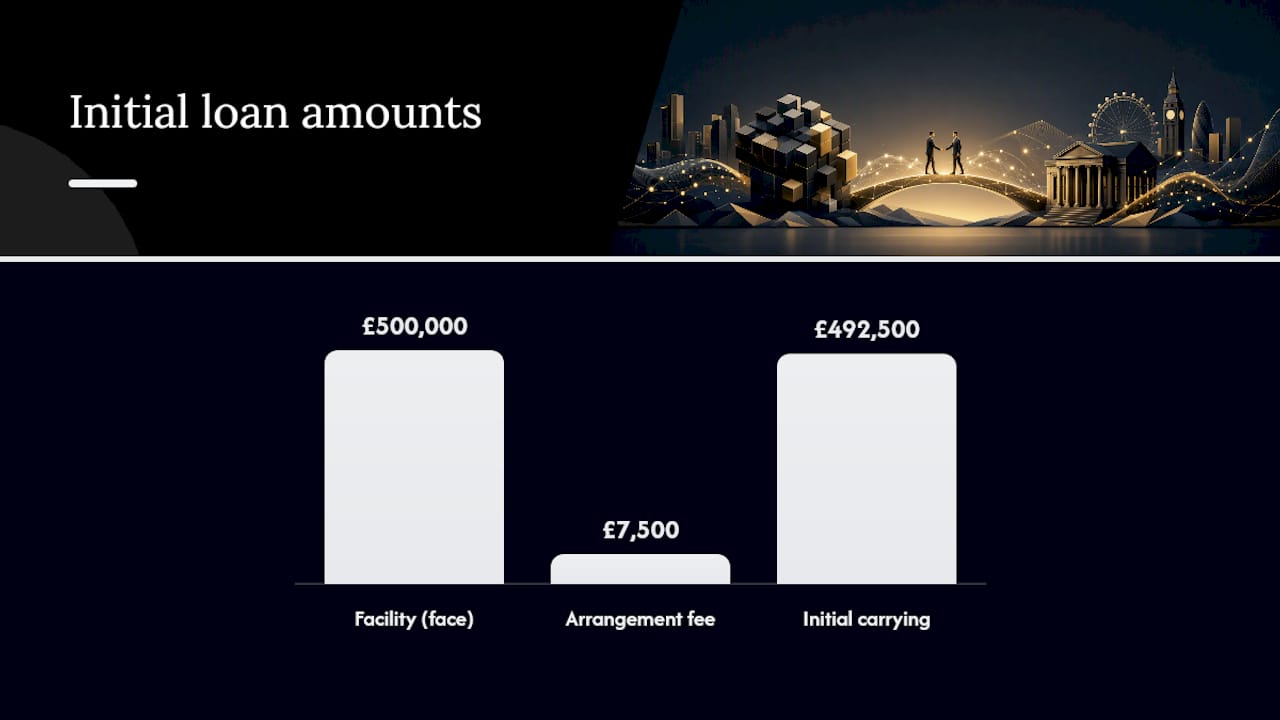
- Initial recognition. Record the loan net of the arrangement fee. A £500,000 facility with a £7,500 fee is initially recognised at £492,500, not £500,000.
- Effective interest rate calculation. Solve for the rate that discounts all future cash flows (interest payments plus final repayment) back to the net £492,500 proceeds. This effective rate will sit above the stated contractual rate because the fee reduces what the borrower actually received.
- Subsequent amortisation. Each period, the interest expense in the profit and loss account equals the carrying amount multiplied by the effective rate, not the cash interest paid. The difference between cash paid and the interest charge adjusts the loan’s carrying value, gradually unwinding the fee discount back to par by maturity.
Not all transaction costs qualify for this treatment. Broker and adviser commissions integral to generating the loan count as transaction costs; the company’s own internal administrative costs of arranging finance do not.
The most common practitioner error is expensing the whole fee to the profit and loss account in the year it is paid, treating it like a subscription cost rather than a financing cost. This overstates profit in the setup year and understates it in later years, and it misstates the loan balance on the balance sheet throughout. Commentators including Steve Collings have flagged this as one of the recurring errors in small company accounts, often only caught at audit or when a bank covenant test throws up an unexplained variance.
Tax treatment in the UK: companies vs sole traders and partnerships
Tax treatment splits sharply by borrower type, and getting this wrong is one of the more expensive mistakes an accountant can make on a client’s return.
- Companies. Tax generally follows the accounting treatment under the loan relationship rules, meaning HMRC expects the same amortisation schedule used in the statutory accounts to drive the tax deduction. You cannot usually accelerate the deduction into an earlier year just because cash left the business at completion.
- Sole traders and partnerships. Incidental costs of loan finance are deductible under S58/S59 ITTOIA where the underlying interest itself would be an allowable deduction, and relief here tends to follow the cash paid rather than a formal amortisation schedule.
- Property businesses. HMRC’s property income guidance confirms that arrangement fees on finance for letting non-residential property are generally deductible, provided the borrowing relates wholly and exclusively to the letting business. Mixed-use finance, where part of the borrowing serves a non-trade purpose, requires apportionment and is worth a specific conversation with a tax adviser rather than a blanket assumption.
The practical trap is applying a company-style amortisation adjustment to a sole trader return, or vice versa. Each regime has its own timing rules, and computational adjustments made on the wrong basis tend to surface only when HMRC queries the return.
Worked example: how the fee changes the effective interest rate
Take a £750,000 facility over five years at a contractual rate of 6%, with a 1.25% arrangement fee, which is £9,375.
- If the fee is added to the loan, the borrower draws £750,000 but the amount owed at outset becomes £759,375, and interest accrues on the higher balance from day one.
- If the fee is paid upfront and expensed for illustration, the borrower receives net proceeds of £740,625 while still owing £750,000 against the contractual schedule, which pushes the effective rate above the stated 6%.
| Treatment | Net proceeds | Contractual rate | Approx. effective rate | Total interest over 5 years |
|---|---|---|---|---|
| Fee capitalised (added to loan) | £750,000 | 6.0% | ~6.0% | Higher cash interest, spread evenly |
| Fee paid upfront (illustrative) | £740,625 | 6.0% | ~6.3% | Slightly lower cash interest, front-loaded cost |
The gap between 6.0% and roughly 6.3% looks small, but on a £750,000 facility it shifts the true borrowing cost by several thousand pounds across the term, and it changes how quickly interest expense hits the profit and loss account. For a business managing covenant headroom, capitalising the fee usually eases initial cashflow but nudges up gross leverage on day one. Paying it upfront preserves a lower principal balance for leverage tests but demands cash the business may not want to release at completion. Either way, refinancing before term-end means recalculating the unamortised fee balance, not just the outstanding principal.
VAT, other lender charges and common pitfalls
Arrangement fees for financial services are generally treated as outside the scope of VAT, but exceptions exist, particularly where a broker or intermediary charges separately for services that HMRC views as distinct from the exempt financial supply. Always check the invoice, not just the facility letter.
Other charges to expect on a term sheet:
- Non-utilisation (commitment) fees on undrawn facility amounts
- Independent valuation fees
- Broker fees, disclosed separately from lender charges
- Legal fees for the lender’s solicitor, often payable by the borrower regardless of outcome
- Exit or redemption charges on early repayment
Pro Tip: Watch for bundled fees that mix arrangement cost with broker commission into one figure. Inconsistent refund terms between the fee and the deposit are the biggest red flag in a rushed bridging term sheet.
Practical checklist: negotiate, document and account for arrangement fees
Before signing anything, work through these steps in order:
- Request an itemised fee breakdown separating arrangement, valuation, legal and broker costs.
- Ask whether the arrangement fee can be capitalised into the loan rather than paid on completion.
- Push for a lender contribution or partial waiver, particularly on larger facilities or repeat business, informed by understanding the broker advantages in commercial leasing deals.
- Confirm refund triggers in writing if the deal fails to complete for reasons outside your control.
- Once terms are agreed, confirm the measurement basis with your accountant and calculate the effective interest rate for the statutory accounts.
- Document the assumptions behind that calculation for your auditor or tax adviser before year-end, not after.
Pro Tip: Keep the amortisation schedule and effective rate workings in the same file as the signed facility letter. When an adviser or auditor asks for it eighteen months later, you want to hand it over, not rebuild it.
For anything involving layered debt stacks, offshore vehicles, or a facility that needs to complete in days rather than weeks, this is the point to bring in a specialist broker or tax adviser rather than negotiating alone.
Publisher perspective: when specialist broker advice changes the fee outcome
Most borrowers negotiate the interest rate and forget the fee is negotiable too. That is a mistake on anything beyond a simple term loan. On complex development finance, layered debt stacks, or urgent bridging where completion speed is the real constraint, an experienced broker’s leverage with lenders regularly secures a fee reduction or a lender contribution that an unrepresented borrower would never see offered. Specialist brokers structure exactly these deals, from bridging and development finance through to mezzanine and JV equity, and the negotiating room on fee terms tends to widen with deal complexity, not shrink. If your facility involves multiple funding layers, get a specialist involved before terms are agreed, not after.
— James William Dawes
Get specialist help structuring your next facility
Arrangement fees are only one line in a much bigger negotiation, and on complex property finance they are rarely the biggest lever available to you. Some specialist brokers work as debt structuring partners rather than single-lender brokers, meaning the goal on every deal is the best overall facility terms, not just the lowest headline fee, whether that means a bridging loan, ground-up development finance, or a multi-layered debt stack against a large acquisition.
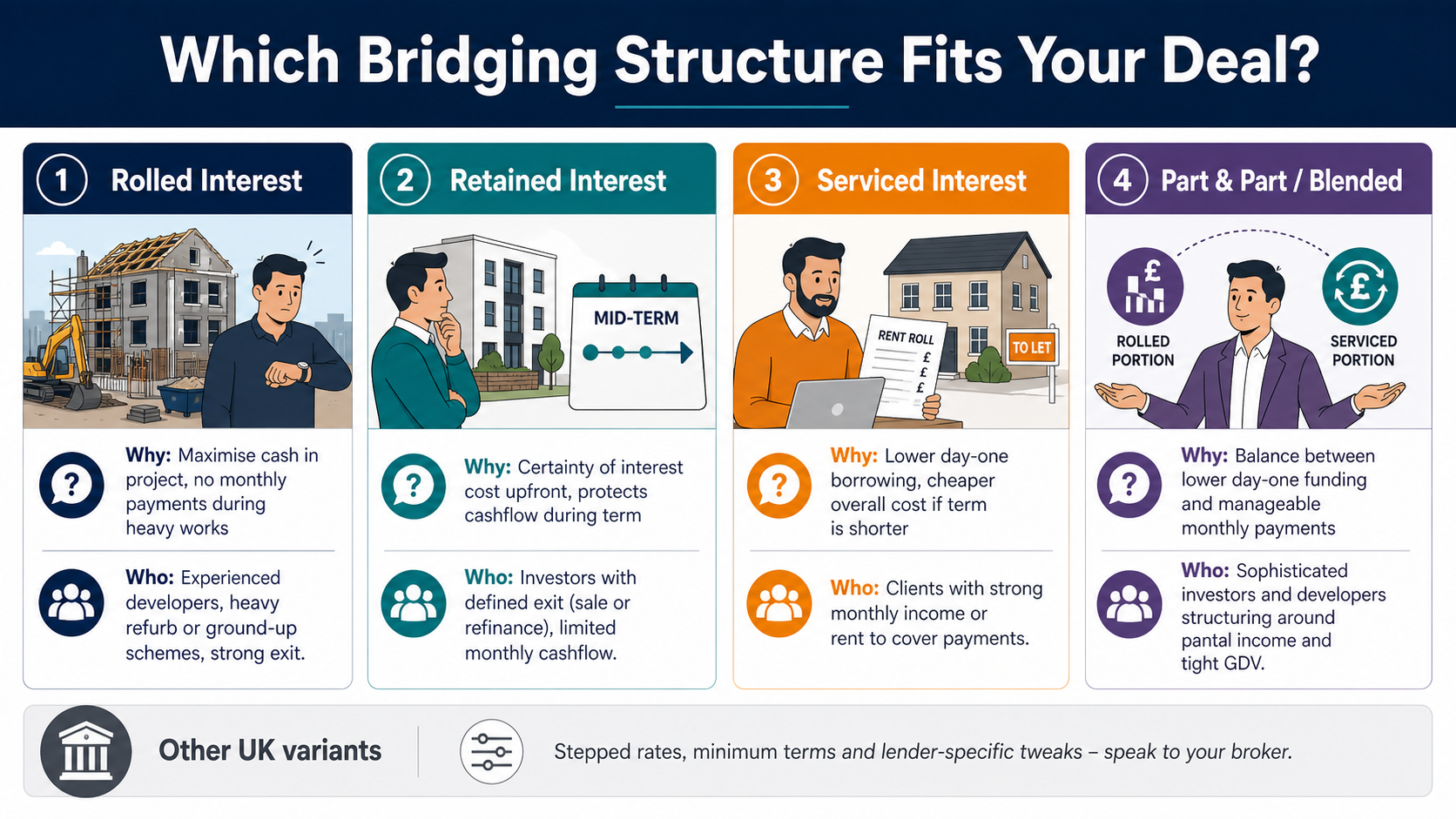
If you are structuring a facility above straightforward buy-to-let territory, get James William & Co Capital involved while terms are still open for negotiation, not after you have signed. Speak to the team about your next property finance transaction and find out what a properly negotiated fee structure could save you.
Sources
- BIM45801 - Specific deductions - incidental costs of loan finance: scope of the legislation - HMRC
- FAQ 11.73.1 – What types of costs can be classified as transaction costs for financial instruments? - PwC manual (Viewpoint)
- Commercial mortgage: documents, timeline and fees - FundBiz
FAQ
What are loan arrangement fees?
An arrangement fee is the charge a lender applies for setting up a facility, covering underwriting, documentation and credit assessment, typically running from 0.5% to 2.5% of the loan amount.
Is it normal to pay a fee for a loan?
Yes, arrangement fees are standard practice across UK commercial and property finance, though the amount and whether it is payable upfront or added to the loan varies by lender and deal type.
What is the average loan processing fee?
For commercial mortgages and development finance, fees commonly sit between 1% and 2% of the loan amount, with residential facilities often charging a lower flat fee instead.
What is an arrangement fee?
It is the charge a lender levies on signing the loan agreement, usually calculated as a percentage of the facility size, separate from valuation, legal and broker costs.
Recommended
Related Topics
Speak to a specialist
Discuss your finance with James directly
Whole-of-market specialist finance — bridging, development, commercial and residential. No call centres, no obligation. James reviews every enquiry personally.
New to specialist finance? How unbiased broker advice works · Deals we have completed
Explore Related Finance