
Published · Updated
negative pledge clause5 Negative Pledge Clause Drafting Rules for UK Property Finance
By James Dawes, CeMAP, Founder, James William & Co Capital

A negative pledge clause is a promise by a borrower not to create security over specified assets in favour of anyone else without the lender’s consent. Its job is to stop the lender’s ranking being undermined by a later charge that jumps the queue. Enforceability turns on how the clause is drafted, and courts now expect lenders to exercise any consent discretion in good faith rather than arbitrarily.
TL;DR:
- Courts now require lenders to exercise consent discretion in good faith, and arbitrary refusals can be challenged if not reasoned and consistent.
- Drafting errors, especially in quasi-security definitions like sale and leaseback or retention of title, can undermine a negative pledge’s effectiveness.
- Borrowers should prepare strong evidence and negotiate permitted security baskets early to prevent conflicts if they use security in full upfront.
- Negative pledge clauses are critical in layered property finance, where poorly scoped restrictions can block later security interests, emphasizing the need for staged waivers and clear scope.
- Proper process, documented reasons, and explicit drafting prevent disputes, while late actions or breaches significantly risk default, subordination, or costly litigation.
Table of Contents
- What is a negative pledge clause and the forms it takes?
- Why lenders use negative pledge clauses: commercial rationale
- Can a lender refuse consent under a negative pledge?
- Drafting considerations and common exceptions
- What should lenders and borrowers do when a negative pledge issue arises?
- Why negative pledge clauses matter more than most covenants in property finance
- Sources
- FAQ
What is a negative pledge clause and the forms it takes?
A negative pledge clause features in facility agreements, bond terms, and standalone deeds of negative pledge. In each case it does the same job: it stops the borrower granting security or “quasi-security” over its assets to a third party without the existing lender’s sign-off. Practical Law describes it as a contractual undertaking against creating encumbrances, and flags that the drafting details matter more than the concept itself.
The distinction between express security and quasi-security is where most disputes start. A mortgage or fixed charge is obvious. Arrangements that achieve a similar economic effect without looking like security on paper are not, and a poorly worded clause can miss them entirely.
Common quasi-security structures that catch out unwary drafters include:
- Sale and leaseback arrangements, where an asset is sold and leased back, effectively removing it from the unsecured creditor pool.
- Invoice factoring or discounting, which gives a third party priority claim over receivables.
- Retention of title clauses in supply contracts, which let a supplier reclaim goods ahead of other creditors.
Lenders sometimes prefer a standalone deed of negative pledge rather than a facility covenant, usually where the restriction needs to bind successors or third parties beyond the immediate loan relationship, or where it sits alongside separate security documents in a wider debt structure.
Why lenders use negative pledge clauses: commercial rationale
Lenders push for a negative pledge because unsecured lending only works if unsecured creditors stay roughly equal. That parity, often called pari passu ranking, collapses the moment a borrower grants a competing charge to someone else. The new security holder jumps ahead in an insolvency, and the original lender’s exposure suddenly looks worse than the day the facility was signed.
The clause also protects the underlying asset value backing a covenant package. If a borrower has pledged unencumbered property or business assets as informal comfort for a facility, a later charge over the same assets can gut that comfort without the lender ever finding out until it is too late. In syndicated lending this matters even more, since multiple lenders are relying on the same negotiated ranking, and the LexisNexis guidance points to LMA precedent language as the market’s usual reference point for keeping that ranking consistent across a syndicate.
Trade-offs still exist. A lender that refuses every consent request risks pushing a good borrower towards a competitor, or towards structures that route around the covenant altogether:
- Permitting limited baskets of security (for equipment finance, for example) keeps the borrower operationally flexible.
- Refusing anything that dilutes the lender’s real recovery position protects the deal’s economics.
Pro Tip: Before agreeing any permitted security basket, ask what happens if the borrower uses it in full on day one. A £2 million equipment finance carve-out sounds trivial until you realise it can absorb most of the unencumbered asset base in a smaller balance sheet.
Can a lender refuse consent under a negative pledge?
Yes, but not on a whim. The High Court has confirmed that lenders may refuse consent to a disposal or new security arrangement where doing so protects a legitimate commercial interest. That discretion is not unconditional. Macdonald Hotels Ltd & Anor v Bank of Scotland plc [2025] EWHC 32 (Comm) applied the Braganza line of authority, which implies a good-faith limitation into contractual discretion clauses even where the contract itself is silent on the point.
The court’s reasoning in Macdonald Hotels makes clear that a lender’s refusal must be rational and consistent with how it has approached similar requests before. Arbitrary or inconsistent decision-making, even where the contract nominally gives the lender an unfettered choice, risks being struck down.
Practically, this means courts will look at whether the lender’s decision was reasoned, whether it followed a consistent internal approach, and whether the refusal actually served a genuine commercial purpose rather than simply frustrating the borrower. This is a narrower version of judicial review, not a rewriting of the bargain.
Where a borrower breaches the clause anyway, the usual consequences follow:
- The breach typically triggers an event of default under the facility agreement, giving the lender enforcement rights.
- The lender may seek an injunction to prevent completion of the offending security or disposal.
- Third-party chargees can find their own security challenged or subordinated if it was taken with knowledge of the negative pledge.
Recent case law also flags that quasi-security taken in breach carries real subordination risk for the third party, not just the borrower.
Drafting considerations and common exceptions
A negative pledge that catches everything is unworkable, and one riddled with careless exceptions is worthless. Getting the balance right comes down to a handful of drafting disciplines.
- Build a narrow permitted security schedule. List specific, capped categories (purchase-money security, statutory liens, security existing at completion) rather than broad generic exceptions that swallow the covenant whole.
- Fix the scope deliberately. Decide whether the restriction binds the borrower alone or the wider group, since intercompany guarantees and cross-charges are a common route around a single-entity negative pledge.
- Name the quasi-security traps explicitly. Sale and leaseback, factoring, and retention of title should appear in the clause by name, not left to a general “security” definition that a court might read narrowly.
- Set out waiver mechanics up front. Specify who can grant consent, what evidence a waiver request needs, and how long the lender has to respond.
- Confirm registration steps. Where a deed of negative pledge or related security interest needs recording, the Companies House charge register entry should match the drafting, since a mismatch is often where third-party disputes originate.
Practical Law’s drafting notes recommend narrow permitted-security baskets and explicit quasi-security wording as the two changes that prevent most disputes before they start.
What should lenders and borrowers do when a negative pledge issue arises?
Most disputes trace back to poor process rather than bad law. A documented, consistent approach protects both sides.
For lenders:
- Adopt a written consent policy and apply it the same way to every request, since Kuits’ commentary points to inconsistency as the main vulnerability in a Braganza-style challenge.
- Record the specific commercial reason behind every refusal, not a generic template response.
- Handle any data shared when explaining a refusal carefully, particularly where third parties are involved.
For borrowers:
- Attach concrete evidence to any consent request: valuations, the proposed security’s ranking, and how it affects the lender’s existing position.
- Negotiate permitted baskets and waiver terms at the term sheet stage, not after the facility is signed.
Pro Tip: If a third party has already taken security in apparent breach, act fast. Retrospective consent, a negotiated waiver, or controlled enforcement are all cheaper than litigation, but only if you move before the third party’s position hardens.
Where a breach looks deliberate or the numbers are large, this is the point to bring in specialist finance counsel rather than handling it through general commercial advisers.
Why negative pledge clauses matter more than most covenants in property finance
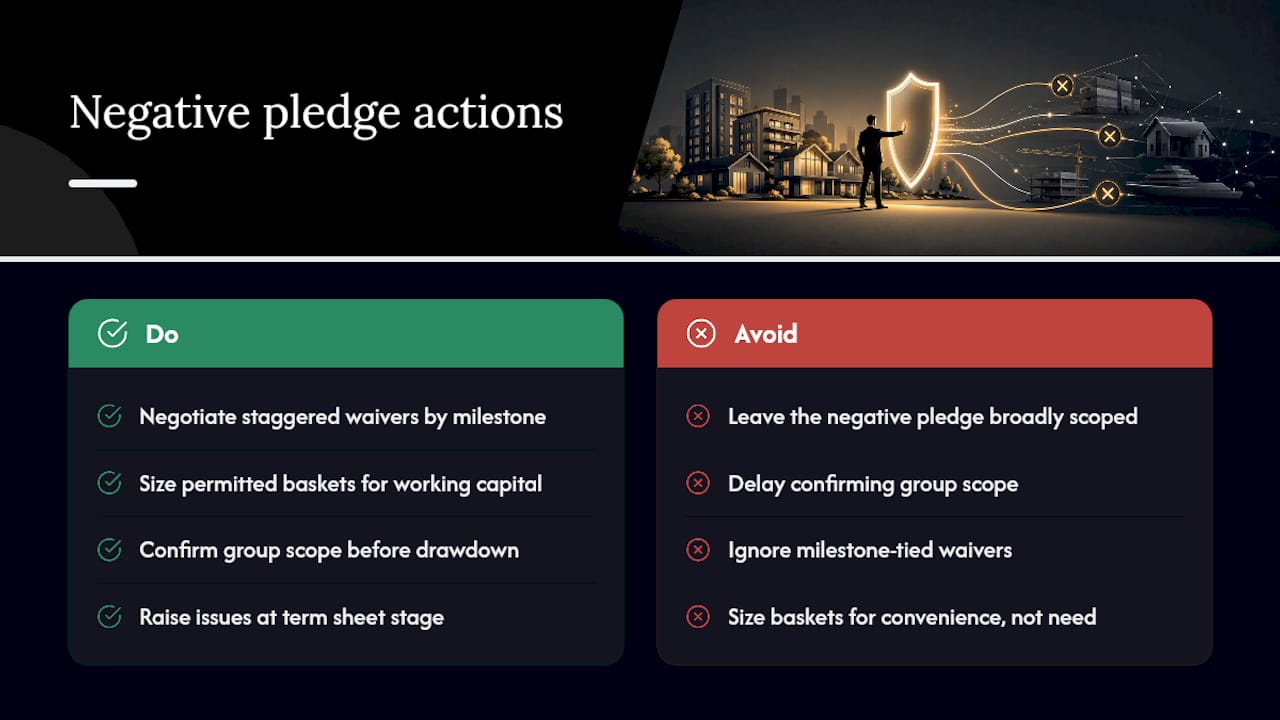
Working across multi-layered debt stacks, the negative pledge is usually the clause that decides whether a refinance is smooth or painful. In a development deal with senior debt, mezzanine, and JV equity all sitting in the same structure, a badly scoped negative pledge at senior level can block the mezzanine lender’s entire security package months later, long after the commercial terms were agreed.
The better approach is staged: negotiate staggered waivers tied to development milestones, agree permitted baskets sized to genuine working capital needs, and confirm group scope before drawdown, not after a dispute. That single conversation, at term sheet stage, saves more legal fees than any clause redraft after the fact.
— James William Dawes
Sources
For the underlying legal test, read the Macdonald Hotels judgment directly. Practical Law’s negative pledge note and LexisNexis’s guidance both offer drafting precedents and checklists worth keeping alongside any facility agreement review. Borrowers structuring a deal involving multiple funding sources should read these before term sheet stage, not after.
If you are negotiating a covenant package across a layered debt stack, James William & Co Capital structures bridging, development, and mezzanine finance around exactly these issues, and can advise on how a negative pledge interacts with the rest of your property finance arrangement before you sign anything.
This article is general information, not a substitute for advice from a qualified lawyer. Consult a qualified legal professional about your own circumstances before acting on anything here.
- Negative pledge | Practical Law - Thomson Reuters
- Negative pledge clauses: Legal guidance — LexisNexis UK
- Enforcing your negative pledge — Kuits Solicitors
FAQ
What Are Examples of Negative Covenants?
Common negative covenants include restrictions on granting security (the negative pledge itself), limits on further borrowing, restrictions on disposing of key assets, and caps on paying dividends above a set threshold.
What Is a Deed of Negative Pledge?
A deed of negative pledge is a standalone document, rather than a clause buried in a facility agreement, that formally restricts a borrower from creating security over specified assets. Lenders use a deed when the restriction needs to bind successors or sit alongside separate security arrangements.
What Is a Double Negative Pledge Clause?
A double negative pledge clause is a promise by a borrower not to grant security to any other creditor unless it grants equivalent security to the lender holding the double negative pledge at the same time. It is common in unsecured bond issuances where investors want protection without taking formal security themselves.
What Is a Negative Pledge on Companies House?
Negative pledge undertakings are not separately registrable in the same way as a charge, but where a related security interest or deed does need recording, the Companies House charge register entry should match the underlying negative pledge wording to avoid disputes with later creditors.
Related Topics
Speak to a specialist
Discuss your finance with James directly
Whole-of-market specialist finance — bridging, development, commercial and residential. No call centres, no obligation. James reviews every enquiry personally.
New to specialist finance? How unbiased broker advice works · Deals we have completed
Explore Related Finance