
Published · Updated
cross default clauseCross Default Clauses: What Property Borrowers Should Negotiate
By James Dawes, CeMAP, Founder, James William & Co Capital

A cross default clause makes a borrower’s default under one loan an automatic default under another, unconnected facility. The moment one lender calls a breach, every other lender holding this wording gains the right to accelerate too. Borrowers, their counsel, and credit committees all need to check this wording before signing, because it can turn a small administrative slip into a group-wide funding crisis.
TL;DR:
- Broadly worded cross default clauses can trigger group-wide defaults from minor breaches, such as late reports or administrative errors, without regard to materiality.
- The trigger can be set off immediately upon default, or only after the lender exercises acceleration, affecting borrower flexibility and timing of enforcement.
- Carve-outs are essential for on-demand facilities, trade payables, and intercompany loans to prevent unrelated or routine issues from causing cascading defaults.
- Requiring notice and cure periods, along with de minimis thresholds, can significantly reduce the risk of trivial breaches escalating to full defaults.
- Proper legal review and tailored drafting are critical for multi-layer debt structures, cross-border facilities, and customized triggers, to avoid systemic fragility and unintended penalties.
Table of Contents
- What is a cross default clause and how does it work?
- Cross default vs cross collateral agreement: which one applies?
- Common drafting variants and clause features to check
- What risks does a cross default clause create for borrowers and lenders?
- How to negotiate and redline cross default language
- Reviewing a facility agreement for cross default exposure
- Why cross default clauses exist in commercial lending
- Real-world situations where cross default clauses have bitten
- Do cross default clauses enforce the same way across jurisdictions?
- Drafting and commercial trade-offs in multi-layer debt stacks
- A lawyer’s checklist worth pinning to the wall
- Get help structuring covenant packages that don’t trap you later
- Sources
- FAQ
What is a cross default clause and how does it work?
A cross default clause is contractual language stating that a default (or, in narrower drafting, an event of default) under one debt instrument automatically constitutes a default under another. Investopedia’s plain-language explanation captures the basic mechanic well, but the commercial risk sits in the detail lawyers argue over.
That detail is whether the trigger fires on “default” or on “event of default”. A default is any breach, however minor or unintentional. An event of default is a breach that has survived any notice period and cure right written into the original facility. Practical Law’s guidance on this distinction makes clear that triggering on mere “default” strips away cure periods and notice rights the borrower may have negotiated elsewhere. Once triggered, the clause operationally links facilities that were never meant to be connected, so a covenant breach on a term loan can instantly touch a revolving facility, a mezzanine tranche, or a bond indenture with no shared lender in common.
Cross default vs cross collateral agreement: which one applies?
Lenders, borrowers, and even experienced counsel sometimes use “cross default,” “cross acceleration,” and “cross collateral agreement” interchangeably. They are not the same thing, and mixing them up in a term sheet causes real drafting problems.
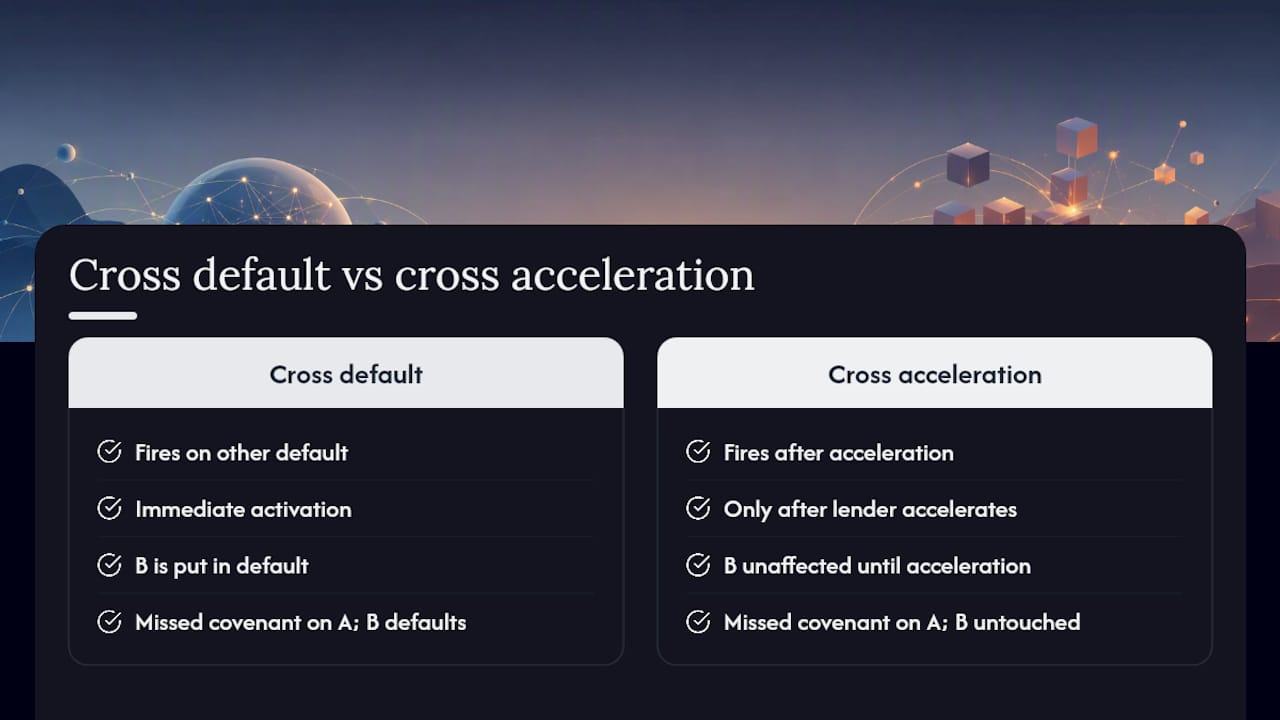
Cross default fires the moment a default (or event of default) occurs elsewhere. Cross acceleration is narrower: it only fires once the other lender has actually exercised its right to accelerate, meaning the debt has already been declared due and payable. A cross acceleration clause gives the borrower more breathing room because a technical breach that never escalates to acceleration never spreads.
Consider two scenarios. Under a cross default clause, a missed covenant test on Facility A immediately puts Facility B in default, even if Facility A’s lender has taken no action. Under cross acceleration, Facility B stays untouched until Facility A’s lender formally accelerates, which many lenders are reluctant to do quickly given the reputational and commercial fallout.
A cross collateral agreement is a different animal entirely. It links security rather than default triggers, meaning multiple loans are secured against the same pool of assets. A facility can carry cross collateralisation without any cross default language, and vice versa, though the two often appear together in property finance where a single portfolio secures several tranches of debt.
Common drafting variants and clause features to check
Cross default clauses vary enormously between term sheets, and small wording choices carry outsized consequences. Reviewing the drafting variants below before signing is standard practice for any credit team.
- Trigger wording: some clauses fire on “default”, others only on “event of default” after notice and cure periods have run.
- Monetary thresholds: a de minimis basket preventing trivial breaches from cascading.
- Materiality carve-outs: language limiting the trigger to breaches that are “material” in the context of the borrower’s overall financial position.
- Trade creditor exclusions: ordinary course trade payables are typically excluded from the definition of financial indebtedness.
- Intercompany loan exclusions: loans between group companies are commonly carved out, since these rarely reflect genuine credit risk.
- On-demand facility treatment: overdrafts and similar on-demand lines need explicit exclusion, discussed further below.
Precedent wording for most of these variants sits in standard clause libraries such as Law Insider’s cross default provisions, though every template still needs adapting to the specific facility structure and lender appetite involved.
What risks does a cross default clause create for borrowers and lenders?
The core risk is the domino effect: one breach, however contained, can trigger acceleration rights across a borrower’s entire debt stack, hitting group companies that had nothing to do with the original default. For a property developer running several facilities across special purpose vehicles, that can mean a single missed covenant test on one development loan pulls acceleration rights into an unrelated refinance.
Two risks catch borrowers out repeatedly:
- Technical or administrative breaches: a late compliance certificate or a missed reporting deadline can count as a “default” under broad wording, even where no genuine credit deterioration has occurred.
- Restructuring paralysis: some clauses are drafted broadly enough to capture the “commencement of negotiations” with another lender as a potential default in itself, which can chill a borrower’s ability to open informal restructuring talks before matters become critical.
Pro Tip: Ask specifically whether the cross default clause references “potential default” or “commencement of negotiations”. Both phrases are red flags that can penalise a borrower simply for seeking early advice.
On-demand facilities compound the problem: an overdraft that a bank withdraws for commercial reasons, unrelated to any breach, can still trip a poorly drafted cross default clause if it isn’t expressly excluded.
How to negotiate and redline cross default language
Negotiation on this clause tends to follow a predictable sequence, and knowing where lenders are likely to concede saves time on both sides of the table.
- Push the trigger to “event of default”. Requiring notice and an unremedied cure period before the clause fires is the single highest-value redline available, and it aligns with the approach Practical Law recommends for preserving cure rights.
- Insert a de minimis threshold. A monetary floor, often paired with a requirement that the breach remain unremedied for a set number of days, stops trivial defaults from cascading, an approach practice notes on the Practical Law standard cross default clause treat as market standard.
- Carve out on-demand facilities and overdrafts explicitly. Silence on this point is a genuine trap, not just a drafting nicety.
- Exclude intercompany and trade debt from the definition of financial indebtedness that the clause captures.
- Decide what to concede for pricing. Lenders will sometimes trade a narrower trigger for a marginally higher margin or tighter security package, and that trade-off is often worth taking.
Resist watering down notice provisions even where thresholds are agreed. Notice rights cost the lender little and protect the borrower’s ability to cure before acceleration becomes possible.
Reviewing a facility agreement for cross default exposure
A structured review catches most problems before signing. Work through this sequence on every facility document that will sit alongside existing debt:
- Confirm whether the trigger is “default” or “event of default”, and whether notice and cure periods apply.
- Check the definition of financial indebtedness for trade creditor and intercompany exclusions.
- Verify that on-demand facilities and overdrafts are expressly carved out.
- Confirm de minimis thresholds exist and are set at a commercially sensible level.
- Note remedies available on trigger (acceleration, enforcement) and cross-reference against other facilities in the debt stack.
- Record every negotiation ask in writing before term sheet execution, not after.
Why cross default clauses exist in commercial lending
Cross default clauses grew out of syndicated lending practice, where multiple creditors extend credit to the same borrower without necessarily coordinating directly with each other. Before this wording became standard, a lender holding a smaller or subordinated facility had no early warning that a borrower had defaulted elsewhere, and often found out only once the larger, senior facility had already been accelerated and the borrower’s assets significantly depleted.
The clause exists to solve a straightforward information and priority problem. Without it, whichever lender discovers a default first, and moves fastest to enforce, effectively gets first claim on the borrower’s remaining assets, leaving other creditors with a much weaker recovery position. Cross default wording levels that playing field by giving every lender who holds the clause the same trigger point and the same window to act, regardless of which facility actually breached first.
This rationale explains why the clause became near-universal in syndicated and leveraged lending through the 1980s and 1990s, and why it now appears routinely in UK commercial mortgages, development finance facilities, and corporate term loans alike. Lenders view it as a basic protection against being structurally disadvantaged relative to other creditors. The trade-off, increasingly recognised in market practice, is that overly broad versions of the clause create exactly the kind of systemic fragility they were designed to prevent, which is why negotiated carve-outs and materiality thresholds have become standard rather than exceptional in modern facility agreements.
Real-world situations where cross default clauses have bitten
The clearest illustrations of cross default risk come from corporate restructurings, where a breach on one instrument cascades through an entire capital structure within days. Highly leveraged groups carrying multiple tranches of debt, senior bank facilities, high-yield bonds, and mezzanine instruments, are especially exposed, because each layer typically carries its own cross default language referencing the others.
A pattern that recurs across corporate insolvency case studies runs like this: a covenant breach on a relatively small revolving credit facility, often triggered by a leverage ratio test rather than a missed payment, becomes a default under that facility’s own terms. Because the group’s senior term loan and its bond documentation both carry cross default clauses referencing “any other financial indebtedness” above a stated threshold, the breach becomes a default across the entire debt stack almost simultaneously. What started as a single covenant test on one facility becomes a group-wide standstill negotiation within days, often before the underlying business performance has actually deteriorated further.
Property finance carries a version of this same exposure. A developer running a multi-tranche debt stack across several special purpose vehicles can find that a delayed valuation update or a missed reporting deadline on one tranche trips cross default wording linked to senior development finance elsewhere in the structure, freezing drawdowns on an active build at the worst possible moment. This is precisely why bespoke carve-outs matter more in layered property financings than in a simple single-facility loan, and why experience negotiating bridging finance structures tends to focus heavily on this exact wording.
Do cross default clauses enforce the same way across jurisdictions?
Cross default clauses are generally enforceable under English law provided they are clearly drafted and the triggering event is capable of objective determination. English courts have historically taken a strict, literal approach to interpreting default and acceleration wording, which cuts both ways: it rewards precise drafting and punishes ambiguity, since a court is unlikely to imply a materiality threshold or cure period that the parties never wrote into the agreement themselves.
That approach differs from jurisdictions with civil law traditions, where courts sometimes have greater latitude to read good faith obligations or proportionality requirements into contractual default provisions, potentially softening the effect of a broadly drafted clause even where the wording itself is unambiguous. Cross-border facilities, particularly those structured through offshore holding vehicles or involving lenders and borrowers in different jurisdictions, need to specify governing law expressly and consider how a cross default trigger interacts with local insolvency and moratorium regimes.
For UK-based transactions, English law and the LMA’s standard approach to events of default remain the dominant reference point, and most sophisticated lenders in the London market draft against that template even where a borrower or guarantor entity sits offshore. Where a debt stack spans multiple jurisdictions, specialist legal advice on how each governing law treats acceleration and cure rights is not optional. Get that wrong and a carve-out that works cleanly in one jurisdiction can prove unenforceable, or interpreted quite differently, in another.
Drafting and commercial trade-offs in multi-layer debt stacks
Bespoke debt stacks change the maths on cross default risk considerably. When a development is funded through senior debt, mezzanine, and JV equity simultaneously, one poorly worded clause can put three separate lender relationships in default from a single missed covenant. Effective redlines here usually trade a slightly tighter security package for a narrower trigger, and lenders in this market will often accept that trade when the request is specific and well-reasoned. Specialist structuring materially reduces the chance of that domino effect ever activating.

A lawyer’s checklist worth pinning to the wall
Limit triggers wherever possible to genuine events of default, insist on notice and cure, and protect on-demand facilities from accidental capture. These three changes resolve the overwhelming majority of practical problems this clause creates. Bring in specialist advisers early, before term sheets are signed rather than after a dispute arises, particularly on multi-lender or cross-border structures where the interaction between facilities is genuinely difficult to map without dedicated experience.
— James William Dawes
Get help structuring covenant packages that don’t trap you later
Cross default wording is rarely the clause that gets proper attention during a fast-moving transaction, and that’s exactly when a poorly drafted trigger causes the most damage later. James William & Co Capital works as a capital concierge across bridging, development finance, and multi-layered debt stacks, which means covenant and cross default language gets scrutinised as part of arranging the facility, not bolted on afterwards.
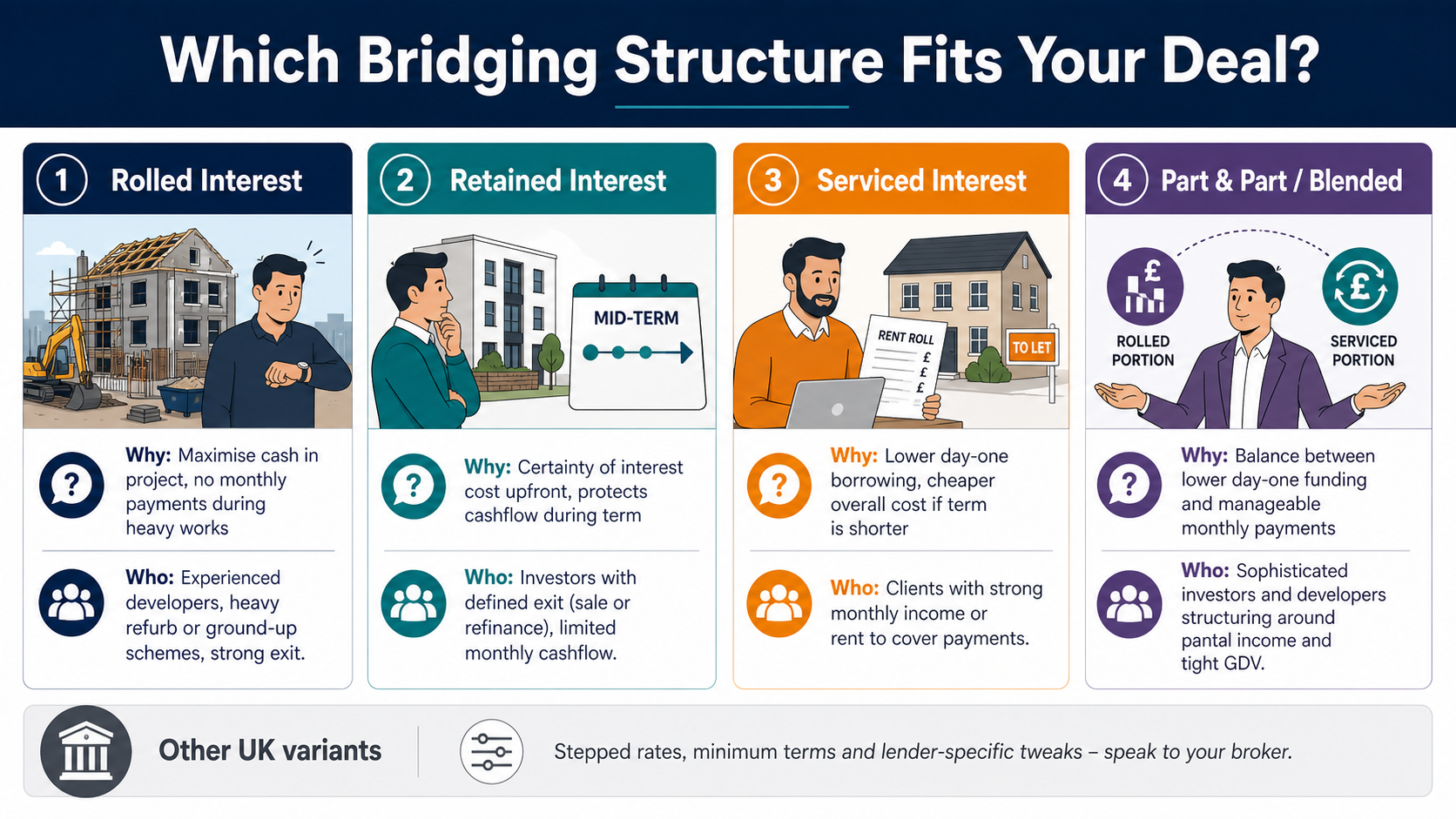
The firm’s role includes testing lender appetite for narrower triggers, negotiating de minimis thresholds, and structuring intercreditor arrangements where several tranches sit across one property or portfolio, drawing on direct experience arranging bridging finance for property transactions. For developers and investors managing several lenders at once, that single point of contact matters when one lender’s demands could otherwise ripple into every other facility in the stack. Speak to the team via the specialist property finance page before your next facility agreement goes to signature.
Sources
- Events of Default: Cross‑Default versus Cross‑Acceleration (Practical Law)
- Potentially toxic clauses in loan agreements (Practical Law excerpt)
This article is general information, not a substitute for advice from a qualified lawyer. Consult a qualified legal professional about your own circumstances before acting on anything here.
FAQ
What is a cross default clause?
A cross default clause is a provision stating that a default under one loan or credit agreement automatically triggers default under another, separate agreement, giving lenders early warning and equal footing to act.
What is the difference between a cross collateral agreement and a cross default clause?
A cross collateral agreement links the security backing multiple loans to the same pool of assets, while a cross default clause links the default status of separate agreements; a facility can have either, both, or neither.
What’s the difference between cross default and cross acceleration?
Cross default fires as soon as a default occurs elsewhere, while cross acceleration only fires once the other lender has actually accelerated that debt, giving the borrower more time before the clause spreads.
Can a cross default clause be triggered by a minor administrative breach?
Yes, if the clause is worded broadly enough and lacks a de minimis threshold, even a late compliance certificate or missed reporting deadline can technically count as a default that trips the clause.
Should on-demand facilities like overdrafts be excluded from cross default clauses?
Yes, on-demand facilities should be expressly carved out, since a bank withdrawing an overdraft for commercial reasons unrelated to any breach can otherwise still trigger the clause unintentionally.
Recommended
Related Topics
Speak to a specialist
Discuss your finance with James directly
Whole-of-market specialist finance — bridging, development, commercial and residential. No call centres, no obligation. James reviews every enquiry personally.
New to specialist finance? How unbiased broker advice works · Deals we have completed
Explore Related Finance