
Published · Updated
vat on commercial propertyAvoid a 20% VAT shortfall on commercial property for buyers & lenders
By James Dawes, CeMAP, Founder, James William & Co Capital
Commercial property is normally exempt from VAT in England, but new buildings and an owner’s formal option to tax can turn a sale or lease standard-rated at 20%. Before exchange, check whether the seller has opted to tax, whether the building counts as new under HMRC’s three-year rule, and whether the deal qualifies as a transfer of a going concern. Get any of that wrong and you either overpay VAT you cannot recover or underfund completion.
TL;DR:
- Sales of new commercial buildings within three years of completion are automatically subject to 20% VAT, regardless of the seller’s preference or exemption status.
- Opting to tax can turn a property’s supply from exempt to standard-rated, enabling the landlord to recover VAT on costs, but requires proper notification to HMRC via Form VAT1614A.
- A transfer of a going concern can exempt a property sale from VAT if the buyer continues the business and timely notifies HMRC of their own option to tax; missing deadlines converts the transaction into a VAT charge.
- The Capital Goods Scheme requires adjusting VAT recovery over ten years if the property’s use changes, meaning inherited VAT positions can impact subsequent owners.
- Buyers often underestimate the need for short-term funding to cover VAT at completion, with specialized bridging finance essential to avoid delays caused by cash flow gaps.
Table of Contents
- How does VAT apply to commercial property?
- When does VAT apply to new buildings and first supplies?
- How does the option to tax work for landlords?
- What happens with a transfer of a going concern?
- Can you recover VAT and what is the Capital Goods Scheme?
- How is VAT treated on construction and refurbishment work?
- What should buyers and tenants check before exchange?
- What are the funding implications of VAT on commercial property?
- Author perspective: key takeaways for investors and lenders
- How James William & Co Capital can help with VAT-driven funding gaps
- Sources
- FAQ
How does VAT apply to commercial property?
The starting point in England is exemption. Most sales, leases and rent on commercial land and buildings carry no VAT by default, under Schedule 9, Group 1 of the VAT Act 1994. That sounds like good news until you look at the flip side: an exempt supplier generally cannot recover the VAT it pays on related costs, including legal fees, agents’ commissions and refurbishment works.
This is the trade-off at the heart of Notice 742A: exemption protects the buyer from an immediate VAT charge but restricts the seller’s ability to reclaim input tax. Where a landlord opts to tax, the position flips. The supply becomes standard-rated at 20%, and the landlord can then recover VAT on costs tied to that property.
A few baseline points worth holding in your head before you go any further:
- Exempt supplies mean no VAT is charged on the transaction, but also no automatic input-tax recovery for the seller or landlord.
- The standard VAT rate in the UK is 20%, which applies whenever a supply is standard-rated, whether through the new-build rule or an option to tax.
- HMRC’s guidance in Notice 742 sets out the detailed rules on land and property, and it is the first document any adviser should pull up when a deal looks unusual.
- Residential elements within a mixed-use scheme keep their own VAT treatment, which is usually exempt or zero-rated, regardless of what the commercial element does.
None of this is exotic tax law. It is the everyday mechanic behind every commercial sale, lease renewal and rent review in England, and it is precisely the mechanic that most buyers skim past until it costs them money.
When does VAT apply to new buildings and first supplies?
The default exemption disappears the moment a building counts as new. HMRC treats a commercial building as new for three years from the date it is completed, and completion is usually fixed by the date of the practical completion certificate or the date the building is fully occupied, whichever comes first.
Inside that three-year window, the freehold sale of a new commercial building is normally standard-rated. It does not matter whether the seller wants exemption or the buyer would prefer it; if the building is new, VAT at 20% applies to the freehold sale automatically.
The three-year window catches more deals than people expect. A developer who completes a warehouse in January 2024 and sells it in late 2026 is still inside the three-year rule, because the clock only stops in early 2027. Buyers assuming a scheme finished “a couple of years ago” must always check the actual completion date, not a rough memory of when the site looked finished.
A first grant of a long lease on a new building is also normally standard-rated like the freehold sale Short leases and lettings on new buildings, by contrast, generally fall back into the ordinary exempt or opted regime once the first major disposal has happened.
Some transaction types where the new-build rule commonly bites:
- A developer selling a freehold industrial unit within three years of practical completion.
- The grant of a 99-year ground lease over a newly built office block.
- Part-completed schemes sold mid-construction, where HMRC still treats the supply as standard-rated because the building has not reached the point of being “old”.
- Civil engineering works, which have their own rules and can be standard-rated regardless of age in certain cases.
Zero-rating is rare in the commercial sphere and mostly reserved for specific circumstances such as qualifying charitable buildings or certain conversions. Do not assume zero-rating applies just because a scheme feels socially useful; check the specific conditions in Notice 708 before relying on it.
How does the option to tax work for landlords?
An option to tax is the landlord’s or owner’s own decision to make future supplies of a particular property standard-rated, even though the default position would be exemption. It is not automatic, it is not permanent by default, and it must be notified to HMRC in writing.
The standard route is form VAT1614A, which notifies HMRC of the option. Where an owner wants to revoke an option, there are separate routes: VAT1614C covers revocation within six months of the original option (among other circumstances), and VAT1614J deals with revocation after the option has been in place for more than 20 years. Each form has its own conditions, and using the wrong one, or missing a deadline, can leave an option in force when the owner thought it had lapsed.
Here is the procedural sequence worth following on any transaction where an option to tax is in play:
- Confirm whether an option has been made at all, and if so, when it took effect.
- Establish exactly what the option covers. An option is normally specified by reference to a particular building and its curtilage, or a defined area of land, and it does not automatically extend to adjoining plots, car parks, or separate buildings on the same site.
- Check for any disapplication provisions, which can override an option in certain scenarios involving residential conversion or intended residential use by the buyer.
- Request HMRC’s written acknowledgement of the option, not just the seller’s assertion that “VAT applies here.”
- Confirm the effective date, since VAT treatment before and after that date can differ.
Pro Tip: Never accept a verbal or emailed assurance from an agent that “the property is opted.” Ask for the seller’s copy of the VAT1614A submission and, ideally, HMRC’s acknowledgement letter. Small scope errors, like an option that covers the main building but excludes a separate yard or plant room, change the VAT liability on that slice of the deal entirely.
Buyers and tenants should also ask specifically what the option covers geographically. A single office block with a car park and a detached storage unit can, in principle, have different VAT histories across those elements if the option notice was drafted narrowly. This is one of the more common and expensive due-diligence gaps in commercial conveyancing, and it rarely shows up unless someone asks the direct question.
What happens with a transfer of a going concern?
A transfer of a going concern, usually shortened to TOGC, can take an entire property sale outside the scope of VAT altogether, meaning no VAT is charged on the transaction at all, rather than VAT being charged and then exempt. That distinction matters for stamp duty land tax calculations and for cashflow at completion.
For a property rental business, TOGC broadly requires that the buyer intends to continue letting the property, that there is no significant break in trading, and, critically, that where the property is opted to tax, the buyer has also opted to tax and has notified HMRC of that option before the relevant date, which is usually the date of completion. Miss that notification window and the sale reverts to a standard VAT-bearing transaction, regardless of what both parties intended.
The practical mechanics that solicitors and advisers need to get right:
- Confirm in writing, before exchange, that the buyer has submitted its own option to tax if the property is currently opted by the seller.
- Establish the precise “relevant date” for notification and build it into the transaction timetable, not as an afterthought after completion.
- Check whether the buyer will be a VAT-registered entity from day one of ownership, since TOGC treatment generally requires this.
- Keep documentary evidence of the letting business being transferred, including tenancy schedules and rent records, because HMRC can challenge TOGC status after the fact.
A TOGC removes VAT from the completion statement, but it does not remove every inherited liability. The Capital Goods Scheme obligations attached to the property can survive the transfer even when the sale itself falls outside VAT, which is the subject of the next section and one of the most overlooked risks in the whole transaction.
Can you recover VAT and what is the Capital Goods Scheme?
Input-tax recovery depends on what the buyer or owner does with the property afterwards. If you make taxable supplies, meaning you charge rent under an option to tax or you occupy the building for a taxable business activity, you can generally recover the VAT you were charged on the purchase and related costs. If your intended use is exempt letting with no option, that recovery route mostly closes — property owners should understand property insurance deductions for UK landlords to model costs accurately.
The Capital Goods Scheme (CGS) is where this gets genuinely tricky for property deals. For qualifying land and building expenditure above the relevant threshold, HMRC requires the VAT recovery position to be reviewed annually over a 10-year adjustment period for immovable property. If the use of the building changes during that period, say a tenant that made taxable supplies moves out and is replaced by one that does not, the input tax originally recovered has to be adjusted, sometimes repaid.
Buyers frequently assume that once VAT has been dealt with at completion, the matter is closed. It is not. A buyer can inherit the remaining years of someone else’s CGS adjustment period, which means the VAT history of a building can follow it through several changes of ownership.
Pro Tip: Always ask the seller for their CGS record before you agree heads of terms, not after. That single document tells you how many adjustment years remain, what the original recovery percentage was, and whether a change of tenant mix could trigger a repayment obligation in your first year of ownership.
Before exchange, request:
- The seller’s CGS schedule, including the date the scheme item entered the scheme and years remaining.
- Historic input-tax claims on the property, particularly around any major refurbishment.
- Evidence of the actual use of the building across recent CGS intervals, since a change of occupier mid-scheme is the most common trigger for an adjustment.
- Confirmation of whether any CGS adjustment is currently pending or in dispute with HMRC.
How is VAT treated on construction and refurbishment work?
Building works sit in three possible VAT categories: standard-rated, reduced-rated, or zero-rated, and the right answer depends heavily on the type of work and the type of building, all set out in detail in Notice 708. Most commercial repairs, fit-outs and general refurbishment are standard-rated at 20%. Certain conversions and works to listed buildings used for a relevant charitable purpose can qualify for reduced or zero-rating, but the conditions are narrow and worth checking before assuming anything.
Since 1 March 2021, the domestic reverse charge for construction services has applied to specified building and construction work between VAT-registered contractors. Where it applies, the contractor does not charge VAT on the invoice. Instead, the customer accounts for that VAT directly to HMRC through its own return. This shifts cash flow rather than the ultimate liability, but it catches out contractors and clients who are not expecting it.
Whether the reverse charge applies depends on written confirmation of “end user” or “intermediary” status between the parties. Get this wrong and you either overpay VAT that should never have appeared on the invoice, or you fail to account for VAT you were supposed to self-charge.
Practical steps worth building into any works contract:
- Confirm end-user or intermediary status in writing before the first invoice is raised, not after works have started.
- Check whether the specific works fall within the reverse charge scope at all, since not every construction service is caught.
- Keep a clear paper trail of VAT treatment decisions on every invoice, particularly on mixed contracts covering several types of work.
What should buyers and tenants check before exchange?
A structured pre-exchange checklist saves more money on commercial property deals than almost any other single piece of due diligence. Work through it in this order:
- Obtain the seller’s option-to-tax evidence, including the VAT1614A submission and any HMRC acknowledgement.
- Confirm the practical completion date of the building to establish whether the three-year new-build rule still applies.
- Request the CGS schedule and years remaining, plus details of any pending adjustment.
- Check whether TOGC treatment is intended, and if so, confirm the buyer’s own option notification has been made and dated correctly.
- Obtain evidence of VAT treatment on any recent works, particularly if the domestic reverse charge should have applied.
- Model completion funding on both a VAT-inclusive and VAT-exclusive basis so the true cash requirement at exchange is visible to lenders and equity partners.
That last point deserves its own illustration, because it is where VAT stops being a legal question and becomes a funding one.
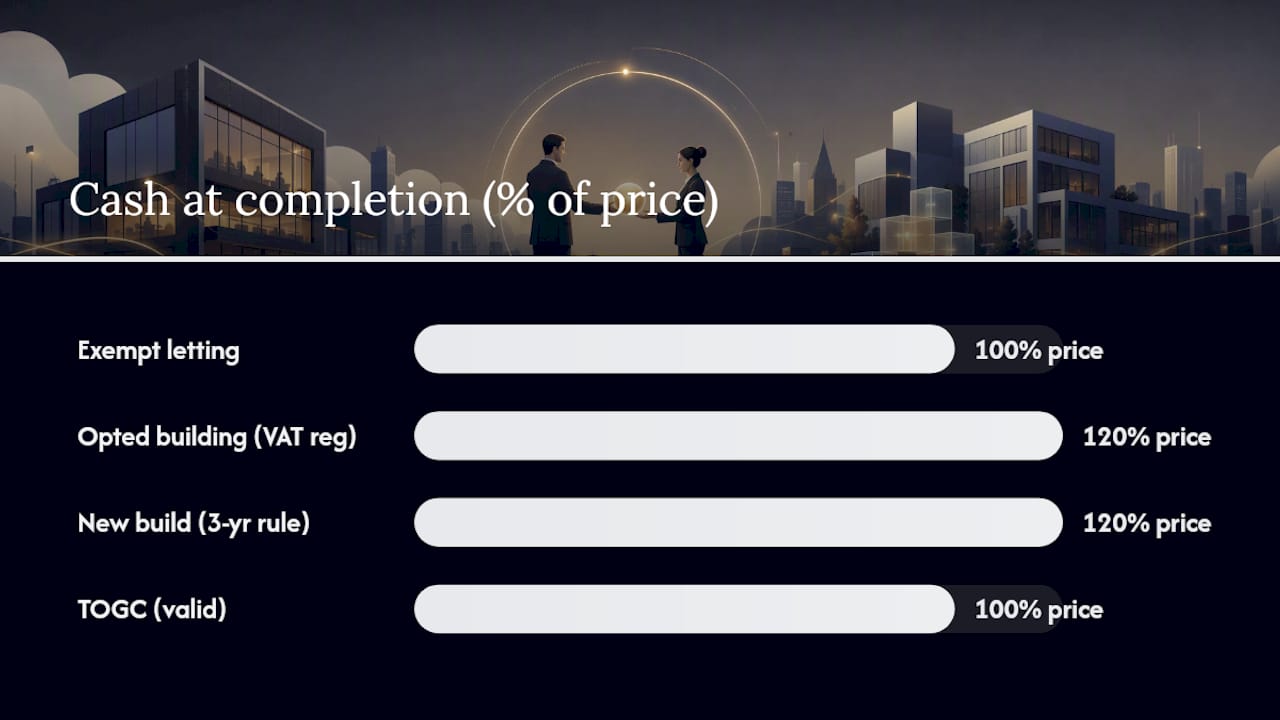
| Scenario | VAT treatment | Cash needed at completion | Recovery timing |
|---|---|---|---|
| Exempt letting, no option to tax | No VAT charged | Purchase price only | Not applicable |
| Opted commercial building, buyer VAT-registered | 20% VAT on price | Purchase price plus 20% VAT | Reclaimed via next VAT return, typically weeks later |
| New building within 3-year rule | 20% VAT compulsory | Purchase price plus 20% VAT | Reclaimed if buyer makes taxable supplies |
| TOGC with valid notification | Outside scope of VAT | Purchase price only | Not applicable |
Notice the pattern in the middle two rows. Even where VAT is fully recoverable, the buyer still has to fund it upfront and wait for HMRC’s repayment cycle, or offset it against the next return. On a large acquisition, that temporary gap can run into hundreds of thousands of pounds, and it is exactly the sort of shortfall that catches buyers who modelled their sources and uses on the VAT-exclusive price alone.
Negotiating who bears the risk of an unexpected VAT liability, through warranties or price adjustment clauses in the sale contract, is worth raising with your solicitor at heads-of-terms stage, not after exchange when leverage has gone.
What are the funding implications of VAT on commercial property?
VAT timing changes what a lender needs to see on day one of a transaction, and this is where the legal analysis meets the practical reality of getting a deal funded. A buyer who has correctly identified that a purchase is standard-rated still has to find the cash to pay that 20% at completion, even if full recovery is expected weeks later.
Lenders typically want to see both a VAT-inclusive and a VAT-exclusive sources-and-uses schedule, precisely because the gap between the two figures is a temporary funding requirement rather than a permanent cost. Some senior lenders will not fund the VAT element at all, on the basis that it is expected to be recovered quickly, which leaves a real hole in the completion budget unless it is planned for in advance.
This is where specialist structuring earns its keep. A short-term facility can cover the VAT element between completion and HMRC repayment, while a longer facility funds the underlying acquisition. On development schemes, staged facilities can be drawn against certified works, with a mezzanine tranche covering any residual gap between senior debt and total project cost, including VAT on construction works caught by the domestic reverse charge.
Before any funding conversation, it helps to have ready:
- A clear VAT-inclusive and VAT-exclusive sources-and-uses table for the lender.
- Evidence of the expected VAT recovery timeline and who bears the interim cost.
- Confirmation of covenant triggers tied to VAT recovery or CGS adjustments, so the lender is not surprised by a later repayment obligation.
- Disbursement triggers agreed upfront if a facility is structured in stages against a development programme.
Pro Tip: If your solicitor flags a VAT-inclusive completion figure that is materially higher than your agreed purchase price, raise it with your funding adviser immediately, not the week before exchange. A short-term facility arranged with two weeks’ notice is far cheaper, in every sense, than a delayed completion.
Further guidance on structuring these facilities, including how developers commonly stack senior debt against mezzanine tranches, is set out in the guide to real estate funding sources for UK developers.
Author perspective: key takeaways for investors and lenders
The single biggest mistake on commercial deals is not a legal error at all. It is a due-diligence gap: nobody actually pulled the seller’s option-to-tax paperwork or the Capital Goods Scheme record until it was too late to renegotiate. That single document request would have flagged most of the expensive surprises this article covers.
Three actions matter more than any others. First, request written option-to-tax and CGS evidence before you agree heads of terms, not after. Second, model your completion funding on a VAT-inclusive basis even if you expect full recovery, because the cash gap is real even when the tax cost is not. Third, treat TOGC notification deadlines as fixed points on your transaction timetable, since missing one turns an outside-the-scope sale into a fully VAT-bearing one overnight.
Call a VAT specialist when the scope of an option to tax is ambiguous or a CGS record looks incomplete. Bring in a funding adviser as soon as you know VAT will be payable at completion, so the temporary cash requirement is planned for rather than discovered during exchange week.
— James William Dawes
How James William & Co Capital can help with VAT-driven funding gaps
VAT timing is a funding problem as much as a tax one, and that is precisely where James William & Co Capital’s structuring experience matters most. Where a traditional bank sees a temporary VAT gap as an inconvenient complication, James William & Co Capital treats it as a standard part of deal structuring, arranging the short-term liquidity to bridge it without derailing completion.
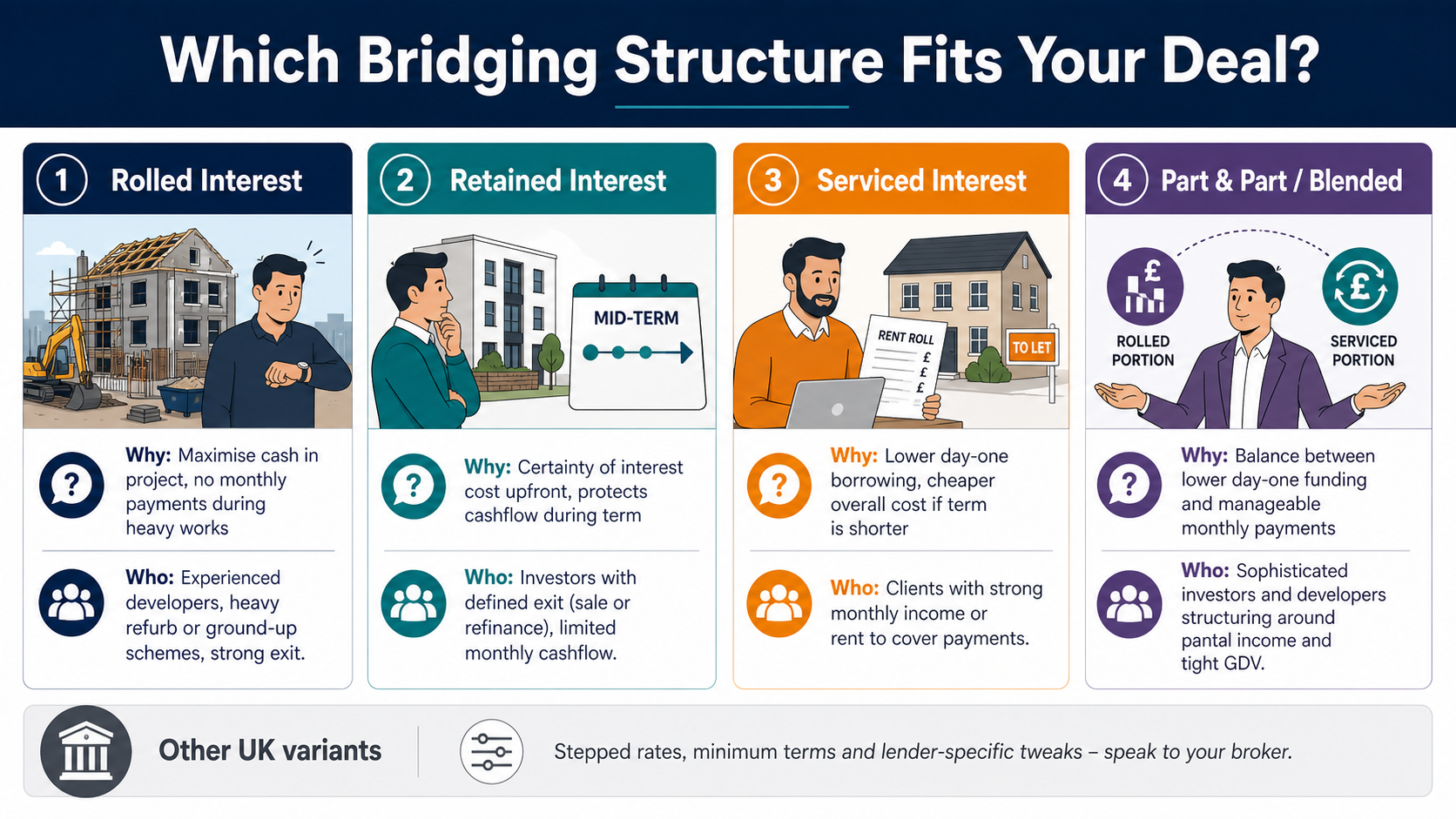
That gap can stall completion entirely if it is not planned for. Bridging finance products exist specifically to cover exactly this kind of short-term shortfall, giving buyers the funds to complete on time while recovery works through the system. For development schemes carrying construction VAT and reverse-charge complexity, development finance facilities, including joint venture equity and mezzanine tranches, can be structured against certified works to manage the funding profile stage by stage. Where VAT is a one-off cost on an acquisition rather than an ongoing cashflow issue, longer-term commercial mortgage products are often more suitable.
If a VAT-inclusive completion figure is putting pressure on your timetable, get a funding diagnostic from James William & Co Capital’s bridging finance team before you’re forced into a rushed decision at exchange.
FAQ
Can I claim VAT back on a commercial property purchase?
You can generally recover VAT on a commercial property purchase if you intend to make taxable supplies from it, such as charging opted rent or running a VAT-liable trade from the premises. If your use is exempt letting with no option to tax in place, that recovery route is closed, and the Capital Goods Scheme can require adjustments to that recovery over a 10-year period if the use changes.
Are new commercial buildings subject to VAT?
Yes. A commercial building is treated as new for three years from the date it is completed, and the freehold sale of a new building is compulsorily standard-rated at 20% during that window. This applies regardless of whether the seller or buyer would prefer exemption.
How much VAT do you pay on a commercial property?
It depends entirely on the VAT status of the specific transaction. Where the property is exempt with no option to tax, no VAT is charged at all; where the seller has opted to tax, or the building is new, VAT applies at the standard rate of 20% on the purchase price, rent, or service charges.
What is a transfer of a going concern and how does it affect VAT?
A TOGC can take a property sale outside the scope of VAT entirely if the buyer continues the letting business and, where the property is opted, notifies HMRC of its own option before completion. Missing that notification deadline reverts the sale to a standard VAT-bearing transaction, so the timetable matters as much as the substance of the deal.
Do I need specialist funding if VAT is payable at completion?
Many buyers do, particularly where full VAT recovery is expected but will not arrive for several weeks after completion. Short-term facilities such as Bridging Finance from James William & Co Capital are designed to cover exactly this kind of temporary gap so a deal can complete on schedule.
Recommended
Related Topics
Speak to a specialist
Discuss your finance with James directly
Whole-of-market specialist finance — bridging, development, commercial and residential. No call centres, no obligation. James reviews every enquiry personally.
New to specialist finance? How unbiased broker advice works · Deals we have completed
Explore Related Finance