
Published · Updated
why choose syndicationWhy choose syndication for property and loan finance?
By James Dawes, CeMAP, Founder, James William & Co Capital

Syndication is worth choosing whenever a deal is too large, too specialist, or too risky for one lender or one investor to take on alone. It lets multiple parties pool capital, share due diligence, and split exposure across a facility or a property, which is precisely why it dominates large-scale commercial finance and ambitious property investment in the UK.
The decision usually comes down to scale and risk appetite. Borrowers turn to syndication when a single lender won’t stretch to the full facility size; investors choose it when they want exposure to a bigger, better asset than their own capital could buy outright.
- For investors: access to bigger assets, shared due diligence, and lower entry tickets than buying alone.
- For borrowers: access to larger loan quantums, coordinated documentation, and one point of contact instead of five separate lender relationships.
Angel syndicate rounds in the UK commonly run between £100,000 and £750,000, a range that shows how syndication scales from modest private deals right up to institutional-sized facilities without changing its basic mechanics.
Key takeaways
Syndication works because it lets several lenders or investors share a facility’s size and risk while keeping each party’s liability limited to its own committed portion.
| Point | Details |
|---|---|
| Best fit | Large, complex, or specialist deals that exceed what one lender or investor can take alone. |
| Lead quality decides outcomes | A strong arranger secures better terms and manages administration; a weak one drags returns down. |
| Costs stack in layers | Arranger fees, agent fees, carry, and SPV setup all reduce net returns, so ask for a full breakdown. |
| Liquidity is limited | Capital is raised after diligence, not held ready, which slows deployment versus a committed fund. |
| Where to get support | James William & Co Capital arranges syndicated bridging, development, and structured facilities as a single point of contact for UK borrowers and investors. |
Table of Contents
- Why choose syndication: what the term actually covers
- How a syndicate is actually put together
- Which syndicate structure fits your situation?
- The real benefits of syndication
- Where syndication falls short
- Syndication versus the alternatives
- How to join a syndicate, or run one, without getting caught out
- Choosing the right lead or arranger: a practical scoring approach
- What syndication actually costs and how long it takes
- An arranger’s perspective: when syndication genuinely earns its complexity
- Get professional support structuring a syndicate
- Sources
- FAQ
Why choose syndication: what the term actually covers
“Syndication” gets used loosely, and that’s part of why people misjudge it. It covers three related but distinct structures, and knowing which one you’re dealing with changes what questions you should ask.
A syndicated loan is a single facility funded by multiple lenders, each committing a slice of the total and each carrying liability only for their own portion, not the whole loan. A property syndicate pools investor capital, usually through a special purpose vehicle (SPV), to buy or develop a specific asset or portfolio. An angel syndicate is the venture equivalent: a lead investor sources a deal, and a group of backers commit alongside them, often via the same SPV structure.
The SPV is the workhorse across all three. It’s a standalone legal entity created to hold one asset or one deal, ring-fencing that investment from the syndicate members’ other affairs. The alternative, a club deal, skips the separate legal entity and has each party sign the underlying contract directly. Club deals are simpler and cheaper to set up but leave less protection if something goes wrong, and they make cap tables messier for anyone raising equity later.
Three quick examples show the range:
- A £40 million commercial refinance syndicated across three mid-sized banks, each holding a several (not joint) commitment.
- A residential development syndicate raising £2 million from twelve investors through an SPV to fund a ground-up scheme.
- An angel syndicate of eight investors backing a growth-stage business with a £300,000 combined ticket, led by one experienced angel who sourced the deal.
Syndication of this kind is standard in project, acquisition, and infrastructure finance precisely because no single lender wants, or is permitted, to hold the full exposure of a nine-figure facility.
How a syndicate is actually put together
Every syndicate has a small cast of recurring roles, and understanding them tells you who to call when something needs deciding.
The lead or arranger originates the deal, negotiates the headline terms, and sells down participation to other lenders or investors. In loan syndication, the arranger frequently keeps the largest single slice and doubles up as facility agent, handling the day-to-day running of the facility once it’s live. A security trustee holds any charge or security on behalf of the whole syndicate, so lenders don’t each need separate legal claims against the same asset. Syndicate members are the participating lenders or investors, and where an SPV is used, it acts as the nominee vehicle through which capital flows.
Commitments in a syndicated loan are structured as several obligations, not joint ones. Each lender is liable only for its own committed share of the facility, not for the whole amount if another lender defaults. That single point of structure is why syndication scales to sizes no bilateral lender would touch.
A typical facility moves through a predictable sequence:
- Term sheet agreed between borrower and arranger, setting headline pricing and conditions.
- Arranging the syndicate, where the arranger approaches suitable lenders.
- Selling down allocations until the facility is fully subscribed.
- Facility documentation, usually built on LMA (Loan Market Association) standard templates in the UK market.
- Drawdown, when funds actually move.
- Life-of-loan administration, covering covenant monitoring, interest payments, and any waiver requests, run by the agent.
Pro Tip: If you’re a borrower comparing arrangers, ask which documentation standard they intend to use before you agree the term sheet. LMA-based facilities are heavily negotiated but familiar to every UK lender’s credit committee, which usually means faster legal turnaround than bespoke paperwork built from scratch.
A short glossary: SPV — a ring-fenced entity holding one deal. Facility agent — the administrator of a live loan on behalf of all lenders. Arranger — the originator who structures and sells down the facility. Several obligations — each party’s liability limited to its own committed share.
Which syndicate structure fits your situation?
Matching the structure to the goal saves a lot of wasted legal fees later.
Syndicated loans suit large corporate finance, acquisitions, and infrastructure projects where the facility size exceeds what any one bank wants on its own balance sheet. Property syndicates suit investors pooling capital for a single asset or a small portfolio, typically through an SPV that owns the property directly. Angel syndicates suit early-stage equity investing, where a lead sources deal flow and backers want exposure without doing the primary diligence themselves. Purchasing consortiums sit slightly apart, most often seen in joint procurement or shared-asset arrangements rather than pure investment.
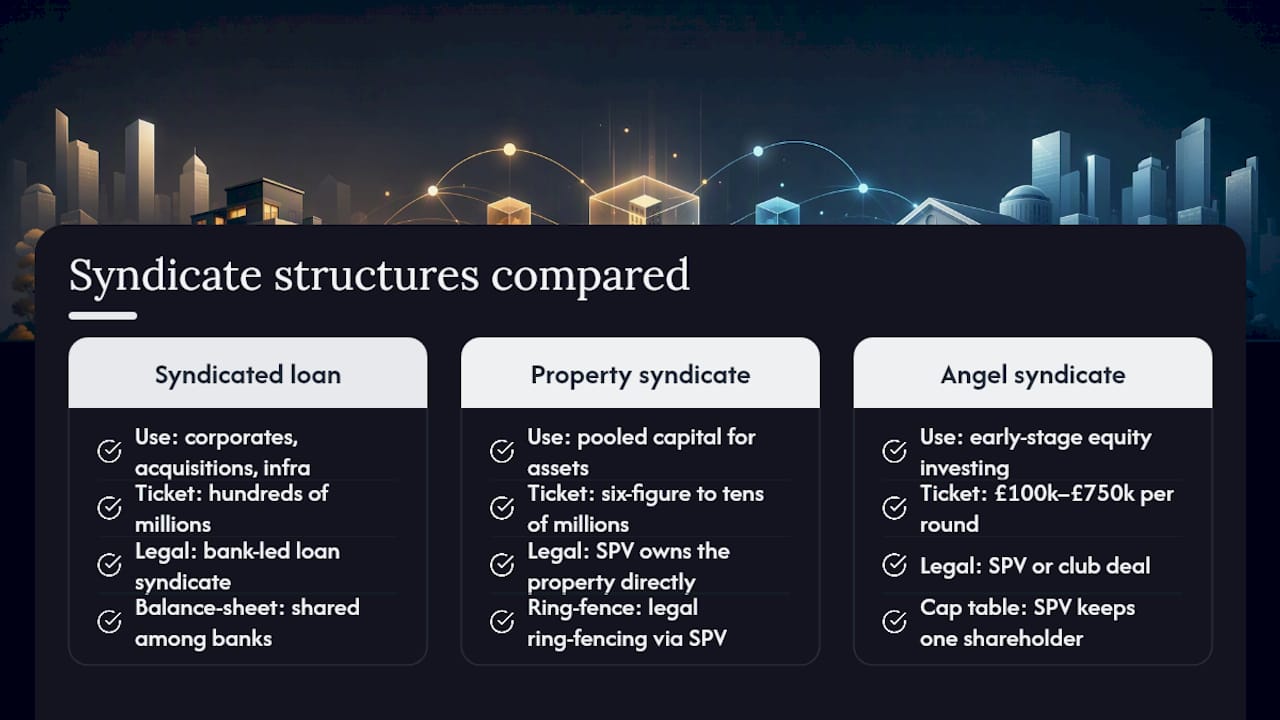
The SPV versus club deal decision matters more than most first-time syndicate members realise. An SPV keeps the cap table clean for founders raising equity, because the company sees one shareholder (the SPV) instead of a dozen individual angels. The trade-off is that SPVs can sometimes jeopardise SEIS or EIS relief if the structure isn’t built correctly, because HMRC generally requires direct equity ownership for certain reliefs. A club deal avoids that risk but leaves a messier cap table and less legal ring-fencing.
Typical ticket sizes vary sharply by type: angel syndicates commonly raise £100,000 to £750,000 per round, property syndicates can range from six figures to tens of millions depending on the asset, and syndicated loans regularly run into the hundreds of millions for large commercial or infrastructure deals.
The real benefits of syndication
The advantages of syndication aren’t abstract. They show up directly in deal access, pricing, and risk exposure.
Pooling capital is the headline benefit, but the more interesting one is what pooling makes possible: access to assets and facilities that would be entirely out of reach solo. A £5 million syndicate ticket buys a stake in a £40 million development that no individual investor in the group could fund alone.
Shared due diligence is underrated. When eight or ten people are examining the same opportunity, combined sector expertise and networks tend to catch issues a solo investor would miss, and the lead’s existing relationships with sellers, agents, or founders often improve terms across the board.
- Lower entry thresholds: investors can access deals with tickets far smaller than a direct purchase would demand.
- Diversification: capital spreads across multiple syndicate positions instead of one concentrated bet.
- Coordinated borrowing: borrowers deal with a single agent rather than negotiating separately with every lender.
- Potential tax transparency: correctly structured property syndicates can be tax transparent, meaning investors are taxed on their individual share of income and gains rather than at an additional corporate layer.
For borrowers, the practical win is scale without complexity multiplying at the same rate. One term sheet, one facility agreement, one agent managing life-of-loan administration, even when the money behind it comes from six or seven separate lenders.
Where syndication falls short
None of this makes syndication risk-free, and pretending otherwise does readers a disservice.
The single biggest variable is lead quality. A weak or inexperienced arranger secures worse terms, manages the facility poorly, and struggles to hold the syndicate together if a member wants to exit early or a covenant breach needs negotiating. This is the risk that does the most damage to actual returns, more than any single fee line.
Costs stack up in ways that aren’t always obvious upfront: arranger fees, agent fees, carry on equity syndicates, SPV setup and ongoing administration, and legal costs for facility documentation. Each of these chips away at net returns, and a syndicate with vague or bundled fee disclosure is a warning sign worth taking seriously.

Liquidity is another genuine constraint. Syndicates don’t hold ready capital the way a closed fund does; fundraising typically happens after due diligence is complete, which slows deployment and makes syndicates a poor fit for fast, competitive auction processes where speed decides the winner.
Watch for these red flags before committing capital:
- Voting rights that are vague or heavily weighted toward the lead with no minority protections.
- No clear provision for what happens if a lender or investor defaults on their commitment.
- Fee disclosure that bundles arranger, agent, and carry into one number without a breakdown.
- No track record the lead is willing to share, or reluctance to provide referee contacts from past deals.
Syndication versus the alternatives
Syndication isn’t always the right tool. Here’s how it stacks up against the other routes to the same capital.
| Dimension | Syndication | Bilateral loan | Fund investment | Crowdfunding platform |
|---|---|---|---|---|
| Best for | Large or specialist deals needing multiple capital sources | Straightforward, smaller facilities with one lender | Passive investors wanting diversified exposure | Small-ticket retail investors, early-stage equity |
| Minimum ticket | Often flexible, from low six figures upward | Set by the single lender’s own criteria | Usually a fixed fund minimum | Often very low, sometimes under £100 |
| Control and governance | Shared; lead/arranger drives decisions | Full control sits with borrower and single lender | Investor has no operational input | Minimal investor input, platform sets terms |
| Fees and set up costs | Arranger, agent, and legal fees; SPV setup if used | Simpler, usually just lender arrangement fee | Annual management fee plus carry | Platform fee, sometimes a carry on exit |
| Tax treatment | Can be tax transparent if structured correctly | Standard treatment for the borrower | Fund-level tax rules apply | Varies by platform and instrument |
| Liquidity/exit flexibility | Limited; depends on syndicate agreement terms | Depends entirely on loan terms | Usually locked for the fund term | Often illiquid until an exit event |
| Complexity/documentation | High; SPV, facility agreement, syndicate agreement | Lower; one set of loan documents | Moderate; fund subscription documents | Low to moderate; platform-standard terms |
A bilateral loan is simpler and faster to agree but caps out at whatever a single lender is willing to hold. A fund gives diversification with zero say over individual deals. Crowdfunding platforms open access to very small tickets but usually mean minimal influence and unpredictable exit timing. Direct one-to-one deals give full control but demand the investor or borrower do all the legwork alone, with no shared due diligence to lean on.
How to join a syndicate, or run one, without getting caught out
Whether you’re putting capital in or raising it, the questions you ask before signing matter more than anything in the small print afterwards.
Investor checklist, step by step:
- Vet the lead’s track record: ask for at least two or three completed deals with outcomes, not just deal names.
- Request the SPV’s constitutional documents and confirm who holds decision-making rights.
- Ask exactly how fees are structured, carry, management, and SPV admin, and get them in writing before committing.
- Confirm the exit route: is there a secondary market, a fixed hold period, or no clear exit at all?
- Check tax treatment directly, particularly whether SEIS/EIS eligibility survives the SPV structure.
- Establish reporting cadence: quarterly updates, annual accounts, or something less frequent?
Borrower checklist, step by step:
- Decide the facility type needed, bridging, development, or long-term commercial debt, before approaching arrangers.
- Choose an arranger based on relevant sector experience, not just headline pricing.
- Negotiate the term sheet fully before allowing documentation to begin; changes later cost far more in legal time.
- Confirm who sits as agent and security trustee, and what their fees and duties actually cover.
- Prepare conditions precedent early: valuations, legal title checks, and any planning consents needed for drawdown.
Ask any prospective lead directly: how many syndicates have you run, what happened when one went wrong, and can I see a redacted example of your facility or SPV documentation? A lead who answers plainly is usually a lead worth working with.
Choosing the right lead or arranger: a practical scoring approach
This is the part most guides skip, and it’s the part that decides whether a syndicate performs or drags on for years with disputes.
Score any prospective lead across five categories, and set a minimum bar for anything above mid-six-figure exposure.
| Category | What to check | Minimum bar for high-value deals |
|---|---|---|
| Track record | Number and size of completed syndicates, actual outcomes | At least three comparable deals with verifiable results |
| Market relationships | Existing lender or investor network, repeat participants | Evidence of repeat backers or lenders across multiple deals |
| Administrative capacity | Systems for reporting, covenant tracking, distributions | Documented process, not ad hoc spreadsheets |
| Documentation standard | Use of LMA templates or equivalent market-standard forms | Willingness to use recognised templates, not bespoke-only |
| Incentive alignment | How carry or fees are structured relative to investor return | Fees weighted toward performance, not flat regardless of outcome |
Market continuity counts for more than most first-time investors expect. An established lead with consistent relationships reduces execution risk and tends to make future financings smoother, because lenders and co-investors already trust the process.
Pro Tip: When reviewing arranger or agent duties in the documentation, check for the remedies clause specifically. It should say what happens, and who can act, if the agent underperforms or a lender needs replacing mid-facility. If that clause is missing, ask why before signing.
What syndication actually costs and how long it takes
Costs and timelines are where syndicate deals surprise people who’ve only dealt with a single lender before.
Fees typically break down into arranger fees (often a percentage of facility size, paid upfront), agent fees (an ongoing charge for administering the loan through its life), carry on equity-style syndicates, SPV setup costs, and legal fees for drafting or reviewing facility documentation. None of these are hidden if the lead is transparent, but they need to be asked about explicitly and in writing.
Timelines vary widely depending on complexity:
- A straightforward refinance syndication can complete in six to ten weeks from term sheet to drawdown.
- An acquisition-linked syndicate, particularly one involving development finance, often runs three to six months, driven by planning, valuation, and legal due diligence.
- Cross-border or multi-jurisdiction facilities regularly extend beyond six months, largely due to additional regulatory and tax review.
Ongoing costs don’t stop at drawdown. SPV administration, annual accounts, and agent reporting fees continue for the life of the facility or the holding period, and any fee disclosure that doesn’t separate these ongoing lines from the one-off setup costs deserves closer questioning.
An arranger’s perspective: when syndication genuinely earns its complexity
Syndication adds most value on the deals that scare off a single lender, not the straightforward ones. Large-scale developments, complex acquisitions, and financings that need to bridge a genuine funding gap between what one lender will offer and what the deal actually requires: that’s where a well-run syndicate outperforms every simpler alternative.

James William & Co Capital works as the arranger and single point of contact on precisely these transactions, coordinating a syndicate across bridging, development, and structured facilities so a borrower isn’t left negotiating with five different lenders separately. The firm’s role is to bring the right combination of family offices, private credit funds, and specialist lenders to a facility, then manage the documentation and administration through to drawdown and beyond.
The caveat worth repeating above all others: a syndicate is only as good as its lead. Everything else, fees, documentation, exit terms, flows from whether the arranger has the track record and relationships to execute cleanly under pressure.
Get professional support structuring a syndicate
Reading a checklist is one thing; negotiating a facility agreement against a syndicate of institutional lenders is another. James William & Co Capital exists to close that gap, acting as arranger and capital concierge so developers, investors, and business owners get a single point of contact rather than five separate lender conversations running in parallel.
The firm structures bridging and development finance, commercial mortgages, mezzanine debt, and SPV-based equity arrangements, drawing on a network of family offices, private credit funds, and specialist lenders to build syndicates suited to large-scale acquisitions and complex refinances. For readers weighing whether a syndicate fits their next acquisition, structured property finance for UK developers sets out how tax-transparent structures and financing stacks are typically arranged. Case studies of comparable structured financings are available on request, and the case studies page shows examples of past syndicate arrangements the firm has supported.
If you’re structuring a facility now, the practical next step is a direct conversation about stress-free investment property management in Milwaukee. Get in touch through the London office to discuss your transaction, or start from the main enquiry page to explain the deal and get a view on structure and timeline.
Sources
These sources go deeper on the templates, tax questions, and mechanics touched on above.
This article is general information, not a substitute for advice from a qualified financial advisor. Consult a qualified financial professional about your own circumstances before acting on anything here.
FAQ
What are the main benefits of syndication?
Syndication pools capital so investors can access larger or better assets, spreads risk across the syndicate, and lets borrowers raise bigger facilities through coordinated documentation with a single agent rather than several separate lenders.
What are the disadvantages of syndication?
The main risks are lead or arranger quality, layered fees (arranger, agent, carry, and SPV costs), limited liquidity since capital is raised after diligence rather than held ready, and documentation complexity.
Are property syndications worth it?
They’re worth considering when the target asset or deal size is beyond what you could fund alone and the lead has a verifiable track record; the trade-off is reduced liquidity and layered costs that a solo purchase wouldn’t carry.
What is the purpose of a syndicate?
A syndicate exists to combine capital and expertise from multiple parties so they can jointly fund or invest in a deal that no single member could, or would want to, take on alone.
How is syndication taxed?
Correctly structured property syndicates can be tax transparent, meaning investors are taxed on their own share of income and gains rather than at an extra corporate layer, though angel syndicate SPVs need careful structuring to protect SEIS/EIS eligibility.
Can I exit a syndicate early?
Exit flexibility depends entirely on the syndicate agreement; some allow a secondary sale of your position, but many, particularly property and angel syndicates, have limited or no formal exit route before the deal concludes.
Recommended
Related Topics
Speak to a specialist
Discuss your finance with James directly
Whole-of-market specialist finance — bridging, development, commercial and residential. No call centres, no obligation. James reviews every enquiry personally.
New to specialist finance? How unbiased broker advice works · Deals we have completed
Explore Related Finance