
Published · Updated
asset backed vs cash flowAsset-Backed vs Cash Flow Lending for UK Businesses
By James Dawes, CeMAP, Founder, James William & Co Capital
Asset-backed lending suits businesses with strong balance sheets but patchy or seasonal earnings, while cash-flow lending suits businesses with predictable revenue but few hard assets to pledge. Property developers, manufacturers and trading businesses with receivables or stock tend to fall into the first camp; service firms, software businesses and professional practices tend to fall into the second. Many established borrowers end up blending both.
TL;DR:
- Asset-backed lending favors businesses with liquid assets like property or receivables that can be valued and regularly audited, typically enabling larger facilities.
- Cash-flow lending suits firms with predictable revenue streams and little hard collateral, relying on management accounts, forecasts, and debt service coverage ratios.
- Borrowing capacity under asset-based loans depends on asset value and advance rates, while cash-flow facilities are based on earnings multiples and covenant tests.
- Smaller businesses can access asset-based financing more easily due to technological improvements in invoice finance and asset management.
- Combining both forms of finance is common for established companies needing flexible working capital and growth funding, but careful modeling of assets versus earnings is essential.
Table of Contents
- Asset backed vs cash flow: a quick comparison
- What do lenders actually check before lending?
- Who qualifies, and what reporting should you expect?
- Comparing true cost, not just the headline rate
- How to choose between the two, step by step
- Where each product actually gets used
- How advisers actually structure these deals in practice
- What actually matters when you’re under pressure to decide
- Primary sources and further reading
- Sources
- FAQ
Asset backed vs cash flow: a quick comparison
The core difference is what the lender is actually measuring. Asset-based lending sizes a facility against the value of specific collateral. Cash-flow lending sizes it against your ability to service debt from trading profit.
- Borrowing capacity: ABL uses a borrowing base tied to asset value and advance rates; cash-flow lending uses debt-service coverage or EBITDA multiples.
- Security: ABL takes fixed and floating charges over specific assets; cash-flow facilities are often unsecured but may still include a general lien or personal guarantee.
- Speed and reporting: ABL demands regular asset reporting and audits; cash-flow lending needs fewer live reports but stricter covenant testing.
- Typical scale: ABL facilities are commonly £5m or more, though smaller deals exist depending on the lender.
- Common users: manufacturers, distributors and property owners lean towards ABL; consultancies, agencies and software firms lean towards cash-flow debt.
Neither model is inherently cheaper. The right one depends on what you can prove: asset value, or earnings consistency.
What do lenders actually check before lending?
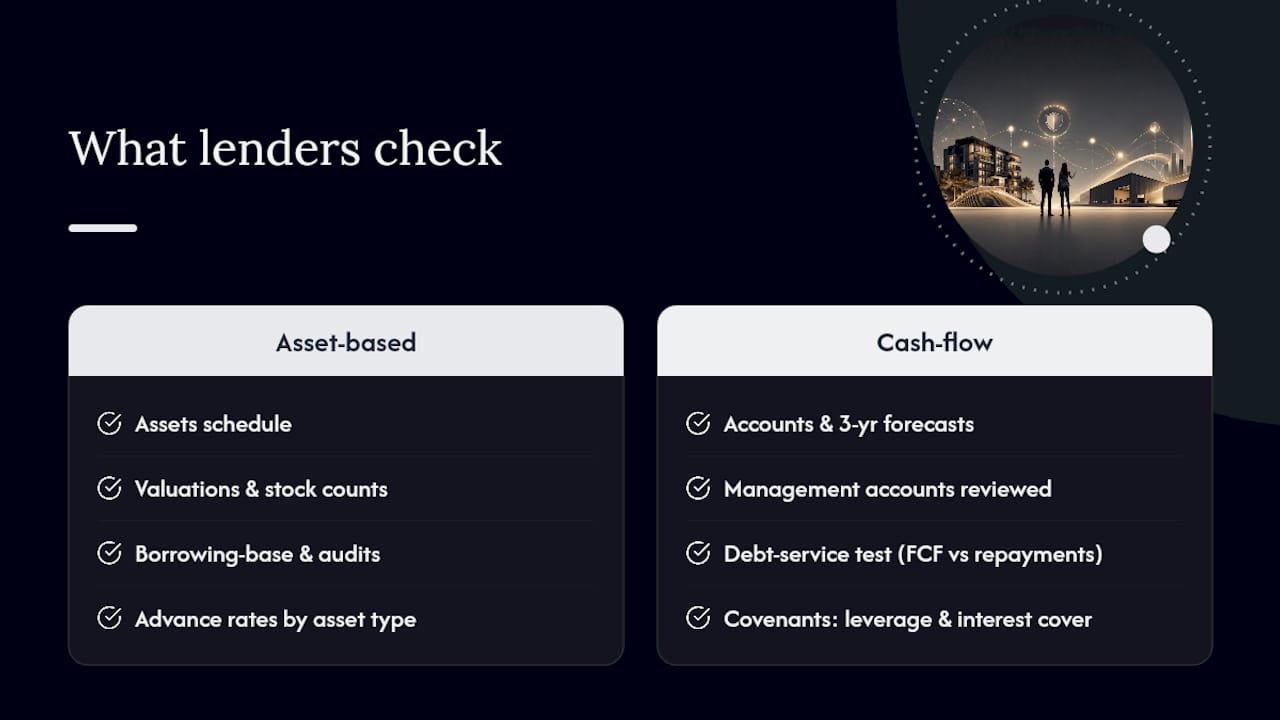
Asset-based lenders start with a schedule of your assets: receivables, stock, plant, property, sometimes intellectual property. They verify each category through valuations, aged debtor reports and stock counts, then apply an advance rate, often higher for property or equipment than for stock. The borrowing base calculation, ongoing audits and eligibility criteria all feed into how much you can actually draw at any given moment, which is why availability moves as your assets move.
Cash-flow lenders work from a different pack: management accounts, three-year forecasts, and a debt-service coverage test comparing free cash flow against loan repayments. Covenants get set around leverage ratios and interest cover rather than asset values.
Certain things quietly wreck an asset-based facility before it starts. Invoices aged past 90 days usually drop out of the borrowing base. Stock prone to obsolescence gets a lower advance rate or gets excluded outright. Debts that cannot legally be assigned, such as some public sector contracts, often cannot be pledged at all.
Who qualifies, and what reporting should you expect?
Scale and record-keeping matter more than most borrowers assume. Asset-based lenders want a clean, reconciled asset register; a business with disorganised debtor ledgers will see its usable headroom shrink even if the balance sheet looks fine on paper, a point ICAEW’s guidance on growth through asset-based finance makes explicit. Cash-flow lenders want at least two to three years of consistent management accounts and a credible forecast model.
- Eligible assets typically include receivables, stock, plant and equipment, commercial property, and occasionally IP.
- Common exclusions: intercompany debt, retentions, aged invoices, and non-assignable contracts.
- Expect monthly or weekly borrowing-base certificates under ABL, versus quarterly covenant reporting under cash-flow deals.
- Reserves and dilution triggers can reduce availability overnight if debtor quality slips.
Smaller SMEs now find asset-based finance more accessible than a decade ago, as ICAEW notes technology has made invoice finance quicker to set up.
Comparing true cost, not just the headline rate
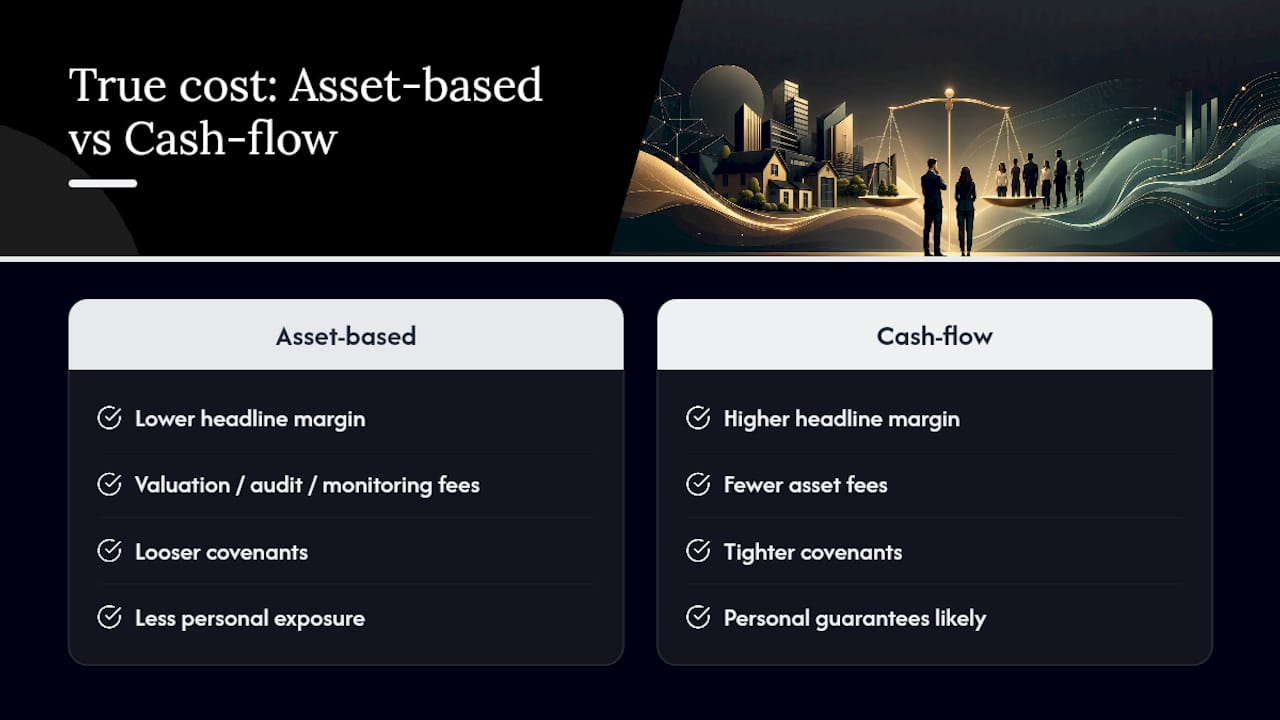
Headline margin tells you almost nothing on its own. Asset-based facilities often quote a lower interest margin but add valuation fees, audit costs and monthly monitoring charges that push the real cost up. Cash-flow loans usually carry a higher margin from the outset because the lender is taking earnings risk rather than collateral risk, and that risk gets priced in through tighter covenants.
Personal guarantees and general liens change the picture further. A cash-flow loan marketed as “unsecured” can still leave a director personally exposed if trading turns down, a point the British Business Bank flags directly when it warns that unsecured facilities frequently carry hidden obligations. Enforcement differs too: ABL lenders can appoint receivers over specific charged assets, while cash-flow lenders typically rely on default clauses and covenant breaches to force renegotiation or repayment.
Pro Tip: *Don’t compare deals on interest rate alone.
How to choose between the two, step by step
Work through these questions before you approach a lender:
- What’s your asset pool worth, and how liquid is it? Property, equipment and receivables all carry different advance rates.
- How predictable is your revenue? Recurring contracts and long client tenures favour a cash-flow structure.
- Are you growing fast enough that asset values will lag behind your funding needs? If yes, a debt-service model may flex better.
- Can your finance team handle weekly or monthly reporting? ABL rewards good bookkeeping; sloppy records erode it.
- How urgent is the funding? Cash-flow facilities can sometimes complete faster with less collateral due diligence.
Many established businesses run both: a senior asset-backed facility for working capital, topped up with a cash-flow term loan or mezzanine layer for growth capital, governed by an intercreditor agreement. When talking to lenders, always ask about advance rates, valuation methodology, covenant tests, reporting cadence and break costs before signing anything.
Where each product actually gets used
A wholesaler with £2m tied up in unpaid invoices typically turns to invoice finance, releasing cash against receivables within days rather than waiting 60 to 90 days for customers to pay. This is the SME use case ICAEW highlights most often for asset-based finance.
Property developers and manufacturers with substantial fixed assets often prefer facilities secured against property or plant, especially when funding an acquisition or a development phase. Layering a property-backed facility with a smaller cash-flow tranche can extend the capital stack without overloading any single lender’s risk appetite.
Service businesses, IP-heavy firms and software companies rarely have assets worth pledging, so a cash-flow loan sized against recurring revenue is usually the only realistic secured or semi-secured route.
How advisers actually structure these deals in practice
Real structuring choices tend to follow a pattern. In one case, a client secured a £600,000 revolving credit facility against a £5m property portfolio, giving flexible working capital without disturbing existing tenancies. In another, a borrower released £600,000 against a London property to fund a business acquisition, using property equity rather than trading cash flow to complete the deal.
The lesson from both: prepare a clean asset register and reconcile receivables before approaching any lender, and agree the reporting cadence up front so nobody is surprised by a covenant test three months in.
What actually matters when you’re under pressure to decide
Most owners overweight the headline rate and underweight certainty of drawdown. If your assets are strong but earnings are lumpy, asset-backed debt will usually get you further, faster. If earnings are the real story, don’t force an asset-based structure that punishes you for having little to pledge. Model both scenarios properly, or get structured advice before you commit.
— James William Dawes
If your business sits between the two, whether that’s a property portfolio generating steady rental income alongside trading receivables, or a growth-stage company that needs both working capital and acquisition funding, James William & Co Capital structures blended debt stacks across asset finance, development finance and mezzanine layers for property developers, investors and business owners. The firm’s business finance service works as a single point of contact through underwriting, valuation and covenant negotiation, drawing on a network of private credit funds and specialist lenders beyond the mainstream banks.
Primary sources and further reading
- Asset-based lending checklist | British Business Bank
- What is cash flow finance? | British Business Bank
- Asset-based finance | ICAEW
- UK Finance IF/ABL data
Sources
- Asset-based lending checklist | British Business Bank
- What is cash flow finance? | British Business Bank
- Asset-based finance | ICAEW
FAQ
What is the difference between assets and cash flow in lending terms?
Assets are things you own that a lender can value and take security over, such as receivables, stock or property. Cash flow is the money moving through your business from trading, which a lender assesses through forecasts and debt-service coverage rather than collateral value.
What is asset-backed finance?
Asset-backed (or asset-based) finance is lending secured against specific business assets like receivables, stock, equipment or property, with borrowing capacity driven by asset value and advance rates. It’s a collective term that includes invoice finance, stock finance and equipment finance.
What is the difference between ABF and ABL?
Asset-based finance (ABF) is the umbrella term, while asset-based lending (ABL) is one component of it, typically a revolving facility secured across a broader mix of receivables, stock and equipment. Invoice finance is another ABF component, focused specifically on receivables, as ICAEW’s guidance sets out.
What are the three types of cash flow?
The three types are usually operating, investing and financing cash flow. Operating cash flow, generated from core trading, is the figure cash-flow lenders scrutinise most closely when assessing a business’s ability to service debt.
Recommended
Related Topics
Speak to a specialist
Discuss your finance with James directly
Whole-of-market specialist finance — bridging, development, commercial and residential. No call centres, no obligation. James reviews every enquiry personally.
New to specialist finance? How unbiased broker advice works · Deals we have completed
Explore Related Finance