
Published
delayed completion financeDelayed Completion Finance: Funding the Gap in England
By James Dawes, CeMAP, Founder, James William & Co Capital

Delayed completion finance is the funding you line up so that a property purchase can exchange now and complete later, or survive completion slipping past the contractual date. In practice that means three things: the deposit due at exchange, the balance due on the agreed completion day, and a fallback if the money you expected is not there on time. We arrange this kind of funding for developers, investors and business owners, and the earlier the structure is agreed, the more options you keep.
This guide is for professionals who buy property with debt: developers, investors, funds, advisers and business owners. It explains what the arrangement is, where the legal exposure sits and how the finance is usually built around it.
TL;DR
- Delayed (or deferred) completion means contracts are exchanged now and the balance is paid on a later agreed date. Late completion is different: it is a breach of a date already fixed.
- Once you exchange, both sides are bound. Missing the date can trigger contractual interest, a notice to complete and, in the end, loss of the deposit.
- Your funding needs to cover the deposit at exchange, the balance at completion and a contingency for slippage, ideally before you exchange.
- Bridging, development finance, mezzanine and joint venture equity each solve a different part of the gap.
- One broker with access to specialist lenders and private credit can keep the structure and the timetable aligned.
Table of Contents
- What delayed completion actually means
- Who agrees the date, and why funding must be ready first
- How a delayed completion purchase is funded
- What delay costs once you have exchanged
- Tax timing: SDLT and cash flow
- Risks that grow with the length of the gap
- A funding checklist before you exchange
- Perspective
- How we can help
- FAQ
- Sources
What delayed completion actually means
In a standard English purchase, exchange and completion happen close together. With delayed completion the gap is deliberate. Contracts are exchanged, the deposit is paid, and legal completion, when the balance is paid and ownership passes, is set for a later date. One example from retirement property is a completion fixed at around 12 months after move-in or four weeks after the buyer’s existing home sells. In commercial and development deals the later date is often tied to planning, vacant possession, a funding milestone or a refinance.
Late completion is a separate event. Cunningtons explains that it arises when contracts have been exchanged, a completion date is agreed and the final stage does not happen on that date. That is a breach of contract and gives rise to compensation claims. Before exchange there is no contract, no obligation and no compensation, so either side can walk away.
The reason this matters for finance is simple. The date is fixed when you exchange. According to the Law Society’s exchange formulae, the solicitor holding both parts dates the contract and inserts the agreed completion date, and from then on it cannot be moved unless both parties agree to vary the contract. Your lender, equity partner or refinance has to be ready for that day, not for a day you hope to negotiate later.
Who agrees the date, and why funding must be ready first
The completion date is negotiated by the buyer’s and seller’s solicitors, and in a chain every party must settle on the same day. It becomes binding at exchange. That order of events creates the main funding trap: the date is agreed in a legal conversation, while the money arrives through a credit process with its own timetable, valuation, legal work and committee approvals.
Cunningtons lists causes of delayed completion that will be familiar to anyone who has funded a deal: mortgage lender delays or expired offers, requirements not actioned within the specified working days, vacant possession problems, administrative delays over searches, planning or lease documents, and last-minute discount demands. Several of these are finance problems in legal clothing. A loan offer that lapses before completion is a funding failure, but the contractual consequences fall on you.
So the sensible sequence is to agree your funding route and its timetable first, then agree a completion date the funding can meet. If the date is set by the seller and cannot be moved, work backwards from it and ask whether your lender can realistically complete in that window.
How a delayed completion purchase is funded
There are three layers of funding, and each can come from a different source.
1. The exchange deposit
The deposit is the first cash call. In the retirement-property scheme Michelmores describes, the buyer pays a 10% deposit at exchange. The amount in your own deal depends on the contract, but the principle is the same: money leaves your account long before you own the asset. Where that cash is tied up elsewhere, there are ways to raise it, which we cover in our guide to exchange deposit funding in England.
2. The balance on completion
This is where the main facility sits. Which product fits depends on what you are buying and what you plan to do with it:
- Bridging finance suits short timeframes, a purchase that must complete before a sale or refinance lands, or a gap between a lapsed offer and a replacement. See our bridging finance service.
- Development finance suits acquisitions where the site is being bought to build, with the loan sized to the land and the works. Our development finance page covers senior debt alongside mezzanine and joint venture equity.
- Commercial mortgages suit stabilised, income-producing property held for the longer term. See commercial mortgages.
- Buy-to-let mortgages suit investors buying let property, including through a limited company. See buy-to-let mortgages.
3. The contingency
The third layer is the one that most often goes missing. If completion slips, you need something to cover the extra days or weeks: a bridge, an extension of an existing facility or a pre-agreed equity top-up. Planning this at the start costs far less than arranging it under a notice to complete.

What delay costs once you have exchanged
The legal consequences are worth knowing in numbers, because they set the price of a funding failure.
Under the Standard Conditions of Sale for England and Wales, the innocent party can claim interest on the outstanding purchase price, less the deposit, at the contract rate from the missed date until actual completion. The contract rate tracks above the Bank of England Base Rate, and the rate in your contract is the one that counts. Where actual losses exceed that interest, the difference can be claimed as reasonable losses, such as temporary accommodation, storage or a broken chain.
Here is an illustrative example. It uses a hypothetical 8% contract rate, not a quote.
| Item | Figure |
|---|---|
| Purchase price | £2,000,000 |
| Deposit paid at exchange (10%) | £200,000 |
| Balance outstanding | £1,800,000 |
| Contract rate (illustrative) | 8% a year |
| Days late | 7 |
| Compensation | £1,800,000 × 8% × 7 ÷ 365 = £2,761.64 |
A week’s delay costs under £3,000 in interest on this deal, which is manageable. The bigger exposure sits behind it. Halsbury’s Laws of England states that completion after the contractual date does not by itself allow the innocent party to end the contract, unless time was of the essence or has been made so by a notice to complete. Once the seller serves that notice, you have a short, fixed window to complete. The Michelmores scheme, for instance, allows the developer to serve 10 working days’ notice to terminate and keep the deposit if legal completion has not occurred in time. On a £2,000,000 deal, that is £200,000 at risk.
The time of day matters too. Under SCS 6.1.2, money received after 2.00 pm is treated, for compensation purposes, as arriving on the next working day. That is a reason to have funds drawn down and with your solicitor early on completion day rather than relying on a late release.

Tax timing: SDLT and cash flow
Stamp Duty Land Tax (SDLT) is the tax on property purchases in England. Its timing depends on how the contract is structured. JV Property Ventures notes that in many cases SDLT is payable on completion rather than at exchange, which can help cash flow while capital is arranged. That is not universal. In the retirement scheme Michelmores describes, moving in at exchange is treated by HMRC as substantial performance, so the buyer pays the deposit plus the SDLT liability at exchange, and an additional 3% surcharge applies where the property is a second home, refundable if the previous home is sold within three years.
The practical point for funding is to ask your solicitor and tax adviser, before exchange, when SDLT falls due on your contract and what it will be. Then include it in the cash-flow plan alongside the deposit. A surprise tax bill at exchange is one of the most avoidable reasons for a funding gap.
Risks that grow with the length of the gap
The longer the gap between exchange and completion, the more can change. Rates move, build costs shift, planning assumptions are tested and the refinance you pencilled in may price differently. Stress-test the deal against a later, less favourable market, and set the completion date with that in mind.
If you are acquiring land for development, check the physical and legal facts while the gap is open. A measured survey is part of that: see when to get a measured survey to confirm boundaries before the balance is paid.
Homeowners should be particularly careful with arrangements where completion is delayed by years rather than months. Citizens Advice explains that in a long-delayed completion the buyer may take over the seller’s mortgage payments, insurance and repairs, but the seller remains legally responsible for the mortgage and could lose the home if payments stop. Anyone in that position should speak to a solicitor and their mortgage lender before signing anything. This article is aimed at professional buyers, so we leave that scenario there.
A funding checklist before you exchange
- Fix the facility timetable. Ask the lender for the latest date their offer remains valid and compare it with the proposed completion date, with room to spare.
- Size the deposit and tax. Know the exchange deposit and when SDLT is due.
- Confirm conditions. If completion depends on planning, vacant possession or a refinance, make sure the lender’s conditions match the contract’s.
- Agree the contingency. Decide in advance what you will use if completion slips: a bridge, an extension or equity.
- Check the contract rate. Read the interest and notice provisions so you know the daily cost of delay.
- Plan completion day. Have funds released early enough to reach the seller’s solicitor before 2.00 pm.
- Align the exit. If the purchase is bridged or developed, confirm the repayment route and its timing.
Perspective
Delayed completion is rarely a legal problem alone. It is a timing problem between a contract that cannot move and a funding process that has several moving parts. We see the best outcomes when the finance is structured at the same time as the deal, not after the solicitors have fixed a date.
Our approach is to treat the purchase as a whole capital structure: deposit, senior debt, any mezzanine or joint venture equity, and a fallback if the timetable slips. Because we work with specialist lenders, family offices and private credit funds beyond the mainstream banks, we can match the structure to the contract rather than forcing the contract to fit a single lender’s process.
For professional buyers, that means one point of contact handling structuring, negotiation and execution, so that when completion day arrives the money is where it needs to be.
James William Dawes
How we can help
We are a specialist broker for UK property developers, investors and business owners, arranging bridging finance, development finance, commercial mortgages, mezzanine debt and joint venture equity. Our service works through a single point of contact for structuring, negotiation and execution, built for complex or time-pressured transactions.
If you are planning an exchange with a later completion, or have a date you need to protect, start with our bridging finance page or speak to us through James William & Co Capital.
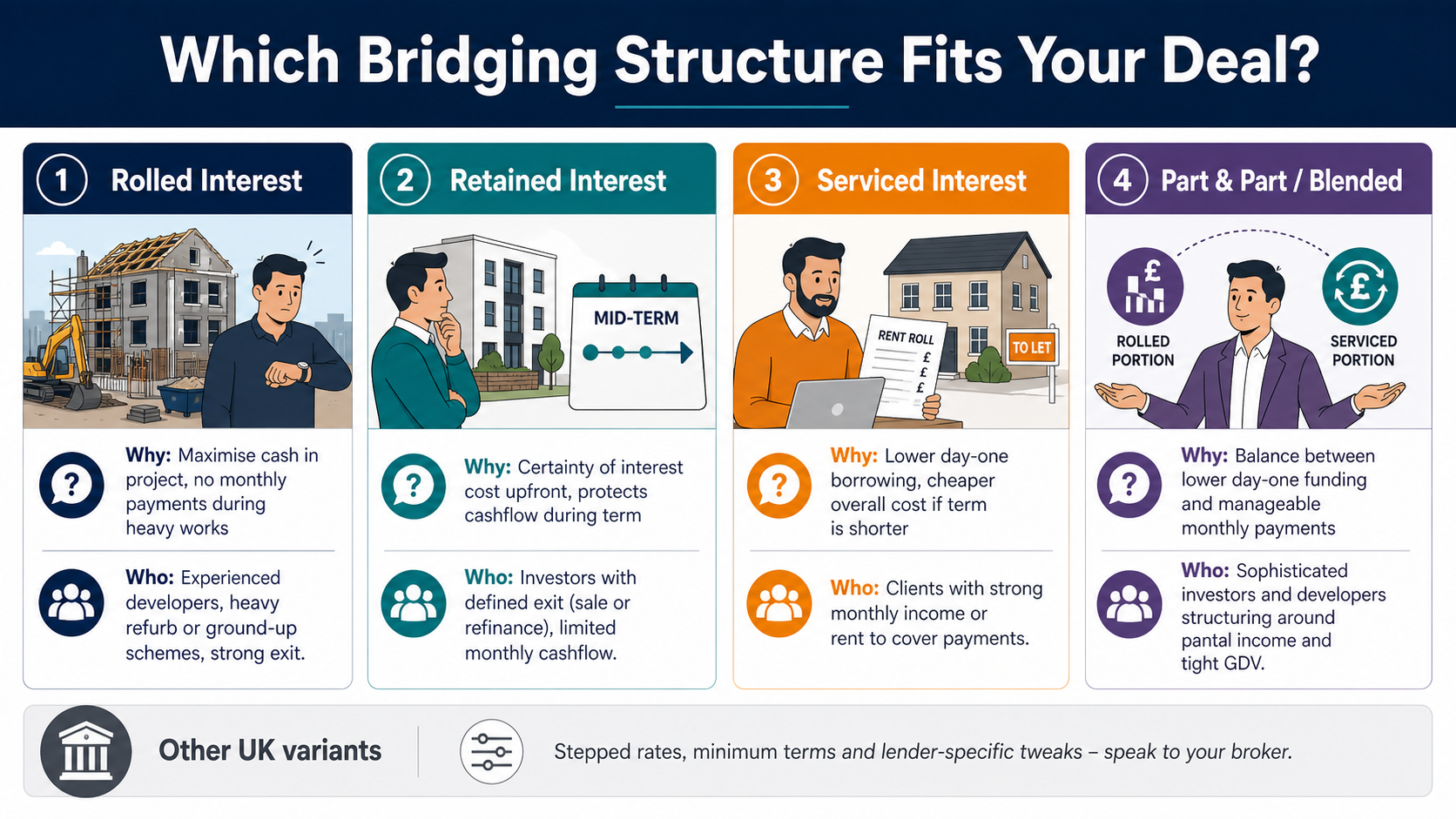
For wider context on structuring, our guides to structured property finance for UK developers and types of property finance set out the options in more depth.
FAQ
Who decides the completion date?
The buyer’s and seller’s solicitors negotiate it, and in a chain every party must agree the same day. It becomes binding when contracts are exchanged, and after that it can only change if both sides agree to vary the contract.
What happens if I cannot complete on the agreed date?
You are in breach of contract. The other side can claim interest on the outstanding balance at the contract rate and any reasonable losses. They may also serve a notice to complete, which makes time of the essence and can ultimately put your deposit at risk.
Is delayed completion the same as late completion?
No. Delayed or deferred completion is a planned gap between exchange and completion that both parties have agreed. Late completion is missing a date that has already been fixed in the contract, and it carries compensation consequences.
Can bridging finance cover a delayed completion?
Bridging finance is commonly used to cover short gaps, for example when a refinance or sale has not yet landed. The right structure depends on the property, the exit and the lender’s timetable, so it is best arranged before you exchange.
Sources
- Understanding Deferred Completion when purchasing a retirement property, Michelmores
- Delayed Completion? Costs, Compensation & Your Legal Rights, Cunningtons
- Formulae for exchanging contracts by telephone, The Law Society
- 440. Delayed completion, Halsbury’s Laws of England, LexisNexis
- Standard Conditions of Sale (5th edition) completion money guidance, LexisNexis
- Delayed Completion Property Strategy, JV Property Ventures
- Problems with selling your home: delayed completion and lease options contracts, Citizens Advice
- Fix Your UK Property Boundary to ±10mm: When to Get a Measured Survey
Recommended
- The Shifting Development Finance Landscape
- Conversion Finance vs New Build: Which Funding Fits?
- Bridging vs Development Finance: Which Fits Your Project?
- Exchange Deposit Funding: How to Find the Money in England
You must keep up your repayments to avoid repossession. We are not a lender. James William & Co Capital Ltd is an Appointed Representative of Flexi Network Ltd, FRN: 1060247. Flexi Network Ltd is authorised and regulated by the Financial Conduct Authority, FRN: 948658. Flexi Network Ltd is an authorised credit broker and not a lender. You can verify both on the Financial Services Register at register.fca.org.uk.
Related Topics
Speak to a specialist
Discuss your finance with James directly
Whole-of-market specialist finance — bridging, development, commercial and residential. No call centres, no obligation. James reviews every enquiry personally.
New to specialist finance? How unbiased broker advice works · Deals we have completed
Explore Related Finance