
Published
bridging vs development financeBridging vs Development Finance: Which Fits Your Project?
By James Dawes, CeMAP, Founder, James William & Co Capital

Bridging finance solves a timing problem: it is short-term, asset-backed money that lets you buy, hold or refurbish a property quickly and then repay from a sale or refinance. Development finance funds a build or conversion over its full programme, releasing money in stages as work is completed. If you need speed and the work is light, bridging usually fits. If you need capital across a construction period, development finance usually fits. Many English schemes use both, one after the other.
This guide sets out how the two products differ, how to choose, and how to move from one to the other without a gap in funding.
TL;DR
- Bridging finance is built for speed and short, defined needs. Development finance is built for delivering a scheme over a longer period.
- Money release differs: a bridge is typically drawn largely upfront, while development finance is normally an initial advance followed by staged drawdowns.
- The facility terms matter more than the label. Some bridges include works tranches, and some development loans include land purchase.
- Both rely on a credible exit: sale of units, refinance onto a term loan, or a mix.
- A common route is bridge to acquire, then development finance once planning and costs are fixed.
Table of Contents
- The core difference in one minute
- When bridging finance is the right tool
- When development finance is the right tool
- The label is not the facility
- How costs and charging differ
- What lenders assess on both
- Moving from bridging to development finance
- Managing the main risks
- A practical way to decide
- Our perspective
- Talk to us about your scheme
- FAQ
- Sources
The core difference in one minute
A bridging loan is generally asset-based and tied to a defined short-term need, with repayment expected through an agreed exit such as a sale or refinance. The lender looks hard at the security and at how you will repay.
Development finance is suited to a project that needs capital over a construction or conversion period. It can fund land acquisition, construction, conversion or substantial refurbishment. The lender reviews your development appraisal and cost plan against the scheme’s expected value and costs, and the facility may include an initial advance with later drawdowns as eligible works are completed.
So the question is rarely “which is better”. It is “what is the money for, and when will I need it?”
| Question | Bridging finance | Development finance |
|---|---|---|
| Main purpose | Bridge a gap: purchase, auction, chain break, light works | Fund the delivery of a build, conversion or heavy refurbishment |
| Typical timeline | Short, often months | Matched to the build programme, so usually longer |
| How funds are released | Mostly at completion, sometimes with works tranches | Initial advance, then drawdowns against progress |
| Main underwriting focus | Security value and exit | Appraisal, cost plan, gross development value and your track record |
| Speed to complete | Generally the faster of the two | More due diligence, so usually slower |
| Repayment | Sale or refinance | Sale of units or refinance onto a term loan |
The exact pricing, loan-to-value and term limits change with lender appetite, so we quote them case by case rather than publish a headline figure.
When bridging finance is the right tool
Bridging suits situations where time is the scarce resource and the plan is clear.
- Auction purchases with a short completion window.
- Chain breaks or buying before you have sold.
- Properties a mainstream lender will not lend on yet, for example those that need work before they are mortgageable.
- Light refurbishment before a sale, a let or a refinance onto a buy-to-let or commercial mortgage.
- Land or site acquisition where you need to secure the asset while planning is finalised.
Because the lender is advancing against property, the security and your exit carry the weight. A strong exit might be a sale at a realistic price, or a refinance where you can show the property will meet a term lender’s criteria once the work is done.
If this sounds like your position, our bridging finance page sets out how we approach it, and our guide on how to arrange bridging finance for property deals walks through the process.
Regulated or unregulated?
This is a point of safe use, not just jargon. A bridge secured on a home you or a close family member live in, or plan to live in, is generally treated as a regulated mortgage contract, which brings Financial Conduct Authority rules and affordability checks. Most investment and development bridging is unregulated, but that does not mean the process is unchecked. If the security could be your home, tell your broker at the outset, and take advice from a solicitor on the loan documents.
When development finance is the right tool
Development finance is for schemes where cost arrives over time. Typical uses include ground-up new build, conversion of offices or commercial units into homes, and substantial refurbishment that changes the property.
The lender will want to see:
- A development appraisal showing costs, gross development value and profit.
- A cost plan, ideally from a quantity surveyor or contractor, that stands up to scrutiny.
- Planning status, with permission in place or a realistic route to it.
- Your track record, or that of your build team, in delivering comparable schemes.
- An exit: sale of completed units, refinance, or a combination.
Funds are usually released in stages. You receive an initial advance, then further drawdowns as eligible works are completed, normally after a lender-appointed monitoring surveyor has checked progress. This protects the lender, and it also keeps you from paying for money you do not yet need.
It helps to understand how the planning route shapes the project. If you plan to convert rather than build, this overview of permitted development rules and what you can build without planning permission is a useful starting point for judging what a lender will see as deliverable.
Our development finance page covers senior debt, mezzanine and joint venture equity. For the reasoning behind choosing it, see why use development finance in the UK.
The label is not the facility
The distinction above is a useful starting point, but products overlap. Some bridges allow staged advances for works, and some development loans include acquisition funding. What matters is how the facility releases money, what it will fund and what it costs.
This is why we compare term sheets line by line rather than by product name. Three questions sort most cases:
- Is the money needed all at once, or in stages?
- Is the work cosmetic or structural?
- How long until the exit is realistic?
If the answers are “all at once”, “cosmetic” and “a few months”, you are in bridging territory. If they are “in stages”, “structural” and “a year or more”, you are in development finance territory. Mixed answers are where structuring earns its keep.

How costs and charging differ
The cost picture depends on how interest is charged and when money is drawn.
With a bridge, interest generally runs on the funds advanced, and much of the loan is drawn at the start. With development finance, interest is typically calculated on what has been drawn, so the balance and the interest rise as the build progresses. Lenders commonly charge arrangement fees and require valuation and legal costs on either product, and development finance usually adds monitoring surveyor fees.
A simple, purely illustrative comparison shows why the pattern matters. Imagine two borrowers each needing a total of £1,000,000 over twelve months. One draws the full amount on day one. The other draws £400,000 on day one and the rest evenly across the build. At the same interest rate, the second borrower pays interest on a smaller average balance. The real quotes will differ, but the principle holds: staged release reduces the time you pay for money you are not using.

That does not make development finance cheaper in every case. It has more fees and more process, and if you only need a short hold, a bridge may be the more efficient route overall. Ask for a full cost illustration including fees, retained or rolled-up interest and exit charges so you can compare like for like.
Our shifting development finance landscape piece looks at how stacked debt changes the cost of a scheme, and how to structure a development finance deal when margins are tight is useful when the numbers are close.
What lenders assess on both
Whichever product you choose, English lenders generally look at the same four things, with different weightings.
Security
Bridging lenders focus on the value and saleability of the property offered as security, usually by a first legal charge. Development lenders look at the site and the works together, and at the value the scheme should reach when finished.
Experience
An experienced developer will find terms easier on development finance. If you are newer, a bridge for a light-touch project, or bringing in a more experienced partner or joint venture equity, can be a sensible way to build a record. We can discuss how to present your experience honestly and clearly.
Deliverability
Lenders want to see that the scheme can actually be built to budget. Planning, contractor choice, build programme and cost control all feed this. Better data on costs is increasingly part of the conversation, and a well-evidenced cost plan removes questions before they arise.
The exit
Both products stand or fall on repayment. A sale exit should rest on realistic values and sales periods. A refinance exit should show the end product will meet a term lender’s requirements, whether that is a buy-to-let mortgage or a commercial mortgage. A second, back-up exit is wise on any scheme.
Moving from bridging to development finance
A common structure is to acquire with a bridge and refinance into development finance once the scheme is ready. This works when you need to move fast on a site but planning, design or costing is still being completed.
What needs to be in place before you refinance:
- Planning permission granted, with conditions that can be discharged in time.
- A finalised cost plan and appraisal that the development lender accepts.
- A contractor or build team in place.
- Enough time left on the bridge term to complete the refinance, with a margin for delays.
- A clear understanding of any exit fees or early repayment terms on the bridge.
The risk is a timing gap: if the development facility is not ready before the bridge expires, you may face extension costs or pressure to sell. We therefore agree the likely development route at the time we arrange the bridge, so there is no surprise later. Our guide to types of property finance for UK developers and real estate funding sources show how these pieces fit together.
An alternative is a single development facility that includes the land purchase, which can remove the refinance step altogether where the scheme is ready to start.
Managing the main risks
Both products are secured on property, so the sensible approach is to plan around what can go wrong.
- Cost overruns. Build in a contingency within your appraisal and ask your contractor for a fixed-price or well-defined contract where possible.
- Delays. Planning, utilities and weather all move programmes. Choose a term with headroom rather than the tightest fit.
- Sales values. Stress-test your appraisal against lower prices and slower sales so your exit still works.
- Refinance conditions. Lending criteria change over time. Keep the end product’s mortgageability in view from the start.
- Borrower location and tax. If you are based outside the UK, extra tax and anti-money-laundering checks can add time, as we explain in our guide to nonresident developer finance in England.
The point of identifying these early is to structure around them, with the right term, the right contingency and a back-up exit.
A practical way to decide
Work through these steps in order:
- Define the use of funds. Purchase only, purchase plus works, or works only?
- Map the timeline. When must you complete, and when will the project be saleable or refinanceable?
- Check planning and cost certainty. If either is incomplete, a bridge may buy time. If both are fixed, development finance is usually more efficient.
- Test the exit. Price it conservatively and identify a second route.
- Compare full terms. Look at the total cost, drawdown structure, fees and flexibility, not just the headline rate.
Our perspective
Most of the deals that reach us are not a pure bridge or a pure development loan. They are a sequence: secure the asset, refine the plan, then fund the build. The best outcomes come when that sequence is designed before the first lender is approached.
That is why we work as a single point of contact from first conversation to completion. Because we have access to specialist lenders, private credit funds and family offices beyond mainstream banks, we can match the structure to the project, whether that is a quick bridge, a staged development facility, or a stack that adds mezzanine or joint venture equity.
Our advice is simple. Decide what the money has to do, be honest about the timeline and the exit, and let the facility terms follow. We are here to help you get there with calm, clear structuring and fast execution when the clock is running.
James William Dawes
Talk to us about your scheme
We arrange bridging finance, development finance, mezzanine and joint venture equity for developers, investors and high-net-worth clients across England. You deal with one point of contact who structures, negotiates and executes the deal with you.
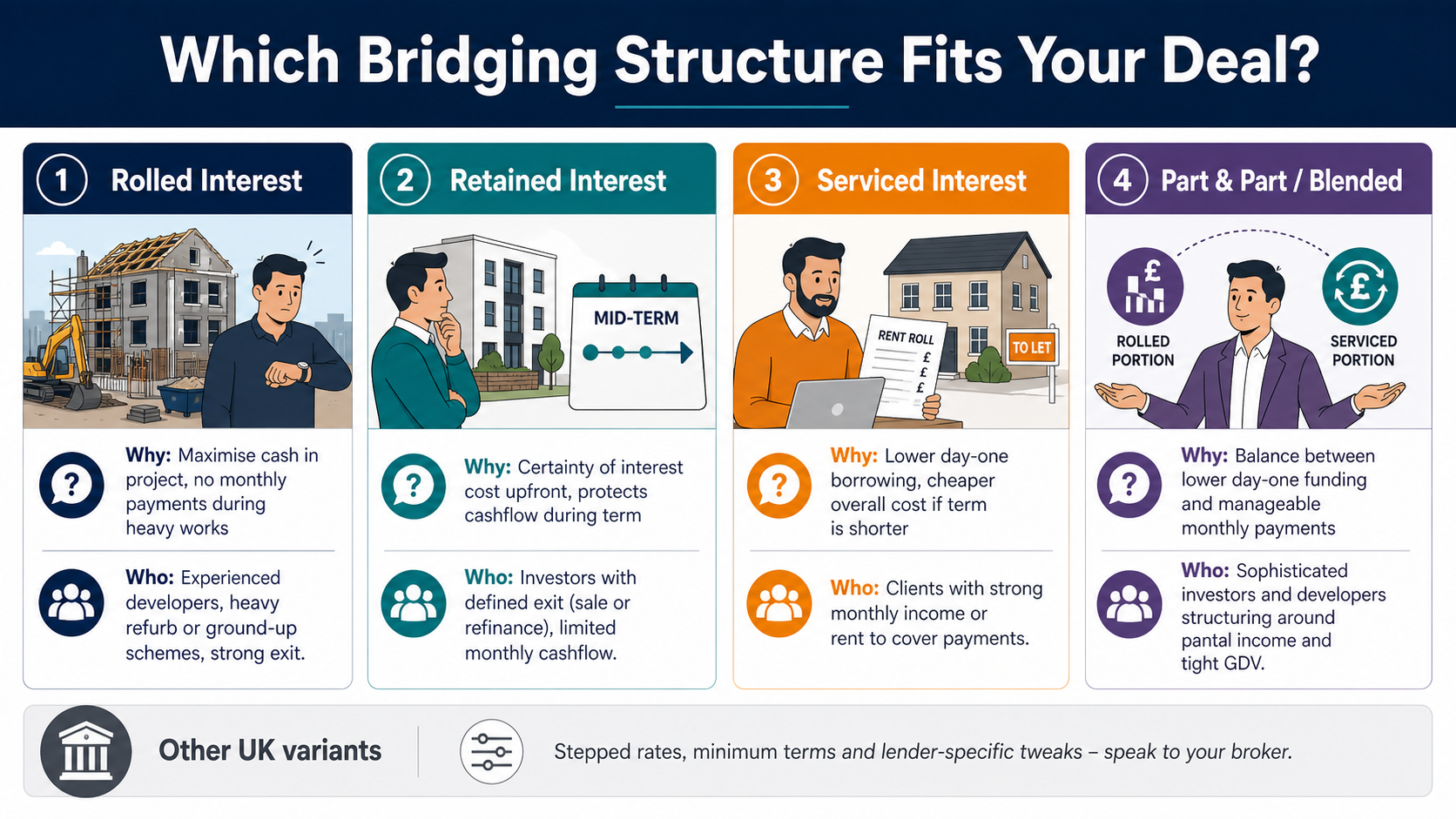
If you would like to see how the options compare for your project, you can compare bridging loans, look at our development finance lender panel, or start on our development finance page and tell us about your scheme.
FAQ
Can I use bridging finance for a development project?
Yes, in some cases. Bridges are often used to buy a site or to fund light refurbishment, and some can release money in stages for works. For a full ground-up build or heavy conversion, development finance is normally the better fit because it is designed to fund costs across the programme.
Is development finance slower to arrange than bridging?
Usually, yes. The lender reviews your appraisal, cost plan, planning position and experience, and appoints a monitoring surveyor. Bridging typically relies more on the security and exit, so it can move faster. Gathering your documents early shortens either process.
Can I refinance a bridging loan into development finance?
Yes, this is a common route. You will normally need planning in place, a finalised cost plan and appraisal, and enough time left on the bridge to complete the refinance. Agreeing the development route when you arrange the bridge reduces timing risk.
How do repayments work on each product?
Both are generally repaid from an agreed exit, such as the sale of the property or units, or a refinance onto a term loan. Interest treatment varies between lenders, so ask for a full cost illustration showing how interest is charged and when it is paid.
Sources
- Bridging Loan vs Development Finance: A Property Developer’s Guide
- Permitted Development Rules: What You Can Build Without Planning Permission
Recommended
- The Shifting Development Finance Landscape
- Bridging Finance Lenders UK | 27+ Panel
- Compare Bridging Loans | 200+ Lenders
- How to Structure a Development Finance Deal When Margins Are Tight
You must keep up your repayments to avoid repossession. We are not a lender. James William & Co Capital Ltd is an Appointed Representative of Flexi Network Ltd, FRN: 1060247. Flexi Network Ltd is authorised and regulated by the Financial Conduct Authority, FRN: 948658. Flexi Network Ltd is an authorised credit broker and not a lender. You can verify both on the Financial Services Register at register.fca.org.uk.
Related Topics
Speak to a specialist
Discuss your finance with James directly
Whole-of-market specialist finance — bridging, development, commercial and residential. No call centres, no obligation. James reviews every enquiry personally.
New to specialist finance? How unbiased broker advice works · Deals we have completed
Explore Related Finance