
Published · Updated
industrial development financeIndustrial Development Finance: A 2026 Guide for UK Developers
By James Dawes, CeMAP, Founder, James William & Co Capital

For UK warehouse, distribution and light-industrial schemes that need construction or refurbishment funding, short-term industrial development finance is the normal route, with bridging reserved for speed-critical acquisitions. The immediate next step is to prepare a gross development value (GDV), a detailed cost plan and planning evidence, then instruct a specialist structurer such as James William & Co Capital to source the right lender.
TL;DR:
- Loan-to-cost or loan-to-value ratios for industrial development finance generally range from 60% to 80%, depending on project risk and developer experience.
- Typical finance terms span 12 to 36 months, with interest either rolled up during construction or serviced from cash flow if the scheme generates income early.
- A fully credible lender application requires planning evidence, detailed cost and GDV appraisals, contractor arrangements, sponsor CVs, and a clear exit strategy.
- Lenders perform thorough due diligence covering legal title, planning, technical site reviews, sponsor finances, and valuation assessments before releasing funds.
- Engaging a specialist broker like James William & Co Capital can significantly streamline multi-layered debt structuring and speed up project approval.
Table of Contents
- What does industrial development finance actually cover?
- How much can you borrow, and on what terms?
- Who lends on industrial development schemes?
- How do you prepare a lender-ready application?
- Structuring the debt stack for an industrial scheme
- Exit strategy: sale, refinance or owner-occupation?
- Regulatory environment and compliance considerations
- How economic cycles shape financing availability
- What due diligence do lenders actually perform?
- Are there government incentives for industrial developers?
- What actually moves the needle in negotiation
- How James William & Co Capital structures industrial finance
- Sources
- FAQ
What does industrial development finance actually cover?
Industrial development finance funds the construction or transformation of warehouses, distribution centres and light-industrial units, not the broader public-sector “development finance” programmes tied to regional economic growth. In this market, it means the loans and structured debt a developer draws down to build, convert or extend commercial industrial stock in the UK.
This type of development finance for warehouses and industrial units typically funds:
- Land or site acquisition costs, including any abnormal ground works
- Build costs across ground-up construction or heavy refurbishment
- Professional fees for architects, quantity surveyors and planning consultants
- Contingency allowances, usually a fixed percentage of build costs
- Rolled-up finance costs and arrangement fees during the build period
Common project types include ground-up logistics sheds, conversions of tired industrial stock into modern units, multi-let business parks and smaller, standalone light-industrial buildings aimed at owner-occupiers.
How much can you borrow, and on what terms?
Loan sizes for industrial development finance range from small six-figure facilities for a single unit up to tens of millions for large logistics schemes, with loan-to-cost or LTV commonly sitting around 60% to 80% depending on developer track record and project risk.
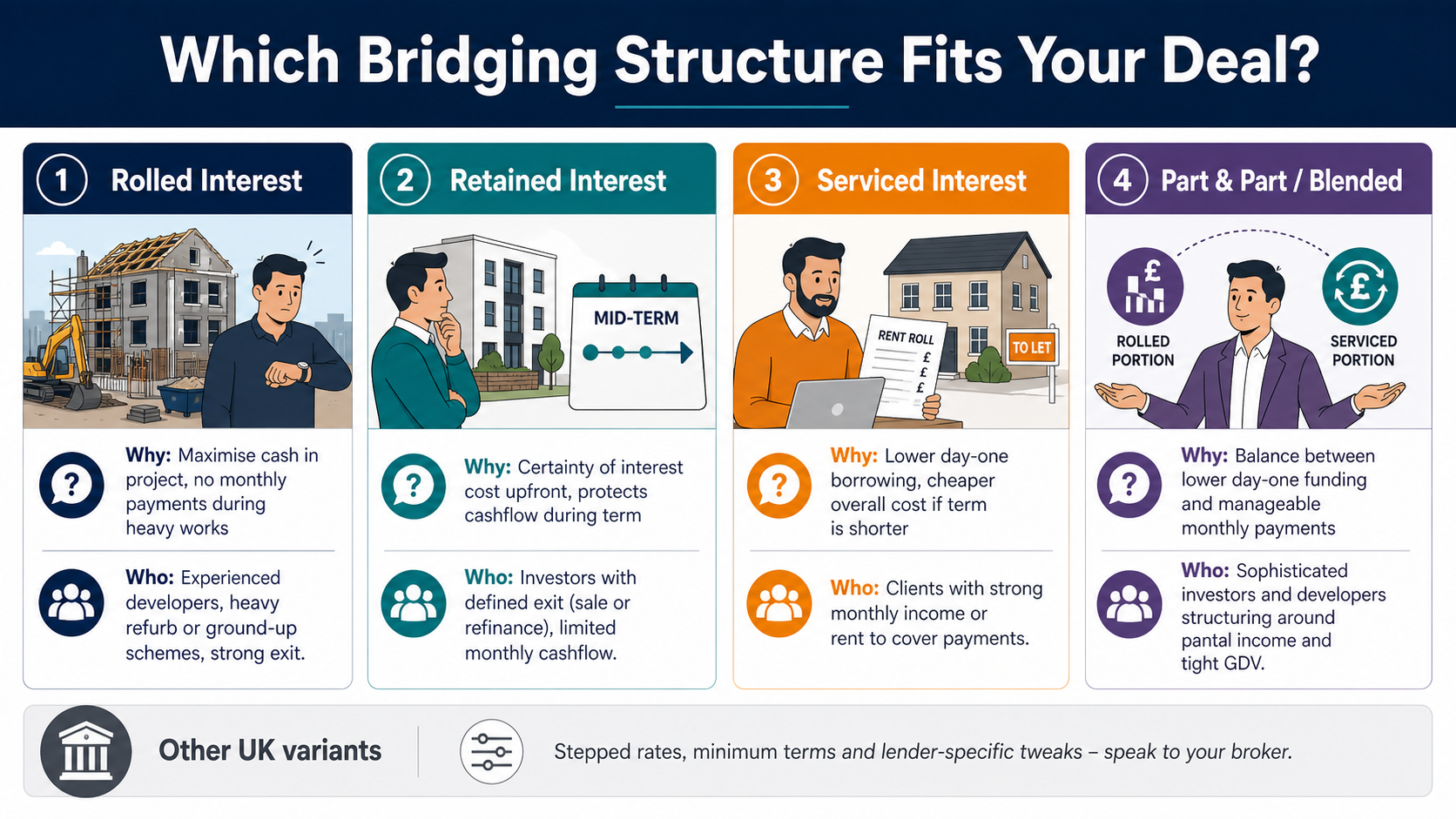
Terms typically run 12 to 36 months, tracking the build programme plus a letting or sale period. Interest is either rolled up monthly and repaid at exit, or serviced from day one where the sponsor has spare cash flow. Rolled-up structures dominate ground-up schemes because there is no income during construction.
Pro Tip: Model your facility against a stressed exit date, not the optimistic one on your contractor’s programme. Lenders price against the worst realistic timeline, and so should you.
Three tests decide how much a lender will actually advance:
- Interest cover ratio (ICR): for schemes moving into income once let, lenders commonly stress ICR around 1.3 to 1.6 times projected rent against the debt service.
- Loan-to-value / loan-to-cost: the headline leverage figure, but for income-producing warehouses it often takes a back seat to cover.
- Weighted average unexpired lease term (WAULT): relevant on part-let or multi-let schemes, where a thin WAULT can pull leverage down even if the ICR looks healthy.
GDV sensitivity matters too.
Who lends on industrial development schemes?
Four broad lender types compete for industrial development finance, and matching the right one to your project stage saves weeks.
- Specialist development lenders move fastest and take on higher-risk projects, including speculative builds without pre-lets, but price accordingly.
- Challenger banks offer competitive pricing for straightforward schemes with strong sponsors and clear planning consent, though appetite narrows for anything unusual.
- High-street banks rarely lead on pure development risk but can step in for stabilised, let assets or owner-occupier purchases where trading affordability drives the decision.
- Private credit and family offices fill gaps the mainstream market won’t touch: complex covenants, unusual security, or speed that a committee-driven bank simply cannot match.
Bridging finance suits vacant possession purchases or situations where speed beats cost, such as securing a site before planning is finalised. Development finance takes over once construction starts. Mezzanine debt or JV equity comes into play when senior debt alone won’t cover the cost stack, typically where the developer wants to preserve cash or push leverage beyond what a single lender will underwrite. Selection ultimately turns on planning status, exit clarity, your track record as a developer, and how much you’re willing to pay for speed.
How do you prepare a lender-ready application?
A credible submission moves faster and attracts sharper pricing. Lenders want to see the same core package regardless of size:
- Planning evidence — full planning permission, or at minimum a resolution to grant with a clear condition-discharge path.
- Detailed cost plan — broken down by trade, ideally reviewed by an independent quantity surveyor.
- GDV appraisal — supported by comparable evidence or a RICS valuation where the scheme is large.
- Contractor arrangements — a JCT contract or equivalent, plus evidence of the contractor’s track record and financial standing.
- Sponsor CVs and references — prior schemes completed, especially anything comparable in scale or sector.
- Exit plan — sale, refinance or owner-occupation, with realistic timing.
Straightforward cases can move from indicative terms to drawdown in two to six weeks; complex multi-lender stacks take considerably longer. The recurring pitfalls are under-stated build costs, a vague exit strategy, and contractor procurement risk where a single-point-of-failure builder hasn’t been properly vetted. Address all three before you approach a lender, not after they’ve asked.
Structuring the debt stack for an industrial scheme
A well-built industrial development finance stack usually has three or four layers, each priced for the risk it carries. Senior debt sits at the base, sized against cost and cover. Mezzanine or subordinated debt sits above it, filling the gap between what senior debt will lend and what the sponsor wants to put in as cash. Sponsor equity and, where needed, JV equity from a co-investing partner sit at the top, absorbing the first loss.
Mezzanine or JV equity earns its place when a developer wants to protect their own cash position without diluting the senior lender’s comfort, or when a value gap opens between total cost and what one lender alone will fund. It’s rarely the cheapest capital in the stack, but it’s often the difference between a scheme proceeding and stalling.
Recapitalisation facilities from private lenders can recycle developer equity once a scheme completes, freeing capital for the next site rather than leaving it locked in a stabilised asset.
This is where a capital concierge model earns its keep. James William & Co Capital’s role is lender access across specialist funds, challenger banks and family offices, bespoke covenant negotiation, and the speed to execute once terms are agreed, rather than leaving a developer to negotiate each layer separately with lenders who don’t naturally talk to one another.
- Senior facility: sized to cost and cover, first charge security
- Mezzanine: second charge or structurally subordinated, higher margin
- Sponsor and JV equity: first loss, aligned to the scheme’s upside
Exit strategy: sale, refinance or owner-occupation?
Your exit route shapes the entire finance structure before a single brick is laid. Lenders underwrite sale-to-investor exits, refinance-to-term exits and owner-occupation very differently.
- Sale to investors relies on a liquid market at completion; lenders stress GDV against comparable transactions and recent yield movement.
- Refinance to term debt depends on achieving a let (or a strong pre-let) before the development facility matures, often via a short stabilisation or bridging loan while lease-up completes.
- Owner-occupation is underwritten differently again. Trading business affordability drives the assessment rather than pure income yield, so lenders look hard at the occupier’s balance sheet and covenant strength.
Exit certainty directly affects pricing. A scheme with a signed pre-let and a clear refinance path attracts tighter margins and a less punishing stressed ICR than a speculative build chasing a sale into an uncertain market. Lenders reward clarity, and they price uncertainty accordingly.
Regulatory environment and compliance considerations
Lenders operate industrial development finance within a Financial Conduct Authority framework that draws a clear line between regulated and unregulated lending. Most facilities to corporate developers and experienced sponsors fall outside FCA-regulated mortgage contracts, since the borrowing entity is typically a limited company or SPV rather than an individual borrowing against a home. That said, personal guarantees from directors bring individual conduct standards and disclosure obligations into play, and lenders will run standard anti-money laundering and source-of-funds checks on every director and beneficial owner.
Planning compliance sits alongside financial regulation as a practical gatekeeper. A facility rarely completes without evidence that permitted development conditions are discharged, or a clear timetable for discharging them, because lenders won’t release funds against a scheme that could stall on a planning technicality. Building regulations compliance, fire safety requirements for larger industrial sheds, and environmental permits for certain industrial uses all feed into a lender’s legal due diligence before drawdown.
Offshore vehicles and multi-jurisdictional ownership structures, increasingly common among institutional investors, trigger additional beneficial ownership disclosure under the UK’s Register of Overseas Entities. Lenders will expect this resolved before completion, not during it. None of this should surprise an experienced developer, but each layer adds time to a transaction if it isn’t addressed at the term sheet stage rather than left until legal documentation begins.
How economic cycles shape financing availability
Industrial development finance availability moves with the broader credit cycle, and 2026 sits in a period where lenders remain selective rather than wide open. Base rate movements feed directly into the cost of senior debt, and margin compression or expansion tends to track wider gilt yields more than any single lender’s individual appetite.
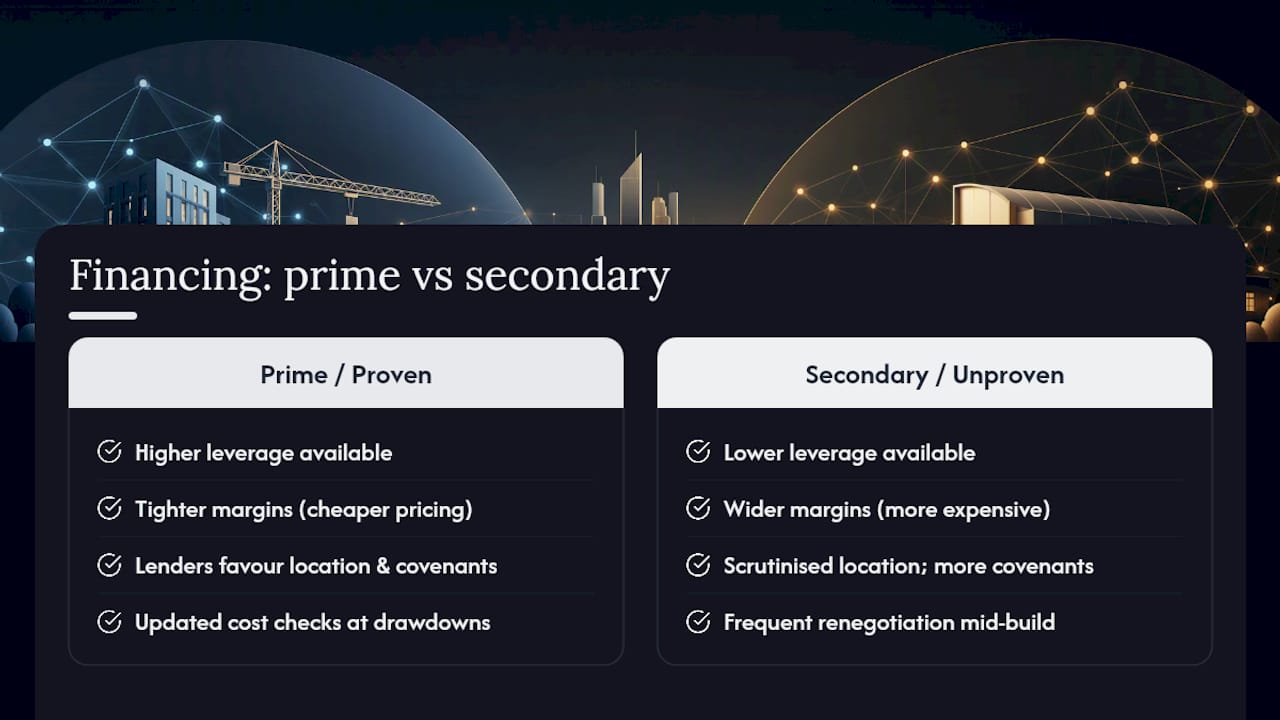
The industrial and logistics sector itself has been through a demand correction after the pandemic-era surge in warehouse take-up cooled. That reset has made lenders more selective about location and covenant strength, favouring schemes near established distribution corridors over speculative sites in untested locations. Rental growth in prime logistics locations has held up better than in secondary industrial parks, and lenders price that distinction into their leverage and margin decisions.
Construction cost inflation, though it has eased from its post-pandemic peak, still erodes contingency buffers faster than developers expect. A cost plan built eighteen months ago on outdated build-cost assumptions is a common reason facilities get re-negotiated mid-build. Lenders now routinely ask for updated cost certification at key drawdown milestones rather than relying solely on the original appraisal.
The practical takeaway for borrowers: appetite hasn’t disappeared, but pricing and leverage now differentiate sharply between prime and secondary industrial locations, and between developers with a proven delivery record and those without one. Schemes with strong locations, credible contractors and realistic cost plans still attract competitive terms; everything else pays a premium for the same money.
What due diligence do lenders actually perform?
Lenders run a structured review before committing to an industrial development facility, and understanding it helps developers anticipate questions rather than scramble to answer them.
Legal due diligence covers title, planning history and any restrictive covenants affecting the site, alongside a review of the building contract and appointment of professional consultants. Technical due diligence usually involves an independent monitoring surveyor, appointed by the lender, who reviews the cost plan, checks the build programme for realism and then certifies each drawdown against physical progress on site.

Financial due diligence extends beyond the scheme itself into the sponsor’s own position: source of equity, prior scheme performance, and personal or corporate credit history. For anything involving offshore vehicles or complex ownership, lenders will dig into the full beneficial ownership chain before committing.
Valuation due diligence, typically a RICS Red Book valuation, tests the GDV assumptions independently of the developer’s own appraisal, and this figure often moves the loan sizing more than any other single input. Insurance due diligence checks that contractor’s all-risks cover, professional indemnity and latent defects insurance are all in place before funds are released. Each strand feeds into the final facility agreement, and gaps in any one of them are the most common reason a deal that looked agreed at term sheet stage slips at legal completion.
Are there government incentives for industrial developers?
A handful of UK schemes reduce the effective cost of industrial development, though none replace the need for development finance itself. Enterprise Zones and Freeports offer business rates relief and enhanced capital allowances for qualifying industrial and logistics investments within designated boundaries, which can materially improve a scheme’s viability once operational.
Local authority infrastructure grants and enabling works funding occasionally support industrial sites where public benefit, such as job creation or brownfield remediation, is part of the case. These vary considerably by region and rarely fund construction costs directly, but they can reduce site preparation costs that would otherwise sit in the development budget.
Capital allowances, including the Annual Investment Allowance and structures and buildings allowance, offer tax relief on qualifying plant, machinery and construction expenditure rather than direct funding, but they materially affect the after-tax return a developer models when deciding whether a scheme stacks up. None of these incentives change the fundamental need for senior debt and equity to fund construction. They sit alongside the finance stack, improving the economics rather than replacing the borrowing itself, and a sponsor’s tax adviser should be modelling them into the appraisal from day one.
What actually moves the needle in negotiation
Most developers focus on the headline rate and miss the levers that shape real execution risk. Security package scope, how much of a portfolio a lender asks to cross-charge, matters more over a scheme’s life than a quarter-point on margin. Covenant granularity, the difference between a lender that tests cover quarterly versus one that reserves the right to review monthly, decides how much operational freedom you keep. Phased draw frameworks and contractor retention mechanisms determine how painful a delay actually becomes.
Mandate a specialist structurer once a deal involves multi-layer stacks, unusual covenants, offshore ownership, or genuine time pressure. That’s precisely where broker relationships with private credit and family offices earn their fee, opening doors a direct approach simply won’t reach.
— James William Dawes
How James William & Co Capital structures industrial finance
Getting the debt stack right on an industrial scheme, senior facility, mezzanine, JV equity, often matters more than chasing the lowest headline rate, especially when speed or a bespoke covenant package is what actually gets a deal done. James William & Co Capital works as a capital concierge across bridging, development finance, commercial mortgages, mezzanine debt and JV equity, giving developers one point of contact instead of negotiating each layer separately with lenders who rarely talk to each other.
That single point of contact is what reduces execution risk on complex schemes. Rather than a developer approaching five lenders cold, James William & Co Capital’s network across specialist lenders, challenger banks, private credit funds and family offices means faster access to the appetite that actually fits your project, negotiated covenant terms, and the ability to move at the pace institutional deadlines demand. For developers weighing a multi-layer stack, an offshore ownership structure, or a scheme that needs terms agreed in weeks rather than months, that access is the practical difference between a deal proceeding and stalling at term sheet stage.
If you’re preparing a GDV, cost plan and planning package for an industrial scheme, book an initial appraisal with James William & Co Capital’s London team and get a realistic read on structure, pricing and timeline before you approach lenders directly.
Sources
The market bands, lender tests and case example used throughout this guide draw on the following:
- Commercial Development Finance UK: Warehouses & Units
- Warehouse purchase and investment finance in 2026
For related guidance, see James William & Co Capital’s articles on property finance sources for UK developers and why developers use development finance.
This article is general information, not a substitute for advice from a qualified financial advisor. Consult a qualified financial professional about your own circumstances before acting on anything here.
FAQ
What is industrial development finance?
It’s short-term structured debt used to fund the construction, conversion or refurbishment of warehouses, distribution centres and light-industrial units in the UK, distinct from public-sector economic development funding.
What LTV can I get on an industrial development scheme?
Loan-to-cost or loan-to-value typically runs 60% to 80% depending on developer track record, project risk and exit clarity.
How long does industrial development finance take to arrange?
Straightforward cases move from indicative terms to drawdown in two to six weeks; complex multi-lender stacks take longer.
Should I use bridging or development finance for an industrial project?
Bridging suits speed-critical or vacant possession purchases; development finance funds the construction phase itself once you own or control the site.
Can a broker help structure a multi-layer industrial finance deal?
Yes. A specialist structurer such as James William & Co Capital arranges senior debt, mezzanine and JV equity together and negotiates covenants across the whole stack rather than one lender at a time.
Recommended
Related Topics
Speak to a specialist
Discuss your finance with James directly
Whole-of-market specialist finance — bridging, development, commercial and residential. No call centres, no obligation. James reviews every enquiry personally.
New to specialist finance? How unbiased broker advice works · Deals we have completed
Explore Related Finance