
Published
interest cover ratio btlInterest Cover Ratio for BTL: How Lenders Test Your Rent
By James Dawes, CeMAP, Founder, James William & Co Capital

The interest cover ratio (ICR) for buy-to-let is the rent a property earns divided by the mortgage interest on it, tested at a higher “stressed” rate rather than your actual rate. Most lenders look for at least 125%, and many ask for around 145% from higher-rate taxpayers borrowing in their own name. Below, we show the formula, the stress rates, worked examples and what to do when the rent falls short.
TL;DR
- ICR is gross rental income divided by mortgage interest, and the Bank of England describes lenders commonly seeking at least 125% on a stressed rate.
- Higher or additional-rate taxpayers borrowing personally are commonly tested at around 145%; limited company borrowers are more often tested at 125%, depending on the lender.
- The stress rate is usually well above your real pay rate, so a deal that looks comfortable on paper can still fail the test.
- If the rent is short, you can adjust the loan size, the structure (personal name or SPV), the product type or the lender.
- Lenders cannot size a loan on equity or expected house price growth, only on affordability.
Table of Contents
- What the interest cover ratio measures
- How to calculate your ICR
- Stress rates: why your pay rate is not the test rate
- Which ICR threshold applies to you
- What counts as a good ICR
- If the rent does not meet the ICR
- Mistakes that cost landlords borrowing power
- Our perspective
- Test your property with us
- FAQ
- Sources
What the interest cover ratio measures
The ICR asks one question: if interest rates rise, will the rent still comfortably cover the interest? The Bank of England defines it as gross rental income divided by mortgage interest repayments. The Prudential Regulation Authority’s underwriting standards take the same view. Under SS13/16, firms are expected to define it as expected monthly rent divided by monthly interest payments that allow for likely future rate increases.
Two points matter in practice:
- It is an interest-only test. Even on a repayment mortgage, most lenders size the loan on interest alone. Capital repayments do not enter the ratio.
- It is not a valuation test. The same PRA standard directs lenders not to base affordability on property equity or expected future price rises. A property with plenty of equity can still fail on rent.
The ICR sits alongside the loan-to-value (LTV) limit. Your maximum loan is the lower of what the rent supports and what the LTV cap allows. For a sense of how lenders weigh income-based and value-based sizing against each other, this debt yield versus LTV explainer is a useful comparison, although it is written with commercial lending in mind.
How to calculate your ICR
The formula is simple:
ICR = annual rent ÷ (loan × stress rate)
Expressed as a percentage, a result of 1.25 means 125%. Use the lender’s stress rate, not the rate on the product you want.
Worked example: testing a property
You plan a £200,000 loan on a property let at £1,300 a month, with a lender stressing at 5.5%.
- Annual rent: £1,300 × 12 = £15,600.
- Stressed annual interest: £200,000 × 5.5% = £11,000.
- ICR: £15,600 ÷ £11,000 = 1.418, or about 142%.
That passes a 125% test comfortably but falls short of 145%. The same property and the same loan produce a different answer depending on the lender’s threshold and your tax position.
Rent needed for a given loan
Work backwards when you already know the loan you want. For a £200,000 loan at a 5.5% stress rate:
| ICR required | Annual rent needed | Monthly rent needed |
|---|---|---|
| 125% | £13,750 | £1,145.83 |
| 145% | £15,950 | £1,329.17 |
Those figures are our own arithmetic on the formula above, so treat them as an illustration of scale rather than any lender’s quote.
Maximum loan from the rent
Rearranged, the formula gives the biggest loan the rent can support: annual rent ÷ stress rate ÷ ICR. Take a property let at £1,500 a month, which is £18,000 a year, with a 5.5% stress rate:
| ICR required | Calculation | Maximum loan |
|---|---|---|
| 125% | £18,000 ÷ 0.055 ÷ 1.25 | £261,818 |
| 145% | £18,000 ÷ 0.055 ÷ 1.45 | £225,705 |
The gap is about £36,000 of borrowing, caused entirely by the threshold. The LTV cap may reduce either figure further.

Stress rates: why your pay rate is not the test rate
The stress rate is the interest rate the lender uses in the calculation. It is normally higher than the rate you will actually pay. One widely quoted approach is the higher of 5.5% or the product rate plus 2%, though each lender sets its own policy and it changes with the market. Check the current criteria on the lender’s own page, or ask your broker for them.
The stress rate also depends on the product you choose. Some lenders apply a lower stress rate to longer fixed rates, because the payment cannot rise during the fix. That is one reason a five-year fix can support a larger loan than a two-year fix or a tracker on the same rent.
A quick example of the product-rate effect
Suppose the product rate is 4.5%. Product rate plus 2% is 6.5%, which is above 5.5%, so 6.5% becomes the stress rate. On £18,000 of annual rent at 125%, the maximum loan falls from £261,818 to about £221,538 (£18,000 ÷ 0.065 ÷ 1.25). You gain nothing on the ICR from a cheaper-looking rate if the stress rule keys off it.

Which ICR threshold applies to you
No single figure applies to everyone. The factors that move it are tax status, ownership structure, property type and portfolio size.
Tax status and ownership
The Bank of England explains that lenders typically look for a minimum of 125% on a stressed rate. For higher or additional-rate taxpayers, mainstream lenders generally apply a higher threshold, commonly around 145%, because restricted mortgage interest tax relief reduces net rental income. Basic-rate taxpayers and limited company borrowers are therefore more often tested at 125%, although individual lenders differ and you should confirm the policy before you apply.
This is a major reason many investors buy through a special purpose vehicle. We cover the practical side in our guide to offshore SPV mortgages in the UK. The right structure depends on your wider tax position, so take advice from your accountant before you decide.
Property type
HMOs, holiday lets and multi-unit freeholds are often tested more strictly. One industry guide puts the thresholds for these between 155% and 170%, reflecting more volatile income. Lenders vary, so treat that as a range, not a rule.
Portfolio landlords
If you own four or more mortgaged buy-to-let properties, expect more scrutiny. The same guide notes that portfolio landlords may face ICRs of 145% to 160%, and that some lenders stress the whole portfolio, not only the new purchase. Under the PRA’s rules, which apply to lenders from 1 January 2027 in their updated form, lenders are expected to assess portfolio landlords’ overall position rather than the single property in isolation. A strong property can therefore be held back by weaker ones elsewhere in your book.

What counts as a good ICR
There is no prize for a high ratio beyond approval, but there are three practical benchmarks:
- 125%: the common minimum on a stressed rate, often used for limited companies and basic-rate taxpayers.
- 145%: the common benchmark for higher-rate taxpayers borrowing personally.
- Above your lender’s threshold by a margin: valuers can come in lower on rent than you expect, and a small cushion stops a re-sized offer.
Your own cash-flow ratio is a separate matter. A deal that passes the lender’s test at a 5.5% stress rate can still leave thin monthly profit once you add management, maintenance, voids and insurance. Some specialist lenders also apply an allowance for voids of around 5%, so check whether yours does.
If the rent does not meet the ICR
A shortfall is common and usually fixable. Work through these in order.
- Reduce the loan. Every £10,000 off the loan at a 5.5% stress rate cuts the rent you need by £550 a year at 100% cover, and by about £687 at 125%. This is the simplest lever, but it needs more equity.
- Change the product. A longer fixed rate can carry a lower stress rate with some lenders, which raises the loan the same rent can support.
- Change the borrower. Moving a purchase into a limited company may lower the threshold from 145% to 125%. Tax, stamp duty and refinancing costs apply, so model it with your accountant first.
- Choose a different lender. Policy on stress rates, thresholds and rental top-ups differs widely. Our buy-to-let lender panel shows the range available beyond the high street.
- Raise the rent legitimately. Refurbishment, a conversion or a change of use may lift the achievable rent. Check what the valuer will accept.
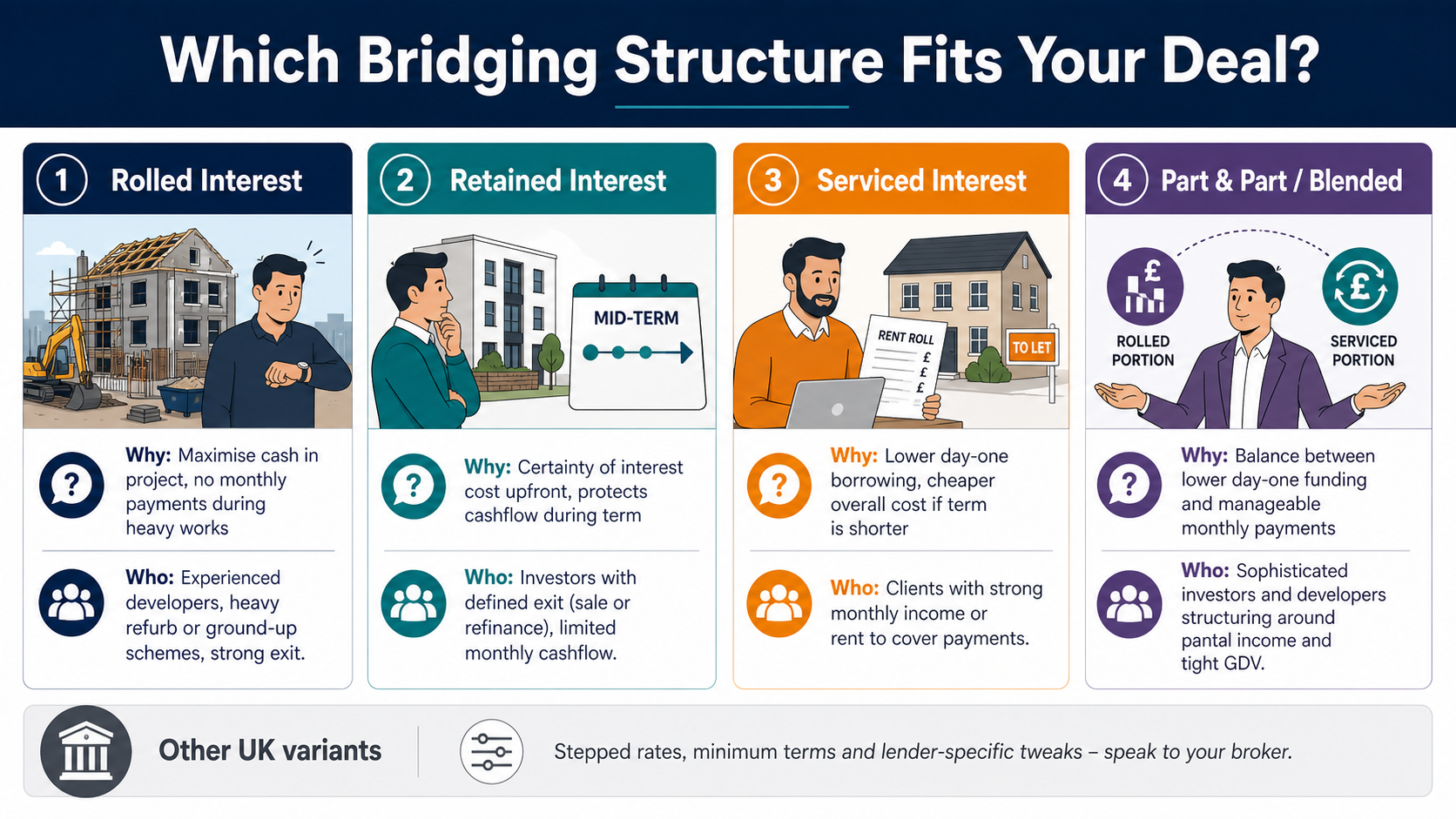
- Use short-term finance first. Where the property needs work before it can earn its rent, a bridging loan or refurbishment finance lets you buy now and refinance onto a term buy-to-let once the rent supports it. Our bridging finance page explains how this works.
If the property will be let on commercial terms, for example a mixed-use block or a unit with a business tenant, the lender may test it on different criteria. A commercial mortgage is then likely to be the right product.
Mistakes that cost landlords borrowing power
- Using the pay rate in the formula. The lender will not. Run every scenario at its stress rate.
- Using the rent you hope for. Valuers and lenders rely on a surveyor’s rental valuation, not your projection.
- Ignoring tax status. A move into a higher tax band can push you from a 125% to a 145% test.
- Forgetting the rest of the portfolio. Weak properties elsewhere can affect the whole application.
- Assuming equity solves it. Because lenders must not rely on equity to judge affordability, it cannot offset low rent.
Our perspective
Most ICR problems we see are not rent problems. They are structure problems. The same property can be a clean pass or a decline depending on whether it is held personally or in a company, which product it sits on and which lender is asked.
For professional investors and developers, we start with the end position. What does the property earn once stabilised, and which lender tests that income most kindly? Then we work back: the right short-term funding to get there, then the term loan that replaces it.
That is where direct access to specialist lenders and private credit funds helps. A single point of contact can test several lender criteria against your numbers before you commit to a valuation or a legal bill, and keep your plans moving while you do.
James William Dawes
Test your property with us
If you hold a portfolio, buy through a limited company or want to know how much a property will support before you commit, we can run your numbers against lender criteria and arrange the right funding. Our buy-to-let mortgage service covers purchases and remortgages, and we also arrange bridging and development finance for properties that need work first.
Talk to us through James William & Co Capital about your next acquisition or refinance.
FAQ
What is a good interest cover ratio for buy-to-let?
Most lenders look for at least 125% on a stressed interest rate, according to the Bank of England. Higher-rate taxpayers borrowing in their own name are commonly tested at around 145%. Aim to clear your lender’s threshold with a small margin.
Is ICR calculated on my actual mortgage rate?
No. Lenders apply a stress rate, usually higher than your pay rate, to test whether rent would still cover the interest if rates rose. The PRA expects firms to allow for likely future rate increases in this way. Ask your broker for the stress rate before you plan the loan.
Does ICR use gross or net rent?
The Bank of England describes ICR using gross rental income, before costs such as management or repairs. Tax enters indirectly through the higher threshold for higher-rate taxpayers. Your own cash-flow planning should still use net figures.
Can a limited company borrow more than I can personally?
Often, yes, because many lenders apply a lower ICR to limited companies than to higher-rate taxpayers borrowing personally. Lender policy varies, and tax, set-up and refinancing costs apply. Speak to your accountant and a broker before you move a property into a company.
Sources
- Bank of England: Buy-to-let mortgages, how do lenders account for tax when assessing affordability
- PRA SS13/16: Underwriting standards, affordability testing
- Understanding ICR for UK landlords
- BTL mortgage stress test calculator
- Debt yield versus LTV explainer
Recommended
You must keep up your repayments to avoid repossession. We are not a lender. James William & Co Capital Ltd is an Appointed Representative of Flexi Network Ltd, FRN: 1060247. Flexi Network Ltd is authorised and regulated by the Financial Conduct Authority, FRN: 948658. Flexi Network Ltd is an authorised credit broker and not a lender. You can verify both on the Financial Services Register at register.fca.org.uk.
Related Topics
Speak to a specialist
Discuss your finance with James directly
Whole-of-market specialist finance — bridging, development, commercial and residential. No call centres, no obligation. James reviews every enquiry personally.
New to specialist finance? How unbiased broker advice works · Deals we have completed
Explore Related Finance