
Published
planning delay bridgingPlanning Delay Bridging: Protecting Your Loan and Exit
By James Dawes, CeMAP, Founder, James William & Co Capital

If planning permission arrives later than your bridging loan expects, the loan does not pause. Interest keeps running, the term keeps shortening, and the exit you priced in (a sale, a refinance or a development facility) moves further away. The way to handle a planning delay on a bridge is to price it in before you borrow: a realistic term, an agreed extension route, a second exit and a lender that understands planning risk. This guide explains how long decisions take in England, what a delay does to a bridging loan, and how we structure around it.
TL;DR
- Statutory decision periods in England are 8, 10 or 13 weeks (16 for EIA schemes), but many applications run well past them, so a bridging term built on the statutory date is a fragile one.
- A delay costs money in three ways: more interest, possible extension fees, and the risk that your exit lender or buyer changes position while you wait.
- Plan for it up front: size the term on a realistic planning date, agree extension terms in writing, and line up a refinance route before you complete.
- If a council overruns, you can appeal against non-determination, but that adds its own time, so it is a lever and not a rescue.
- Specialist brokers can match planning-dependent deals to lenders who will lend on that risk, which is much harder to do once the clock is already running.
Table of Contents
- How long a planning decision takes in England
- What a planning delay does to a bridging loan
- A worked example
- Building delay into the structure
- Questions to ask a lender before you sign
- How we approach planning-dependent bridges
- Our perspective
- FAQ
- Sources
How long a planning decision takes in England
The legal timetable looks reassuring. Government guidance sets the statutory periods at 13 weeks for major development, 10 weeks for technical details consent and public service infrastructure, and 8 weeks for other development. Applications subject to an Environmental Impact Assessment get 16 weeks.
There is also a longer backstop. The planning guarantee expects major applications to be decided within 26 weeks and non-major applications within 16 weeks, with the fee refunded if the application is still undecided after that, unless a longer period was agreed and you have not appealed.
Actual performance is looser. The Home Builders Federation restates those 13 and 16 week targets while arguing that delays are holding back housing delivery. Designing Buildings reports that statutory targets are now more often missed than met, with some councils averaging 40 to 50 weeks for certain decisions.

The practical point for a borrower: the statutory date is the earliest sensible date, not the expected one. A bridging term should be built around the second.
Why applications slow down
Government-commissioned research found the most common causes of delay were problems with the information submitted, amendments following consultation, and negotiating Section 106 agreements. That research was based on interviews carried out between 2019 and 2020, so the detail will have moved on, but the pattern is familiar to anyone who has taken a scheme through a local authority.
Two of those three causes are partly in your hands. A complete, well-evidenced submission and an early conversation about Section 106 heads of terms are cheaper than any extension fee.

What a planning delay does to a bridging loan
Bridging is short-term by design. The lender prices the loan on the basis that you will repay it from a defined exit within the agreed term. Planning delay attacks that assumption directly.
Interest keeps accruing
Whether your interest is serviced monthly, rolled up or retained from the advance, a longer period means a bigger bill. With retained interest, the amount set aside at drawdown covers the original term only, so extra months have to be paid from somewhere else. With rolled-up interest, the balance you must repay grows with each extra month, which in turn reduces the equity left in the property.
That last point matters to lenders as well as to you. In a 2014 direction relating to one bridging lender, the FCA required it to consider the impact on remaining equity with the customer before extending a roll-up or retained-interest mortgage. It applied to that firm only and expired in 2016, but it shows why extensions are not a formality: the cost of waiting comes out of your equity.
Extensions are a request, not a right
An extension is usually a new agreement with the lender, often with a fee and a fresh look at your exit. Unless the facility letter says otherwise, assume the lender can say no or reprice. Read the extension clause before you sign, not when the term is running out.
Default is a legal state, not just a bad month
Most commercial facility terms list events of default well beyond missed payments. One bank’s published conditions for commercial facilities include inability to pay debts when due, misrepresentation, and events likely to have an adverse effect on the borrower’s business. The same document allows the lender to demand legal, security and valuation costs incurred in administering or enforcing the facility.
That is one lender’s wording, not a rule for every bridge, but the structure is typical of the market. Once the term expires, you are typically dealing with default terms, enforcement costs and a lender whose priority is recovering its money, not waiting for your planning officer. Check your own facility letter for the exact default interest and enforcement provisions.
The exit moves too
A delay rarely hits only the bridge. A buyer may withdraw, a development lender’s terms may lapse, or a valuation may be refreshed in a softer market. LSE and UCL research on planning risk finds that the financial cost of risk is highest before permission is obtained, and that delays or revisited permissions are especially costly, with financiers pricing that uncertainty into lending decisions and required returns.
In plain terms: the period before consent is when finance is hardest to get and most expensive. A delay stretches you through that period for longer.
A worked example

To show the mechanics, here is an illustrative case with invented round numbers. It is not a quote and not a client case.
You buy a site with a bridging loan of £2,000,000 at an assumed rate of 0.85% a month, with a 12-month term. You plan to submit a major application, expect consent by month 6, then refinance onto development finance.
| Scenario | Planning decision at | Extra months on bridge | Extra interest at 0.85% a month |
|---|---|---|---|
| Plan | Month 6 | 0 | £0 |
| Modest slip | Month 9 | 3 | £51,000 |
| Statutory overrun plus S106 | Month 12 | 6 | £102,000 |
| Refusal and resubmission | Month 18 | 12 | £204,000 |
The interest alone is simple arithmetic: £2,000,000 × 0.85% = £17,000 a month. Add an extension fee, fresh legal and valuation costs, and the fact that a month-12 decision leaves no time at all to arrange the next facility, and the true cost of the slip is higher than the table shows. The bigger danger is the third row: a decision landing right at the end of the term, with nothing arranged behind it.
Building delay into the structure
Most of the pain is avoidable if the loan is designed with delay in mind. These are the points we look at on any planning-dependent bridge.
1. Set the term on a realistic date
Take the statutory period, then add time for validation, consultation amendments and any Section 106 negotiation. Check the local authority’s recent performance on similar applications rather than assuming the target. Then add a buffer for the refinance itself, because arranging the exit lender takes weeks of its own.
2. Agree extension terms before you complete
Ask what the extension fee is, how many extensions are allowed, and whether the lender will revalue. Get it in the facility letter. An extension negotiated from a position of strength before you borrow is very different from one requested when the term has two weeks left.
3. Decide how interest is handled
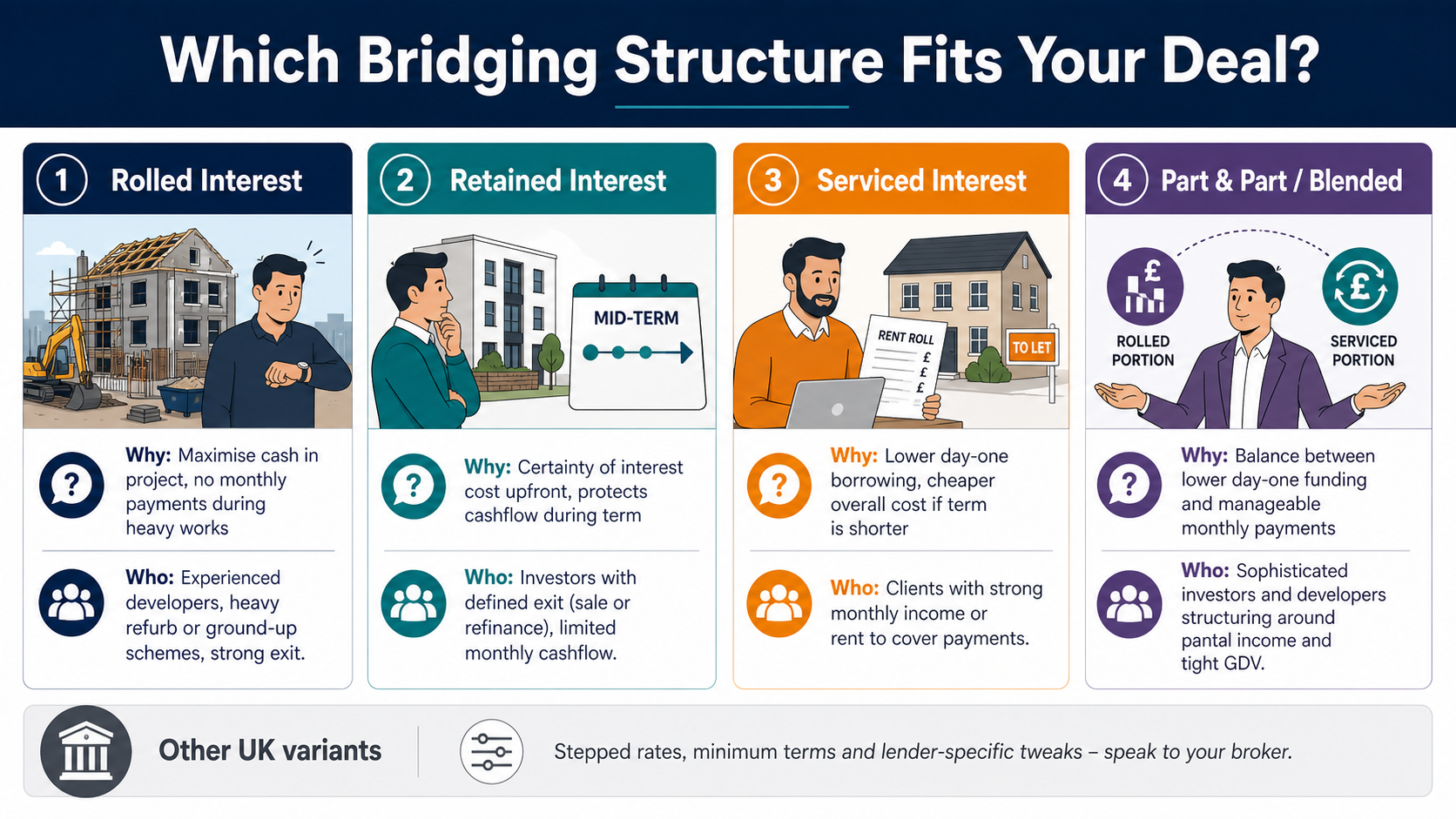
Retained interest is convenient but fixed to the original term. Serviced interest keeps the balance stable but needs cashflow. Rolled-up interest preserves cash but erodes equity if the delay is long. The right choice depends on how much slack your scheme and balance sheet have, and we would rather test that on paper than in month eleven.
4. Build a second exit
If the primary exit is a development facility on the back of consent, the second might be a sale of the site with or without permission, a refinance onto a term loan against its current value, or partner capital. A lender wants to see that the exit survives a delay. So do you.
5. Use the planning route actively
If an authority overruns, you can appeal against non-determination once the statutory period or an agreed period has passed. The planning guarantee fee refund applies only if no appeal is made and the application is still undecided after 26 weeks for a major application or 16 weeks for a non-major one, unless a longer period was agreed. The official guidance sets out both routes. Treat an appeal as a decision with its own timeline, not a shortcut, and take planning advice before agreeing any extension of time with the council, because it can affect your rights.
6. Consider whether bridging is the right tool
If the scheme is going to need a long planning process, a bridge may be the wrong shape of debt. Sometimes the answer is a lower-geared acquisition facility, a longer-term loan against existing assets, or a joint venture partner who takes planning risk with you. Our guide to how stacked debt can be structured when margins are tight covers the layers, and our overview of types of property finance for UK developers helps compare them.
Questions to ask a lender before you sign
- What is the extension fee, and is it fixed in the facility letter?
- Is interest retained, serviced or rolled up, and what happens to the retained amount if I extend?
- Do you revalue on extension, and could that change the LTV?
- What is the default rate, and which events trigger it besides missed payments?
- Which costs (legal, valuation, monitoring) can you charge me on enforcement?
- Will you lend against a planning-dependent exit, or only a sale or refinance of the existing asset?
Lenders differ widely on these answers, which is why comparing bridging lenders on terms, not only headline rate, matters.
How we approach planning-dependent bridges
We arrange bridging and development finance for UK developers, investors and high-net-worth clients, working with specialist lenders, private credit funds and family offices beyond the high street. On a deal where planning timing is the main risk, we start by stress-testing the timetable, then match the structure to lenders who accept that risk.
If you are comparing options, our bridging finance page sets out how we work, and our guide to arranging bridging finance for property deals walks through the process. If the end goal is a build, see our development finance service, which also covers mezzanine and joint venture equity.
Talk to us before the clock starts. Contact James William & Co Capital with your site, your planning position and your intended exit, and we will tell you plainly whether a bridge fits or whether another structure serves you better.
Our perspective
We see the same pattern on planning-dependent deals. The headline rate gets the attention, but the deals that go wrong are the ones where the term was set on the statutory date, the extension was never discussed, and the exit lender was only approached once consent landed.
Our view is that planning risk should be priced and structured at the start, not managed in a panic at the end. That means being candid with the lender about the timetable, choosing an interest structure that survives a slip, and holding a second exit in reserve. Because we work with a broad range of specialist lenders and funds, we can often place a deal with a funder who already understands consent risk, rather than asking a lender who does not to stretch.
It also means saying no sometimes. If a bridge is the wrong tool for a scheme with a long, uncertain planning path, we would rather say so and restructure than arrange a loan that is likely to need rescuing. Expect the same candour whether you are an experienced developer or doing your first scheme.
— James William Dawes
FAQ
What happens to my bridging loan if planning permission is delayed?
The loan continues to run on its agreed terms, so interest keeps accruing and the term keeps shrinking. You will usually need to ask the lender for an extension, which may carry a fee and a fresh look at your exit, or refinance elsewhere. If neither happens before the term ends, default provisions and enforcement costs in your facility letter can apply.
How long can a planning decision take in England?
The statutory periods are 8, 10 or 13 weeks depending on the type of development, and 16 weeks for EIA applications, per government guidance. In practice many councils overrun, and the planning guarantee only expects decisions within 26 weeks for major and 16 weeks for non-major applications. Plan on the realistic figure for your authority, not the target.
Can I appeal if the council takes too long?
Yes. If a valid application is not determined within the statutory or agreed period, you can appeal against non-determination. Speak to a planning consultant first, because an appeal has its own timeline and agreeing extensions of time with the council can affect your position.
Is a bridging loan a good idea before planning is granted?
It can be, if the term allows for a realistic delay, the extension terms are agreed and you have a second exit. Where permission is uncertain or likely to take a long time, a different structure such as a lower-geared facility or a joint venture partner may fit better. A broker can compare these against your timetable.
Do I need a different exit strategy if planning is slow?
Yes, ideally two. The primary exit might be a development facility once consent is granted, with a fallback such as selling the site or refinancing against its current value. Lenders tend to look more favourably on a plan that still works if the decision slips.
Sources
- Determining a planning application, GOV.UK
- Planning delays are holding back England’s housing and infrastructure goals, Home Builders Federation
- Delayed, derailed and devalued: how the UK’s planning crisis is undermining British manufacturing, Designing Buildings
- Delays and barriers experienced in the planning applications process, final report
- FCA direction on MCOB 11.6, Capital Bridging Finance (London) Ltd
- Conditions for Commercial Facilities, December 2018 to 2024
- Planning risk and development, LSE London
Recommended
- Bullet vs Amortising Loans in UK Property Finance: Plan the Exit First
- Conversion Finance vs New Build: Which Funding Fits?
- How to Structure a Development Finance Deal When Margins Are Tight
- Bridge to let: a UK investor’s guide to the two-stage strategy
You must keep up your repayments to avoid repossession. We are not a lender. James William & Co Capital Ltd is an Appointed Representative of Flexi Network Ltd, FRN: 1060247. Flexi Network Ltd is authorised and regulated by the Financial Conduct Authority, FRN: 948658. Flexi Network Ltd is an authorised credit broker and not a lender. You can verify both on the Financial Services Register at register.fca.org.uk.
Related Topics
Speak to a specialist
Discuss your finance with James directly
Whole-of-market specialist finance — bridging, development, commercial and residential. No call centres, no obligation. James reviews every enquiry personally.
New to specialist finance? How unbiased broker advice works · Deals we have completed
Explore Related Finance