
Published · Updated
explaining loan amortisationLoan amortisation explained: calculate and check your schedule
By James Dawes, CeMAP, Founder, James William & Co Capital

Loan amortisation is a fixed-payment repayment structure where each monthly instalment covers the interest owed on the remaining balance plus a slice of the principal, so the debt reaches exactly zero by the final payment. Three things every borrower should know immediately: early payments are mostly interest (not principal), which is why overpaying in the first few years saves disproportionately more; the combination of interest rate and term determines your total cost far more than the monthly payment figure alone; and you are entitled to request a full amortisation schedule from any lender before signing, so you can see every payment broken down before you commit. The standard formula behind all of this is M = P × [r(1+r)^n] / [(1+r)^n − 1], and the CMC Markets amortisation glossary confirms this is the accepted method used by UK lenders.
- Early payments are weighted heavily toward interest because the outstanding balance is at its highest.
- A longer term lowers monthly payments but increases total interest paid, sometimes dramatically.
- Always ask for the full amortisation schedule before accepting a loan offer.
Key takeaways
Loan amortisation works on a single, verifiable formula: each fixed payment covers interest on the remaining balance first, with the rest reducing principal, so the debt reaches zero at maturity.
| Point | Details |
|---|---|
| Verify your monthly payment | Use M = P × [r(1+r)^n] / [(1+r)^n − 1] with your principal, monthly rate, and term to check any lender’s figure. |
| Check the first-month split | Multiply opening balance by the monthly rate; the result is your first interest charge and the hardest figure to fake. |
| Overpay to shorten the term | Reducing the term saves more total interest than reducing the monthly payment, provided there is no prepayment charge. |
| Request the full schedule | Ask for every payment row before signing; confirm the final balance is zero and the APR matches the offer letter. |
| Separate loan and accounting amortisation | In financial models, keep cash debt service and intangible amortisation as distinct line items to avoid covenant errors. |
Table of Contents
- How does loan amortisation work in practice?
- The standard amortisation formula and a worked example
- How to read an amortisation schedule
- Common amortisation variants and pitfalls to watch for
- How overpayments and refinancing change your schedule
- Loan amortisation versus accounting amortisation
- Questions to ask your lender before signing
- Build and verify your own amortisation schedule in a spreadsheet
- Why getting amortisation right matters for property and business borrowers
- Sources
- FAQ
How does loan amortisation work in practice?
The core mechanic is straightforward: each month, the lender charges interest on whatever principal remains outstanding, then the rest of your fixed payment reduces that principal. Because the balance falls a little each month, the interest charge the following month is slightly smaller, so a larger slice of the same fixed payment goes toward principal. This compounding effect starts slowly and accelerates, which is why a repayment mortgage feels like it barely dents the balance in the early years.
Picture a typical mortgage where, in early months, the interest portion of your fixed payment is much higher than the portion reducing principal, illustrating how initial payments are mostly interest while principal repayment starts small and grows over time. By year 20, the outstanding balance might be around £60,000, so the monthly interest charge is closer to £225, and roughly £886 of the same payment goes to principal. The payment never changes; the split inside it does.
Lender quirks can create small discrepancies between your own calculation and the official schedule. First-month handling varies: some lenders charge interest from the drawdown date to the end of that calendar month as a separate “stub” payment, then begin the regular monthly cycle. Last payments are often a few pence different due to accumulated rounding. Payment dates matter too, because a lender calculating on a 365-day basis rather than a 30/360 convention will produce slightly different figures. UK loan calculators note that these rounding and timing differences are the most common reason a borrower’s own spreadsheet does not match the lender’s schedule exactly.
The standard amortisation formula and a worked example
The formula every UK lender and calculator uses is:
M = P × [r(1+r)^n] / [(1+r)^n − 1]
Where:
- M = monthly payment
- P = principal (the amount borrowed)
- r = monthly interest rate (APR ÷ 12, expressed as a decimal)
- n = total number of monthly payments (years × 12)
A quick note on APR versus nominal rate: the APR (Annual Percentage Rate) includes fees and is the legally required disclosure figure in the UK. For the formula, you use the nominal annual rate divided by 12 to get the monthly rate. If a lender quotes a 6.9% APR with no additional fees, the nominal rate and APR are effectively the same for calculation purposes, giving a monthly rate of 0.069 ÷ 12 = 0.00575.
Step-by-step worked example: £10,000 at 6.9% APR over 60 months
- Identify the inputs. P = £10,000; APR = 6.9%; n = 60 months; r = 0.069 ÷ 12 = 0.00575.
- Calculate (1+r)^n. (1.00575)^60 = approximately 1.4083.
- Apply the numerator. P × r × (1+r)^n = £10,000 × 0.00575 × 1.4083 = £81.00 (rounded).
- Apply the denominator. (1+r)^n − 1 = 1.4083 − 1 = 0.4083.
- Divide. M = £81.00 ÷ 0.4083 = approximately £198.37 per month.
The UKCalculator loan repayment tool produces a figure of approximately £197.47 for this example, with the small difference attributable to rounding at intermediate steps. Always carry full decimal precision through the calculation and round only the final answer.
First-month split:
- Interest = £10,000 × 0.00575 = £57.50
- Principal = £198.37 − £57.50 = £140.87
- Remaining balance after payment 1 = £10,000 − £140.87 = £9,859
That £57.50 interest charge is the highest it will ever be on this loan. From month two onward, it falls slightly every single month.
How to read an amortisation schedule
An amortisation schedule is a table listing every payment from month one to the final settlement, with each row showing exactly where your money goes. Investopedia’s amortisation reference confirms the standard columns: payment number, payment date, total payment, interest portion, principal portion, and outstanding balance.
What each column tells you:
- Payment number / date: the sequence and calendar date of each instalment.
- Payment amount: the fixed monthly sum (constant throughout for a standard amortising loan).
- Interest portion: interest charged on the opening balance for that period.
- Principal portion: the amount by which the outstanding balance actually falls.
- Outstanding balance: the debt remaining after that payment, which should reach £0.00 on the final row.
First-year schedule sample: £10,000 at 6.9% APR over 60 months
Rounding note: individual rows may show ±£0.01 variance due to rounding at each step. The final balance at payment 60 should be £0.00; if it is not, the lender has applied a different rounding convention.
What to check on any schedule you receive:
- The final row balance must be zero (or within a few pence if a rounding adjustment is applied to the last payment).
- Multiply the monthly payment by the number of payments and compare to the sum of all interest and principal columns — they must reconcile.
- Verify the first-month interest manually: opening balance × monthly rate. If it does not match, ask the lender which rate they used.
- Confirm the APR stated on the schedule matches the APR on your loan agreement.
Common amortisation variants and pitfalls to watch for
Standard fixed-payment amortisation is not the only structure lenders offer, particularly in commercial and property finance. LexisNexis UK’s amortisation glossary notes that schedules can be sculpted, include balloon payments, or even be negatively amortising under specific structures, each of which carries distinct risks for covenant compliance and refinancing.
Common variants:
- Interest-only periods: payments cover only the interest charge; the principal does not reduce. Common in bridging finance and some buy-to-let mortgages. The full principal remains outstanding at the end of the interest-only window, requiring either a lump-sum repayment or a switch to a repayment structure.
- Balloon repayment: the loan amortises partially over the term, but a large lump sum (the “balloon”) remains due at maturity. Often used in commercial mortgages where the amortisation period is longer than the loan term.
- Sculpted repayments: capital repayments are varied each period to match anticipated cashflow, common in development finance where income arrives in stages. Always request the underlying calculation to verify the sculpt.
- Negative amortisation: monthly payments are set below the interest charge, so the shortfall is added to the outstanding balance. The debt grows rather than shrinks. This can arise in some adjustable-rate structures when rates rise sharply.
Pitfalls that catch borrowers out:
- Confusing the nominal rate with the APR. A loan quoted at 6.5% nominal with arrangement fees can carry an APR above 7%, materially changing total cost.
- Mismatched amortisation period and loan term. A 25-year amortisation period on a 5-year loan term means a balloon payment is due at year five, which is not always clearly signposted.
- Prepayment penalties. Many commercial loans include early repayment charges, sometimes calculated as a percentage of the outstanding balance or as a yield-maintenance formula. Read the loan agreement before making any overpayment.
- Hidden fees rolled into the balance. If an arrangement fee is added to the loan rather than paid upfront, the amortisation schedule starts from a higher principal, increasing every interest charge.
How overpayments and refinancing change your schedule
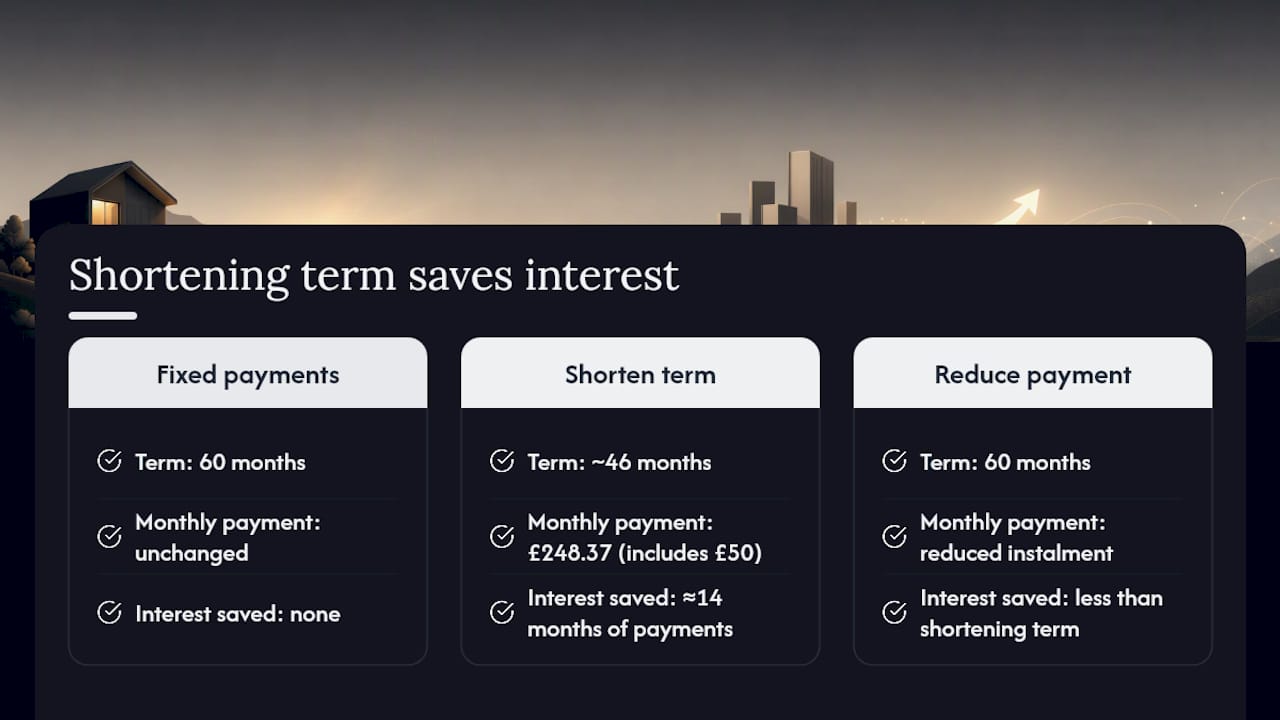
Making extra payments is one of the most effective ways to reduce total interest, but the mechanics depend on how the lender applies the overpayment. Investopedia confirms the two standard outcomes: keep the monthly payment the same and shorten the term, or reduce the monthly payment while keeping the term unchanged.
Scenario A: overpay to shorten the term
Using the £10,000 example above, suppose you pay an extra £50 per month from month one, bringing total monthly payments to £248.37. The extra £50 goes entirely to principal, accelerating the balance reduction. The loan would clear in roughly 46 months rather than 60, saving approximately 14 months of payments and the interest that would have accrued on the remaining balance during that period. The total interest saving is meaningful precisely because the interest charges in months 47–60 would have been relatively small, but eliminating them also eliminates the compounding effect on any future borrowing.
Scenario B: reduce the monthly payment
Some lenders recalculate the monthly payment after a lump-sum overpayment, keeping the original term but lowering the instalment. This improves monthly cashflow but saves less total interest than shortening the term, because the loan runs for the same number of months.
Refinancing resets the amortisation clock. Moving from a 6.9% rate to a 5.0% rate on the remaining balance sounds straightforwardly beneficial, but if the new loan restarts on a fresh 60-month term, you are paying interest for longer on a balance that was already partly amortised. Always model the total interest across the full remaining life of both options, not just the monthly payment difference.
Pro Tip: Before making any overpayment, locate the “early repayment charge” or “prepayment fee” clause in your loan agreement — typically in the “Repayment” or “Fees and Charges” section. If the charge exceeds the interest saving, overpaying is counterproductive.
Small changes to APR or term can shift total interest substantially. Shortening a term raises the monthly payment but can reduce total interest by a significant margin, making term choice one of the most important levers a borrower has when structuring property or business finance.
Loan amortisation versus accounting amortisation
The word “amortisation” appears in two entirely different contexts, and mixing them up in a financial model or conversation with an adviser can cause real errors.
| Feature | Loan amortisation | Accounting amortisation |
|---|---|---|
| What it covers | Repayment of a debt (principal + interest) | Spreading the cost of an intangible asset over its useful life |
| Cash flow effect | Cash leaves the business each period | Non-cash expense; no cash movement |
| Applies to | Mortgages, loans, credit facilities | Patents, goodwill, software licences, trademarks |
| Accounting standard | Loan agreement / lender schedule | FRS 102 (UK GAAP) or IFRS |
| Method | Fixed-payment formula | Straight-line or reducing-balance |
A practical example: a company repays £2,000 per month on a commercial mortgage (loan amortisation, cash out) and simultaneously charges £500 per month to write down the cost of a patent it acquired (accounting amortisation, non-cash). Both appear on financial statements, but only the mortgage repayment affects the cash flow statement. HMRC’s corporate intangibles manual sets out the UK tax treatment of intangible amortisation under the corporate intangibles regime, which is entirely separate from how a loan repayment schedule is structured.
The distinction matters most when building debt-service forecasts or reviewing covenant tests. A lender’s debt-service cover ratio (DSCR) covenant is calculated on cash debt service, not on accounting amortisation of intangibles. Conflating the two understates or overstates the DSCR and can trigger a technical breach. For property developers and investors working across UK real estate debt structures, keeping these two line items separate in every model is non-negotiable.
Questions to ask your lender before signing
Receiving a loan quote without a full amortisation schedule is like agreeing to a journey without seeing the route. Here is a ready-to-use checklist for any borrower or property professional reviewing a finance offer.
Before you sign, request and verify:
- The full amortisation schedule for the entire loan term, not just a summary of monthly payments.
- Confirmation of whether the schedule uses APR or the nominal rate to derive the monthly rate, and the exact monthly rate applied.
- How the first payment is calculated: does it cover a partial month from drawdown to month-end, or does the regular cycle begin immediately?
- How the final payment is calculated: is it the same as all others, or adjusted for accumulated rounding?
- The prepayment terms: is there a charge for overpayments, a minimum overpayment amount, or a window during which overpayments are not permitted?
- Whether any fees (arrangement fee, broker fee, valuation fee) are added to the loan balance or charged separately, and how each affects the schedule.
Sample questions to put to a lender or broker:
- “Can you provide the full amortisation schedule showing each payment’s split between interest and principal?”
- “What monthly rate have you used to produce this schedule, and how does it relate to the APR on the offer letter?”
- “Is there an early repayment charge, and if so, how is it calculated?”
- “Does the first payment cover a partial month, and if so, what is the exact amount?”
Keep the signed loan agreement, the amortisation schedule, and any correspondence confirming rate or fee changes in one place. If the lender later adjusts the schedule (for example, after a rate change on a variable product), request an updated schedule and reconcile it against the original. Discrepancies of more than a few pence per row warrant a written explanation from the lender.
Build and verify your own amortisation schedule in a spreadsheet
Building the schedule yourself takes about 20 minutes and gives you a precise cross-check against any lender’s figures. Use a loan amortisation calculator first to confirm your monthly payment, then replicate the logic in a spreadsheet.
Step-by-step spreadsheet recipe:
- Set up input cells. In cells B1, B2, B3, enter: Principal (e.g., £10,000), Annual rate (e.g., 0.069), Term in months (e.g., 60). Use absolute references ($B$1, $B$2, $B$3) throughout.
- Calculate the monthly payment. In B4, enter:
=B1*(($B$2/12)*(1+$B$2/12)^$B$3)/((1+$B$2/12)^$B$3-1). This is the formula M = P × [r(1+r)^n] / [(1+r)^n − 1] in spreadsheet form. - Create the schedule headers. In row 6, label columns: Payment No., Opening Balance, Payment, Interest, Principal, Closing Balance.
- Row 7 (payment 1). Opening Balance = B1. Payment = $B$4. Interest = Opening Balance × ($B$2/12). Principal = Payment − Interest. Closing Balance = Opening Balance − Principal.
- Row 8 onward. Opening Balance = previous row’s Closing Balance. Copy the Payment, Interest, Principal, and Closing Balance formulas down for all 60 rows.
- Lock the rate and term references. Every Interest formula must reference $B$2 (absolute), not B2 (relative), or the rate will shift as you copy rows down.
Validation checks to run before trusting the schedule:
- Closing balance in row 66 (payment 60) must equal £0.00 or within ±£0.01.
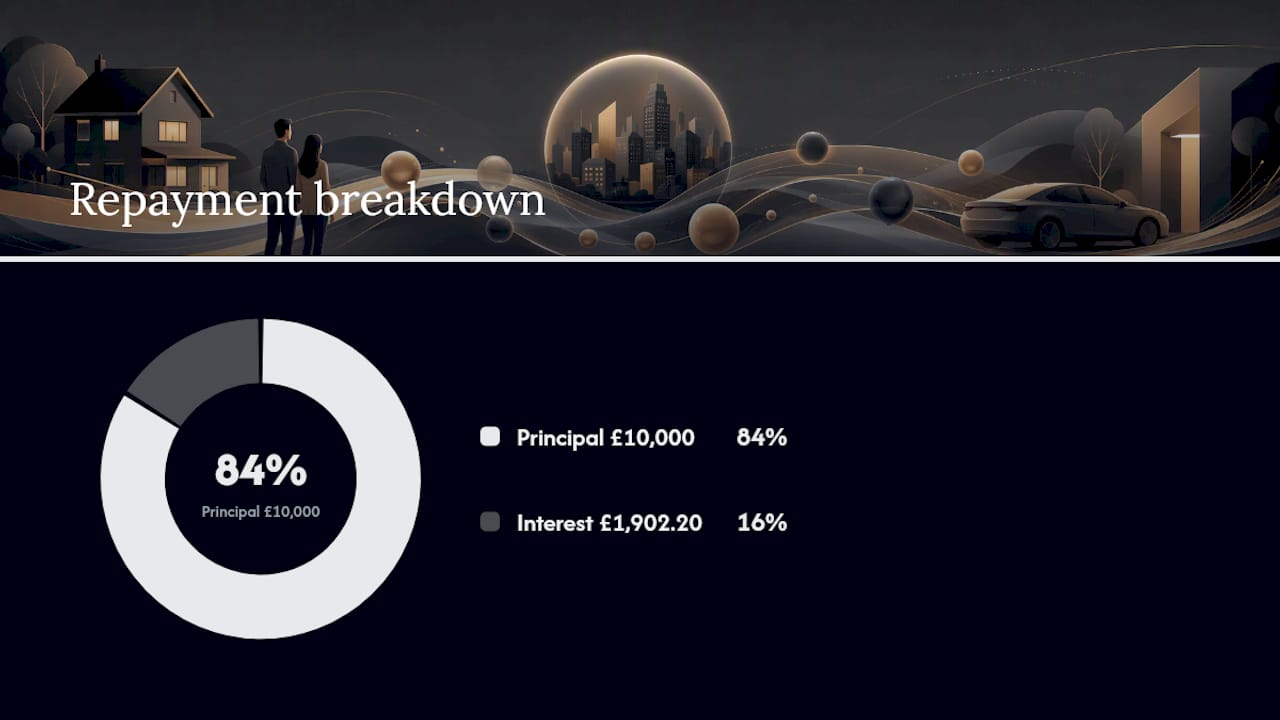
- Sum of the Interest column should equal total amount repaid minus original principal (£198.37 × 60 − £10,000 = approximately £1,902.20 in total interest for this example).
- Payment 1 interest cell must match your manual calculation: £10,000 × (0.069/12) = £57.50.
- If any closing balance goes negative before the final row, check for a formula fill error where the rate reference has shifted.
Common spreadsheet pitfalls:
- Using a relative reference for the monthly rate so it shifts as rows are copied, producing nonsense figures from row 8 onward.
- Entering the annual rate as a percentage (6.9) rather than a decimal (0.069), which inflates every interest charge by a factor of 100.
- Date handling: if you use actual calendar dates rather than payment numbers, ensure the date formula increments by one month correctly, particularly across February and month-end dates.
The UKCalculator loan repayment tool is a reliable cross-check once your spreadsheet is built. If the two differ by more than £0.02 on any row, recheck your rate input and rounding approach.
Why getting amortisation right matters for property and business borrowers
Precise amortisation modelling sits at the centre of every lending decision we work on at James William & Co Capital. Whether the structure is a straightforward commercial mortgage or a multi-tranche development facility with sculpted repayments tied to practical completion milestones, the amortisation profile determines debt-service cover, covenant headroom, and ultimately whether a deal is fundable at the terms a client needs.
The worked examples in this article apply directly to residential and buy-to-let mortgages, but the same arithmetic underpins far more complex structures. In bridging and development finance, where repayment may be interest-rolled or tied to an exit event, understanding the standard formula makes it easier to interrogate a lender’s term sheet and spot where a sculpted schedule diverges from a simple amortising one. For investors reviewing UK property finance trends and considering refinancing decisions, the total-interest comparison across different amortisation profiles is often the decisive number.
If your loan involves bespoke repayment terms, a balloon, or a sculpted schedule, the standard formula is a starting point, not the whole answer. That is where a specialist adds genuine value. James William & Co Capital works with property developers, investors, and high-net-worth clients to structure and verify amortisation profiles across bridging, development, and commercial finance. For complex or bespoke funding, speak to a specialist who can model the full schedule and stress-test it against your cashflow before you commit.
Sources
Use external calculators to cross-check your figures. The lender’s official offer letter and amortisation schedule remain the binding documents.
This article is general information, not a substitute for advice from a qualified financial advisor. Consult a qualified financial professional about your own circumstances before acting on anything here.
FAQ
Can you explain loan amortisation in simple terms?
Each month you pay a fixed amount; part covers the interest on what you still owe, and the rest reduces the debt. The split shifts over time: early payments are mostly interest, later ones mostly principal, until the balance hits zero.
How do you amortise a loan?
Apply the formula M = P × [r(1+r)^n] / [(1+r)^n − 1] to find the fixed monthly payment, then each month calculate interest on the remaining balance, subtract it from M, and reduce the balance by the difference. Repeat until the balance is zero.
Is there a downside to loan amortisation?
The main drawback is front-loading: because interest is charged on the full outstanding balance first, you repay very little principal in the early months. If you sell or refinance early, you will have paid proportionally more interest and reduced the balance less than you might expect.
What is the difference between loan amortisation and accounting amortisation?
Loan amortisation is a cash repayment schedule that reduces a debt to zero. Accounting amortisation is a non-cash accounting entry that spreads the cost of an intangible asset (such as a patent or goodwill) over its useful life under FRS 102 or IFRS. The two have no mechanical connection.
Recommended
Related Topics
Speak to a specialist
Discuss your finance with James directly
Whole-of-market specialist finance — bridging, development, commercial and residential. No call centres, no obligation. James reviews every enquiry personally.
New to specialist finance? How unbiased broker advice works · Deals we have completed
Explore Related Finance