
Published · Updated
fixed vs floating rateAvoid Breakage: Fixed or Floating Rate for Borrowers, 5 Year Example
By James Dawes, CeMAP, Founder, James William & Co Capital

A fixed rate locks your interest cost for an agreed term, so your payment stays the same regardless of what markets do. A floating rate moves with a benchmark such as SONIA or the Bank of England’s Bank Rate, meaning your cost rises and falls with the market. The trade-off is simple: fixed buys certainty, floating buys flexibility, and both show up across mortgages, commercial loans, bonds and currency regimes.
TL;DR:
- A fixed rate offers certainty and is best suited for borrowers with a known exit or refinancing timeline within 2 to 5 years, while floating rates benefit those expecting rates to fall or planning an early sale.
- Fixed rates often carry a premium for longer terms and can incur substantial breakage costs if repaid early, so borrowers must carefully consider their project duration.
- Floating rates are set by a reference like SONIA or Bank Rate, which may require compounding calculations and complicate cashflow forecasting for tight-margin projects.
- Interest rate swaps allow borrowers to hedge floating obligations into fixed payments, but they involve counterparty risk and require active management.
- Matching the rate structure to your actual timeline and stress-testing against rate rises are essential steps before choosing fixed or floating, especially for complex development or structured property finance.
Table of Contents
- Fixed vs floating rate: a quick comparison by context
- How does a fixed rate actually work?
- How does a floating rate get set and reset?
- What are interest rate swaps and how do they hedge risk?
- When should you choose fixed over floating?
- A worked example: fixed vs floating over five years
- What hidden costs and risks should you check first?
- SONIA vs LIBOR: what changed and what to check
- How James William & Co Capital applies fixed vs floating in practice
- Three things to remember about fixed vs floating rate decisions
- How specialist brokers can help you decide
- Sources
- FAQ
Fixed vs floating rate: a quick comparison by context
The right choice depends heavily on where you’re borrowing and for how long.
- Mortgages and buy-to-let: fixed suits landlords who want stable monthly costs over a 2 to 5 year term; floating (tracker or SVR) suits those expecting rates to fall or planning an early sale.
- Commercial loans and development finance: fixed protects tight development budgets; floating often costs less upfront but demands cashflow headroom.
- Bonds: fixed-coupon bonds appeal to income investors; floating-rate notes appeal when rates are expected to climb.
- Exchange rates: fixed pegs need central bank reserves to defend; floating regimes let the market adjust, avoiding that reserve burden but accepting more volatility.
Longer fixed terms generally carry a rate premium in exchange for that certainty.
How does a fixed rate actually work?
A fixed rate holds your interest cost steady for a set period, commonly 2, 5 or 10 years on mortgages and commercial loans, or the full life of a bond in the case of a fixed coupon. Lenders typically hedge this promise themselves, often using swaps, and that hedge is precisely why exiting early can be costly.
- Payment certainty makes budgeting and covenant compliance far easier for a business borrower.
- Breakage costs apply if you repay or refinance before the term ends, because the lender’s own hedge needs unwinding.
- Fixed terms suit projects with a known, fixed timeline.
Pro Tip: Ask your lender for the exact breakage cost formula before signing, not just an example figure. Many quote a “typical” cost that bears no resemblance to what you’d actually pay if rates move sharply.
How does a floating rate get set and reset?
A floating rate is built from two parts: a reference rate plus a lender margin. The reference rate moves with the market; the margin usually stays fixed for the life of the facility.
- Trackers move directly with Bank Rate, resetting whenever the Bank of England changes it.
- SVRs (standard variable rates) are set at lender discretion, giving less transparency than a tracker.
- SONIA-linked facilities compound overnight rates over a set period, common on larger structured and development loans.
The practical catch is compounding. Because SONIA is backward-looking, your exact payment for a period often isn’t confirmed until near the end of it, which complicates cashflow forecasting for anyone running tight margins on a project.
What are interest rate swaps and how do they hedge risk?
A plain vanilla interest rate swap lets a borrower exchange a floating obligation for a fixed one, or vice versa, without touching the underlying loan itself. One party pays a fixed rate, the other pays a floating rate on the same notional amount, and only the net difference actually changes hands.
- The borrower keeps their floating-rate loan but enters a swap paying fixed and receiving floating.
- The floating payments received from the swap roughly cancel the floating payments owed on the loan.
- The borrower is left paying, in effect, a fixed rate, a structure often called a synthetic fixed rate.
Corporate Finance Institute confirms that swaps settle only the net difference, with no exchange of the notional itself. PIMCO notes that because swaps trade over the counter, borrowers must actively manage counterparty credit risk and liquidity, not just the rate itself. On a multi-million pound facility, a one percentage point gap between the fixed and floating legs translates to a significant amount changing hands each year, a useful sanity check when a lender quotes swap pricing.
When should you choose fixed over floating?
Match the decision to your specific circumstances rather than a general preference for one or the other.
- Match the fixed term to your holding or refinance horizon. A 5 year fix on an asset you plan to sell in year 3 wastes money on breakage risk.
- Stress-test your cashflow against a 2 to 3 percentage point rate rise before choosing floating.
- Weigh exit costs honestly. A cheap floating rate with heavy early-repayment penalties on the eventual refinance can cost more than a fixed deal.
- Developers and investors running tight interest cover ratios usually favour fixed or a swap-hedged structure during the build phase, then reassess at practical completion.
Pro Tip: If you’re within 18 months of a planned exit or refinance, ask whether a shorter fix or a capped floating product gets you closer to your actual horizon than a standard 5 year fix.
A worked example: fixed vs floating over five years
Assume a £1 million loan, a fixed rate of 6.0% for five years against a floating rate starting at 5.5% (SONIA plus margin).
- Fixed scenario: payments stay at 6.0% throughout, a known annual interest cost of £60,000.
- Floating scenario, rates fall: if the floating rate averages 5.0% over the five years, annual cost drops to roughly £50,000, saving £50,000 over the term versus fixed.
- Floating scenario, rates rise: if the floating rate averages 6.5%, annual cost rises to roughly £65,000, costing £25,000 more than fixed over the term.
The result flips entirely on where average floating rates land relative to the fixed rate you were offered. That’s the whole decision in miniature: fixed removes the guesswork, floating bets on the direction of Bank Rate.
What hidden costs and risks should you check first?
Several costs only surface once you’re locked into a structure, so check them before signing anything.
- Breakage costs on fixed deals can be substantial if you exit early, since the lender must unwind its own hedge.
- Basis risk arises when your loan references one benchmark but your hedge references another, or when lender discretion on SVRs breaks the link to Bank Rate entirely.
- Counterparty risk on swaps matters because these are bilateral contracts; if the counterparty weakens financially, your hedge weakens with it.
- Caps, collars and staged fixes offer a middle ground, capping the downside of floating without paying full fixed-rate premiums.
A partner guide on property risk management is worth a read if you’re weighing how rate volatility interacts with wider project risk, particularly on insurance and contingency planning.
SONIA vs LIBOR: what changed and what to check
LIBOR was phased out because it relied on bank submissions rather than actual transactions, leaving it open to manipulation and thin trading data. SONIA replaced it for sterling markets, based on actual overnight transactions and compounded backwards over a set period rather than quoted forward like LIBOR was.
- Backward-looking compounding (SONIA) confirms your exact rate near the end of the period, unlike LIBOR’s known-in-advance rate.
- Day count and compounding method in your facility agreement determine how that backward-looking rate actually applies to your payments.
- Fallback language matters if a benchmark is ever discontinued again; check what your contract defaults to.
Get these details wrong in the paperwork and your actual cashflow can diverge meaningfully from what a simple rate comparison suggested.
How James William & Co Capital applies fixed vs floating in practice
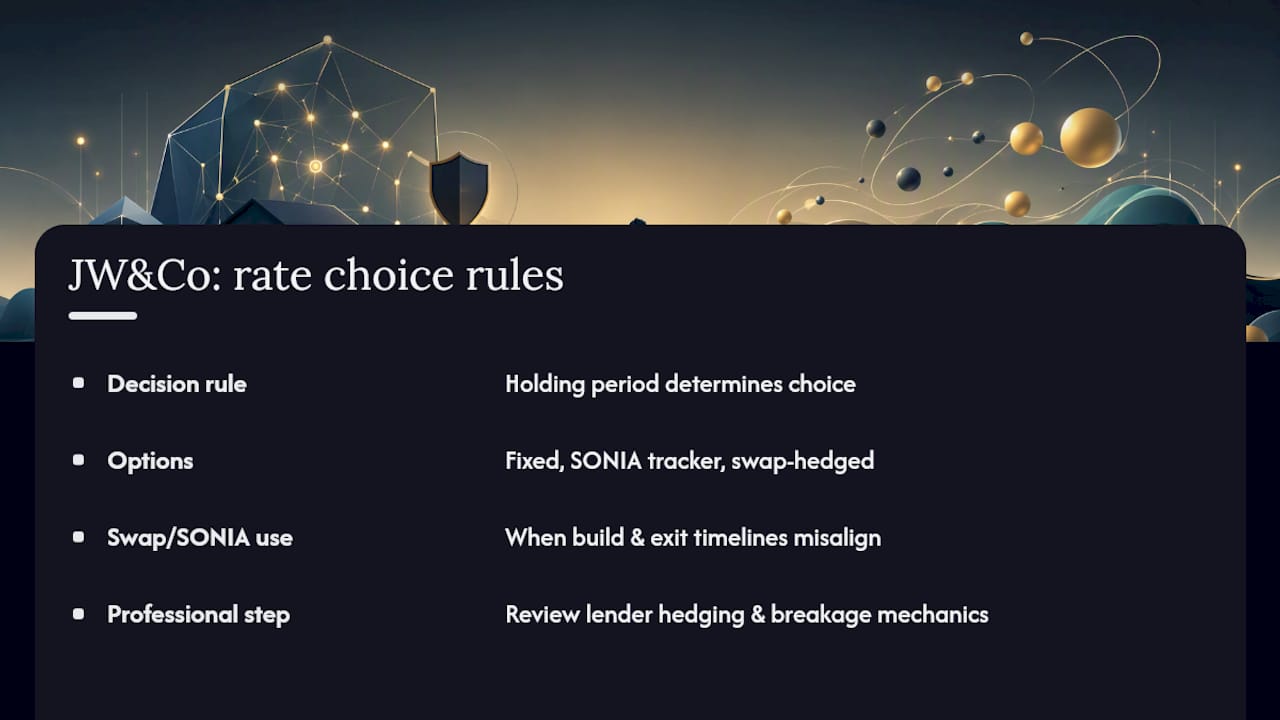
James William & Co Capital treats the fixed vs floating decision as a timeline problem before it’s a rate problem: the first question is always how long the client will hold the asset or project, not which headline rate looks cheapest today. That shapes whether a straight fix, a SONIA-linked tracker, or a swap-hedged structure fits best.
For professional clients, the process includes reviewing lender hedging exposure and likely breakage-cost mechanics before a facility is signed, to avoid surprises at refinance. On complex developments, structured property finance often uses swaps or SONIA-linked facilities specifically where the build timeline and exit plan don’t line up neatly with a standard fixed term.
Three things to remember about fixed vs floating rate decisions
Match the fixed term to your actual holding horizon, not the cheapest headline rate on offer. Stress-test any floating structure against a real rate rise before you commit, and always get a written, specific breakage-cost figure rather than a rough estimate. For anything beyond a straightforward residential mortgage, particularly development or bridging finance, get regulated advice before locking in a structure you can’t easily unwind.
— James William Dawes
How specialist brokers can help you decide
Specialist brokers give professional borrowers something a standard high-street lender rarely offers: a single point of contact who structures the fix vs float decision around your actual project timeline, not a generic rate table. They arrange bridging finance, development finance, structured commercial lending and hedging advisory, including swap and SONIA-linked structures for larger debt stacks.
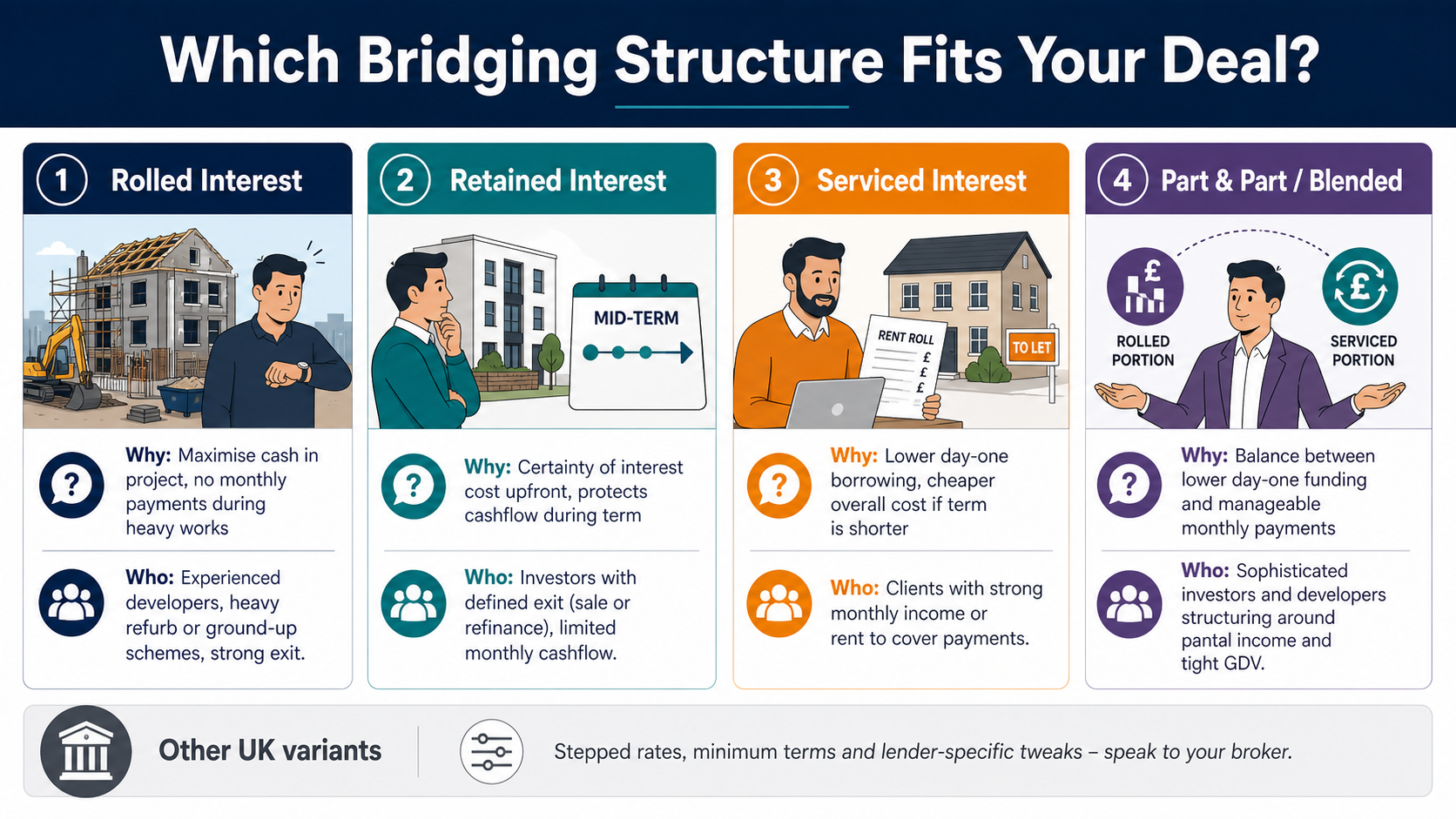
An initial engagement typically starts with a review of your existing facility documents and project timeline, followed by worked examples comparing fixed, floating and swap-hedged options against your actual cashflow, then direct negotiation with lenders on your behalf. If you’re weighing a fix against a floating structure on a development, refinance or acquisition, visit the specialist property finance page to talk through your numbers before you commit to a term.
Sources
- Interest rate swap | Corporate Finance Institute
- Understanding interest rate swaps | PIMCO
- Floating and fixed exchange rates - benefits and costs | tutor2u
FAQ
Is floating rate or fixed rate better?
Neither is universally better; fixed suits borrowers who need budget certainty or plan to hold long term, while floating suits those expecting rates to fall or needing an easy exit.
What is the difference between fixed and floating interest rates?
A fixed rate stays the same for the agreed term, while a floating rate moves with a reference benchmark like SONIA or Bank Rate plus a lender margin.
What is the difference between fixed and floating exchange rates?
A fixed exchange rate is pegged and defended by central bank reserves, while a floating exchange rate is set by market supply and demand, with the central bank influencing it only indirectly through Bank Rate.
Is it better to fix for 2 years or 5 years?
It depends on your horizon: a 2 year fix suits borrowers expecting to refinance or sell soon, while a 5 year fix suits those wanting longer certainty and willing to accept a rate premium for it. James William & Co Capital typically matches this choice to the project’s actual exit timeline rather than the cheapest rate on the day.
Recommended
Related Topics
Speak to a specialist
Discuss your finance with James directly
Whole-of-market specialist finance — bridging, development, commercial and residential. No call centres, no obligation. James reviews every enquiry personally.
New to specialist finance? How unbiased broker advice works · Deals we have completed
Explore Related Finance