
Published · Updated
jv equity structuresStop renegotiation: JV equity structures for UK developers
By James Dawes, CeMAP, Founder, James William & Co Capital

Most UK development joint ventures use a company SPV when a lender needs clean security and straightforward charges, or an LLP or limited partnership when tax transparency or an institutional investor’s mandate demands it. The right choice depends on lender preference, tax treatment, investor requirements and how much governance control each partner wants to retain.
TL;DR:
- Most UK development JVs prefer a company SPV for site-specific projects due to familiar security structures, despite the profits facing a corporation tax layer.
- LLPs are suitable when tax transparency is needed, but some lenders or investor mandates may restrict their use.
- Equity, member loans, and mezzanine financing must be carefully modeled against delayed completion scenarios to avoid financial shortfalls.
- Clear reserved matters, escalation procedures, and deadlock resolution mechanisms are crucial to prevent disputes in 50:50 joint ventures.
- Securing lender approval involves negotiating full security packages, guarantee caps, and subordination early in the process to avoid costly renegotiations later.
Table of Contents
- Common JV vehicle options and when to use each
- How equity, member loans and mezzanine sit in the capital stack
- Governance, reserved matters and deadlock resolution
- Returns: preferred returns, promotes and waterfall mechanics
- Funding and lender perspective: security packages, guarantees and subordination
- Tax and transactional costs that affect vehicle choice
- Applying these choices in practice: how James William & Co Capital approaches structuring JV finance
- Negotiation priorities and practical red flags
- How James William & Co Capital can help structure JV equity and layered finance
- Sources
- FAQ
Common JV vehicle options and when to use each
A company SPV is the default choice for most site-specific developments because lenders understand the structure, security is straightforward to grant and shares can be charged cleanly. The trade-off is a corporation tax layer on profits before any distribution reaches the partners. An LLP gives members tax transparency, so profits are taxed in the hands of members rather than at the vehicle level, though some lenders find the structure less familiar and some investor mandates cannot hold LLP interests. A two-tier limited partnership, typically a general partner paired with an LP vehicle, suits institutional or tax-exempt investors who need a recognised fund structure, at the cost of running two constitutional documents rather than one. A contractual JV, with no separate legal entity, offers flexibility and lower setup cost but can limit the security a lender is able to take over the arrangement.
- Choose a company SPV when a lender will be funding the site and wants a single charge point.
- Choose an LLP when the partners want tax transparency and lender familiarity is not a barrier.
- Choose an LP when an institutional or tax-exempt investor’s mandate requires it.
- Choose a contractual JV only for low-leverage or short-term arrangements where lender security is not a factor.
A practical rule of thumb: ringfence each development in its own SPV so lender liabilities and site-specific risks never cross into other projects.
How equity, member loans and mezzanine sit in the capital stack
Senior debt usually sits at the top of the stack by priority even though it is the last money drawn, with sponsor and investor equity absorbing the first losses. Member loans from partners often sit between the two, giving flexibility to fund early costs without diluting equity shares, but they need a cap and a clear interest rate so returns are not eroded if the project overruns. Mezzanine or preferred equity can bridge a shortfall between senior debt and available equity, though it changes the priority of distributions and can dilute the sponsor’s promote if drawn too heavily.
- Cap member loans at the outset and agree interest terms before drawdown begins.
- Set drawdown schedules against defined conditions precedent, not open discretion.
- Treat mezzanine as a priority claim ahead of equity, not as quasi-equity with equal risk.
Pro Tip: Model the capital stack against a delayed completion scenario before signing, not just the base case.
Governance, reserved matters and deadlock resolution
Reserved matters typically require a higher voting threshold than day-to-day decisions, and getting the list right at the outset avoids disputes later. A shareholders’ agreement commonly reserves annual budget approval, material changes to the business plan, major financing commitments and any change to the JV structure itself for unanimous or supermajority consent. In a 50:50 JV, an explicit deadlock process is essential because neither party can force a decision through outright.
- List reserved matters clearly, covering budgets, borrowing, land disposals and business plan changes.
- Set an escalation path: management discussion, then a partner-level meeting, then formal mediation.
- Include an expert determination clause for technical or valuation disagreements.
- Add a buy/sell or “Texas shoot-out” mechanism as a last resort for irreconcilable deadlock.
- Keep a delegation matrix alongside a living business plan so day-to-day decisions do not need partner sign-off.
Returns: preferred returns, promotes and waterfall mechanics
A preferred return is the minimum annualised return investors receive before the sponsor shares in any profit, typically calculated on drawn capital rather than committed capital. Once that hurdle is met, a catch-up provision lets the sponsor receive a larger share of subsequent profit until an agreed split is restored, after which the promote applies to profit above the hurdle. Waterfall ordering usually runs: development costs and agreed fees first, then senior debt service, then return of capital to investors, then the preferred return, and only then the sponsor’s promote.
- Keep fee allocation explicit; fees dressed up as development costs distort the waterfall and investor returns.
- Define exactly which costs qualify as development costs before the waterfall is drafted.
- Build in a mechanism for what happens if the waterfall is exhausted before the promote tier is reached.
Funding and lender perspective: security packages, guarantees and subordination
Lenders funding a development JV will typically want a full security package, including a legal charge over the site, a debenture over the SPV’s assets, and often a charge over shares or equitable interests in the vehicle. Personal or corporate guarantees may be requested where the sponsor’s covenant is thin, though these can often be capped or limited to cost overruns rather than the whole facility.
- Expect a legal charge, a debenture and possibly a share charge as standard lender requirements.
- Negotiate guarantee caps early rather than after terms are agreed in principle.
- Subordinate member loans and mezzanine explicitly in an intercreditor arrangement to avoid conflict with senior debt.
Pro Tip: Share a draft of the JV agreement with the lender’s solicitor before signing so security and governance terms are not renegotiated later. Our guidance on optimising real estate funding covers how to sequence this alignment.
Tax and transactional costs that affect vehicle choice
The choice between a partnership vehicle and a company often comes down to tax. Partnership structures such as LLPs and LPs are tax-transparent, so profits are taxed once at member level, whereas a company vehicle adds a corporation tax layer before distribution. Transferring land into a JV can also trigger a Stamp Duty Land Tax charge, and partnership structures may offer SDLT advantages over a company on certain transfers, though the detailed position depends on how the land and interests are structured.
- Model both structures’ tax outcomes before committing, not after the JV agreement is drafted.
- Expect some institutional investors to insist on an LP regardless of other trade-offs, because it fits their fund mandate.
- Take specific SDLT advice before any land transfer into the vehicle, since outcomes vary by structure.
Applying these choices in practice: how James William & Co Capital approaches structuring JV finance
Coordination of equity, member loans, mezzanine and senior debt as a single negotiation rather than sequential conversations can streamline the financing process, similar to a capital concierge approach. Typical arrangements may include matched funding where a landowner’s contribution is treated as equity alongside cash partners, loan-note mechanics for flexible drawdown, and capped guarantee structures agreed with the lender before terms are finalised. Before opening JV negotiations, it is recommended to have a draft business plan, an indicative capital stack and early sight of any lender’s security requirements, so the shareholders’ or members’ agreement can be drafted around what funding will actually allow.

Negotiation priorities and practical red flags
Prioritise funding certainty over headline promote, cap every guarantee before it is signed, and insist on a defined exit mechanism rather than leaving it to “future agreement”. Watch for vague reserved matters, uncapped member loans and waterfalls with no clause for what happens if cash runs short. Take tax and lender advice before the structure is fixed, not after.
— James William Dawes
How James William & Co Capital can help structure JV equity and layered finance
Structuring a development JV usually means negotiating equity, member loans, mezzanine and senior debt with several parties at once, and getting the sequencing wrong costs time developers rarely have. Some brokers work as a single point of contact across the whole capital stack, leveraging direct access to specialist lenders and private credit funds to move faster than a series of separate conversations would allow.
- Structuring JV equity alongside development finance and mezzanine as one coordinated package.
- Negotiating capped guarantees and lender security terms before they become a bottleneck.
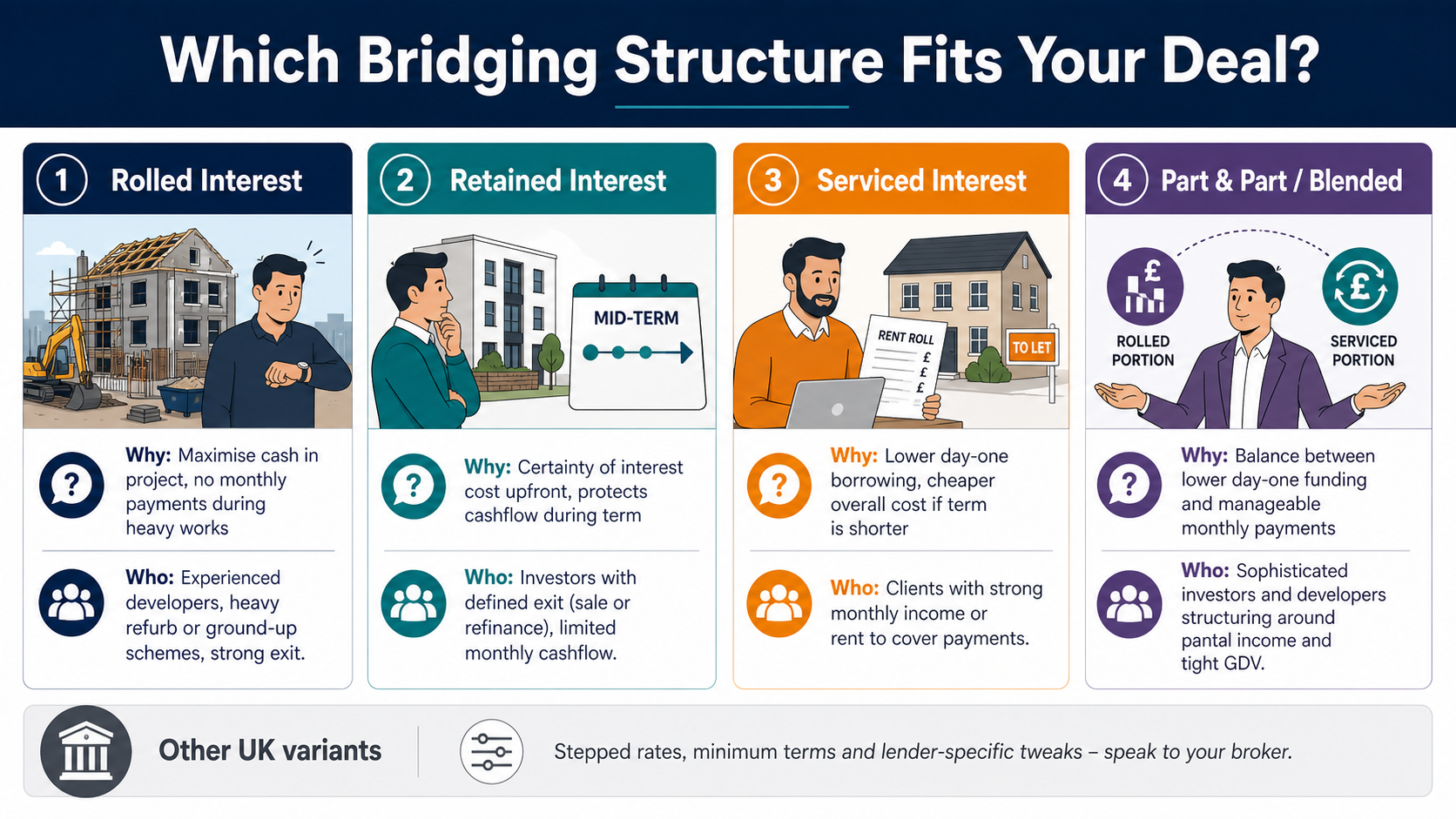
- Arranging bridging finance where short-term liquidity is needed alongside the JV.
If you are structuring a development JV and want the funding side settled early, talk to us about your development finance and JV equity requirements or explore bridging finance for interim cashflow needs.
Sources
- Joint venture shareholders’ agreement—deadlock and reserved matters (LexisNexis)
- Joint ventures in property development (RICS)
- Joint venture guidance (UK government publication)
FAQ
What is a JV structure?
A JV structure is the legal vehicle two or more parties use to develop or invest in property together, commonly a company SPV, an LLP, a limited partnership or a contractual arrangement with no separate entity. The choice shapes tax treatment, lender security and how decisions are governed between the partners.
What does JV equity mean?
JV equity is the capital partners contribute to a joint venture in exchange for an ownership stake and a share of profits, sitting below senior debt and any mezzanine in the capital stack. It typically carries the first risk of loss but also the upside once debt and preferred returns are paid.
What are the four types of joint ventures?
In UK property development, the four common forms are a company SPV, a limited liability partnership, a limited partnership, and a contractual joint venture with no separate legal entity. Each has different tax, governance and lender-security implications, as set out in government JV guidance.
Is a JV always 50/50?
No, a JV split can reflect whatever contribution and risk-sharing the partners agree, and many development JVs are structured unevenly based on land value, cash equity or development expertise. Where a JV is genuinely 50:50, an explicit deadlock resolution process becomes essential because neither partner can outvote the other.
Recommended
Related Topics
Speak to a specialist
Discuss your finance with James directly
Whole-of-market specialist finance — bridging, development, commercial and residential. No call centres, no obligation. James reviews every enquiry personally.
New to specialist finance? How unbiased broker advice works · Deals we have completed
Explore Related Finance