
Published · Updated
role of joint venture equityRole of joint venture equity in UK property development
By James Dawes, CeMAP, Founder, James William & Co Capital

TL;DR:
- Joint venture equity involves shared ownership in property projects, enabling resource pooling and risk spreading for UK developers and investors. Success depends on clear governance, precise profit-sharing structures, and proper tax planning from the outset. Mistakes often include neglecting detailed agreements and underestimating tax implications, which can undermine returns and project viability.
Joint venture equity is defined as a shared ownership stake in a property development vehicle, where two or more parties contribute capital, land, or expertise in exchange for a proportionate share of profits and losses. The role of joint venture equity in UK real estate is to enable developers and investors to pool resources, spread financial risk, and access projects that neither party could fund alone. Structures such as Special Purpose Vehicles (SPVs) and Limited Liability Partnerships (LLPs) sit at the heart of most UK JV arrangements. Understanding how these vehicles work, how profits are distributed, and how governance is managed separates successful partnerships from costly disputes.
What is the role of joint venture equity in property deals?
Joint venture equity, known in industry practice as equity participation in joint ventures, gives each party a defined ownership position in a project rather than a fixed debt return. JVs spread risk and amplify returns through collaboration, making them the preferred route for ground-up developments, large site acquisitions, and complex mixed-use schemes. That pooling effect is the core strategic advantage. A developer with land but limited capital pairs with an investor holding capital but no development pipeline. Both parties gain access to a project they could not execute independently.

The distinction between JV equity and debt financing matters. Equity JVs trade certainty for potential upside and longer timelines, suited to patient investors who accept higher risk in exchange for a share of development profit. Debt finance offers a fixed return and priority repayment. Equity sits below debt in the capital stack, meaning equity holders absorb losses first if a project underperforms. That risk profile shapes every structural and governance decision in a JV arrangement.
How are joint venture equity deals typically structured?
SPVs versus LLPs
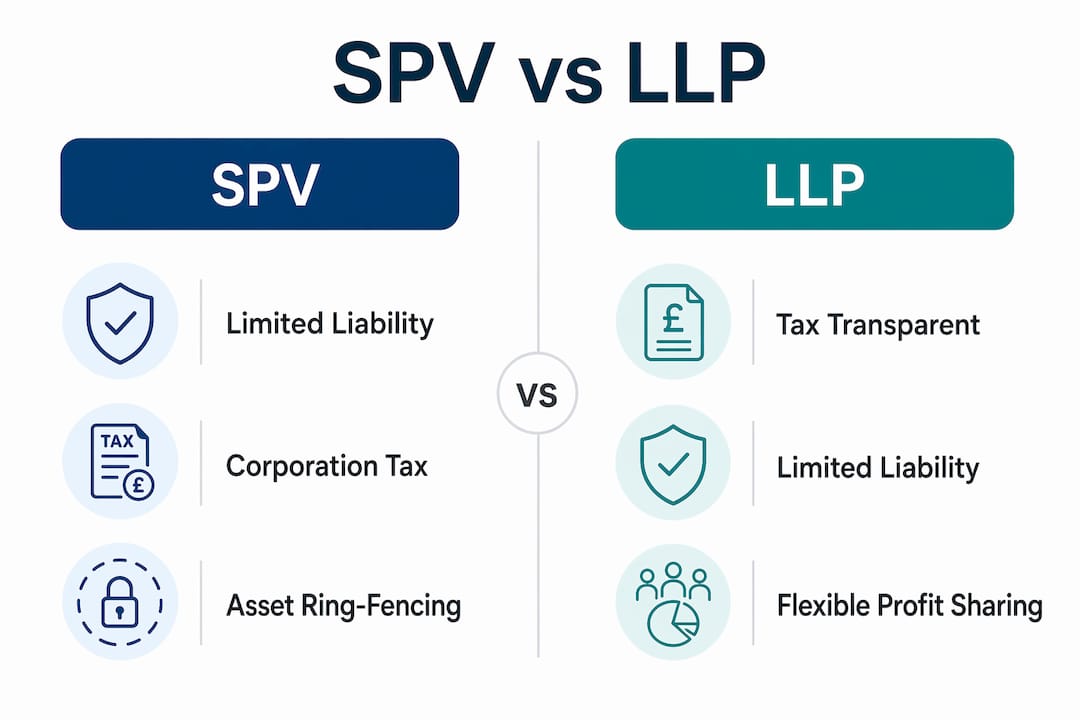
The SPV remains the preferred UK property JV structure for limited liability and asset ring-fencing in 2026, while LLPs are used when tax transparency is required. The choice between them has direct financial consequences. SPVs pay 25% corporation tax on profits, which requires careful dividend planning to avoid eroding returns. LLPs pass profits directly to partners, who pay income tax or capital gains tax at their individual rates. Neither structure is universally superior. The right choice depends on each partner’s tax position, the project timeline, and how profits will be extracted.
| Feature | SPV (Limited Company) | LLP |
|---|---|---|
| Liability | Limited to share capital | Limited, but different rules apply |
| Tax on profits | 25% corporation tax | Tax-transparent, passed to partners |
| Profit extraction | Via dividends or salary | Direct allocation to partners |
| Reporting | Companies House filings | Partnership tax returns |
| Control | Board and shareholder structure | Partnership agreement governs |
The profit waterfall and preferred returns
The waterfall’s sequence is foundational: investors receive their initial capital back first, then an 8–10% preferred annual return, and then remaining profits split with the developer promote paid last. That sequence protects the investor’s downside while giving the developer a meaningful upside for delivering the project. A poorly drafted waterfall can skew rewards unfairly. If the distribution sequence is ambiguous, investors may receive outsized returns despite a developer delivering strong performance, or developers may lose their promote through poorly worded trigger clauses.
Standard preferred returns range from 8–10% annually and act as a hurdle before any developer promote is earned. That hurdle aligns incentives. The developer only earns above-average returns by delivering above-average results.
Pro Tip: Negotiate the waterfall before agreeing headline profit splits. A 70:30 profit share means very little if the preferred return hurdle and return of capital sequence are not precisely defined in the shareholders’ agreement.
Cash call clauses
Cash call clauses require partners to contribute additional funds on cost overruns, often within windows as short as 10 working days. That timeline is tighter than most developers expect. Failure to fund a cash call can trigger dilution of equity, forced sale provisions, or project stoppages. Budgeting for contingency from day one, rather than treating cash calls as a last resort, is the mark of an experienced JV partner.
What governance and risk management does a JV equity deal need?
Governance is where most JV partnerships succeed or fail. 50:50 JV partnerships require strict governance arrangements to manage operational decisions and avoid deadlocks, with clear shareholder agreements defining reserved matters and dispute resolution processes. A handshake deal or a brief heads of terms document is not sufficient for a multi-million pound development.
The key governance elements every JV equity arrangement needs are:
- Decision rights: Define which decisions require unanimous consent, which require a simple majority, and which the developer can make unilaterally as operator.
- Reserved matters: List specific actions, such as taking on additional debt, changing the project scope, or appointing contractors above a set value, that require investor approval.
- Board composition: Agree on the number of directors each party appoints and how casting votes work in a deadlock.
- Dispute resolution: Include a formal escalation process, from senior management discussion through to independent expert determination or arbitration, before any party can exit.
- Exit provisions: Define drag-along and tag-along rights, buy-out mechanisms, and what triggers a forced sale.
Governance frameworks must also comply with updated Building Safety Act requirements to avoid liability and delays on residential schemes. The Building Safety Act 2022 places new duties on developers and building owners, and a JV structure does not dilute those obligations. Each party must understand their statutory duties as a director or partner, separate from their commercial rights as a shareholder.
Pro Tip: In a 50:50 JV, never rely on goodwill to resolve a deadlock. Agree a formal escalation mechanism in writing before the first pound of capital is committed. The cost of a well-drafted shareholders’ agreement is a fraction of the cost of a High Court dispute.
What are the financial implications of equity participation in joint ventures?
Equity JV investors sit at the bottom of the capital stack, bearing significant risk if costs overrun or market conditions worsen. Developer profit is often the first to evaporate in a cost overrun scenario, making the operator’s skill and contingency planning the primary risk mitigation tool. That reality shapes how developers should present their track record to prospective equity partners.
The financial implications for developers and investors include:
- Upside sharing: Developers access larger projects without committing all their own capital, but share the profit with the equity investor.
- Downside exposure: Both parties lose equity before any senior debt lender is affected. Equity is the most expensive capital in the stack precisely because it carries the most risk.
- Tax liabilities: Improper JV structuring can lead to double taxation or unexpected VAT, SDLT, and capital gains liabilities that erode profits. Developers frequently underestimate the tax cost of extracting profits from an SPV.
- Developer promote: The promote is the developer’s share of profits above the preferred return hurdle. It rewards execution skill and aligns the developer’s incentive with project success.
- Portfolio growth: Equity participation allows developers to run multiple projects simultaneously by recycling their own capital across several SPVs rather than tying it all into one scheme.
Understanding the capital stack risks and preferred returns in detail before committing to a structure is the single most effective way to protect returns. Tax planning is not an afterthought. The structure chosen at the outset determines the tax cost of every distribution made throughout the project’s life.
How do you arrange joint venture equity successfully?
Arranging JV equity requires preparation before any investor conversation begins. Successful JV partners invest time upfront on clear contractual documentation, structured tax planning, and contingency funding arrangements. The following steps reflect best practice for UK developers and investors.
- Prepare a detailed project appraisal. Include land cost, build cost, professional fees, finance costs, contingency, and projected gross development value. Investors assess risk from the appraisal before they assess the developer.
- Agree heads of terms early. Document the proposed equity split, preferred return, waterfall sequence, governance structure, and exit mechanism before instructing solicitors. Heads of terms are not legally binding, but they prevent costly renegotiation later.
- Instruct specialist legal and tax advisers. A shareholders’ agreement or LLP agreement for a development JV is not a standard document. It requires property law, corporate law, and tax expertise working together.
- Define roles and responsibilities clearly. Specify who manages the build contract, who signs off on draw-downs, who holds the planning consent, and who is responsible for Building Safety Act compliance.
- Budget for contingency and cash calls. Agree the cash call mechanism, the notice period, and the consequence of non-payment before the project starts. A 10% contingency budget is a minimum for ground-up development.
- Plan the exit from day one. Agree whether the project will be sold on completion, refinanced and held, or sold in phases. The exit strategy determines the tax treatment and the timeline for returning capital to investors.
- Review the structure as the project progresses. Regulatory changes, planning variations, and market shifts can all affect the optimal structure. Build in a formal review point at planning consent and at practical completion.
For developers exploring property finance structures for the first time, understanding how JV equity sits alongside senior debt, mezzanine, and bridging finance is critical to building a capital stack that works.
Key takeaways
Joint venture equity is the most powerful tool available to UK property developers for scaling projects beyond their own capital base, but only when the structure, governance, and tax planning are executed correctly from the outset.
| Point | Details |
|---|---|
| Structure choice matters | SPVs and LLPs have different tax and liability profiles; choose based on each partner’s tax position. |
| Waterfall clarity protects returns | Define the preferred return hurdle and profit split sequence precisely before signing any agreement. |
| Governance prevents disputes | 50:50 JVs need formal decision rights, reserved matters, and dispute resolution mechanisms in writing. |
| Tax planning is non-negotiable | Improper structuring creates VAT, SDLT, and capital gains liabilities that directly reduce final returns. |
| Cash calls need pre-agreed terms | Agree the cash call notice period and dilution consequences before the first capital is committed. |
JV equity in practice: what I have seen work and what I have seen fail
The most common mistake I see developers make is treating the equity conversation as a funding conversation rather than a partnership conversation. They focus on the percentage split and the preferred return, and they skip the governance. Six months into a project, when a planning variation requires additional spend and the investor wants a board vote, the absence of a clear decision-making framework becomes very expensive very quickly.
The deals I have seen work well share a common trait. Both parties spent more time on the shareholders’ agreement than on the commercial negotiation. The profit split is almost always less contentious than the reserved matters list. Investors want to know they have a meaningful veto on decisions that could materially change their risk exposure. Developers want to know they can operate without seeking approval for every contractor invoice. Getting that balance right in writing, before the project starts, is what separates a functional JV from a dysfunctional one.
The other pattern I observe consistently is that developers underestimate the tax cost of the SPV structure. The 25% corporation tax rate on profits, combined with dividend tax on extraction, can reduce a developer’s net return materially compared with a well-structured LLP arrangement. That calculation depends entirely on individual circumstances, which is why specialist tax advice at the structuring stage is not optional. The developers who treat tax planning as a post-completion exercise are the ones who call me after the fact, frustrated that their headline profit did not translate into the net return they expected. Reviewing real estate funding options early, with tax and legal advisers alongside a finance specialist, is the approach that consistently produces better outcomes.
— James William Dawes
How James William & Co Capital structures JV equity finance
Arranging JV equity is rarely a standalone exercise. Most UK development projects require a layered capital stack combining senior debt, mezzanine finance, and equity, and each layer needs to be structured so it works with the others.
James William & Co Capital works with developers and investors to structure the full capital stack around their JV equity arrangement, drawing on a network of family offices, private credit funds, and specialist lenders. Whether you are arranging specialist property finance for a ground-up development or refinancing an existing JV vehicle, the team provides a single point of contact for structuring, negotiation, and execution. Contact James William & Co Capital directly to discuss your project and receive a tailored funding assessment.
FAQ
What is JV equity in property development?
JV equity is a shared ownership stake in a property development vehicle, where partners contribute capital, land, or expertise in exchange for a proportionate share of profits and losses.
How do preferred returns work in a joint venture?
Preferred returns, typically 8–10% annually, are paid to equity investors before any profit split or developer promote is calculated, acting as a minimum return hurdle.
What is the difference between an SPV and an LLP for a property JV?
An SPV pays 25% corporation tax on profits and offers limited liability, while an LLP is tax-transparent, passing profits directly to partners who pay tax at their individual rates.
How do you arrange joint venture equity for a UK development?
Arranging JV equity requires a detailed project appraisal, agreed heads of terms, specialist legal and tax advice, and a formally documented shareholders’ or partnership agreement before capital is committed.
What risks do equity investors face in a property JV?
Equity investors sit at the bottom of the capital stack, meaning they absorb losses before senior debt lenders, and their returns depend entirely on the developer’s ability to deliver the project on budget and on time.
Recommended
Related Topics
Speak to a specialist
Discuss your finance with James directly
Whole-of-market specialist finance — bridging, development, commercial and residential. No call centres, no obligation. James reviews every enquiry personally.
New to specialist finance? How unbiased broker advice works · Deals we have completed
Explore Related Finance