
Published · Updated
senior debt vs mezzanineDevelopers: Senior Debt vs Mezzanine: 4 Negotiation Priorities
By James Dawes, CeMAP, Founder, James William & Co Capital

Senior debt is the first-ranking, lowest-cost loan in any deal; mezzanine sits below it, costs considerably more, and exists mainly to protect the sponsor’s ownership stake. The practical implication is straightforward: cheaper capital demands stronger security and tighter covenants, while mezzanine buys flexibility at a price. However, layer the two badly, and refinance risk climbs fast.
TL;DR:
- Mezzanine finance is significantly more expensive than senior debt due to its subordinated position and risk profile, often involving PIK interest and equity kickers.
- The enforcement sequence favors senior lenders, who have first security over assets, while mezzanine lenders rely on contractual protections like standstill periods and consent rights.
- Proper structuring of intercreditor agreements and security layers is crucial, especially in development projects, to prevent refinance delays and maintain flexibility.
- Mezzanine pricing is highly sensitive to delay and refinance risks, with compounding interest and strict covenants potentially eroding returns if timing mismatches occur.
- Choosing between senior only or senior plus mezzanine debt depends on the borrower’s leverage targets, exit certainty, and ability to tolerate extra flexibility versus cost.
Table of Contents
- Senior debt vs mezzanine: definitions and where each sits
- What actually separates senior debt and mezzanine in practice
- When should you use mezzanine instead of senior debt alone?
- Structuring and intercreditor basics developers must understand
- Broker-led priorities: what actually gets negotiated
- Which route suits your deal: senior only or senior plus mezzanine?
- Typical maturities, repayment profile and effect on exit timing
- Covenants and financial maintenance tests compared
- Credit profile and lender type: who actually provides each layer
- Tax treatment differences worth understanding
- The gap between the textbook comparison and how these deals actually behave
- Sources
- FAQ
Senior debt vs mezzanine: definitions and where each sits
Senior debt is the loan that ranks first for repayment and holds first-ranking security over the asset, whether that’s a development site, an investment property, or a trading business. Lenders underwrite it primarily on recoverability: what happens if things go wrong and the asset needs to be sold, as detailed in buy to let mortgages in London. That focus on downside protection is why senior debt characteristics usually include lower loan-to-value ratios, first charge security, and tighter reporting.
Mezzanine finance sits between senior debt and equity in the capital stack. It is subordinated, meaning it only gets paid once senior debt is settled, and it often carries hybrid features such as payment-in-kind (PIK) interest, arrangement fees, warrants, or a right to convert into equity. Crucially, mezzanine finance is a market term, not a statutory category. There’s no law that defines it. Where mezzanine ranks, and what rights it carries on enforcement, comes down entirely to the loan agreement and the intercreditor deed sitting behind it. Two mezzanine facilities can look identical on a term sheet and behave completely differently in a default scenario, purely because of how the documentation was drafted.
What actually separates senior debt and mezzanine in practice
The difference between senior debt and mezzanine shows up most clearly in four places: price, security, covenants, and what happens when a deal goes wrong.
Pricing reflects risk position, not just headline rates. Senior lenders price for recoverability, so margins tend to sit in a tighter band. Mezzanine providers price for subordination, and because mezzanine is typically more expensive than senior debt, that extra cost usually shows up as a blended rate plus PIK interest, an exit fee, or an equity kicker that only crystallises on sale or refinance.
Security works differently too. Senior lenders typically hold a first legal charge over the asset. Mezzanine providers accept a second charge, a share pledge over the holding company, or structural subordination where mezzanine sits at a different entity level entirely. That second position matters enormously on enforcement, because senior lenders underwrite for asset recovery first, and mezzanine only gets what’s left.
Covenants and monitoring intensity diverge sharply between the two:
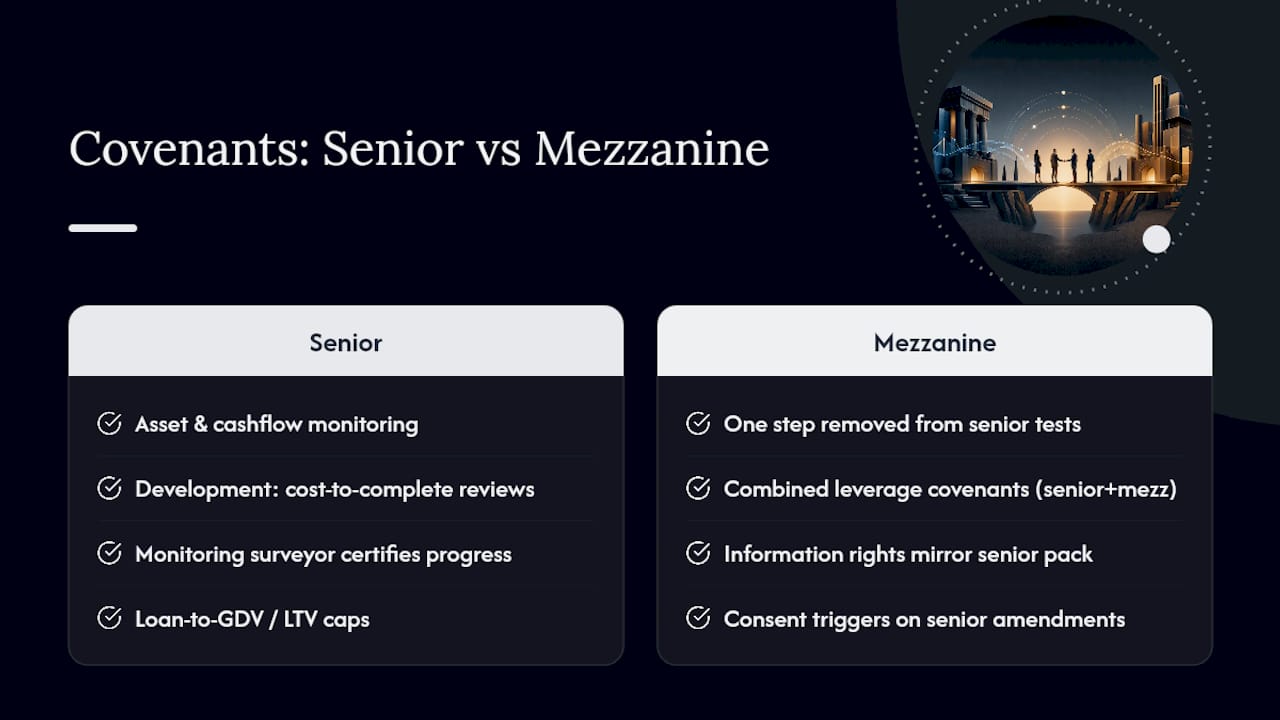
- Senior lenders usually run monthly or quarterly financial covenant tests, cost-to-complete reviews on developments, and drawdown certification from a monitoring surveyor.
- Mezzanine providers often accept looser day-to-day reporting but demand stronger information rights and consent triggers around any change to the senior facility.
- Senior debt typically caps leverage tightly (loan-to-cost or loan-to-GDV); mezzanine caps combined leverage, since it’s protecting its own subordinated position.
- Breach consequences differ: a senior covenant breach can trigger step-in rights fast; a mezzanine breach usually just restricts distributions or triggers a standstill notice to the senior lender.
Enforcement is where the practical consequences bite hardest. If a senior lender enforces, mezzanine is usually forced to stand still for a defined period before it can act, and any recovery proceeds get paid down the waterfall senior first. That sequencing shapes refinance timing too: a lender assessing a refinance will look at the full stack, not just the senior balance, because mezzanine repayment (including any accrued PIK) has to be cleared or refinanced simultaneously.
When should you use mezzanine instead of senior debt alone?
Mezzanine earns its higher cost when senior capacity genuinely falls short of what a project needs and the exit or refinance is credible enough to support the extra debt service. It’s the wrong tool when margins are thin or the business plan still has unresolved planning, letting, or sales risk. Using mezzanine to patch an undercapitalised project rather than to bridge a genuine funding gap increases refinance risk substantially, because you’re stacking cost on top of uncertainty rather than on top of a plan that’s already de-risked.
Run through this before committing to a mezzanine facility:
- Check your LTV and interest cover headroom. If senior debt alone gets you to 65% loan-to-value with comfortable cover, ask whether mezzanine is filling a real gap or just reducing your own equity contribution.
- Stress-test the exit. Model a six-month sales or refinance delay. If the numbers only work on the base case, mezzanine’s extra cost will hurt disproportionately.
- Assess sponsor track record. Lenders price mezzanine partly on execution risk; a first-time developer will pay more for the same facility than an experienced one.
- Check sensitivity to delay. PIK interest compounds, so a stalled project doesn’t just cost time, it costs materially more at redemption.
Pro Tip: Ask any prospective mezzanine lender exactly how their fee and PIK interest compound if the project runs three months over schedule. The answer tells you more about the real cost of the facility than the headline rate ever will.
Structuring and intercreditor basics developers must understand
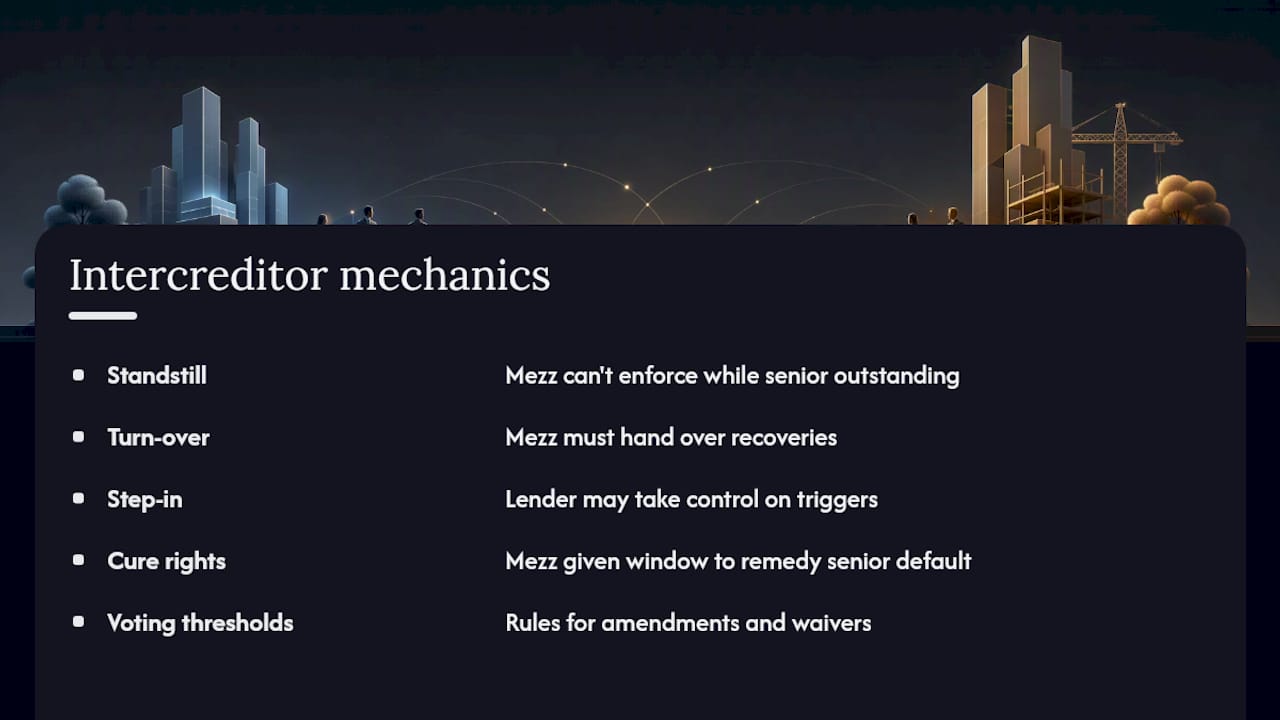
The intercreditor agreement is the document that actually determines what happens in a default, and it matters more than either individual loan agreement. Standard clauses include a standstill period, during which mezzanine cannot enforce its own security while senior debt remains outstanding; turn-over provisions, requiring mezzanine to hand over any recovery received in breach of the agreed order; step-in rights, letting either lender take control of the asset or borrower entity under specified triggers; and cure rights, giving mezzanine a window to remedy a senior default (often by injecting cash) before senior can enforce. Intercreditor agreements set out these mechanics precisely, including voting thresholds for amendments and waivers.
Security layering compounds this. It’s common in development structures to place senior debt at the operating company level and mezzanine at the holding company level, a form of structural subordination that changes how enforcement actually plays out, since mezzanine’s recourse runs through share pledges rather than direct security over the asset. Sponsors do have negotiation levers here: cure period length, the scope of consent rights, and how tightly “permitted refinancing” is defined all affect how much flexibility you retain later. Get the drafting wrong and a straightforward refinance six months before completion can turn into a three-way negotiation.
Broker-led priorities: what actually gets negotiated
A recurring pattern is sponsors focusing on headline rate and missing the clauses that decide how a deal actually plays out under pressure. Structuring senior and mezzanine debt together well protects ownership without leaving you boxed in when it’s time to refinance.
Negotiation priorities that consistently matter more than rate:
- Covenant flexibility, particularly cost-to-complete triggers on developments, where a single re-forecast shouldn’t cause default.
- A clear payment waterfall, agreed in the intercreditor deed before drawdown, not negotiated retrospectively under pressure.
- Fee and PIK mechanics, spelt out with worked examples for a delayed completion, not just a headline percentage.
- Consent thresholds, so routine decisions (a rent review, a minor variation) don’t require senior sign-off.
Lenders typically want a full business plan, three years of accounts or a development appraisal, a build programme with contingency, and evidence of exit routes before terms are issued. Engage a broker early, ideally before you’ve approached lenders directly, because structuring the senior and mezzanine layers as one package usually produces better combined pricing than negotiating each in isolation. If your headroom on cost or timing looks thin, that’s the signal to bring in a specialist rather than push ahead alone.
Which route suits your deal: senior only or senior plus mezzanine?
Borrowers with strong equity, conservative leverage targets, and no urgency to preserve every percentage point of ownership do fine on senior debt alone. Sponsors who need extra leverage to hit a return target, and have a credible, tested exit, are the right candidates for mezzanine on top.
Two things to do next: run a proper sensitivity case on your exit or refinance date before signing anything, and if headroom looks tight on either leverage or timing, speak to a specialist broker before you commit. The mezzanine market moves quickly, and terms agreed under time pressure are rarely the best ones available.
Typical maturities, repayment profile and effect on exit timing
Senior debt on a development typically runs the length of the build programme plus a short tail, often 12 to 24 months, with a bullet repayment on practical completion, sale, or refinance. Investment senior facilities run longer, sometimes five years or more, usually amortising or interest-only against rental income.
Mezzanine maturities are almost always matched to the senior facility, or set to expire slightly before it, so the sponsor isn’t left holding subordinated debt with no senior facility behind it. Repayment is rarely amortising. Most mezzanine rolls up interest as PIK, meaning nothing is paid until redemption, at which point the accrued balance (principal plus compounded interest plus any exit fee or kicker) is due in full.
This has a direct effect on exit and refinance timing. A senior lender assessing a refinance three months before mezzanine’s maturity will factor in the full redemption sum, not just the senior balance, because both facilities typically need to clear or roll over together. Delay the exit by even a quarter and the compounding PIK balance can shift the economics meaningfully, sometimes enough to erode the equity kicker the sponsor was counting on retaining. That’s why sensitivity testing on timing matters more with mezzanine in the stack than with senior debt alone.
Covenants and financial maintenance tests compared
Senior lenders build their monitoring around asset and cashflow protection. On development finance, that usually means cost-to-complete reviews at each drawdown, a monitoring surveyor certifying progress, and a loan-to-GDV cap that can’t be breached without a cure. On investment or trading facilities, expect interest cover ratio (ICR) tests and loan-to-value covenants tested quarterly, alongside minimum EBITDA or debt service cover thresholds for trading businesses.
Mezzanine covenants tend to sit one step removed. Rather than duplicating every senior test, mezzanine providers usually rely on combined leverage covenants (senior plus mezzanine against total value or cost), information rights that mirror the senior reporting pack, and consent triggers tied to any amendment of the senior facility. The logic is simple: mezzanine’s real protection is knowing early if the senior position is under strain, since that’s what threatens its own subordinated recovery.
Breach consequences differ meaningfully. A senior covenant breach can trigger default interest, a monitoring surveyor visit, or in serious cases, step-in rights within weeks. A mezzanine breach more commonly restricts cash distributions to the sponsor or triggers a standstill notification to the senior lender, rather than immediate enforcement. Sponsors negotiating either facility should push for headroom on cost-to-complete triggers specifically. Re-forecasts happen on almost every development, and a covenant with no tolerance for a single revision creates unnecessary default risk on an otherwise healthy project.
Credit profile and lender type: who actually provides each layer
Senior debt is dominated by banks, challenger banks, and specialist real estate lenders with strong balance sheets and a low cost of funds, which is precisely why they can price first-ranking security so competitively. Their credit committees focus on recoverability: independent valuations, build cost certainty, and borrower track record all feed directly into pricing and leverage.
Mezzanine capital comes from a different pool entirely, typically private credit funds, family offices, and specialist mezzanine lenders comfortable with subordinated risk in exchange for a higher return. These providers underwrite the sponsor and the business plan more heavily than the asset alone, because their recovery in a downside scenario depends on the plan working, not just the asset holding its value. That’s also why mezzanine terms vary so much between providers. A family office with patient capital might accept a longer, more flexible structure; a fund with return targets tied to its own investor base may push harder on exit fees and kickers.
Borrower credit profile influences pricing across both layers, but the effect is sharper on mezzanine. A sponsor with a strong completed-projects track record can often negotiate meaningfully tighter mezzanine terms than a first-time developer seeking the same facility, because the lender’s real risk is execution, not just the asset.
Tax treatment differences worth understanding
Senior debt interest is generally treated as a deductible business expense against profits, subject to the usual UK corporate interest restriction rules that limit deductibility above certain thresholds for larger borrowing groups. Most single-project developers and SMEs sit well within those thresholds, but it’s worth checking with an accountant on any larger, multi-facility structure.
Mezzanine is more complicated because of its hybrid features. Cash-pay interest is typically deductible in the same way as senior interest. PIK interest can be treated differently depending on how and when it’s recognised for tax purposes, and equity kickers or warrants introduce a further layer of complexity, since a conversion right or profit share can shift the instrument’s tax characterisation depending on how it’s structured and when value is realised. Mezzanine’s treatment flows from contract and insolvency principles rather than a fixed statutory label, which is exactly why tax treatment isn’t uniform either. Two mezzanine facilities with different drafting around PIK recognition and kicker mechanics can produce genuinely different tax outcomes for the same borrower. Anyone structuring a mezzanine facility should get specific tax advice on the instrument as drafted, not rely on general assumptions carried over from senior debt.
The gap between the textbook comparison and how these deals actually behave
Most guides to senior debt and mezzanine treat them as a binary choice: cheap and safe versus expensive and flexible. That framing misses the point. The real skill in structuring a deal isn’t picking one over the other, it’s deciding how much mezzanine a project can genuinely absorb without turning a manageable delay into a solvency problem.
The conventional advice to “use mezzanine to bridge the equity gap” is true as far as it goes, but it understates how brutally PIK interest compounds against a slipping timeline. A three-month delay on a well-capitalised deal is an inconvenience.
What I’d prioritise first, ahead of rate shopping: get the intercreditor mechanics right, particularly cure rights and standstill periods, before comparing headline pricing between lenders. A slightly more expensive mezzanine facility with sensible cure provisions is worth more than a cheaper one that lets senior step in the moment a covenant slips.
— James William Dawes
Sources
- Mezzanine finance meaning in UK Law - Glossary - LexisNexis UK
- Is mezzanine finance right for your business? | British Business Bank
- Guide to mezzanine finance | OakNorth
- Mezzanine Debt - Practical Law
FAQ
What qualifies as senior debt?
Senior debt is any loan that ranks first for repayment and typically holds first-ranking security over the underlying asset or business, giving the lender priority in a default or sale scenario.
What is the difference between mezzanine and junior debt?
Junior debt is a broad category covering any debt subordinated to senior debt; mezzanine is a specific, more structured form of junior debt that usually adds hybrid equity features like warrants or PIK interest.
What are the key differences between mezzanine debt and convertible debt?
Mezzanine debt is defined primarily by its subordinated ranking and often includes optional conversion rights as one feature among several; convertible debt is defined specifically by its conversion mechanism into equity, and it may or may not be subordinated to other lenders.
What is the key difference between senior debt and subordinated debt?
Senior debt ranks first for repayment and enforcement; subordinated debt (including mezzanine) ranks behind it, gets paid only after senior debt is satisfied, and typically carries higher pricing to compensate for that lower priority.
Recommended
Related Topics
Speak to a specialist
Discuss your finance with James directly
Whole-of-market specialist finance — bridging, development, commercial and residential. No call centres, no obligation. James reviews every enquiry personally.
New to specialist finance? How unbiased broker advice works · Deals we have completed
Explore Related Finance