
Published · Updated
preferred vs common equity10–25% Gap Financing: Preferred vs Common Equity for UK Developers
By James Dawes, CeMAP, Founder, James William & Co Capital

Preferred equity sits senior to common equity in a development joint venture, carrying priority distributions and capped upside but limited say in how the project runs. Common equity takes the residual risk, the residual upside, and usually keeps the sponsor’s promote intact.
TL;DR:
- Preferred equity generally accounts for 10 to 15% of project costs in ground-up developments with a construction loan covering 60 to 70%, filling funding gaps without diluting sponsor control.
- It often carries targeted returns of 10 to 14%, accruing during construction, and is redeemed after sale or refinance, which helps absorb delays and softer exit scenarios.
- Securing preferred equity recognition by senior lenders requires clear legal documentation with enforceable protections, recognition clauses, and defined redemption mechanics.
- The choice between preferred equity and mezzanine debt depends on senior lender policies, project control preferences, and the importance of secure remedies versus flexible return mechanics.
- Sponsors often underestimate the necessity of early credit approval and modeling for delayed exits, focusing too much on base case returns without stress-testing PIK accruals during construction.
Table of Contents
- Preferred vs common equity: comparing the capital stack
- When should a deal use preferred equity instead of more common equity or mezzanine?
- Structuring documentation that lenders will actually accept
- Two capital stack examples: mezzanine-heavy vs preferred-equity bridge
- What sponsors get wrong about preferred equity
- How James William & Co Capital structures preferred and common equity deals
- Sources
- FAQ
Preferred vs common equity: comparing the capital stack
Every development capital stack ranks funding by repayment priority: senior debt first, mezzanine debt next, then preferred equity, then common equity. That order sounds tidy on a term sheet. In practice, what actually gets paid, and when, depends far more on the contract than on the label attached to the tranche.
Preferred equity sits above common equity in the waterfall and is entitled to a fixed or targeted return before common equity sees a penny of profit. That priority is contractual, not statutory, so its strength depends entirely on how the joint venture agreement is drafted, and whether the senior lender has formally recognised it.
Return mechanics differ sharply between the two. Preferred returns can be paid currently from operating cashflow, accrued and paid in kind (PIK), or a mix of both depending on how the project performs during construction. This flexibility is exactly why preferred investors often accept accrual during the build phase, collecting their return at refinance or sale rather than month by month. Common equity, by contrast, has no fixed return at all; it earns whatever is left after debt service, preferred distributions, and fees, which is why sponsors chase higher IRRs on the common piece to compensate for that residual risk.
Security is where preferred equity gets interesting. It remains equity in law, structured inside the joint venture as an LLC or partnership interest rather than as a secured loan, yet sophisticated preferred investors negotiate protections that behave much like debt: step-in rights, manager replacement triggers, and buy-sell mechanics.
Governance is the real trade-off. Preferred investors typically accept limited day-to-day control in exchange for those hard protections; common equity holders, especially the sponsor, keep operational control unless a default trigger fires. The practical dimensions break down like this:
- Priority: preferred is paid before common on both distributions and return of capital.
- Target returns: preferred often runs 10 to 14%; common equity, 15% to 25%-plus on ground-up schemes.
- Governance: preferred holds approval rights and step-in triggers; common holds day-to-day control.
- Cashflow flexibility: preferred can accrue or PIK; common has no fixed entitlement at all.
- Security: preferred negotiates debt-like remedies inside an equity wrapper; common has none beyond its ownership stake.
None of this works without the senior lender’s blessing, and that is the detail sponsors underestimate most often.
When should a deal use preferred equity instead of more common equity or mezzanine?
Preferred equity earns its place on ground-up development where the senior construction loan covers roughly 60 to 70% of cost and a gap remains that neither the sponsor nor a straight equity partner wants to fill with dilutive common capital. In that scenario, preferred typically fills 10 to 25% of total project cost, leaving the sponsor’s own common equity smaller, but intact.
The other reason sponsors reach for preferred rather than issuing more common equity is control. Bringing in a co-general-partner who wants board seats and a veto over major decisions is expensive in a different currency: your autonomy. Preferred equity lets the sponsor keep to promote without handing over the steering wheel, which explains its popularity on value-add and ground-up multifamily schemes where the sponsor’s track record is the asset.
Mezzanine debt is the other substitute worth weighing, and the choice between the two often isn’t the sponsor’s to make at all. Senior lenders frequently have a fixed policy on whether they’ll permit a secured mezzanine loan behind their charge, or whether they’d rather see an equity-structured preferred tranche instead. Engaging the senior lender early avoids wasted weeks negotiating a structure they won’t sanction — learn more about mortgages for finance professionals.
Common equity remains the right answer when the sponsor wants full upside, the stack is simple, and there’s no funding gap to bridge. Before choosing, run the deal team through this checklist:
- When does the project generate enough cashflow to service a current-pay preferred return, and does that timing survive a six-month construction delay?
- How likely is refinance or sale within the preferred investor’s expected hold, and what happens to accrued PIK if it slips?
- Will the senior lender formally recognise and subordinate the preferred position, or will they resist a structure that looks debt-like?
- How much of the sponsor’s promote is the team willing to trade for the extra flexibility preferred capital brings?
Pro Tip: Model the preferred accrual against a delayed exit, not the base case. Sponsors who only stress-test the on-time scenario are usually the ones surprised by how large a PIK balance has grown by the time refinance actually happens.
Structuring documentation that lenders will actually accept
The waterfall clause is where most disputes start, so it needs to specify the preferred return rate, whether it compounds, how any catch-up to common equity works once the preferred hurdle clears, and the exact redemption trigger at sale or refinance.
Senior lenders will not simply tolerate a preferred tranche sitting behind their debt; they need to see it, and usually to formally recognise it, because enforcement mechanics and the speed of remedy matter more to lender risk teams than the nominal ranking on a term sheet. A preferred structure that looks perfect on paper but hasn’t been run past the senior lender’s credit committee is a structure that will stall at the worst possible moment, usually during drawdown.
A well-drafted preferred equity agreement should include, at minimum:
- Manager replacement rights if performance covenants or distribution tests are breached.
- Buy-sell mechanics that let the preferred investor force a resolution rather than sit trapped indefinitely.
- Formal lender recognition or an intercreditor-style agreement acknowledging the preferred position without breaching senior covenants.
- Clear redemption and IRR hurdle language defining exactly when and how the preferred is taken out.
- Reporting covenants that give the preferred investor visibility on construction progress and cost overruns.
Because preferred equity is structured inside the joint venture rather than as a secured loan, it carries different tax and reporting consequences than mezzanine debt, and lender consent requirements can differ too. That distinction belongs in the term sheet from day one, not discovered during legal review three weeks before completion. Anyone weighing preferred equity vs mezzanine debt on a live deal should treat this documentation stage as inseparable from the pricing decision, not a formality that follows it.
Two capital stack examples: mezzanine-heavy vs preferred-equity bridge
Example A: mezzanine-heavy stack. A scheme funded with 65% senior debt, 15% mezzanine, and 20% common equity carries fixed mezzanine interest payments from day one, win or lose. If the sale slips six months, those payments keep accruing against a project generating no sales revenue yet, squeezing sponsor cashflow hard and forcing either a capital call or a costly bridge extension.
Example B: preferred-equity bridge. The same 65% senior debt is paired with 20% preferred equity accruing a PIK return, plus a modest profit share, and 15% common equity. No cash leaves the project during construction. At sale or refinance, the preferred is redeemed first with its accrued return, the sponsor’s promote on the remaining common equity stays largely protected, and preferred returns in this structure typically land around 10 to 15%.
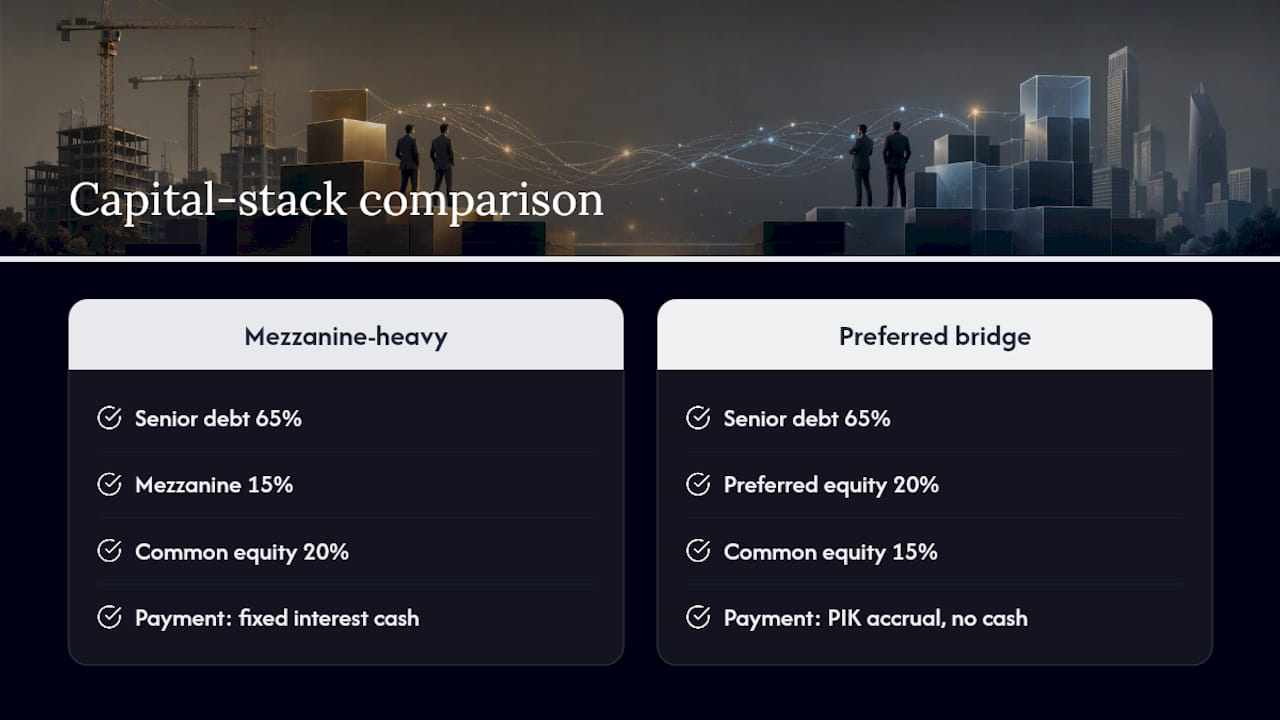
The sensitivity is the real lesson: a delayed exit or a softer sale price erodes common equity fastest in Example A, where fixed payments never stop, while Example B’s accrual mechanics absorb some of that shock, at the cost of a larger balance due at redemption.
What sponsors get wrong about preferred equity
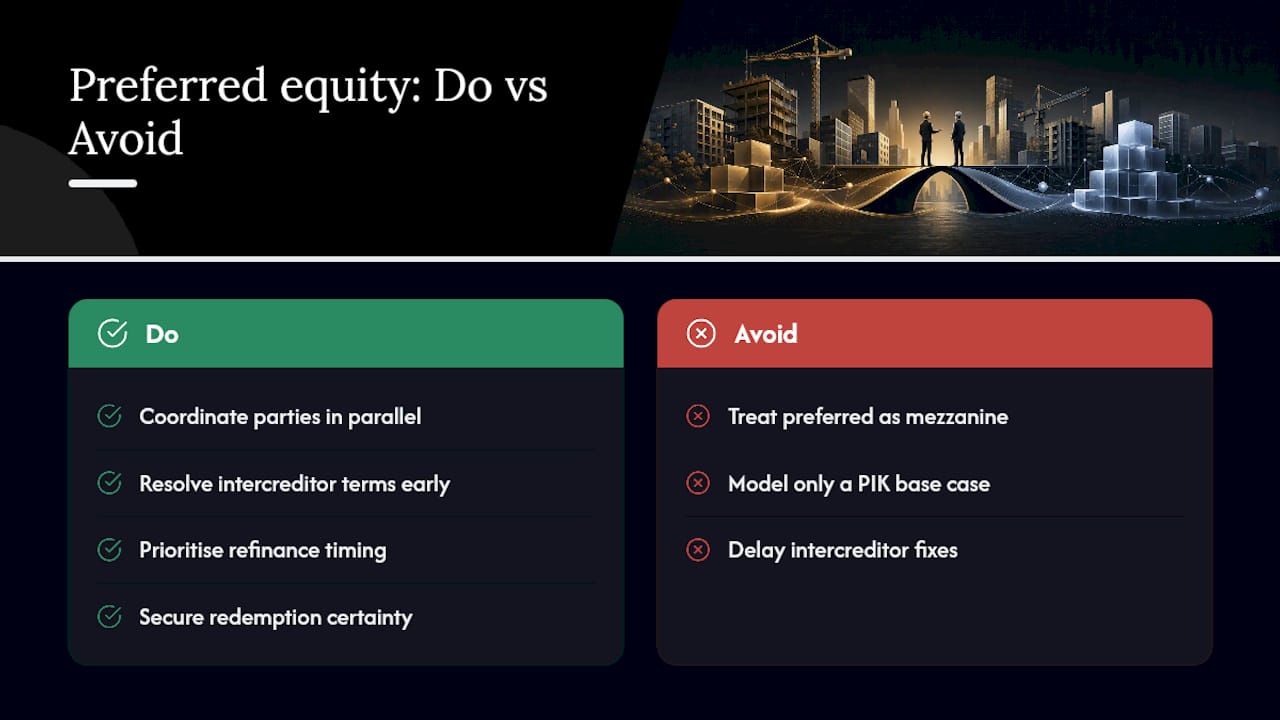
Sponsors treat preferred equity as a mezzanine substitute far too often, when the real question is always about enforcement, not labels. A capital concierge approach, coordinating lender, sponsor, and investor terms in parallel rather than sequentially, cuts weeks off negotiation because the intercreditor and recognition questions get resolved before the term sheet is signed, not after.
The pitfall I see repeatedly is under-stressing refinance timing. Sponsors model the base case, see a comfortable PIK accrual, and stop there. Family offices and private credit funds structuring preferred rarely make that mistake; they focus on redemption certainty and manager replacement rights well before they focus on the headline rate. That discipline is worth borrowing regardless of who is writing the cheque.
— James William Dawes
How James William & Co Capital structures preferred and common equity deals
Getting a preferred equity tranche recognised by a senior lender, or negotiating the redemption mechanics that protect a sponsor’s promote, is not a task for a single email to a single fund. James William & Co Capital arranges JV equity, mezzanine debt, and bespoke debt stacks for UK property developers and institutional investors, working across family offices and private credit funds to get complex structures agreed and documented without months of back and forth.
Using a single point of contact to handle lender introductions, term sheet negotiation, and documentation support in parallel rather than in sequence can reduce delays in complex deal structuring. If you’re structuring a development gap, a bridge to refinance, or a full preferred and common equity stack, get in touch through James William & Co Capital’s specialist property finance team to discuss your project’s structure.
Sources
- What is a capital stack in real estate? | JPMorgan
- I95capital
- Preferred Equity for Multifamily Development: A Broker’s Guide | Janover Pro
- Realestateprivateequity
FAQ
What is the main difference between preferred and common equity?
Preferred equity is senior to common equity, with priority distributions and a capped target return; common equity carries the residual risk and the residual upside.
Is preferred equity the same as mezzanine debt?
No. Preferred equity is structured inside the joint venture as an ownership interest, while mezzanine debt is a secured loan sitting behind the senior lender’s charge; senior lender policy often decides which is feasible on a given deal.
What return does preferred equity typically target?
Preferred equity on ground-up development commonly targets a 10 to 14% return, often with accrual or PIK mechanics during construction, repaid at refinance or sale.
Can preferred equity convert to common equity?
Some structures include conversion or step-in provisions triggered by a default or covenant breach, letting the preferred investor take a governance role or convert its position if the sponsor underperforms.
Does a senior lender need to approve a preferred equity tranche?
Senior lenders typically require formal recognition of the preferred position, since enforcement mechanics and remedy speed, not the nominal ranking, determine how a lender views the risk.
Recommended
Related Topics
Speak to a specialist
Discuss your finance with James directly
Whole-of-market specialist finance — bridging, development, commercial and residential. No call centres, no obligation. James reviews every enquiry personally.
New to specialist finance? How unbiased broker advice works · Deals we have completed
Explore Related Finance