
Published · Updated
s106 and cil fundingS106 and CIL: Stop Six Figure Liabilities Derailing English Developments
By James Dawes, CeMAP, Founder, James William & Co Capital
Section 106 secures site-specific mitigation, and it is the only route to affordable housing contributions; the Community Infrastructure Levy is a fixed, published charge for wider infrastructure. Both regimes can apply on the same site, provided every S106 obligation still meets the Regulation 122 tests. Check the local charging schedule and infrastructure funding statement before you finalise a scheme, then model both CIL liability and S106 contingency into your feasibility appraisal from day one.
TL;DR:
- S106 obligations are site-specific and negotiated case by case, typically covering affordable housing, infrastructure, and monitoring fees, with costs varying widely.
- CIL is a fixed, formula-based levy applied uniformly across zones and linked to net additional floor area, with rates index-linked and potentially changing over time.
- Both funding mechanisms can apply to the same development if each obligation meets Regulation 122 tests, but planning strategically requires modeling both from early design stages.
- Missing CIL relief application deadlines results in forfeiture, and councils often offer discretionary relief only if viability evidence supports it; timing differences also affect cash flow management.
- Developers should analyze local charging schedules, infrastructure statements, and consider financing options for timing gaps, especially before proceeding with detailed feasibility assessments.
Table of Contents
- S106 and CIL funding: the legal basis behind both mechanisms
- S106 vs CIL: what’s actually different, and where they overlap
- What can S106 and CIL money actually pay for?
- CIL exemptions, reliefs and payment triggers you can’t afford to miss
- How councils report and monitor S106 and CIL receipts
- Practical steps for budgeting and viability
- What the Infrastructure Levy reform means for your models
- Managing the funding gap between S106, CIL and completion
- Where to check the detail yourself
- Sources
- FAQ
S106 and CIL funding: the legal basis behind both mechanisms
Section 106 agreements sit under section 106 of the Town and Country Planning Act 1990, and they exist to make development acceptable in planning terms that would otherwise be refused. A council negotiates these obligations directly with the developer. They typically cover affordable housing, on-site infrastructure such as roads or drainage, and monitoring fees that councils charge to cover the cost of overseeing delivery.
The Community Infrastructure Levy works differently. It was introduced under the Planning Act 2008 and sits in the Community Infrastructure Levy Regulations 2010, later updated through several amendments. Rather than a negotiation, CIL is a non-negotiable charge set out in each charging authority’s own charging schedule, calculated by multiplying a published rate per square metre by the net additional floor area a scheme creates. Rates vary block by block across a borough and get index-linked annually against the Royal Institution of Chartered Surveyors’ building cost index, so the figure a council quotes in year one will not match year three.
The practical distinction matters for how you plan a scheme: one is bespoke and negotiated, the other is fixed and calculable from day one.
S106 vs CIL: what’s actually different, and where they overlap
S106 obligations are negotiated case by case, shaped by what a specific site needs to make it acceptable. CIL is fixed by formula and applies uniformly across a charging zone, which gives certainty but no flexibility for site circumstances. That difference has real consequences for viability: a scheme with unusual infrastructure needs can find its S106 costs spiralling well past what a comparable CIL charge would have been, or vice versa.
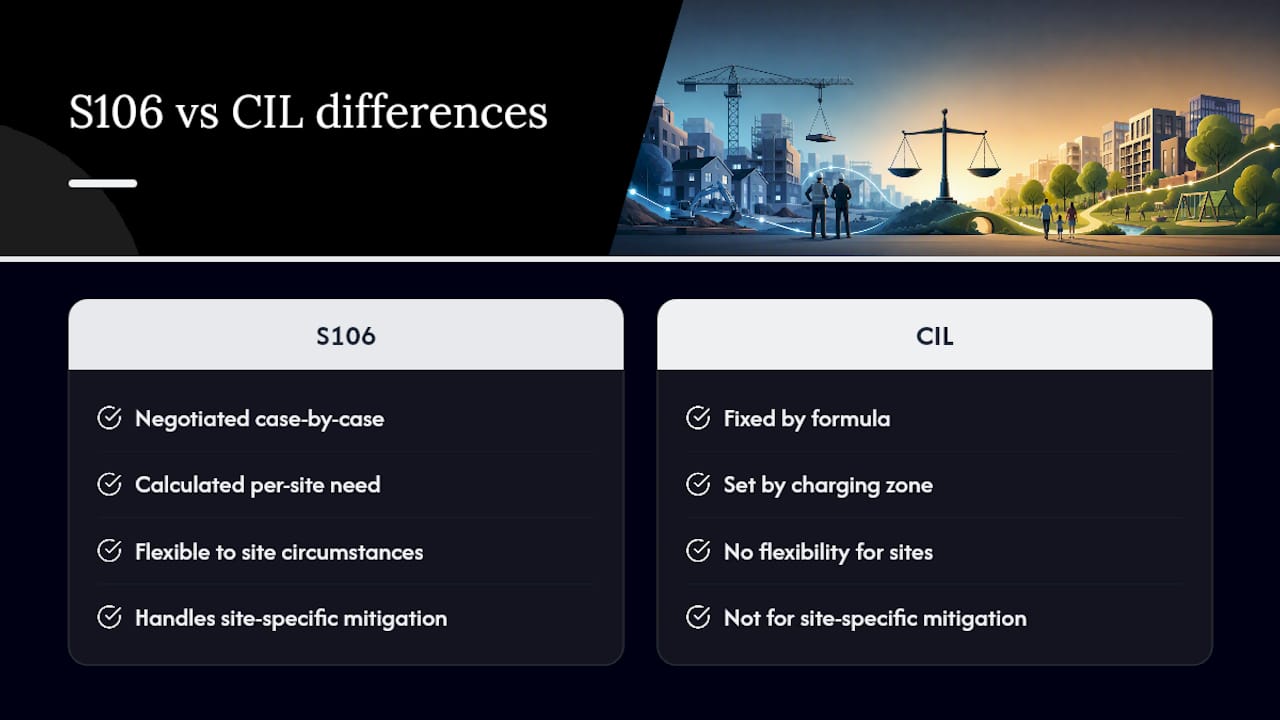
Every S106 obligation still has to pass the Regulation 122 tests: it must be necessary, directly related to the development, and fairly and reasonably related in scale and kind. Since 2019, councils have been able to use S106 and CIL to fund the same type of infrastructure, because the Regulation 123 list and the old five-pooling restriction were both removed. Practitioners increasingly describe S106 as handling the “micro” and CIL the “macro”, site-specific mitigation on one side, strategic area-wide funding on the other. Most councils now lean on CIL for cumulative infrastructure like transport upgrades, and reserve S106 for anything genuinely tied to your site.
What can S106 and CIL money actually pay for?
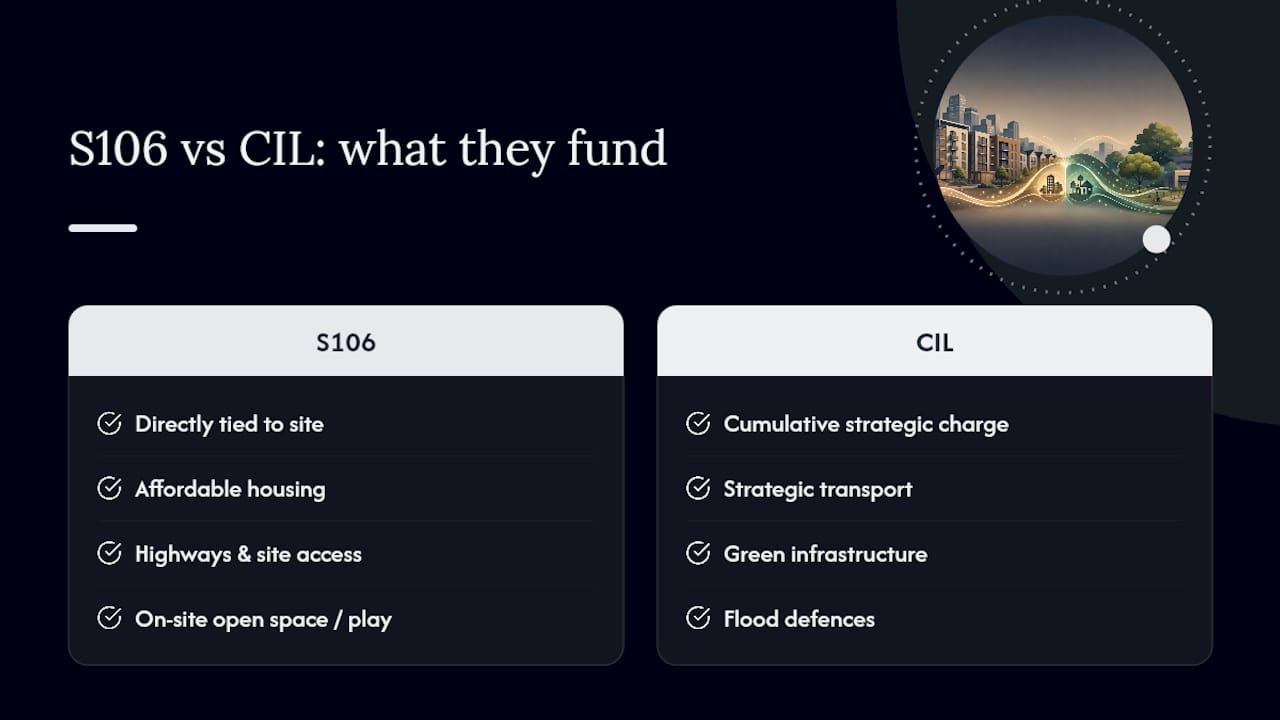
Section 106 money funds things a council can tie directly to your development. Affordable housing dominates this list, whether delivered on-site or, less commonly, through an off-site payment. Beyond housing, S106 typically covers highways works and site access improvements, on-site open space or play provision, and the monitoring fees that pay for a council officer to check you have actually delivered what you promised.
CIL funds broader, cumulative pressures a single development contributes to rather than causes alone. That means strategic transport schemes, green infrastructure, flood defences, and increasingly digital infrastructure like fibre ducting. A fixed percentage, usually 15% to 25%, gets passed down as the neighbourhood portion for local ward-level spending, and in London a separate Mayoral CIL layer funds Crossrail-style strategic projects on top of the borough charge.
A typical heads of terms document for a 150-unit scheme might commit you to 30% affordable housing, a signalised junction upgrade, and an annual monitoring fee, while the same site separately triggers a six-figure CIL liability payable once building starts.
CIL exemptions, reliefs and payment triggers you can’t afford to miss
Several CIL reliefs exist, and missing the paperwork deadline forfeits them entirely. Self-build homeowners, charities delivering charitable purposes, and social housing providers can all claim exemption, but every claim must be submitted and approved before commencement. Start work first and the relief is gone, regardless of how clearly you would otherwise have qualified.
Charging authorities can also grant discretionary relief where paying the full levy would make a scheme unviable, though this depends on local policy and normally requires viability evidence referencing your S106 costs directly. Not every council offers it, so check your authority’s charging schedule before assuming it applies.
Timing differs sharply between the two regimes. CIL typically becomes payable within 60 days of commencement unless the council operates an instalment policy, and it cannot be used to secure affordable housing under any circumstances. S106 payments, by contrast, get triggered by whatever milestones the agreement specifies, first occupation, a percentage of units sold, or practical completion, which gives you more room to negotiate timing against your cashflow.
How councils report and monitor S106 and CIL receipts
Every charging authority must publish an infrastructure funding statement each year, covering CIL receipts, how much has been allocated and spent, the neighbourhood portion breakdown, and every S106 agreement signed alongside what money has actually moved. It’s the single best due diligence document available to a developer sizing up a council’s track record before entering negotiations.
S106 money usually carries a spend-by deadline written into the agreement, and unspent funds can trigger clawback provisions that return the money to the developer. CIL has no equivalent statutory spend-by deadline, which is one reason receipts sometimes sit unspent for years. Reconciling planning triggers against your own finance model, particularly around indexation dates, is the practical discipline that keeps a scheme’s numbers honest through delivery.
Practical steps for budgeting and viability
Run three checks before you submit a planning application. Pull the council’s current charging schedule and its latest infrastructure funding statement together, so you know both the rate you’ll pay and how the authority has actually spent money historically. Stress-test your S106 exposure against a range of affordable housing percentages, not just the figure in your pre-application advice. Confirm whether the authority operates an instalment policy for CIL, because that single detail can shift your peak funding requirement by months.
Build a genuine contingency line into your GDV model for S106 negotiation drift and CIL indexation, not just a token percentage. Timing gaps between land completion, CIL demand notices, and S106 milestone payments are where schemes actually run into cashflow trouble, not at the headline cost level.
Pro Tip: Model your CIL liability using the current indexed rate, then add a second column assuming one more year of indexation before you expect to commence. The gap between the two numbers is usually a more realistic contingency figure than any flat percentage.
What the Infrastructure Levy reform means for your models
The Levelling Up and Regeneration Act 2023 sets out a new, value-based Infrastructure Levy intended to replace CIL and reduce reliance on S106, though transition arrangements are phased and local rollout timing remains unclear. Keep modelling both existing systems until your specific authority publishes its own transition detail. Betting a feasibility appraisal on reform that hasn’t landed locally yet is a mistake worth avoiding.
Managing the funding gap between S106, CIL and completion
There are other ways developers try to plug timing gaps, extending build programmes, phasing sales earlier, or simply carrying more equity than planned. None of them are free, and all of them cost you optionality when a CIL demand notice or an S106 milestone payment lands at an awkward point in the build.
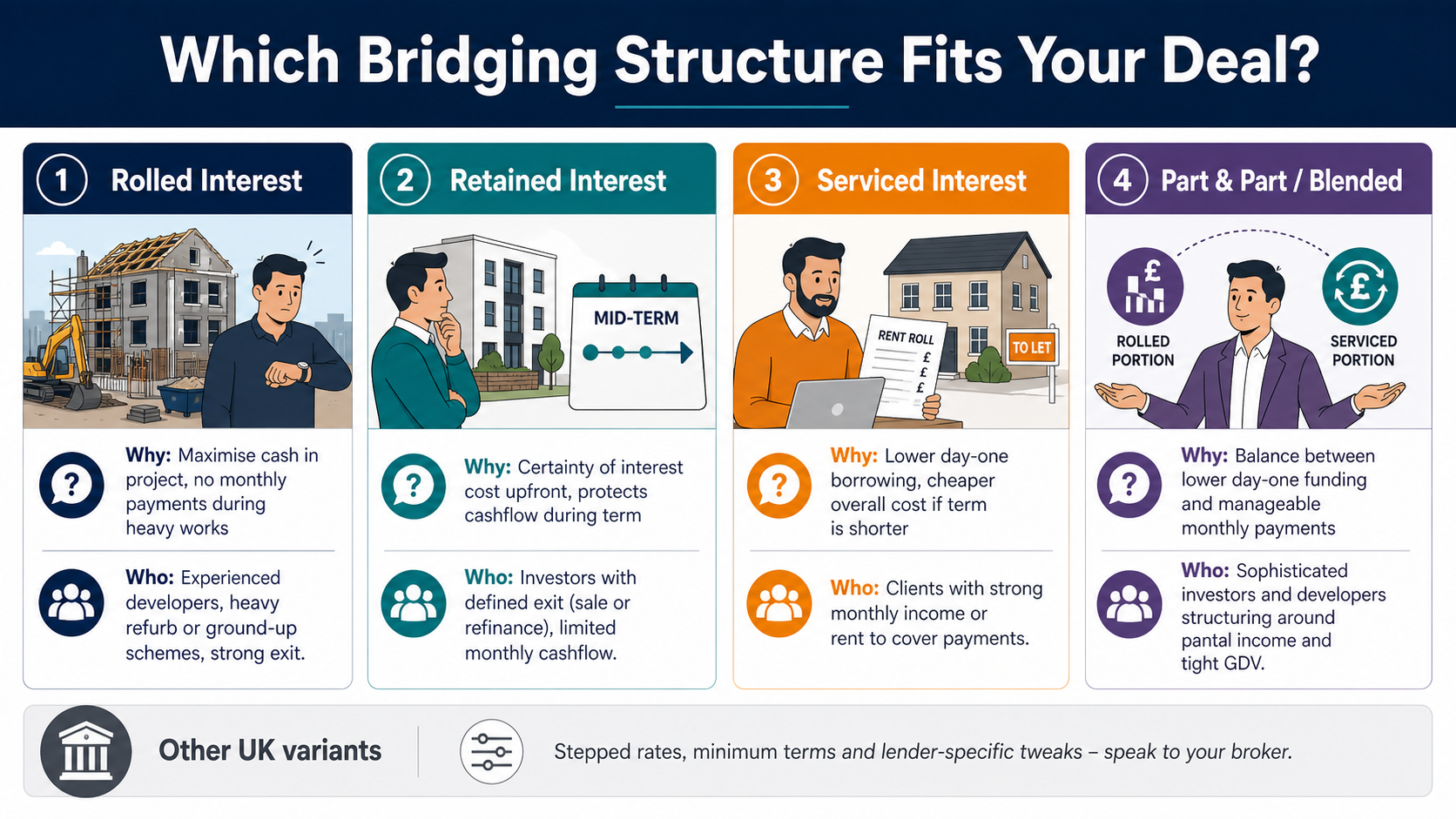
Specialist finance brokers can work as debt structuring partners for developers facing exactly this kind of timing pressure, when a CIL instalment or an S106 trigger falls before a unit sale or refinance completes. Development finance, joint venture equity and mezzanine finance can be structured to absorb a funding gap without forcing a fire sale or a stalled site, and where the shortfall is short and sharp, bridging finance covers the days between a payment trigger and your next capital event. Access to specialist lenders and private credit funds beyond mainstream banks allows finance solutions to be structured around the actual timeline, not a generic lending template. If a feasibility model shows a gap around a CIL or S106 milestone, consider speaking to a specialist finance provider to discuss how a development finance facility could be structured against a specific site.
Where to check the detail yourself
Start with GOV.UK’s planning obligations guidance and the CIL guidance page for the primary legal framework, then pull your own council’s charging schedule and its latest infrastructure funding statement to reconcile local rates against actual spend before you negotiate.
FAQ
Are CIL and S106 the same thing?
No. S106 is a negotiated legal agreement tied to a specific site’s impacts, while CIL is a fixed, published charge applied uniformly across a charging zone. They serve different purposes and, since 2019, can both apply to the same development provided each S106 obligation independently meets the Regulation 122 tests.
What can S106 funding be used for?
S106 funding covers site-specific mitigation, most commonly affordable housing, along with highways works, on-site open space and monitoring fees. It remains the only mechanism available for securing affordable housing contributions, and in 2022/23 it funded at least part of 47% of all affordable homes delivered in England.
What are the exemptions from paying CIL?
Self-build homeowners, charities, and social housing providers can claim exemption, but the claim must be approved before work starts or it is forfeited. Charging authorities may also grant discretionary relief where the levy would make a scheme unviable, usually alongside viability evidence referencing S106 costs.
How much does a Section 106 agreement cost?
There’s no fixed figure. Costs depend entirely on what a council negotiates against your specific site, commonly a percentage of units as affordable housing plus highways or open space works and a monitoring fee set out in the agreement itself. This contrasts with CIL, which is calculated by a published rate multiplied by net additional floor area.
Can James William & Co Capital help with S106 or CIL payment timing?
Yes. James William & Co Capital structures development finance, bridging finance and mezzanine debt for developers managing cashflow gaps around CIL demand notices or S106 milestone payments, with pricing available on request based on the specific deal structure.
Recommended
Related Topics
Speak to a specialist
Discuss your finance with James directly
Whole-of-market specialist finance — bridging, development, commercial and residential. No call centres, no obligation. James reviews every enquiry personally.
New to specialist finance? How unbiased broker advice works · Deals we have completed
Explore Related Finance