
Published · Updated
business acquisition finance ukBusiness acquisition finance UK: routes, costs and lender tests
By James Dawes, CeMAP, Founder, James William & Co Capital

Acquisition finance is the combination of debt, equity and deferred payments a buyer uses to purchase a UK business rather than paying the full price from cash reserves. In practice, most funded SME deals are built as a capital stack: senior debt secured against the target’s assets and cash flow, topped up with a buyer equity contribution, sometimes bridged by vendor finance or mezzanine debt.
Senior lenders typically advance 2 to 4 times EBITDA, stretching to around 5x only for exceptional targets. Buyers usually still need to find a meaningful equity slice.
- Definition: acquisition finance funds a business purchase through layered debt, equity and deferred consideration.
- Numeric cue: senior debt commonly sits at 2 to 4x EBITDA; buyer equity contributions vary widely by deal quality and lender appetite.
- Next step: model your true cash-to-complete before you approach any lender.
Pro Tip: Build your cash-to-complete model before you fall in love with a target. It stops you wasting weeks pursuing a deal your balance sheet can’t actually support.
Key Takeaways
UK acquisition finance succeeds when buyers layer senior debt, equity and vendor terms into a capital stack sized against stress-tested serviceability, not the headline purchase price.
| Point | Details |
|---|---|
| Leverage stays disciplined | Senior debt commonly runs 2 to 4x EBITDA, occasionally 5x for exceptional targets, with equity filling the remainder. |
| Cash-to-complete exceeds price | Budget for fees, due diligence, stamp duty and a working-capital buffer beyond the headline purchase figure. |
| Deal structure shapes financing | Share purchases generally transfer borrowing capacity intact; asset purchases need explicit assignment of intangibles. |
| Document intangibles early | Evidenced IP can unlock IP-backed lending, reducing the equity a buyer must find. |
| Specialist structuring pays off | James William & Co Capital structures multi-layered stacks across specialist lenders to compress timescales on complex deals. |
Table of Contents
- What are the main funding routes for a UK business acquisition?
- Building the capital stack: what does completion actually cost?
- How do lenders assess acquisition finance applications?
- Does share purchase or asset purchase change how you can borrow?
- How do you prepare your business to secure acquisition finance?
- What transaction costs and legal documents should buyers budget for?
- When does a specialist broker improve your acquisition finance outcome?
- What UK regulatory and compliance rules apply to acquisition finance?
- What tax issues affect acquisition finance beyond stamp duty?
- What are the biggest risks in UK acquisition finance deals?
- What do successful UK acquisition finance deals look like?
- Author perspective: practical counsel for owners using acquisition to grow
- How James William & Co Capital structures your acquisition finance
- Sources
- FAQ
What are the main funding routes for a UK business acquisition?
Every acquisition finance route trades cost against control, and the right mix depends on the target’s asset base, cash generation and how quickly you need to complete. Understanding financing options for acquisitions before you start negotiating saves you from discovering, halfway through heads of terms, that your preferred structure won’t stack up.
Senior debt is the backbone of most deals. A bank or specialist lender sizes the loan against the target’s EBITDA and takes security over its assets, usually a first charge over the business and its property or equipment. It is the cheapest money in the stack, but it comes with covenants and regular repayment obligations that the target’s cash flow must comfortably absorb.
Asset-based lending, invoice discounting and factoring suit businesses with strong receivables or physical stock rather than pure cash-flow strength. A distribution or manufacturing target with a healthy debtor book can often support more leverage this way than a pure EBITDA multiple would allow, because the lender is financing against a tangible, realisable asset rather than projected earnings.
Mezzanine debt, unitranche and private credit sit behind senior debt in the pecking order and cost more accordingly, often with an equity kicker attached. Buyers use it to bridge a gap between what senior lenders will advance and what the vendor wants, without diluting ownership as heavily as a straight equity raise would. According to Sprintlaw’s breakdown of UK acquisition funding routes, the right combination depends heavily on the target’s asset profile and the buyer’s available equity.
Bridging finance, vendor finance and earn-outs offer speed and flexibility where a conventional lender timeline would kill the deal. Bridging finance gets you to completion fast, usually to be refinanced onto cheaper term debt within months. Vendor finance and earn-outs, meanwhile, keep the seller financially invested in the business’s future performance, which can reassure a nervous lender.
Equity financing for business acquisition becomes attractive when leverage alone can’t bridge the gap, or when a buyer wants a partner’s expertise alongside their capital. Bringing in a minority investor or family office dilutes ownership but reduces repayment pressure, which matters enormously for a target with thin or seasonal cash flow.
- Senior debt: cheapest, most covenant-heavy, sized on EBITDA.
- Asset-based lending: strong for receivables and stock-heavy targets.
- Mezzanine/unitranche: fills gaps, costs more, sometimes dilutes.
- Bridging/vendor finance: fast, flexible, often temporary.
- Equity: reduces repayment strain, dilutes control.
Building the capital stack: what does completion actually cost?
The capital stack is the layered order of who gets repaid first: senior debt sits at the top, mezzanine or vendor finance beneath it, and buyer equity absorbs whatever risk remains at the bottom. Getting this sequence right, and knowing what each layer genuinely costs, is what separates a deal that completes smoothly from one that stalls at the finance stage.
Take a £3 million acquisition as a worked example:
- Senior debt at 3x EBITDA of £700,000 provides £2.1 million.
- A vendor loan note of £300,000 bridges part of the remaining gap, deferred over two years.
- The buyer contributes £600,000 in cash equity, roughly 20% of the purchase price.
That covers the headline price. It does not cover completion. Transaction costs, due diligence fees and a working-capital buffer typically add a further layer on top of the equity figure, and stamp duty on share purchases (0.5% of consideration) adds another line buyers routinely forget until the solicitor’s completion statement lands.
The true cash-to-complete, then, is purchase price plus fees, plus diligence costs, plus a working-capital cushion for the target’s first weeks under new ownership, minus whatever debt and vendor finance you’ve secured. Buyers who model only the purchase price routinely find themselves short by tens of thousands of pounds on completion day.

One increasingly useful lever here is IP-backed lending. Where a target has evidenced intellectual property, whether that’s registered trademarks, software code or a proprietary process, specialist UK lenders will now lend against that intangible value rather than treating it as unbankable. That can materially shrink the equity gap for knowledge-intensive or brand-led businesses, provided the IP is properly identified and valued well before you approach a lender.
How do lenders assess acquisition finance applications?
Lenders test three things before they commit: can the combined business service the debt, is the leverage sensible for the sector, and is there enough security to protect their position if trading disappoints.
Serviceability testing starts with normalising EBITDA, stripping out one-off costs, owner’s discretionary spending and non-recurring revenue to find the target’s real earning power.
Leverage multiples in UK SME deals commonly run 2 to 4 times EBITDA for senior debt, with a stretch towards 5x reserved for high-quality, recurring-revenue businesses. Buyer equity contributions tend to fill most of the remaining gap, though vendor finance and mezzanine can reduce the cash burden.
- Fixed and floating charges over the target’s assets, sometimes a debenture covering the whole business.
- Personal guarantees from the buyer, particularly on smaller deals.
- Covenants on leverage ratios, minimum cash balances and restrictions on further borrowing.
Practitioners describe acquisition financing as an assembly job: the skill lies in layering debt, equity and deferred consideration so the target can genuinely service the repayments while the buyer keeps enough control to run the business the way they intended.
Due diligence scope matters as much as the numbers. Lenders expect thorough financial due diligence and clear evidence of working-capital headroom before they’ll release funds, and gaps here, an unresolved customer concentration issue, an unclear lease, a messy cap table, are what typically derail offers at the eleventh hour.
Does share purchase or asset purchase change how you can borrow?
The legal structure of your deal directly shapes what a lender will lend against and how comfortable they feel taking security.
Share purchases transfer the target company whole, including its existing contracts, licences and, often, its existing borrowing arrangements. Lenders tend to find this structure more straightforward because the company’s trading history and security package generally transfer intact, which is why share deals are often the lender-friendlier route for financed acquisitions.
Asset purchases let a buyer cherry-pick what they acquire and leave unwanted liabilities behind, which appeals to buyers worried about historic risk. The friction comes on the financing side: contracts often need formal novation, and if you want to borrow against intangibles such as customer lists, brand value or software, they need explicit assignment and separate valuation, adding time and legal cost.
Vendor loan notes and deferred consideration reduce how much external finance you need on day one. Instead of paying the seller everything at completion, part of the price is deferred over one to three years, effectively turning the vendor into a subordinated lender. This eases the immediate funding burden but requires careful drafting so the vendor’s repayment terms don’t clash with your senior lender’s covenants.
- Share purchase: contracts and licences usually transfer intact; generally easier for lenders to assess.
- Asset purchase: cleaner risk profile, but intangibles need explicit assignment to be financeable.
- Vendor loan notes: reduce upfront cash need, subordinated to senior debt.
- Earn-outs: bridge valuation disagreements, but lenders scrutinise performance-contingent payments closely since they add uncertainty to the enlarged group’s future cash flow.
How do you prepare your business to secure acquisition finance?
Preparation is where most deals are won or lost, long before a lender sees your application.
- Model serviceability early. Stress-test the combined business against a downside revenue scenario and calculate your true cash-to-complete, not just the headline price, before you make an offer.
- Assemble the document pack lenders expect. That means three years of accounts, management information, key customer and supplier contracts, an asset register and, where relevant, evidence of registered IP or intangible value.
- Hire the right advisers. A solicitor handles the legal documentation, an accountant runs financial due diligence, a corporate finance adviser can help with valuation and negotiation, and a specialist broker sources and structures the actual finance package.
- Time your finance arrangement carefully. If the vendor wants speed, arrange bridging finance or at least soft-market test with lenders before you sign heads of terms, so you’re not negotiating your funding and your purchase price simultaneously.
Pro Tip: Get a specialist broker involved before you agree heads of terms, not after. Renegotiating price because your finance fell through is far weaker than walking into a negotiation already knowing what you can fund.
What transaction costs and legal documents should buyers budget for?
Beyond the purchase price, buyers routinely underestimate the secondary costs that lenders and lawyers add to a deal.
- Lender arrangement fees, typically a percentage of the facility, plus valuation and legal fees on their side.
- Your own legal costs for drafting and negotiating the sale agreement and loan documentation.
- Financial and commercial due diligence fees, which scale with deal complexity.
- A working-capital buffer to keep the target trading smoothly through its first weeks under new ownership.
- Stamp duty of 0.5% on share purchase consideration.
The key documents are Heads of Terms (setting out the commercial deal before legal work starts), the sale and purchase agreement, the loan and security package from your lender, and, where relevant, a shareholders’ agreement if equity investors are involved. Legal practice guidance on UK acquisition finance sets out these stages and the parties typically involved in more detail.
Financed deals typically take longer than cash purchases because lender due diligence runs in parallel with legal work; build in extra weeks and keep a cash reserve ready for completion-day surprises.
When does a specialist broker improve your acquisition finance outcome?
A capital-concierge broker does something a single lender relationship can’t: it structures the whole stack, not just one layer, then negotiates across multiple funders simultaneously to get terms that actually fit the deal.
That matters most on complex, multi-layered transactions, a business acquisition that also involves a property asset, or a deal where the vendor’s timeline leaves no room for a slow high-street process. Adviser-led execution often compresses completion timescales and opens access to specialist lenders, bridging funds, private credit, mezzanine, that don’t sit on a standard bank’s product list.
- Sources and negotiates across senior lenders, asset-based finance, mezzanine and private credit simultaneously.
- Structures multi-layered stacks so covenants across different lenders don’t conflict.
- Acts as a single point of contact through negotiation, documentation and execution.
- Typically works on a success or arrangement fee basis, agreed upfront before work begins.
The value of a broker isn’t finding one lender. It’s knowing which three or four will actually say yes to this specific deal, and structuring the offer so they don’t trip over each other’s covenants.
What UK regulatory and compliance rules apply to acquisition finance?
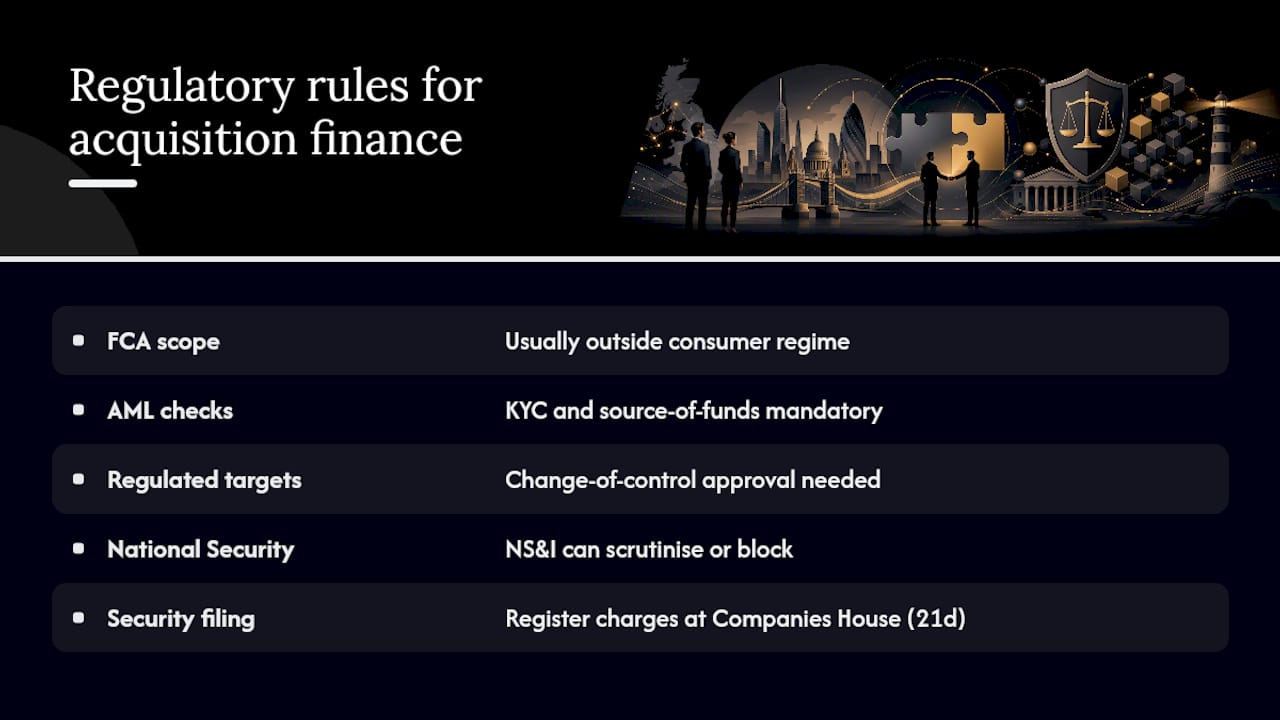
Acquisition finance in the UK sits across several regulatory frameworks, depending on how the deal is funded and who the parties are. Lenders offering commercial acquisition facilities generally fall outside the Financial Conduct Authority’s consumer credit regime, since business lending to companies is typically unregulated business-to-business credit, but that doesn’t mean compliance is absent.
Anti-money laundering checks are mandatory for every party in the chain: lenders, solicitors and brokers must all carry out know-your-client and source-of-funds checks under the Money Laundering Regulations, and expect this to slow down completion if your ownership structure involves offshore entities or complex trusts.
Where a target operates in a regulated sector, financial services, healthcare, education, buyers need separate regulatory approval or notification before change of control completes, and lenders will often make funding conditional on that approval being secured. The National Security and Investment Act 2021 also gives the government power to scrutinise and, in limited cases, block acquisitions in sensitive sectors such as defence, energy and advanced technology, even for relatively modest deal sizes.
Security registration matters too. Charges over company assets must be registered at Companies House within 21 days of creation, and missing that window can invalidate the lender’s security entirely. Buyers using offshore holding structures or complex JV vehicles should expect additional beneficial ownership disclosure requirements under the Persons with Significant Control regime, which lenders will want sight of before releasing funds.
What tax issues affect acquisition finance beyond stamp duty?
Stamp duty on share purchases (0.5% of consideration) is only the most visible tax cost. The structure you choose to finance a deal has consequences that run for years afterwards.
Interest on acquisition debt is generally tax-deductible against the target’s trading profits, which is one reason buyers often push debt down into the operating company rather than leaving it at holding-company level. But the UK’s corporate interest restriction rules can cap how much interest expense a group can deduct once net interest exceeds £2 million a year, a real constraint on highly leveraged deals.
Asset purchases carry different VAT and capital allowances implications than share purchases. Buying assets can trigger VAT on the transaction unless it qualifies as a transfer of a going concern, whereas share purchases are generally VAT-exempt because you’re buying equity, not assets. Capital allowances also reset differently: an asset purchase lets the buyer claim allowances on the assets acquired at their purchase value, which can be more favourable than inheriting a target’s existing tax written-down values through a share deal.
Vendor loan notes and earn-outs carry their own tax treatment for the seller, often affecting whether they qualify for Business Asset Disposal Relief, and structuring these badly can make a deal less attractive to the vendor even when the headline price looks identical. Getting specialist tax advice alongside your finance structuring, rather than after signing, avoids expensive restructuring later.
What are the biggest risks in UK acquisition finance deals?
Leverage cuts both ways. A well-structured stack lets you buy a business you couldn’t otherwise afford, but it also means the enlarged group carries debt service obligations from day one, regardless of how integration actually goes.
Integration risk is the most common deal killer that finance can’t fix. A target that looked strong in due diligence can lose key staff, customers or supplier terms within months of a change of ownership, and if your serviceability model didn’t stress-test for that, covenant breaches follow quickly.
Interest rate exposure matters more on floating-rate facilities, common in acquisition finance, than fixed-rate residential mortgages. A base rate move can meaningfully change your monthly repayment burden across a multi-year facility, and buyers who didn’t model a rate rise scenario sometimes find serviceability tighter than expected within the first year.
Covenant breaches carry real consequences beyond a stern letter from the lender. Depending on the facility agreement, a breach can trigger default interest, demand for additional security, or in severe cases acceleration of the whole facility. Buyers should negotiate covenant headroom that reflects realistic trading volatility, not just the optimistic base case in their financial model.
Vendor and warranty risk is often underweighted. If due diligence missed something, undisclosed liabilities, a customer contract about to lapse, the buyer is often left pursuing a warranty claim against a seller who has moved the funds elsewhere, while the debt still needs servicing regardless.
What do successful UK acquisition finance deals look like?
The pattern across successful financed acquisitions is rarely a single clever funding trick. It is disciplined layering: senior debt sized conservatively against normalised EBITDA, vendor finance closing part of the gap so the seller stays invested in a smooth handover, and buyer equity sized to leave genuine headroom against a downside scenario rather than the base case.
A common successful pattern in professional services acquisitions, an accountancy or legal practice buying a smaller competitor, involves combining senior debt against the combined firm’s recurring fee income with a vendor loan note repaid from future profits. This keeps the departing partner financially aligned with client retention through the handover period, which lenders view favourably because it directly reduces their serviceability risk.
In manufacturing and distribution deals, asset-based lending against the target’s stock and debtor book frequently does more heavy lifting than a straight EBITDA multiple would allow, because it lets buyers access working capital that scales with the trading cycle rather than a fixed term loan amount.
Where a target held meaningful property assets alongside its trading business, buyers have combined commercial mortgage debt against the property with separate trading finance against the operating business, effectively splitting the acquisition into two financeable pieces rather than forcing one lender to assess a blended risk they’re uncomfortable pricing. Readers acquiring a business with a property component should look at how real estate debt structures combine with trading finance in exactly this way.
Author perspective: practical counsel for owners using acquisition to grow
Acquisition finance is the right tool when the target’s cash flow can genuinely absorb debt service and you’ve stress-tested that against a bad year, not just the vendor’s optimistic forecast. It is the wrong tool when you’re stretching leverage purely because the price feels too good to pass up.
The real trade-off isn’t debt versus equity. It’s speed and leverage versus control. More debt gets you to completion with less dilution, but it also means covenants dictating how you run the business for years afterwards. I’d rather see a buyer take slightly more equity dilution and sleep at night than max out leverage on optimistic projections.
Model your cash-to-complete honestly, and talk to a specialist early. The gap between what a deal looks like on paper and what it costs to actually complete is where most buyers get caught out.
How James William & Co Capital structures your acquisition finance
Most buyers approach one bank, get one answer, and either accept unfavourable terms or watch the deal collapse. James William & Co Capital works differently: as your capital concierge, we assemble the full stack, senior debt, mezzanine, vendor finance, asset-based lending, across our network of specialist lenders, private credit funds and family offices, rather than relying on a single relationship that may not fit your deal.
That matters most when your acquisition is complex: a target with property assets, an IP-heavy business needing intangible-backed lending, or a vendor timeline that won’t wait for a conventional bank process. We negotiate across multiple funders in parallel and structure covenants so they don’t conflict with each other, then manage the transaction through to completion as your single point of contact.
If you’re preparing to buy a business and want to know what you can realistically fund before you make an offer, get in touch through our specialist property and business finance page to discuss your deal.
Sources
- Opag
- Acquisition finance: funding routes for business buyers | Sprintlaw
- How to finance a business acquisition in the UK - ASC
- UK acquisition finance practice note (LexisNexis)
FAQ
How do you finance a business acquisition in the UK?
Most buyers combine senior debt, sized at 2 to 4x EBITDA, with an equity contribution and sometimes vendor finance or mezzanine debt to close the funding gap, structured as a single capital stack.
What is M&A in the UK context?
M&A, mergers and acquisitions, refers to transactions where one company buys, merges with or takes a controlling stake in another; UK acquisition finance is the funding side of that process, covering debt, equity and deferred consideration structures.
How do you get funding to buy a business in the UK?
Prepare your document pack, accounts, management information, asset registers, model your serviceability and cash-to-complete honestly, then approach lenders directly or through a specialist broker like James William & Co Capital, which can structure and negotiate across multiple funders simultaneously.
What leverage multiple can I expect for a UK SME acquisition?
Senior lenders typically advance 2 to 4 times EBITDA, with a stretch to around 5x reserved for exceptionally strong, recurring-revenue targets; buyers fund the remainder through equity or subordinated finance.
Do I need a specialist broker for acquisition finance?
Not always, but a specialist broker materially helps on complex, multi-layered or time-sensitive deals by sourcing lenders outside standard high-street channels and structuring covenants across facilities so they don’t conflict.
Recommended
Related Topics
Speak to a specialist
Discuss your finance with James directly
Whole-of-market specialist finance — bridging, development, commercial and residential. No call centres, no obligation. James reviews every enquiry personally.
New to specialist finance? How unbiased broker advice works · Deals we have completed
Explore Related Finance