
Published · Updated
club deal vs syndicationClub Deal vs Syndication: Funding Larger UK Property Deals
By James Dawes, CeMAP, Founder, James William & Co Capital

A club deal is a small, take-and-hold multi-lender loan arranged for speed and relationship banking, typically involving two to six lenders who intend to hold their share to maturity. A syndicated loan is a broadly distributed facility arranged to spread risk and create liquidity across a wider lender pool. The principal difference is scale and intent: clubs favour relationship and speed, syndications favour risk distribution and market pricing.
TL;DR:
- Club deals typically involve two to six lenders committed to holding their share until maturity, making them faster and more confidential than syndications.
- They are usually used for deals under $150 million, such as mid-market acquisitions and refinancing, with bespoke consent rights and lower costs.
- Syndicated loans involve many lenders, broader risk distribution, active secondary markets, and generally larger deal sizes, often taking more than a month to close.
- Lenders prefer syndications for higher fees, faster capital recycling, and wider market signaling, while borrowers valuing speed and discretion favor club deals.
- Borrowers should choose a club deal for smaller, high-speed transactions with existing relationships or when confidentiality outweighs market visibility.
Table of Contents
- Club deal vs syndication: what actually defines a club deal?
- What is loan syndication, and how does it actually work?
- Club deal vs syndication: comparing the two structures side by side
- How to decide between a club deal and syndication
- Why lenders push for one structure over the other
- What we’ve learned arranging mid-market property finance
- Where this market is heading, and what borrowers should do about it
- How James William & Co Capital arranges the right structure for your deal
- Sources
- FAQ
Club deal vs syndication: what actually defines a club deal?
A club deal is market-defined rather than a fixed legal category. It typically involves a small group of lenders, commonly between two and six, each intending to hold its share rather than sell it on. That “take-and-hold” behaviour is the defining feature. Lenders in a club aren’t building a loan to trade; they’re backing a relationship they expect to keep.
Documentation still tends to follow LMA-style facility agreements, but the voting and consent mechanics get tailored for a small number of participants rather than a large group. That matters more than it sounds. A syndicate of thirty lenders needs majority thresholds and standardised waiver processes to function at all. A club of four banks can negotiate bespoke consent rights, which changes how amendments and covenant waivers actually play out later in the deal’s life.
Costs are usually lower too, since the borrower avoids broad sell-down fees and general syndication costs, and relationship lenders often compete on pricing to win the mandate. Practical Law notes that club deals are commonly pre-marketed to a select group and are typical for facilities under roughly $150 million. That makes them a natural fit for mid-market acquisitions, real estate finance and refinancing, where speed and confidentiality outweigh the benefits of a wide distribution.
What is loan syndication, and how does it actually work?
Loan syndication is the process of pooling multiple lenders to fund a single large facility, coordinated by a mandated lead arranger (MLA) who structures the deal and often takes on administrative and agency duties once it closes. HSBC’s explainer frames syndication as existing mainly to help banks manage risk and improve capital efficiency, rather than simply to raise bigger cheques.
There are two standard flavours: underwritten deals, where the arranger commits to the full amount and then sells down the exposure, and best-efforts syndications, where the arranger only commits to what it can place with other lenders. Club deals sit as a subtype within this spectrum, distinguished mainly by their smaller lender count and take-and-hold intent rather than by any different legal framework.
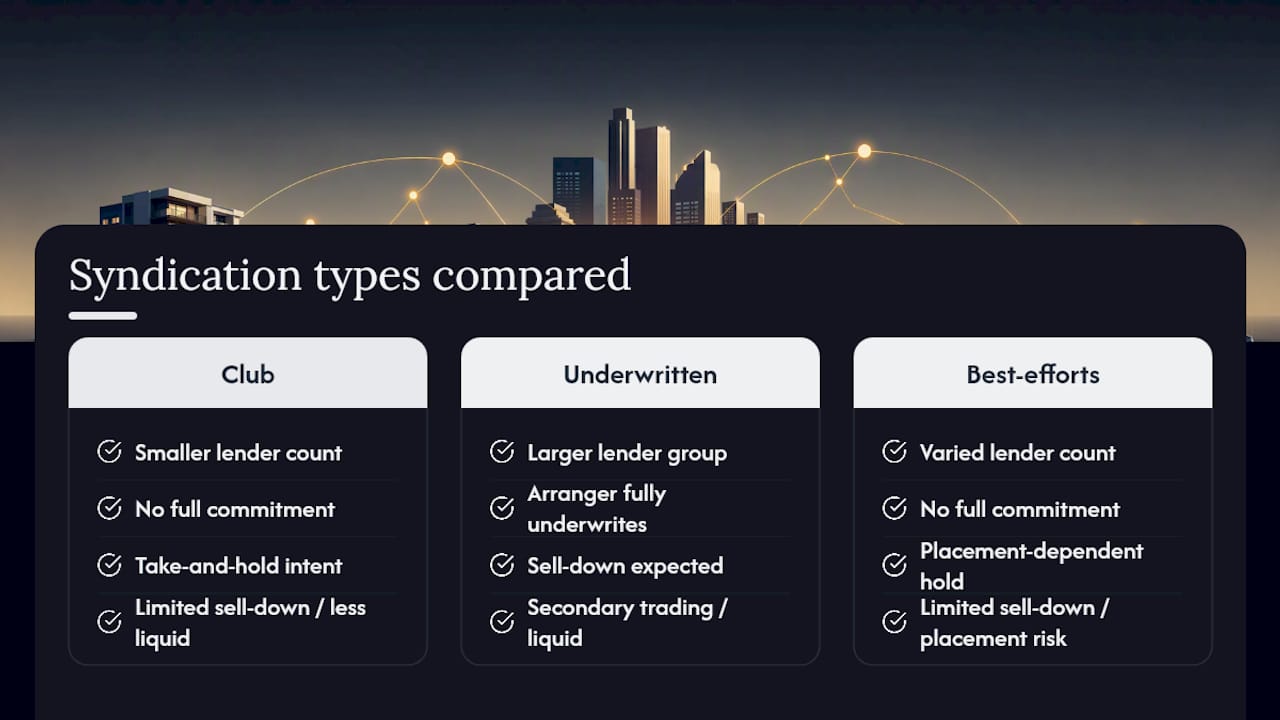
Sell-down dynamics drive the difference in liquidity. In a broadly syndicated deal, tranches trade in a secondary market, which lets lenders manage exposure and lets pricing move with credit sentiment. Each lender in a syndication typically holds a direct contractual relationship with the borrower, replacing what would otherwise be a tangle of bilateral loans with one facility agreement. Syndication tends to become the default route once a deal moves comfortably past the club threshold, usually because no small group of relationship lenders can or will absorb the full ticket alone.
Club deal vs syndication: comparing the two structures side by side
| Dimension | Club deal | Syndicated loan |
|---|---|---|
| Typical loan size | Often under $150 million | Larger facilities, scaling well beyond that threshold |
| Typical number of lenders | Commonly two to six | A dozen to several dozen, sometimes more |
| Documentation and governance | LMA-style agreement with bespoke voting and consent rights | Standardised agreement built for broad participation and agent administration |
| Pricing and fee profile | Generally lower arrangement and legal costs, but tighter covenants | Higher arrangement/underwriting fees, offset by wider pricing competition |
| Execution speed | Can close in under a month in many cases | often over a month once distribution time is factored in |
| Liquidity / secondary market | Limited; lenders intend to hold, not trade | Active secondary trading in many tranches |
| Typical use cases | Mid-market acquisitions, real estate finance, refinancing | Large acquisitions, leveraged buyouts, project finance |
The trade-offs are fairly stark once you line them up. A club buys you speed, confidentiality and a tighter relationship with your lenders, but it concentrates risk on a small number of balance sheets and can leave you with less room to manoeuvre if one lender turns difficult. Syndication spreads that risk widely and creates a liquid market for the debt, but it costs more to arrange, takes longer to close, and puts your covenant package in front of a much larger group of stakeholders. Borrowers who value discretion over distribution tend to gravitate towards clubs; borrowers financing genuinely large transactions rarely have a choice.
How to decide between a club deal and syndication
Work through this in order rather than jumping straight to a lender list.
- Size the facility first. If you’re financing a deal comfortably under the low hundreds of millions, a club is worth exploring before you default to a wider process.
- Weigh speed against distribution. If completion timing is tight, a club’s faster path may outweigh the pricing benefits of a broader syndication.
- Assess relationship depth. A club only works well if you already have two or more lenders willing to hold the exposure long term.
- Test your appetite for concentrated risk. Clubs put more weight on fewer balance sheets. If that concentration worries you or your board, syndication is the safer route.
- Check covenant tolerance. Clubs typically mean tighter, more bespoke covenants with more direct lender involvement in waivers.
- Consider market signalling. A syndicated deal broadcasts scale and credibility to the wider market; a club stays quieter, which suits sensitive acquisitions or refinancings.
Ask any prospective lender directly about agency arrangements, fee allocation, and whether they plan to hold or sell down their position. A staged approach, starting with a club and expanding into wider syndication later, often makes sense for borrowers who expect to return to the market repeatedly and want to build lender relationships before scaling up. If you’re preparing a term sheet request, our guide on arranging bridging finance for property deals sets out the documents most lenders will ask for regardless of structure.
Pro Tip: Before approaching lenders, decide internally whether you’d accept a slightly worse rate in exchange for a faster close. That single answer usually tells you which structure to pursue first.
Why lenders push for one structure over the other
Lenders aren’t neutral in this choice, and understanding their incentives changes how you negotiate.
- Relationship banks often accept lower headline returns on club deals because they value the ancillary revenue and long-term relationship over pure arranger economics.
- The downside for lenders is capital retention: club participants hold their exposure on balance sheet rather than distributing it, which ties up capacity they might prefer to deploy elsewhere.
- Banks lead syndications partly because arranger and underwriting fees are meaningfully higher, and partly because distribution lets them recycle capital faster.
- The operational cost is complexity: running a syndicate means agency administration, ongoing reporting to a large lender group, and slower consent processes.
- GlobalCapital’s market commentary notes that when high-value acquisitions get “clubbed out” among a handful of relationship banks, it can compress pricing and squeeze arranger returns, which is one reason some banks resist clubbing on their most profitable underwritings.
These incentives shape covenant drafting too. A club’s smaller lender group tends to negotiate more bespoke, sometimes tighter, covenant terms, while syndications lean on standardised templates that scale across a large group without constant renegotiation.
What we’ve learned arranging mid-market property finance
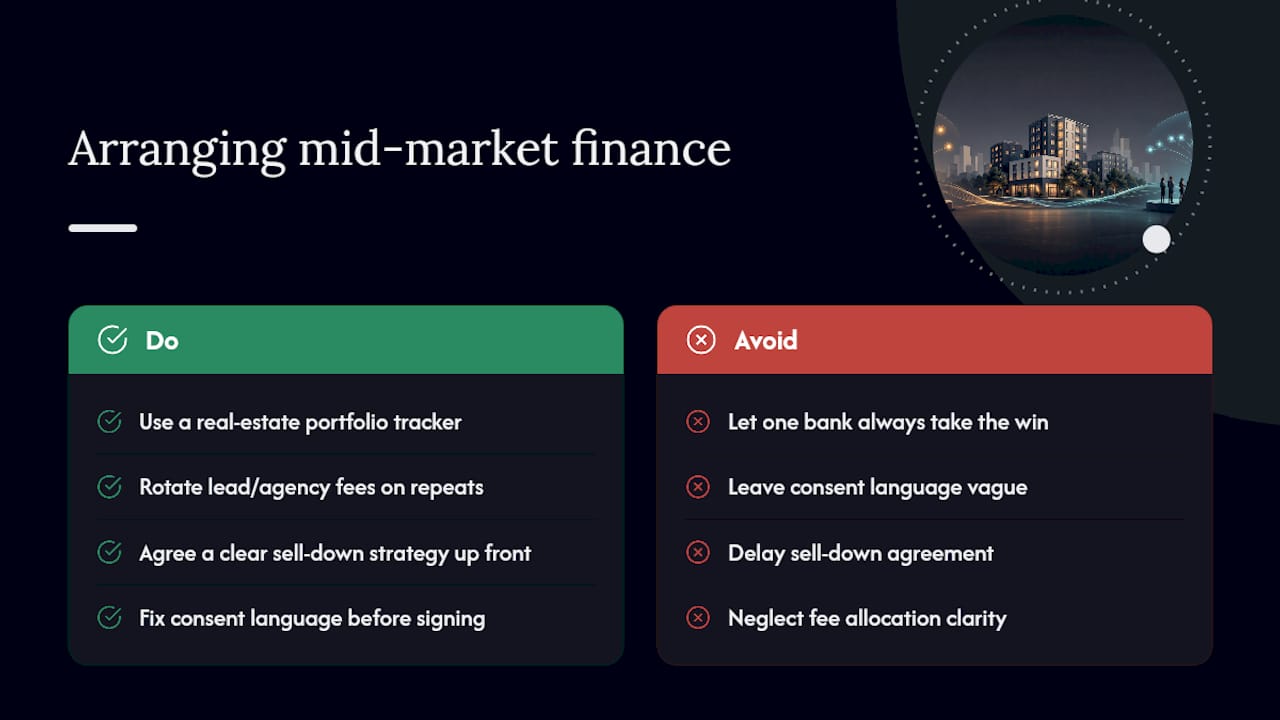
On mid-market real estate deals, the agency and fee allocation decision often makes or breaks lender appetite, highlighting the value of a real estate portfolio tracker for investors who want clarity. We generally favour rotating lead or agency fees among club participants on repeat transactions, which keeps relationships equitable rather than letting one bank always take the “win.” A clear sell-down strategy agreed at the outset, even for a deal structured as a club, avoids awkward conversations later if the borrower’s needs grow. The most common red flag in early term sheets is vague consent language around future amendments; fixing that before signature, not after a covenant breach, saves everyone a difficult negotiation.
Where this market is heading, and what borrowers should do about it
The rise in club deals for larger transactions isn’t purely cyclical. Relationship banking economics, tighter capital rules and borrower appetite for confidentiality all point to a structural shift, not just a response to volatile pricing. For borrowers who lean on a small group of relationship lenders repeatedly, the sensible policy is simple: formalise how agency fees rotate and how sell-down rights work before you need them under pressure, not mid-negotiation. Deals structured reactively tend to favour whichever lender has the most leverage at signing.
— James William Dawes
How James William & Co Capital arranges the right structure for your deal
Whether your transaction suits a tight club of relationship lenders or a broader syndicated facility, the choice shouldn’t be made by whichever lender calls first. Debt structuring partners can arrange lender introductions, negotiate agency and fee terms, and execute bespoke property and acquisition finance across bridging, development finance, commercial mortgages, mezzanine debt and JV equity.
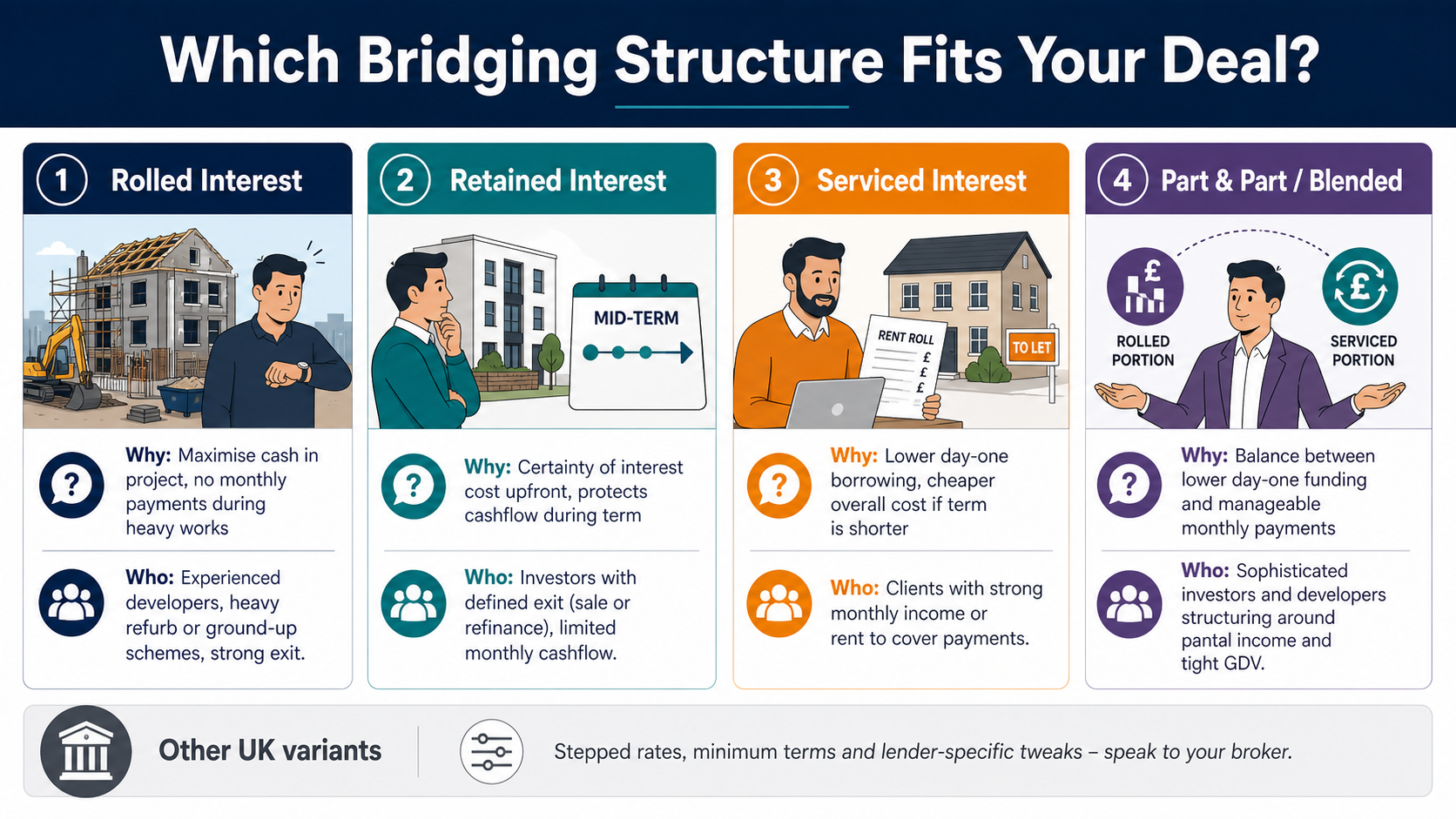
Before you speak to a broker, have your target facility size, timeline and key transaction documents ready, along with a clear view on how much lender involvement you’re prepared to accept in exchange for pricing or speed. If you’re weighing funding sources for a UK property project, our guide to real estate funding sources for UK developers is a useful starting point. When you’re ready to structure a facility, whether that’s a club, a syndication, or a staged mix of both, get in touch through our specialist property finance team to discuss lender introductions and execution.
Sources
FAQ
What are the disadvantages of syndication?
Syndication generally costs more to arrange, takes longer to close (often 45 days or more), and exposes covenant terms to a much larger, less flexible group of lenders during amendments or waivers.
What is the difference between a syndicated loan and a participation loan?
In a syndicated loan, each lender has a direct contractual relationship with the borrower; in a participation loan, the participant has no direct contract with the borrower and instead relies on the lead lender.
What are the different types of syndicated loans?
The two standard types are underwritten deals, where the arranger commits to the full amount before selling it down, and best-efforts syndications, where the arranger only places what the market will absorb; club deals sit alongside these as a smaller, take-and-hold variant.
Is a club deal a type of joint venture?
No. A club deal is a lending structure where multiple lenders provide debt to a single borrower, while a joint venture typically involves shared equity ownership between parties in a project.
When should a borrower choose a club deal over syndication?
A club deal suits borrowers who need speed and confidentiality on facilities generally under $150 million and who already have strong relationships with a handful of lenders willing to hold the exposure long term.
Recommended
Related Topics
Speak to a specialist
Discuss your finance with James directly
Whole-of-market specialist finance — bridging, development, commercial and residential. No call centres, no obligation. James reviews every enquiry personally.
New to specialist finance? How unbiased broker advice works · Deals we have completed
Explore Related Finance