
Published · Updated
capital raise on investment propertyRaising Capital on Investment Property in England
By James Dawes, CeMAP, Founder, James William & Co Capital

The realistic routes for a capital raise on investment property in England are a capital-raising remortgage, bridging finance, development finance, joint venture or mezzanine equity, selling existing assets, pension or equity release, crowdfunding, and commercial lending. Remortgaging suits steady portfolio growth, bridging suits speed, development finance and mezzanine suit ground-up projects, and every route needs a lender-ready case, proper legal and tax advice, and a credible exit.
TL;DR:
- Selling or using savings for funding avoids interest, but triggers potential capital gains tax and risks opportunity cost due to cash being tied up.
- Bridging finance offers quick access within weeks for urgent purchases but incurs high rates and short-term caps, making it suitable only for temporary gaps.
- Using pension or home equity funds can entail significant tax and inheritance consequences, with regulated advice and careful consideration necessary before proceeding.
- Engaging a specialist broker is recommended for complex deals involving multilayer capital stacks, mezzanine finance, or offshore structures to ensure proper arrangement and legal compliance.
Table of Contents
- Saving and selling assets: the low-risk starting point
- How does a capital-raising remortgage work?
- Should you release pension funds or home equity to invest?
- When does bridging finance make sense?
- What is development finance and where does capital sit in the stack?
- Joint ventures and mezzanine finance: which suits your deal?
- Is property crowdfunding or peer-to-peer lending worth considering?
- Commercial mortgages and business lending for portfolio landlords
- How do I choose the right capital-raising route?
- A worked example: structuring a multi-layer capital stack
- When is a specialist broker worth the fee?
- Get a capital stack built around your project, not a template
- Where to check the detail yourself
- Sources
- FAQ
Saving and selling assets: the low-risk starting point
Using savings or selling an asset to fund a purchase avoids interest charges entirely, and underwriting is simpler because there is no lender to satisfy on affordability or security. Costs stay lower over the life of the investment, since you are not servicing debt on top of your existing mortgage commitments.
The trade-off is opportunity cost. Cash tied up in a deposit stops working elsewhere, and selling an asset such as shares or a second property can trigger a capital gains tax event that eats into the sum you actually have to invest.
Before committing funds this way, check the following:
- Confirm the money is genuinely liquid and not locked into a notice account or investment wrapper with exit penalties.
- Work out the tax due on any disposal before you count the proceeds as available capital.
- Time the sale to land before exchange, not after, since delayed proceeds are one of the most common reasons purchases fall through.
How does a capital-raising remortgage work?
A capital-raising remortgage releases equity from a property you already own by increasing the mortgage balance, with the surplus paid out to you for a deposit or renovation costs elsewhere. Lenders typically allow loan-to-value ratios near three quarters on standard buy-to-let stock, though this is lower for houses in multiple occupation, new-build flats, or properties needing structural work.
Lenders scrutinise the stated purpose far more closely when the funds are earmarked for investment rather than home improvement, and a vague answer to “what’s this money for?” is one of the fastest ways to get an application declined outright.
- Get an up-to-date valuation and, where the property is unusual or high value, a full structural survey rather than a desktop assessment.
- Confirm affordability against the new loan using rental income stress tests, not just personal income.
- Budget for arrangement fees (often 1 to 2% of the loan), solicitor costs, and any early repayment charge on your existing deal.
Pro Tip: Ask your broker to check the Land Registry title before you apply. Lenders run their own search regardless, and unresolved title issues, restrictive covenants or missing consents are what quietly derail remortgage timelines that should take six weeks and instead take four months. Up-to-date title records held by HM Land Registry are what every lender’s solicitor checks before releasing funds, so sorting discrepancies early saves real time later.
Should you release pension funds or home equity to invest?
This is the route to treat with the most caution, and for good reason. UK rules on taking your pension set out when and how you can access pension benefits, and using that money to fund a property purchase almost always means giving up tax relief, triggering an income tax charge, or both.
Equity release against your main residence, usually a lifetime mortgage, works differently: no monthly repayments, but interest compounds against the property’s value for as long as the loan runs, often for decades. It can suit an older landlord with no mortgage and no intention of leaving the property to dependants debt-free, but it materially changes what’s left of your estate.
- Pension withdrawals for investment purposes require regulated financial advice, not just a broker’s opinion.
- Equity release products come with long-term retirement and inheritance consequences that are difficult to reverse once drawn down.
- Cheaper alternatives, such as a standard remortgage or a smaller-scale bridging facility, are worth ruling out first.
When does bridging finance make sense?
Bridging loans exist for situations where speed matters more than rate: auction purchases with a 28-day completion deadline, breaking a chain to secure a property before a buyer is found for your own, or covering a short gap before a development finance facility or mortgage completes. Speed is the entire point. A bridging lender can often complete in one to three weeks where a mainstream mortgage lender needs two months.
That speed carries a cost. Rates typically run at a high monthly percentage depending on the lender and security, well above standard mortgage pricing, and lenders usually cap terms at one to two years.
- Security is generally assessed against a conservative loan-to-value, often no higher than about two thirds to three quarters of the property’s current value.
- Arrangement fees, valuation costs and exit fees stack up quickly, so bridging rarely suits a hold of more than a year.
- Every lender wants a credible exit before agreeing terms, whether that’s a sale, a refinance onto a term mortgage, or completion of a development facility.
Non-bank lenders and private credit funds have increased their share of this market, and often move faster on decisions than high-street banks precisely because bridging and development finance sit outside their standard product lines. A lender who cannot see a clear exit route will either decline the deal or price it so cautiously that bridging stops making financial sense. For a fuller walkthrough of arranging one of these facilities, see how to arrange bridging finance for property deals.
What is development finance and where does capital sit in the stack?
Development finance funds construction or heavy refurbishment in stages, with funds released against build progress rather than as a single lump sum, which distinguishes it from bridging or a standard term mortgage. Senior lenders typically underwrite to loan-to-gross-development-value (LTGDV) and loan-to-cost (LTC) metrics rather than simple loan-to-value, because the security they’re lending against does not yet exist.
A typical capital stack for a mid-size scheme in England includes senior development debt as the largest portion, with mezzanine or preferred equity and developer equity following, and investor or JV capital often blended into the equity layers behind senior debt.

Senior lenders on this kind of facility expect a monitoring surveyor tracking build progress, an approved professional team (architect, contractor, project manager), and a clear exit through sale or refinance. Industry guidance on development finance confirms senior debt usually forms the largest single layer, with private investor capital sitting behind it as mezzanine or preferred equity. For the mechanics of arranging these facilities, our guide to real estate funding sources for UK developers covers the ground in more depth.
Joint ventures and mezzanine finance: which suits your deal?
A joint venture brings in an equity partner who shares the profit, and usually the loss, in exchange for capital and sometimes expertise. Mezzanine finance is debt, sitting behind senior lending as a second charge, with a fixed or profit-linked return but no ownership stake in the project itself.
The distinction matters because it changes who controls decisions. A JV partner typically expects a say in major decisions, from build specification to sale timing, formalised through a shareholders’ agreement. Mezzanine lenders want repayment and interest, governed by an intercreditor agreement that ranks their charge behind the senior lender, but they don’t sit on your board.
- JV structures suit developers who want to preserve cash but are comfortable sharing upside and control.
- Mezzanine suits developers who want to keep full ownership and are willing to pay a higher rate for that control.
- Intercreditor deeds and clear charge ranking are standard lender expectations in England, and their absence is a red flag for any senior lender reviewing the deal.
Is property crowdfunding or peer-to-peer lending worth considering?
Property crowdfunding platforms in the UK generally operate one of three models: debt crowdfunding, where investors lend against a secured charge; equity crowdfunding, where investors take a share stake in a specific scheme or company; and peer-to-peer bridging or development lending, which functions much like a bridging loan but is funded by pooled retail or institutional money rather than a single lender.
Before treating a platform as a serious capital source, check its FCA registration status, its track record through at least one full market cycle, and how it has handled defaults in the past. A platform with no disclosed default history is one that hasn’t been tested yet.
- Debt-based platforms typically target returns in the mid-single to low double digits, funded by borrower interest.
- Equity crowdfunding ties your return to the scheme’s eventual profit, with no fixed timeline for repayment.
- Fees and minimum investment thresholds vary widely, so read the platform’s own documentation rather than its marketing copy.
Commercial mortgages and business lending for portfolio landlords
Commercial mortgages and secured business loans differ from residential and standard buy-to-let lending in one key respect: the underwriting focuses on the business or portfolio’s ability to service debt, not just a single property’s rental yield. British Business Bank guidance sets out how commercial mortgages, bridging and secured loans each apply differently depending on the property and purpose.
- Landlords with four or more properties, or those buying through a trading business, typically move to commercial-style lending because portfolio-wide affordability and interest cover ratio (ICR) or debt service coverage ratio (DSCR) become the primary tests.
- Lenders on this kind of facility usually expect a special purpose vehicle (SPV) structure, with security taken as a debenture or a charge over company shares rather than a personal guarantee alone.
- SPV ownership brings clear tax and structuring implications, from corporation tax treatment of rental profit to how mortgage interest is relieved, so involve an accountant before, not after, incorporating.
For more on choosing between mortgage products at this scale, see types of commercial mortgages: choosing the right funding.
How do I choose the right capital-raising route?
Start by defining the purpose precisely, because vague liquidity requests are one of the most common reasons lenders reject applications outright, regardless of the applicant’s creditworthiness. A lender needs to see exactly what the money funds and how it comes back.
- Define the purpose: purchase, refurbishment, ground-up development, or refinance of existing debt.
- Match the route to what matters most for that purpose, whether that’s speed (bridging), scale (development finance), or lower ongoing cost (remortgage).
- Confirm the exit before applying: sale, refinance, or rental income covering repayments, and stress-test that exit against a slower market.
Before approaching a broker or lender, gather proof of income or company accounts, existing mortgage statements, a schedule of works and planning consent for development projects, and documentation proving the source of your deposit funds for anti-money laundering checks. Watch for red flags on the lender or introducer side too: an adviser who can’t explain their exit assumptions, fees that appear only in the small print, or return projections that sound better than anything comparable in the market.
Pro Tip: If a small-scale extension or refurbishment is what’s funding your next stage of growth, understanding how extension finance is mapped to cost bands before you apply saves you from over-borrowing or under-specifying the facility you need.
A worked example: structuring a multi-layer capital stack
A recent case involved a mid-scale residential conversion in the South West. The senior development facility was set at a conservative loan-to-gross-development-value, deliberately below what the lender’s maximum appetite allowed, because that headroom made the deal far easier to place with a monitoring surveyor and quicker to draw down against build stages.
Investor capital sat behind the senior debt as a second-charge mezzanine position, with an intercreditor agreement setting out exactly how repayment ranked if the project underperformed.
The single most important factor in getting this kind of stack underwritten quickly wasn’t the rate. It was having a documented, credible exit, whether sale or refinance, agreed before the senior lender even saw the application.
- Source-of-funds documentation for every capital provider was prepared before approaching lenders, not requested reactively mid-process.
- Legal and tax advisers were briefed alongside the broker from week one, not brought in after terms were agreed.
- The full facility, from first lender conversation to drawdown, ran to roughly ten weeks, helped substantially by having the professional team and documentation ready in advance.
Anyone assembling a similar stack should expect legal and structuring checkpoints around SPV formation and debt ranking well before drawdown, not as a late-stage formality. Our own guide to capital raising best practices for UK property developers covers the documentation checklist in more detail.
When is a specialist broker worth the fee?
A bespoke broker earns their fee on the complex deals, not the straightforward ones. A single buy-to-let remortgage rarely needs a capital concierge. A multi-layer stack with senior debt, mezzanine, and an offshore vehicle almost always does, because the coordination between lender, legal team and tax adviser is where deals stall.
Developers, high-net-worth investors, and anyone running an institutional-style transaction benefit most. Whoever you engage, verify their credentials and track record before you hand over a mandate.
Get a capital stack built around your project, not a template
Specialist brokers exist for exactly the deals covered above: the ones where a standard high-street mortgage application isn’t going to cut it. Such firms arrange bridging finance, development finance, mezzanine debt, JV equity introductions and commercial mortgages, structured through a single point of contact rather than juggling separate conversations with a lender, a solicitor and an equity partner.
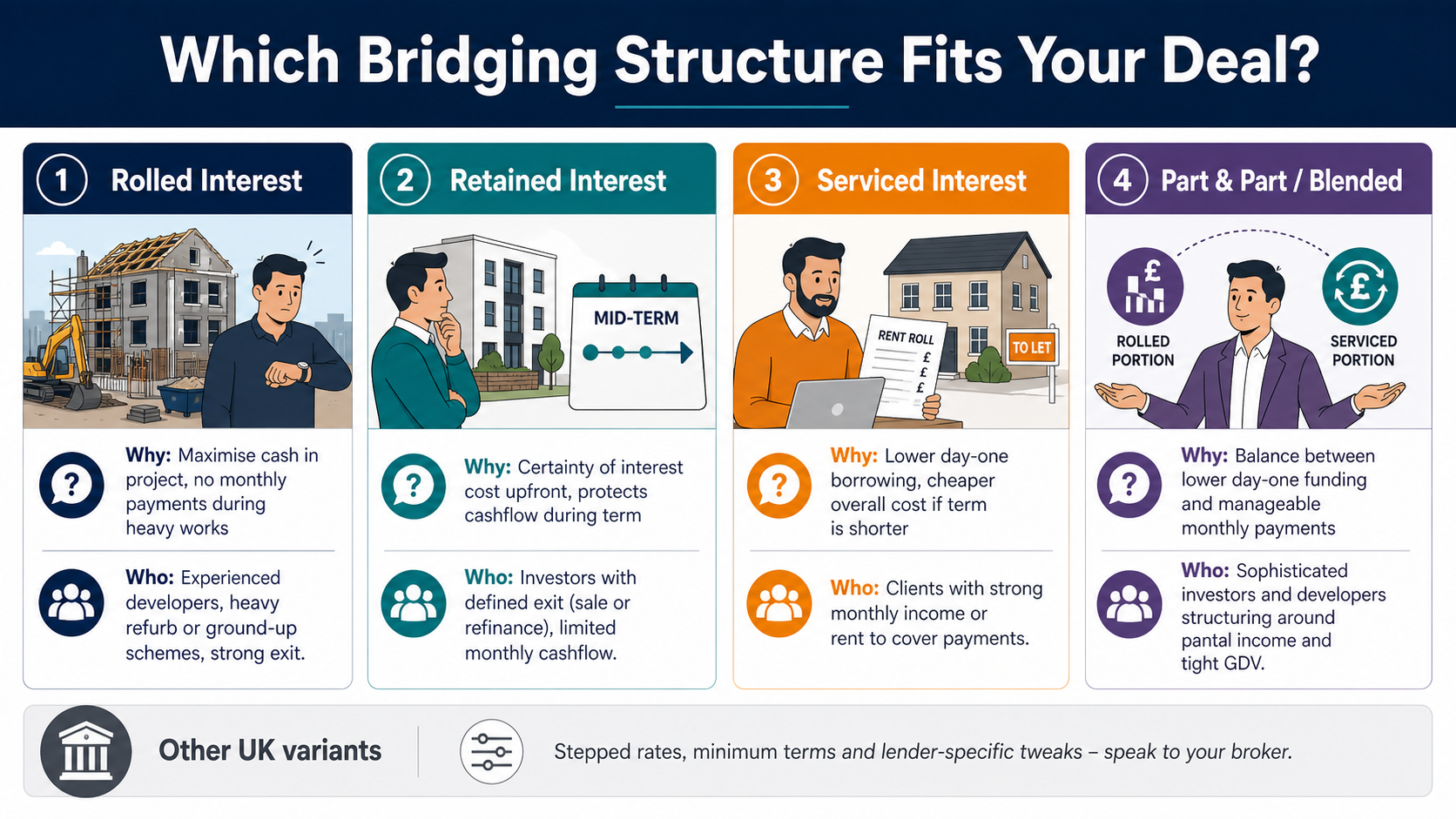
Before a first conversation, it helps to have a rough sense of your project cost, the security available, and your target completion date, since that shapes which lenders are even worth approaching. Clients typically come away with access to specialist lenders and private credit funds that don’t advertise on the high street, plus a capital stack shaped around their actual project rather than a generic product. If your next acquisition or development needs finance structured properly rather than bolted together, James William & Co Capital’s specialist property finance team is the place to start that conversation.
Where to check the detail yourself
For primary reading beyond this guide: HM Land Registry for title and ownership records, gov.uk pension guidance for regulated withdrawal rules, and the Office for National Statistics for market data.
Sources
- Gov
- Development Finance — Complete Investor Guide (PropInvestUK)
- How to finance a commercial property purchase (British Business Bank)
- Key legal considerations investing in UK commercial real estate (NatLawReview)
FAQ
What is the 2% rule for property investment?
The 2% rule suggests monthly rental income should equal at least 2% of the property’s purchase price for the numbers to work comfortably, though it’s a rough US-originated benchmark rarely achievable in most of England’s higher-value markets and should be treated as a sense check, not a hard rule.
How do I raise capital for a property investment in England?
The main routes are a capital-raising remortgage, bridging finance, development finance with mezzanine or JV equity, selling existing assets, pension or equity release as a last resort, crowdfunding, and commercial or business lending, with the right choice depending on speed, cost and the security available.
Who is eligible to invest through property crowdfunding platforms?
Eligibility varies by platform, but most FCA-registered debt and equity crowdfunding platforms require investors to pass an appropriateness or sophistication check before accessing higher-risk property investment opportunities.
Is a capital-raising remortgage better than bridging finance?
A remortgage generally suits lower-cost, longer-term equity release where speed isn’t critical, while bridging finance suits time-pressured purchases such as auctions or chain-breaks, despite carrying higher monthly rates and shorter terms.
Do I need an SPV to raise development or commercial finance?
Most senior lenders funding development or commercial property in England expect a special purpose vehicle structure, since it ring-fences the asset and clarifies debt ranking, which materially affects both lender appetite and pricing.
Recommended
Related Topics
Speak to a specialist
Discuss your finance with James directly
Whole-of-market specialist finance — bridging, development, commercial and residential. No call centres, no obligation. James reviews every enquiry personally.
New to specialist finance? How unbiased broker advice works · Deals we have completed
Explore Related Finance