
Published · Updated
high net worth mortgagesHigh net worth mortgages: how the UK's wealthy borrow differently
By James Dawes, CeMAP, Founder, James William & Co Capital

A high net worth mortgage is a UK residential loan assessed under the FCA’s HNW framework, triggered when a borrower has at least £300,000 in annual net income or £3,000,000 in net assets, excluding their main home and pensions. That status unlocks bespoke underwriting for complex income and asset profiles that mainstream lenders simply cannot price. If you fall into this bracket, the next step is straightforward: speak to a specialist broker with three years of accounts, a schedule of assets, and clarity on how you want to structure the deal.
TL;DR:
- Most high net worth mortgage applicants qualify through either three years of verified income exceeding £300,000 annually or net assets over £3 million excluding main residence and pensions.
- Lenders offering private bank or specialist loans can provide higher LTVs and more flexible underwriting when complex income sources like RSUs, trust distributions, or carried interest are properly documented.
- A typical four to six-week process is possible for straightforward cases, but complex structures involving trusts, offshore income, or cross-border assets can extend timelines to eight or more weeks.
- Borrowers should gather detailed documentation early, including vesting schedules, portfolio valuations, and trust deeds, to avoid delays and secure better pricing.
- Expat and non-resident applicants face stricter scrutiny, with more detailed proof of assets and potential legal or tax complexities that require professional advice from the start.
Table of Contents
- What counts as a high net worth mortgage in the UK?
- Who qualifies in practice: income route versus asset route
- Lender routes and product types available to HNW borrowers
- How underwriters assess complex income and what to prepare
- Pricing, LTVs, and realistic timelines
- How a specialist broker actually helps HNW borrowers
- Risks and challenges unique to high net worth mortgages
- Tax implications specific to high net worth mortgage structures
- Estate planning and succession alongside HNW borrowing
- What I ask for on the first call
- Talk to James William & Co Capital about your case
- Sources
- FAQ
What counts as a high net worth mortgage in the UK?
The FCA’s definition is precise, and it matters because it changes which rules apply to you. Under FCA Handbook glossary G2953, a high net worth mortgage customer needs annual net income of £300,000 or more, or net assets of £3,000,000 or more, with the main residence and pension pots stripped out of that asset calculation.
This threshold isn’t a badge of honour. It’s a legal gateway that changes how a lender is allowed to underwrite you. Standard mortgage regulation under MCOB assumes affordability is measured by income multiples and standard verification. Once you clear the HNW bar, MCOB and COBS provisions permit whole-of-wealth assessment, so a lender can look past a modest salary and weigh trust distributions, portfolio income, or business equity instead.
A few things trip people up here:
- Loan size alone doesn’t confer HNW status. A £4 million mortgage on a conventional salary is still assessed under standard rules.
- The certified statement used for some promotional exemptions sits in COBS 4 Annex 2, separate from the mortgage-specific threshold test.
- Regulated conduct duties, including fair treatment and suitability, still apply even where affordability rules are relaxed.
Who qualifies in practice: income route versus asset route
Most HNW applicants fall into a handful of recognisable profiles: senior law or accountancy partners, C-suite executives with heavy equity compensation, founders who’ve just exited a business, trustees managing family wealth, and retirees or expats living off a substantial portfolio.
The route you qualify through shapes which lenders will even look at your case.
- The income route. You meet the £300,000 threshold through salary, bonus, dividends, or a mix. Lenders will want three years of evidence and a clear pattern, not a single bumper year.
- The asset route. You clear £3,000,000 in net assets, excluding home and pensions, even if your income is modest or irregular. This is common among retirees, trustees, and business owners who’ve deferred income for tax efficiency.
- Documentary evidence for income-based cases. Self-assessment returns, an accountant’s reference letter, employment contracts confirming bonus structure, and P60s where relevant.
- Documentary evidence for asset-based cases. Portfolio valuations, property schedules, trust deeds showing beneficial entitlement, and bank statements confirming liquidity.
Expats and non-UK residents often qualify through the asset route rather than income, since UK employment records may not exist. Lenders in this space will ask harder questions about ownership structure and cross-border tax exposure, and the documentation expectations for foreign nationals tend to be more granular than for UK-resident applicants.
Lender routes and product types available to HNW borrowers
Not every lender chases HNW business, and the ones that do split roughly into three tiers. Private banks typically lend starting at a million pounds up to tens of millions, and many expect some assets under management as part of the relationship. Specialist lenders sit slightly below that, often starting around a million pounds with varying maximums, with more flexible criteria but less appetite for very large tickets. High-street lenders, even their “premier” divisions, generally follow standard income multiples regardless of your balance sheet.
- Private banks: highest ticket sizes, most flexible underwriting, frequently AUM-linked.
- Specialist HNW lenders: strong on complex income, smaller minimum loan sizes, no AUM requirement.
- Dry lending: borrowing without transferring assets under management, usually at a rate premium.
- AUM-linked lending: better pricing in exchange for consolidating investments with the lender.
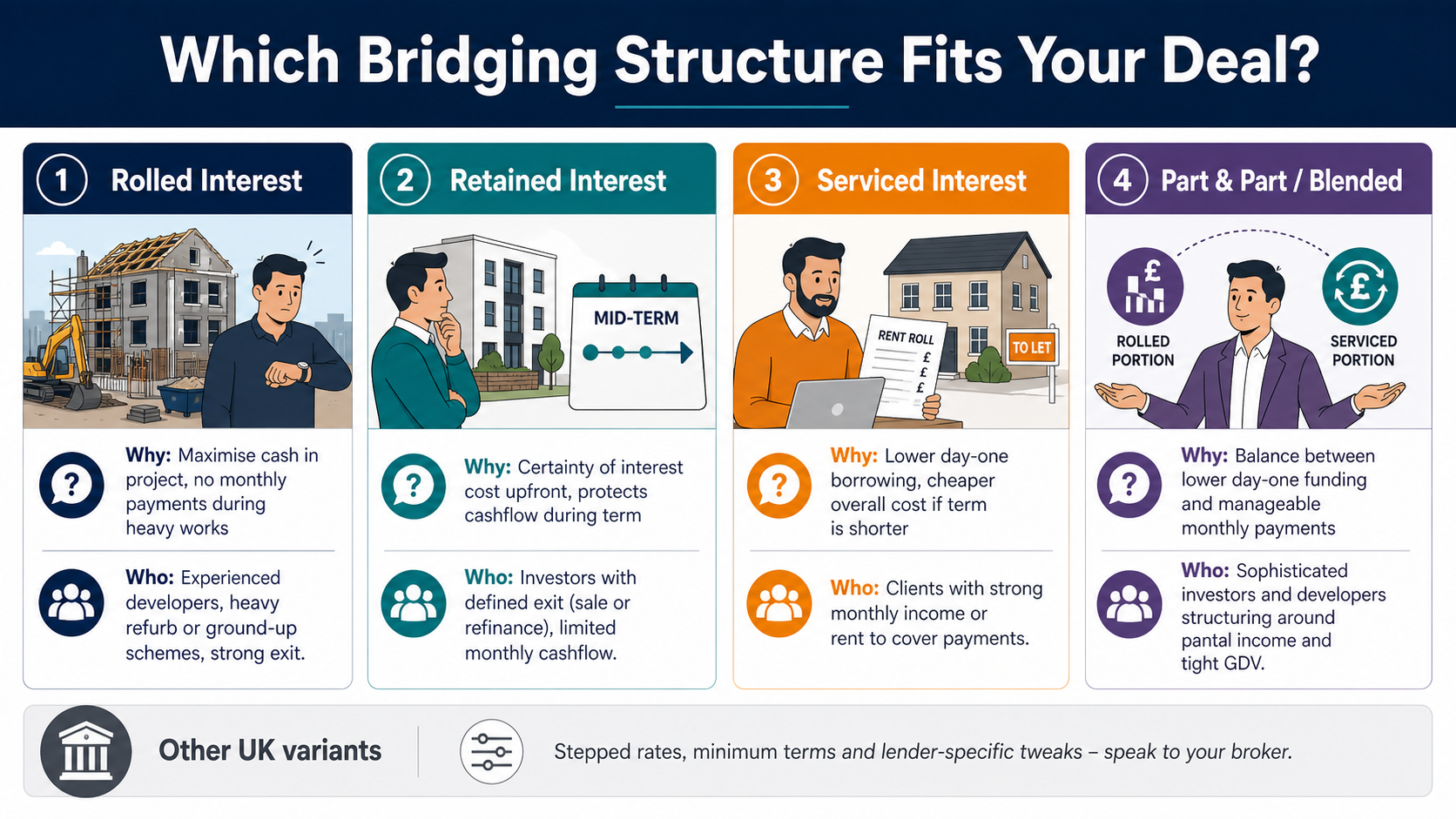
Product shapes vary as much as the lenders do. Interest-only remains common at higher loan-to-value ratios where there’s a credible exit, such as a documented share vesting schedule or planned business sale. Part-and-part structures blend interest-only with capital repayment. Securities-backed or Lombard facilities let you borrow against an investment portfolio rather than the property itself, which can be faster to arrange but is exposed to market swings. Bridging and development finance sit alongside these for HNW clients buying at auction, restructuring a portfolio, or funding a project ahead of a longer-term facility.
Pro Tip: If you’d rather not consolidate your portfolio with one bank, ask about dry lending early. It costs more in margin, but you keep your investment manager and your mortgage lender as two separate relationships, which some borrowers value more than the rate saving.
How underwriters assess complex income and what to prepare
Mainstream lenders often look at salary and little else. Private banks and specialist lenders will dig into carried interest, RSUs, dividends, and trust income, but only if you present them properly.
- Bonuses and discretionary pay: averaged over two or three years, discounted if volatile.
- RSUs and share vesting: credited against a vesting schedule, with lenders typically discounting for share price risk rather than crediting face value in full.
- Carried interest: assessed cautiously and usually averaged over a longer period, since realisation timing is unpredictable.
- Dividends from an owned business: supported by audited accounts, not just a tax return.
- Trust distributions: require the trust deed and evidence of a consistent distribution pattern.
- Foreign income: needs currency and tax-treatment clarity, particularly for expats.
The paperwork that actually moves a case forward: RSU grant and vesting letters, audited company accounts, an accountant’s reference letter, trust deeds, and statements confirming assets under management where relevant. Private banks and specialist HNW lenders will generally credit these income types far more generously than a high-street underwriter working from a rigid affordability calculator.
Pro Tip: Start gathering vesting schedules and trust documentation at least six weeks before you plan to apply. The most common pitfall isn’t a weak financial profile, it’s incomplete paperwork arriving in dribs and drabs, which stalls underwriting and can cost you a rate.
Pricing, LTVs, and realistic timelines
Loan-to-value bands depend heavily on lender tier and how the income is evidenced. A well-documented case with strong liquidity can reach high LTV with certain private banks, while more conservative lenders cap lower for complex-income cases without an AUM relationship.
- Private banks: LTVs vary widely depending on relationship depth.
- Specialist lenders: generally offer competitive LTVs without an AUM requirement.
- Dry lending: usually available but typically at a higher rate than AUM-linked deals.
The typical pricing gap between AUM-linked and dry lending reflects the relationship value a bank places on managing your investments alongside your mortgage. On timelines, a straightforward asset-route case with clean paperwork can complete in four to six weeks. A complex case involving trust structures, offshore income, or a multi-lender debt stack often runs eight to twelve weeks, largely dictated by how quickly supporting documents arrive rather than the lender’s internal process.
How a specialist broker actually helps HNW borrowers
Packaging is where most cases are won or lost, and it’s the part borrowers underestimate most. James William & Co Capital works as a single point of contact across the structuring, negotiation, and execution of a case, drawing on relationships with family offices, private credit funds, and specialist lenders that most individual applicants have no direct access to.
- Selecting the lender tier that actually fits your income shape, rather than applying broadly and hoping.
- Packaging bonuses, RSUs, carried interest, and trust income into a coherent affordability narrative lenders can approve quickly.
- Negotiating covenant terms and, where needed, layering bridging, mezzanine, or JV equity alongside a core mortgage.
- Coordinating a multi-part debt stack when a single lender won’t cover the full requirement.
At first contact, worth asking any broker: which lenders they’ve placed similar cases with, how their fee structure works, and whether they can show (without breaching confidentiality) a comparable transaction they’ve executed.
Risks and challenges unique to high net worth mortgages
Securities-backed lending carries a risk mainstream mortgages don’t: your collateral can lose value overnight. If you’ve borrowed against an investment portfolio through a Lombard facility, a sharp market fall can trigger a margin call, forcing you to inject cash or sell assets at the worst possible moment. This is the trade-off for speed and flexibility that securities-backed lending offers over a conventional property-secured loan.

Interest-only structures carry their own exposure. If the “credible exit” underpinning the loan (a share sale, a business disposal, a vesting event) slips or shrinks in value, you’re left servicing a large facility with no capital repayment built in. Lenders will stress-test this scenario, but borrowers should too, rather than assuming a projected liquidity event will land exactly as planned.
AUM-linked lending introduces relationship risk. Consolidating investments with one bank to secure better mortgage pricing means your borrowing and your portfolio management sit with the same institution, which limits your flexibility if that relationship sours or the bank’s risk appetite shifts.
Cross-border cases add currency and legal risk on top of everything else. An expat borrowing against foreign-currency assets is exposed to exchange rate movement between the asset base and the sterling loan, and trust or offshore structures can face closer scrutiny under evolving anti-money-laundering rules, which can slow or complicate an otherwise straightforward application.
Tax implications specific to high net worth mortgage structures
The mortgage itself doesn’t usually trigger a UK tax event, but the structures built around it often do. Borrowing against a portfolio through a Lombard facility rather than selling assets outright can defer a capital gains liability that a straight sale would crystallise immediately, which is one reason securities-backed lending appeals to portfolio-heavy borrowers.
Trust-held property brings its own layer of complexity. Income distributed from a trust to fund mortgage payments may carry a different tax treatment than income drawn directly, and the trust deed’s terms around distribution and beneficial entitlement need to align with what a lender is willing to accept as evidenced income.
Non-resident and expat borrowers face additional considerations around non-resident capital gains rules on UK property and how foreign income is treated for UK tax purposes if a mortgage requires evidence of that income. None of this replaces proper advice: a mortgage broker structures the borrowing, but a chartered tax adviser should sign off on how that borrowing interacts with your wider tax position, particularly where offshore vehicles or trust income are involved.
Estate planning and succession alongside HNW borrowing
A large mortgage on a family home or investment property doesn’t sit in isolation from your wider estate. If the property is intended to pass to children or into a trust, the outstanding loan balance affects both the net value of the estate and how any inheritance tax liability gets calculated on death.
Some HNW borrowers use mortgage debt deliberately as part of estate structuring, borrowing against a property rather than liquidating other assets, to preserve liquidity elsewhere for gifting or trust funding. Whether that makes sense depends entirely on your circumstances and should sit alongside advice from a solicitor or wealth planner rather than being decided as a side effect of a mortgage application.
Trust-owned property adds another layer. If a trust holds the property being mortgaged, lenders will want clarity on the trustees’ authority to borrow and how that debt interacts with the beneficiaries’ entitlements. Getting this wrong at application stage can delay completion by weeks. Reviewing succession intentions before you apply, not after, tends to save both time and legal cost. It’s also worth revisiting existing borrowing whenever a will or trust structure changes materially.

What I ask for on the first call
Five things move a case forward fast: three years of accounts or tax returns, a schedule of assets and liabilities, vesting or trust documents where relevant, a target loan amount and property, and a realistic completion date. The three mistakes I see most often: applying to a lender that doesn’t credit your income type, submitting incomplete trust paperwork, and leaving tax advice until after the mortgage offer lands. If trusts, offshore structures, or succession planning are in play, bring in tax or trust advice alongside the mortgage from day one, not as an afterthought.
— James William Dawes
Talk to James William & Co Capital about your case
James William & Co Capital arranges the sort of borrowing high-street lenders won’t touch: bespoke residential mortgages, bridging, mezzanine debt, and layered structures for buyers whose income doesn’t fit a standard affordability calculator. Where a mainstream lender needs a payslip, we build an affordability narrative from your accounts, vesting schedules, and trust documents, then take it to lenders who actually credit that income.
A confidential initial review costs you nothing beyond an hour of your time. Bring three years of accounts or tax returns, a schedule of assets, and details of the property or transaction, and we’ll tell you honestly which lender tier fits and what the likely terms look like. Start that review through our specialist property finance team in London, or explore how we structure layered financing across development and mezzanine facilities if your case involves more than a single mortgage.
Sources
- FCA Handbook — glossary G2953: high net worth mortgage customer
- Fox Davidson — High net worth mortgage guide (2026)
FAQ
What is a high net worth mortgage?
It’s a UK mortgage assessed under the FCA’s HNW framework, available to borrowers with annual net income of £300,000 or more, or net assets of £3,000,000 or more excluding their main home and pensions, allowing lenders to underwrite complex income and asset profiles that standard affordability calculators cannot handle.
What is considered high net worth in the UK?
Under FCA rules, high net worth status for mortgage purposes means annual net income of £300,000 or more, or net assets of £3,000,000 or more excluding your main residence and pension funds.
Which banks in the UK offer high net worth banking?
Private banks and specialist lenders serve this market rather than typical high-street brands, with private banks generally lending from around £1 million upwards and specialist lenders covering a similar range with more flexible criteria. A broker such as James William & Co Capital can match your profile to the lenders most likely to approve it.
What is the top 1% net worth in the UK?
Published wealth data varies by methodology and year, so there’s no single fixed figure to quote here; what matters for mortgage purposes is whether you clear the FCA’s specific income threshold of £300,000 or asset threshold of £3,000,000.
Can expats or non-residents get a high net worth mortgage in the UK?
Yes, though the lender pool narrows and documentation requirements are more detailed, particularly around proof of asset ownership, access to funds, and cross-border tax clarity.
Recommended
Related Topics
Speak to a specialist
Discuss your finance with James directly
Whole-of-market specialist finance — bridging, development, commercial and residential. No call centres, no obligation. James reviews every enquiry personally.
New to specialist finance? How unbiased broker advice works · Deals we have completed
Explore Related Finance