
Published · Updated
monitoring surveyor roleThe Monitoring Surveyor: What It Means for Your Drawdowns
By James Dawes, CeMAP, Founder, James William & Co Capital
A monitoring surveyor, also called a project monitor or bank monitor, is the lender’s independent technical advisor on a construction or development loan. Appointed to protect the funder’s financial exposure, the surveyor inspects progress, checks costs against the loan appraisal, and signs off each stage before money is released. Lenders bring one in whenever a project carries construction risk that a standard credit review cannot price. The RICS practice information on lenders’ independent monitoring surveyors sets the benchmark that most UK appointments follow.
TL;DR:
- Monitoring surveyors are appointed when construction risk exceeds standard credit assessments, typically in staged fund releases, complex projects, or schemes with narrow margins.
- They conduct five key phases, including pre-funding due diligence, regular site monitoring, verifying drawdown evidence, routine reporting, and final certification before releasing funds.
- Monitors must hold chartered status, such as RICS membership, and carry appropriate professional indemnity insurance scaled to project size to limit liability.
- Their reports influence drawdown approvals by verifying progress, costs, and statutory compliance, with delays occurring if evidence is incomplete or disputed.
- The role is non-statutory, based on contractual scope, and primarily funded by borrowers, but their primary duty remains to the lender with a clear escalation process for disagreements.
Table of Contents
- Understanding the monitoring surveyor role: definitions and when lenders use one
- What a monitoring surveyor actually does: core duties and tasks
- How monitoring surveyors do it: inspections, reports and health & safety checks
- Qualifications, experience and professional standards for the role
- Scope of appointment and typical deliverables
- Working relationships, independence and conflicts of interest
- Career paths and employment opportunities for monitoring surveyors in England
- Practitioner perspective: how monitoring reports drive drawdown decisions
- Legal implications and liabilities in the monitoring surveyor role
- An editor’s take on where the sector gets this wrong
- How James William & Co Capital works alongside your monitoring surveyor
- Where to find the primary guidance
- Sources
- FAQ
Understanding the monitoring surveyor role: definitions and when lenders use one
You’ll see this job under several names, and they all describe the same function. “Monitoring surveyor” is the most common label, but “project monitor,” “bank monitor” and “independent monitoring surveyor” (often shortened to IMS) all refer to the person a lender hires keeping an eye on their money once it’s tied up in bricks and mortar. The terminology varies between lenders and regions, but the job doesn’t.
Retail banks, specialist development lenders and private credit funds all use monitors, though the intensity of oversight differs sharply between them. A high street bank funding a straightforward residential scheme might commission fairly light-touch monthly visits. A private credit fund backing a complex mixed-use scheme with mezzanine debt stacked underneath the senior facility will typically want a monitor embedded from the earliest due diligence stage, reporting far more frequently.
What triggers an appointment usually comes down to risk, not project size alone:
- Any loan where funds are released in stages against physical progress, rather than as a single drawdown
- Ground-up developments, major refurbishments and conversions where construction risk is significant
- Schemes with tight margins, complex contractor arrangements, or multiple funding layers (as often applies to stacked debt structures)
- Borrowers with limited track record on schemes of this scale
One point worth clearing up before going further: this is a practice-based role, not a statutory one. There’s no single law defining “monitoring surveyor” and no licensing body that grants the title exclusively. LexisNexis’s guidance on the project monitor role describes it as descriptive rather than legally defined, though the function is widely and consistently used across England and Wales. That gap between informal terminology and formal expectation is exactly why RICS and Homes England guidance carries so much weight in practice.
What a monitoring surveyor actually does: core duties and tasks
The role splits into five distinct phases, and missing any one of them is where inexperienced monitors run into trouble.
- Pre-funding due diligence. Before a single pound is drawn down, the monitor reviews the design, the building contract, the cost plan and the programme. This is where a monitor catches an underpriced groundworks package or a contractor’s payment schedule that doesn’t match the loan’s drawdown profile.
- Construction phase monitoring. Regular site visits check actual progress against the baseline programme, assess whether the contractor has the resources and competence to deliver, and flag slippage before it becomes a funding crisis.
- Drawdown control. Each stage payment the borrower requests gets checked against verified progress, not just an invoice. The monitor confirms the works claimed for have actually happened, and that spend to date matches the original appraisal.
- Reporting routine. Monthly reports feed the lender’s credit committee, typically including a progress summary, a financial position, and an updated risk register flagging anything moving in the wrong direction.
- Close-out and final certification. At practical completion, the monitor checks snagging lists, confirms statutory paperwork is in order, and signs off the final certificate that releases the last tranche of funds.
Monitors approve drawdowns by confirming that expenditure matches the project appraisal and financing documentation, not by taking the borrower’s figures at face value. That distinction between checking evidence and trusting a submission is the entire point of the role.
Pro Tip: If you’re a developer preparing for a drawdown request, submit certified valuations and dated site photographs alongside your invoices. Monitors move faster when the evidence arrives with the ask, not after a follow-up query.
RICS guidance is explicit that this work sits within a defined scope of services agreed at appointment, covering technical due diligence, construction phase monitoring, drawdown certification and close-out reporting as a coherent package rather than an ad hoc checklist. A monitor working outside that agreed scope, or one asked to comment on matters beyond technical opinion, is stepping into territory that creates liability for everyone involved.
How monitoring surveyors do it: inspections, reports and health & safety checks
The mechanics behind each drawdown decision rely on a fairly consistent set of evidence, whatever the lender.
Before a site visit, most monitors ask the borrower for a standard pre-visit pack: invoices and certified valuations, contractor payment applications, updated programme information, and as-built photographs from the previous month. A well-scoped appointment specifies exactly what’s required each month, and RICS’s short form of consultant’s appointment for monitoring services shows this checklist materially reduces site visit time and speeds drawdown approval.
On site, the monitor is checking several things simultaneously:
- Whether work matches the specification and drawings, not just “looks finished”
- Standard of workmanship against what a reasonably competent contractor should deliver
- Outstanding snags and whether they’re being tracked and closed
- Site safety practice and evidence of a functioning health and safety management system
Health and safety competence matters more than many newcomers to the role expect. Practice guidance on Homes England framework appointments recommends monitors hold or work towards recognised health and safety qualifications such as NEBOSH, SMSTS or Grad IOSH, reflecting the fact that a monitor walking an active construction site needs genuine CDM awareness, not a passing familiarity.
What monitors won’t do is just as important as what they will. A monitoring surveyor gives a technical opinion on progress and cost. That’s not a design warranty, a structural guarantee, or a substitute for the contractor’s own quality assurance. Any appointment that asks a monitor to underwrite construction risk beyond that technical opinion is asking for something the role was never built to provide.
Qualifications, experience and professional standards for the role
Lenders overwhelmingly expect monitors to be chartered surveyors, and RICS membership (MRICS) sits at the centre of what most appointment briefs specify. The RICS Black Book practice information describes the IMS function as a specialist service requiring RICS membership or equivalent demonstrable competence, and that framing shapes how lenders write their appointment criteria.
Most working monitors come from one of a handful of backgrounds:
- Chartered building surveyors with construction site experience
- Quantity surveyors who’ve moved into cost and progress verification
- Project managers with a strong technical grounding in construction delivery
- Engineers with relevant chartered status and site-based experience
Professional indemnity insurance is non-negotiable, and the level of cover matters as much as having a policy at all. RICS guidance stresses that appropriate PII, matched to the scale and risk of the schemes being monitored, is a core expectation rather than a nice-to-have. A monitor covering a £2 million residential conversion and one covering a £40 million mixed-use scheme need very different levels of cover, and lenders increasingly check this before confirming an appointment.
Continuing professional development matters too, particularly around construction technology, safety regulation and lending practice, all of which shift often enough that a qualification from a decade ago won’t carry the same weight it once did.
Scope of appointment and typical deliverables
A well-drafted appointment sets out exactly what the borrower and lender can expect to receive, and when.
- Initial report. This is the foundation document, covering technical due diligence on the design, contract, cost plan and programme, alongside an initial risk register. Homes England’s Lot 3 monitoring surveyor initial report guidance sets out a detailed public-sector scope for what this document should contain, and it’s a useful benchmark even for private appointments.
- Monthly monitoring reports. These track progress against the baseline programme, confirm how funds have been used against the appraisal, and update the risk register with anything that’s changed since the last visit.
- Drawdown certificates. Each certificate confirms the works claimed for have been verified on site, with supporting evidence such as valuations, payment applications and photographic records attached or referenced.
- Close-out reports. The final deliverable confirms practical completion, verifies snagging has been addressed, and checks statutory paperwork, including Building Regulations completion certificates, health and safety files and relevant gas or electrical certifications, is all in place before the last drawdown releases.
- Bespoke additions. Some appointments add extra services, such as valuation input or specific technical surveys, agreed and priced separately from the core scope.
Monitors will typically withhold final certification until every piece of statutory completion paperwork is confirmed, according to RICS Black Book guidance on lenders’ independent monitoring surveyors. That’s not bureaucratic caution. It’s the last line of defence against a lender releasing final funds on a building that isn’t legally complete.
Working relationships, independence and conflicts of interest
The monitor’s primary duty runs to the appointing lender, even where the borrower foots the bill, which happens on most private development deals. That arrangement can feel counterintuitive to borrowers paying the invoice, but it’s the structure that gives the report credibility with the fund actually taking the risk.
- Appointment sets the lines of authority. The engagement letter typically confirms who instructs the monitor, who receives reports first, and what communication protocol governs contact between the monitor, the borrower and the contractor.
- Conflicts get disclosed, not managed away. A monitor who has previously worked for the borrower, or holds a financial interest in the scheme, should disclose it at appointment stage. Reputable practice is to decline the instruction rather than attempt to manage a genuine conflict.
- Escalation paths are built in. Where a monitor and borrower disagree over a drawdown decision, most appointments specify an escalation route through the lender’s credit team before any dispute reaches a formal process.
Association of Property Lenders and RICS collaboration on this guidance underlines that IMS appointments work best for both sides when scope is agreed clearly upfront, precisely because ambiguity over who the monitor answers to is where most disputes actually start.
Career paths and employment opportunities for monitoring surveyors in England
If you’re weighing this up as a career move, the routes in are fairly well trodden. Consultancies specialising in development monitoring, high street and challenger banks with in-house monitoring teams, and specialist monitoring firms working directly for private credit funds all hire for this role, often under slightly different job titles: monitoring surveyor, project monitor, bank monitoring surveyor or development monitoring surveyor.
Recruitment listings for senior and specialised monitoring positions, particularly around London, commonly show salary bands in the £50,000 to £85,000 range, though this varies with seniority, region and whether the role is permanent, fixed term or consultancy-based. Contract patterns split fairly evenly between in-house permanent roles at lenders and freelance or consultancy arrangements serving multiple lender clients.
If you’re building a CV for this field, put these front and centre:
- RICS membership or clear progress towards chartered status
- Relevant health and safety credentials, such as SMSTS or NEBOSH
- Concrete examples of monitoring or site inspection reports you’ve produced, even redacted samples
- Experience reading contracts, cost plans and construction programmes, not just site inspection
Approach specialist monitoring consultancies directly, as many roles never reach general job boards, and speak to lenders’ credit teams if you already have construction consultancy experience, since several build panels of approved monitors rather than advertising openly.
Practitioner perspective: how monitoring reports drive drawdown decisions
Monitoring reports don’t sit in a drawer. A credit committee reviewing a drawdown request reads the monitor’s risk register alongside the numbers, and a flagged concern, even a minor one, can delay a release by weeks while it’s investigated. Developers who treat the monitor as an obstacle rather than a checkpoint tend to see slower drawdowns, not faster ones.
The fastest approvals go to developers who prepare properly: certified valuations ready before the visit, a programme update that matches what’s visible on site, and a single point of contact who responds to the monitor’s queries within days, not weeks. Structuring finance so monitoring conditions are built in from the outset, rather than bolted on after a lender’s credit team raises concerns, tends to produce a smoother relationship across the life of the loan.
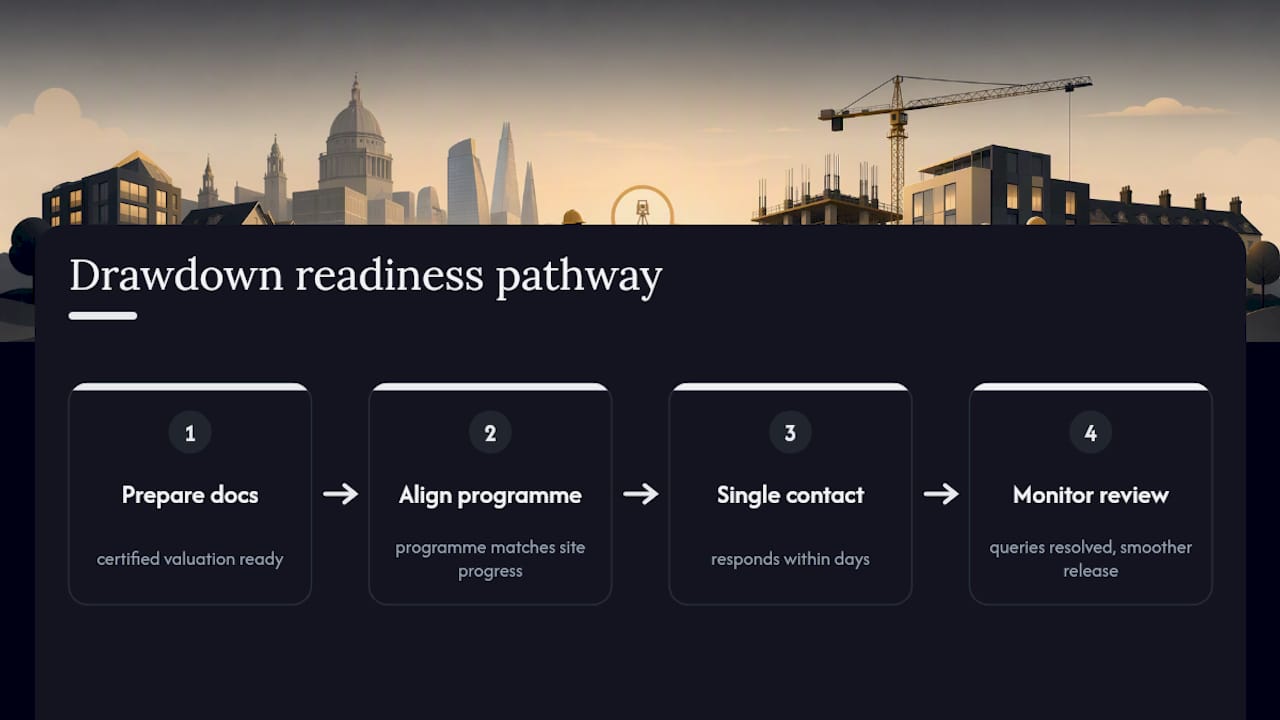
Pro Tip: Brief your monitor before the first site visit, not after. A five-minute call covering programme changes and known risks saves everyone a longer, more defensive conversation later.
Legal implications and liabilities in the monitoring surveyor role
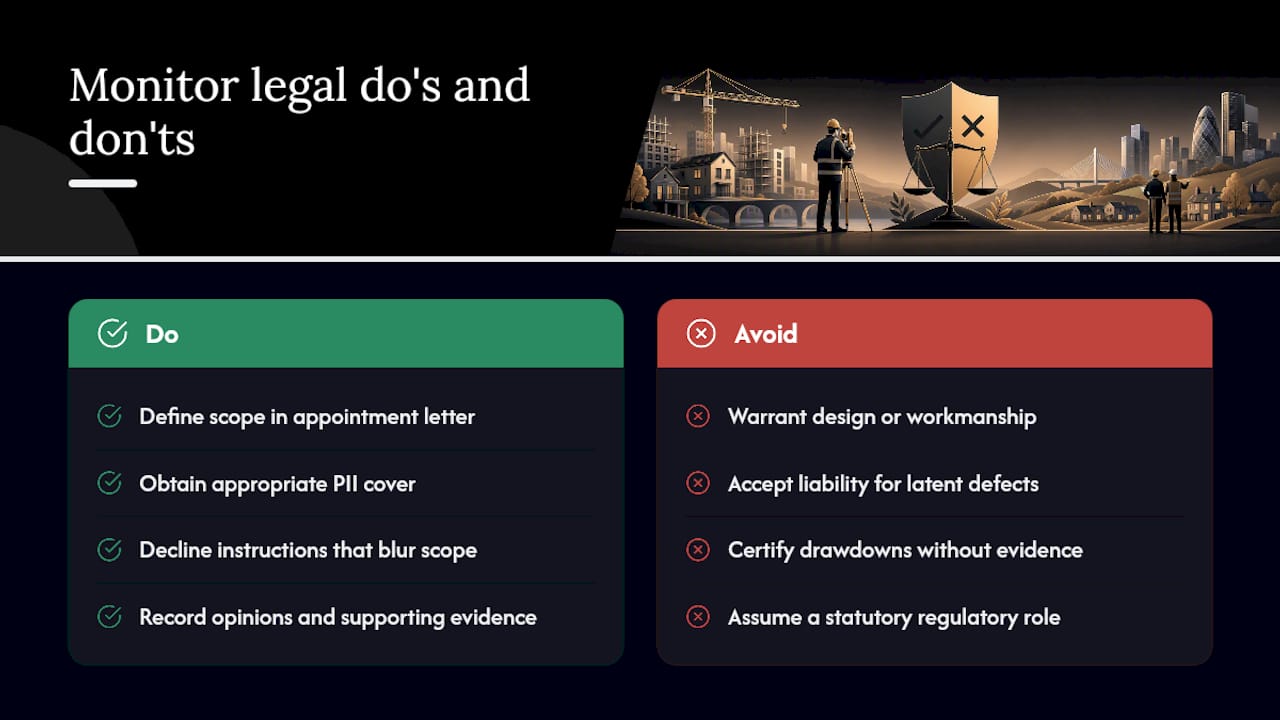
The monitor’s liability is bounded by the scope of the appointment, and that boundary matters enormously in practice. A monitor gives a technical opinion on progress, cost and risk. They are not warranting the design, guaranteeing the contractor’s workmanship, or accepting liability for defects that only a full structural survey or a warranty provider would cover. Appointment letters typically state this exclusion explicitly, and RICS guidance recommends monitors decline any instruction that blurs this line.
Professional indemnity insurance exists precisely because liability, while bounded, is real. If a monitor certifies a drawdown negligently, missing evidence that should have raised a flag, and the lender suffers a loss as a result, that’s a professional negligence exposure with genuine financial consequences. This is why appropriate PII cover, scaled to the size of schemes being monitored, isn’t a formality; it’s the mechanism that makes the whole system workable for lenders who are, in effect, relying on the monitor’s opinion to release large sums of money.
Because the role isn’t statutory, disputes over a monitor’s conduct typically get resolved through the contractual terms of the appointment itself, RICS’s professional conduct rules, or negligence claims through the courts, rather than through a dedicated regulatory tribunal. That places even more weight on a clearly drafted appointment letter at the outset, since ambiguous scope is where most legal disputes over a monitor’s performance actually originate.
An editor’s take on where the sector gets this wrong
Most guidance on monitoring surveyors focuses entirely on process: what a report should contain, how drawdowns get certified, which qualifications matter. That’s necessary, but it misses the more useful point. The best monitors aren’t policing a build; they’re giving a lender early warning while there’s still time to act on it. A report that lands after a problem has already cost three weeks of programme time has failed at its core job, however tidy the paperwork looks.
The conventional advice for jobseekers, meanwhile, leans too hard on qualifications and not enough on evidence. RICS membership matters, but a candidate who can show a lender exactly how they’d write up a stalled groundworks package, in commercial terms a credit committee understands, will beat a chartered surveyor who can’t translate technical risk into funding consequences. That translation skill is what separates monitors lenders keep reappointing from those they use once.
For developers, the priority is simpler than most guides suggest: get your paperwork rhythm sorted before the first drawdown, not after the second delay.
— James William Dawes
How James William & Co Capital works alongside your monitoring surveyor
Monitoring conditions aren’t a hurdle James William & Co Capital works around. They’re a structural feature we build into how development and bridging finance gets arranged from day one. When a lender’s monitor is part of the deal, the difference between a smooth drawdown schedule and a stalled one usually comes down to how well the finance was structured against that monitoring framework in the first place.

We arrange development finance, joint venture equity and mezzanine finance for schemes where staged drawdowns and independent monitoring are standard lender requirements, and bridging finance for developers who need interim funding while those conditions are satisfied. Because of direct relationships with specialist lenders and private credit funds who appoint monitors, the debt stack, reporting cadence and drawdown triggers can be structured to align from the outset, rather than negotiating friction between borrower and monitor after the loan has already drawn.
If your next scheme involves a monitoring surveyor and you want the finance structured to match, consider contacting a specialist commercial finance broker to discuss your project.
Where to find the primary guidance
- RICS practice information sets the professional benchmark for scope, competence and PII expectations for monitoring surveyors.
- Homes England’s Lot 3 monitoring surveyor initial report shows the detailed public-sector scope and reporting format used on government framework appointments.
- LexisNexis’s legal guidance clarifies the project monitor’s non-statutory status and its role across England and Wales.
Use these directly when drafting a formal appointment brief or checking a legal question, rather than relying on secondary summaries.
Sources
- Lender’s independent monitoring surveyor (RICS)
- Lot 3 — Monitoring surveyor — Initial report (Homes England)
- Role of the project monitor (LexisNexis UK)
FAQ
What does a monitoring surveyor actually do day to day?
A monitoring surveyor inspects construction sites on behalf of a lender, checks progress and costs against the original loan appraisal, and approves staged drawdowns once the evidence supports them. Between visits, they compile monthly reports covering progress, spend and risk for the lender’s credit team.
Who pays for the monitoring surveyor, the lender or the borrower?
The borrower usually pays the monitor’s fee on most private development deals, but the monitor’s primary duty runs to the appointing lender regardless of who pays. This arrangement is set out in RICS’s independent monitoring surveyor guidance to preserve independence.
Do you need to be RICS qualified to become a monitoring surveyor?
Most lenders expect RICS membership (MRICS) or clearly demonstrable equivalent competence, since RICS practice information treats the role as a specialist service requiring chartered status or its equivalent. Backgrounds in building surveying, quantity surveying or construction project management are the most common routes in.
What is the typical salary for a monitoring surveyor in the UK?
Senior and specialised monitoring roles, particularly around London, are commonly advertised in the £50,000 to £85,000 range, though pay varies with seniority, region and whether the position is permanent or consultancy-based. Contract and fixed-term positions are common alongside in-house lender roles.
Can a monitoring surveyor refuse a drawdown request?
Yes. If the evidence submitted doesn’t match verified progress on site, or spend doesn’t align with the financing documentation, the monitor can decline to certify that drawdown until the discrepancy is resolved. This is the core protection the role provides for the lender’s financial exposure.
Recommended
Related Topics
Speak to a specialist
Discuss your finance with James directly
Whole-of-market specialist finance — bridging, development, commercial and residential. No call centres, no obligation. James reviews every enquiry personally.
New to specialist finance? How unbiased broker advice works · Deals we have completed
Explore Related Finance