
Published · Updated
planning gain financeUK developers: planning gain finance, lenders' tests and S106
By James Dawes, CeMAP, Founder, James William & Co Capital

Planning gain finance is a short term, security backed bridging loan used to buy or control land or buildings while you secure planning permission, so you can capture the value uplift once consent is granted. It suits developers who need to move fast on a site, ahead of a mainstream lender, because the deal depends on planning potential rather than existing income or an already-consented asset. The trade-off is straightforward: you get speed and flexibility, but you carry the risk that planning takes longer, or delivers less, than the appraisal assumed.
TL;DR:
- Most planning gain loans have a maximum term of 12 to 18 months, aligning with local authority decision times plus additional buffers for delays or appeals.
- Securing written proof of early planning support, such as pre-application responses or expressions of interest, can significantly boost borrowing capacity.
- Exit strategies include selling the site after planning approval, refinancing to development finance post-permission, or selling to strategic buyers or housebuilders, each affecting risk differently.
- Due diligence on CIL and Section 106 contributions is essential, as these costs reduce the appraised net value and influence lender underwriting.
Table of Contents
- What is planning gain finance and when do developers use it?
- How is planning-led bridging finance structured?
- What do lenders look for in a planning gain application?
- What are the exit routes for planning gain finance?
- How do S106, CIL and viability affect planning gain deals?
- How do you prepare a planning gain finance application?
- Regulatory and legal considerations specific to planning gain finance
- What do real planning gain finance outcomes look like?
- How do market conditions affect planning gain finance today?
- What a broker actually does on a planning gain deal
- Get planning gain finance arranged through a single point of contact
- Sources
- FAQ
What is planning gain finance and when do developers use it?
Planning gain finance is not the same as a planning obligation. That distinction trips up a lot of first-time applicants. Planning gain refers to the increase in a site’s value once it secures consent for a higher-value use, agricultural land becoming residential, or a tired retail unit becoming flats above shops. Planning obligations, covered later in this article, are the payments a local authority extracts from that uplift through Section 106 agreements or the Community Infrastructure Levy. Lenders care about both, but they underwrite the deal around the first and stress-test the second.
You will typically see this type of finance used in four situations:
- Buy-to-permit-and-sell: acquiring a site with no consent, running it through planning, then selling with the benefit of that consent rather than building out yourself.
- Bridge-to-development: holding the asset on bridging terms until full permission arrives, then refinancing onto a development finance facility once construction can start.
- Auction completions: auction houses typically demand completion within 28 days, far faster than a mainstream lender can turn around, so bridging fills the gap while the planning case is built in parallel.
- Chain breaks: freeing up capital tied up in one site so a developer can move on a second opportunity without waiting for the first to sell or refinance.
Lenders in this space assess exit credibility over speculative uplift. A specialist bridging lender wants to know how you will repay the loan and what evidence supports the plan, whether that is a signed pre-application response, a comparable sale, or a housebuilder’s letter of intent. Bridging can often complete in days once a case is well packaged, because the underwriting focuses on the asset and the exit rather than personal income, but that speed only holds when the paperwork is genuinely ready.
How is planning-led bridging finance structured?
Most planning gain facilities run for 12 to 18 months, and that window is not arbitrary. It is set to roughly match a typical local authority determination period, plus a buffer for committee referral, a possible appeal, or a discharge of pre-commencement conditions. Standard planning applications commonly take several months, sometimes longer once appeals are factored in, so a lender offering a six-month term on a planning-led deal is either pricing in a very fast local authority or expecting you to fail your exit test on day one.
Loan-to-value is the next variable to model carefully. Bridging lenders in this market average around mid-50s loan-to-value, with the strongest planning-led cases reaching 70 to 75 percent. Where you sit in that range depends heavily on land type, greenfield versus brownfield, allocated versus unallocated, and on how strong your exit evidence is. A site with an allocation in the emerging local plan and a supportive pre-application response will command a materially better rate and higher gearing than a speculative punt on unallocated farmland.
Pro Tip: Get your exit evidence in writing before you approach a lender, even informally. A one-page pre-application response or a housebuilder’s expression of interest can move you several percentage points on loan-to-value.
Pricing mechanics follow a familiar bridging structure, but with features specific to planning risk:
- Monthly interest, usually quoted as a rate per month rather than an annual percentage, reflecting the short-term nature of the product.
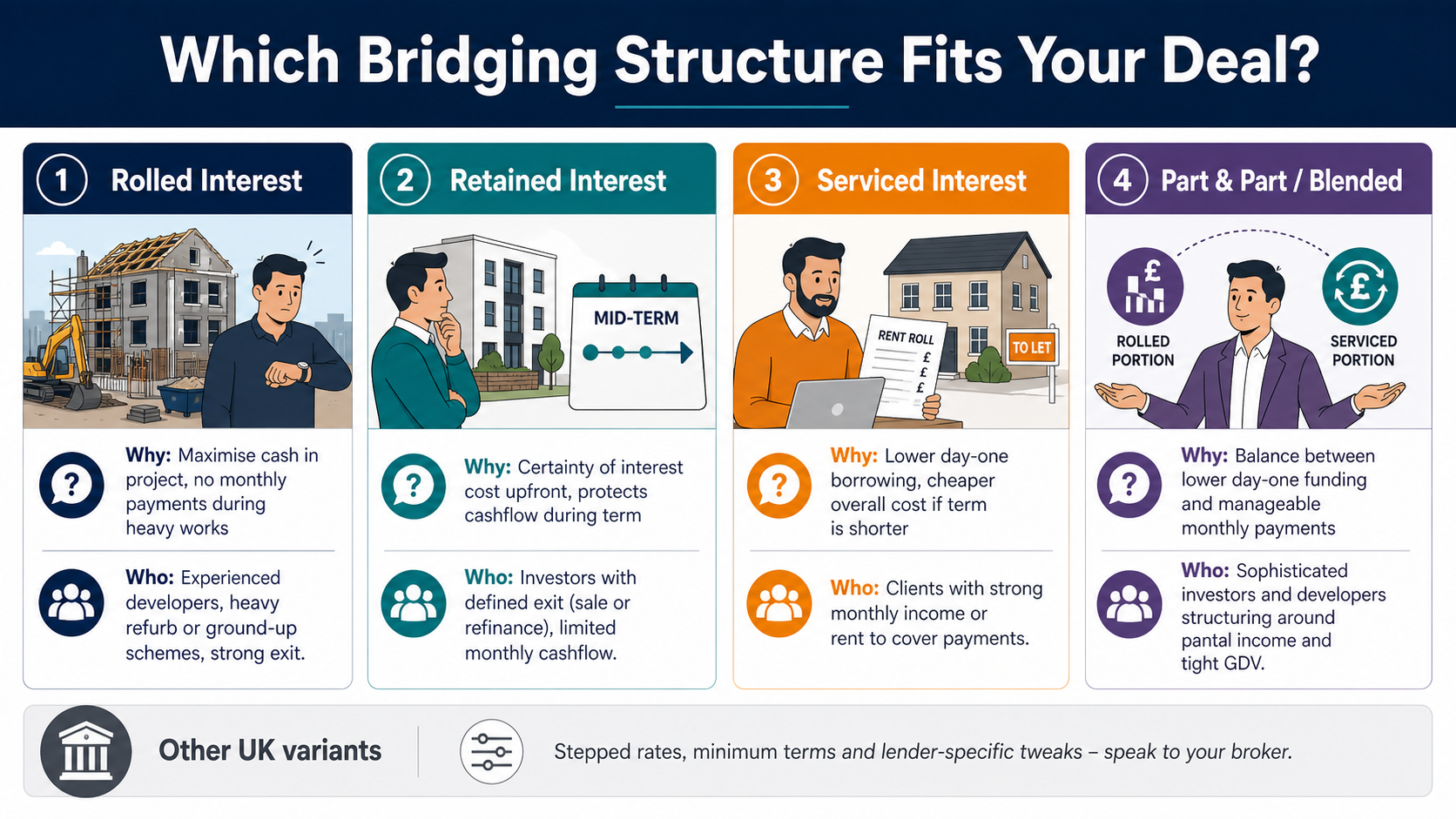
- Rolled or retained interest, where the lender deducts interest upfront so you are not servicing the loan monthly while the site produces no income.
- Arrangement and exit fees, typically charged as a percentage of the facility rather than fixed sums.
- Staged draws, releasing funds in tranches tied to planning milestones rather than as a single lump sum.
Staged draw structures and retained interest let you conserve equity while still funding planning consultants, ecology surveys and transport assessments as the application progresses, rather than tying up all your capital from day one. Covenants usually include milestone reporting requirements, such as evidence of a submitted application by a set date, and a loan-to-value trigger that can force early repayment if the appraisal moves against you. Bridging market pricing has become sharper in recent years as lender appetite for credible planning-led cases has grown, so it is worth benchmarking any indicative terms against current bridging loan rates before committing.
What do lenders look for in a planning gain application?
Underwriting for planning-led bridging rests on five pillars, and missing any one of them slows the deal down or pushes up the price. Lenders want clean title, an independent valuation reflecting both current and prospective use, a robust and evidenced exit, a sponsor with a credible track record, and a planning rationale that stands up to scrutiny rather than optimistic guesswork.
Documentation you should have ready before you approach a lender:
- A site plan and title summary, confirming ownership, boundaries and any restrictive covenants.
- Pre-application feedback from the local planning authority, even informal correspondence carries weight.
- A viability appraisal, showing gross development value, build costs, and an allowance for Section 106 or CIL contributions.
- A cost plan from a quantity surveyor or experienced contractor, covering the build-out if the exit involves development finance.
- Proof of funds for any shortfall, demonstrating you can cover the gap between loan proceeds and total project cost.
Pro Tip: Bring your viability appraisal even if it feels premature. Lenders read a properly costed appraisal, complete with a realistic Section 106 allowance, as a sign you understand the deal rather than someone chasing headline uplift.
Mixed-use or homeowner scenarios add complexity. Where a loan touches a primary residence or falls under consumer protections, regulated lending checks apply, and that typically means more documentation and a slower path to completion than a purely commercial case. If your site includes an occupied dwelling you intend to convert, flag this early. Lenders structure around it differently than a straightforward commercial or land transaction.

What are the exit routes for planning gain finance?
Three exits dominate this market, and each one carries a different risk profile that a good broker or lender will stress-test before drawdown.
The cleanest exit is a sale on planning consent, selling the site once permission is granted, without building anything yourself. This suits developers who specialise in planning promotion rather than construction, and it typically produces the fastest turnaround from loan drawdown to repayment.
The second route is refinance to development finance, moving from the bridging facility onto a construction-focused loan once full permission is in hand. Mainstream development finance lenders typically require full planning permission before advancing funds, which is precisely why the bridging facility exists in the first place, to hold the position until that condition is met. At refinance, the new lender will stress-test your build costs, your contractor’s track record and your sales or rental assumptions afresh, so it pays to keep those figures current throughout the planning period rather than dusting them off at the eleventh hour.
The third is a sale to a housebuilder or strategic buyer, common where the site’s scale or location suits a national or regional builder better than a smaller developer’s own delivery capacity.
Whichever exit you plan around, build in a buffer for delay:
- Assume interest will roll for longer than the headline term if committee dates slip or an appeal becomes necessary.
- Ask your lender about re-bridge options before you need them, not after your facility has already expired.
- Understand your loan-to-value covenant trigger, so you know exactly how much headroom you have if the appraisal moves against you.
- Keep your refinance lender warm throughout the process rather than approaching them cold once consent lands.
A refinance onto development finance works best when the groundwork, cost plan, contractor appointment, sales strategy, has been done in parallel with the planning application, not afterwards.
How do S106, CIL and viability affect planning gain deals?
Local authorities do not let developers keep the whole of a planning uplift. Section 106 agreements in England and Wales (Section 75 in Scotland) are legal agreements attached to a planning consent, typically requiring contributions towards affordable housing, highways, education places or open space. The Community Infrastructure Levy is a separate, tariff-based charge set by the local authority, calculated per square metre of new floorspace. Together they capture a meaningful share of the value that planning permission creates.
Developer contributions secured through these mechanisms ran into billions of pounds nationally, which gives a sense of how central they are to local authority funding, and why negotiations over them can become a genuine sticking point in an application timetable rather than a rubber-stamp formality.
Viability assessments are where this gets tested in practice. If a site’s appraisal cannot absorb the full policy-compliant level of contributions and still deliver a reasonable return, a developer can submit a viability case arguing for a reduced obligation. Practitioners are clear that planning uplift and planning obligations are separate concepts, lenders treat the uplift as the opportunity, but they expect every mandatory contribution to be costed into the appraisal before they will lend against it. An appraisal that ignores or underestimates Section 106 costs is one of the fastest ways to have a facility declined or repriced.
Practical steps worth taking before you make an offer on a site:
- Ask the local planning authority for its adopted CIL charging schedule before you finalise a purchase price.
- Build a contingency line into your appraisal for Section 106 negotiation, contributions rarely land exactly where the first draft suggests.
- Monitor monitoring fees, smaller charges attached to Section 106 agreements that cover the council’s cost of checking compliance, and that developers frequently forget to budget for.
How do you prepare a planning gain finance application?
Packaging a strong application is largely about sequencing. Get the order wrong and you either waste weeks on legal work before terms are agreed, or you agree terms that unravel once the valuer or solicitor finds something you had not disclosed.
- Share the site details early, including title, any existing planning history and your proposed use, so a lender or broker can give you an accurate indicative view before you spend money on reports.
- Receive indicative terms in writing, covering rate, loan-to-value, term and any conditions, before instructing paid third parties.
- Instruct valuation and legal work in parallel rather than sequentially, this alone can save several weeks against a typical bridging timetable.
- Agree staged draws upfront if your appraisal depends on funding planning consultants or surveys out of the facility itself, rather than assuming a single lump sum.
The most common mistakes are predictable once you have seen a few deals go wrong. Developers underestimate how long planning genuinely takes, especially where a scheme needs committee approval rather than delegated officer sign-off. They ignore Section 106 or CIL costs in their initial appraisal, only for a lender’s valuer to flag the gap. And they walk into a lender meeting with no evidence for their exit beyond “I’ll sell it once it’s got permission.”
Pro Tip: Model your appraisal against a worst-case timeline, not your best case. If committee referral or an appeal would add six months, price that scenario into your interest cost before you commit, not after.
Mitigate these risks by holding back a contingency reserve for extended interest cost, keeping a refinance lender warm throughout the process, and revisiting your viability numbers every time the scheme design changes, not just at the outset.
Regulatory and legal considerations specific to planning gain finance
Planning gain finance sits at the intersection of two separate regulatory regimes, and conflating them causes real problems. Planning law governs whether and how a site can be developed; lending regulation governs how the loan itself is arranged and disclosed. Applying for planning permission goes through your local planning authority, and building without consent risks formal enforcement action, including notices that can require work to be undone at the developer’s cost. Any facility structured against speculative or informal planning progress needs to account for that enforcement risk explicitly, not treat it as a remote possibility.
On the lending side, most planning-led bridging is arranged as unregulated commercial lending, since it typically involves a business purpose and a non-residential asset. That changes the moment a residential occupier or consumer protection applies, a facility secured against a home you intend to occupy, for example, and at that point Financial Conduct Authority regulated mortgage rules come into play, with different disclosure and affordability requirements. Mixed-use sites, part commercial and part residential, often sit in a grey area, and it is worth clarifying regulatory status with your broker or lender before terms are agreed rather than discovering it during legal due diligence.
Title issues also deserve early legal attention. Restrictive covenants, ransom strips, and unregistered land can all delay both the planning application and the loan completion, and a solicitor experienced in development transactions will spot these faster than a generalist conveyancer working their first bridging case.
What do real planning gain finance outcomes look like?
Consider a typical buy-to-permit-and-sell scenario: a developer identifies a brownfield commercial yard with strong pre-application feedback suggesting support for residential conversion. A bridging facility funds the acquisition and the cost of a full planning application, structured with staged draws to cover the planning consultant, transport assessment and ecology survey as each becomes due. Consent arrives within the facility’s term, and the site sells to a regional housebuilder at a premium reflecting the new permission, with the loan repaid from sale proceeds.

A bridge-to-development case looks different in shape. A developer secures a site with outline permission already in place, uses bridging finance to complete the purchase quickly at auction, then spends the facility term discharging pre-commencement conditions and finalising a detailed reserved matters application. Once that detail permission lands, the facility refinances onto a development finance facility, and construction begins.
A chain-break scenario involves a developer with capital tied up in a nearly-consented site elsewhere. Bridging releases equity against that first asset, allowing a swift move on a second opportunity that would otherwise have gone to a cash buyer. Each of these patterns depends on the same underlying discipline: a credible exit, evidenced early, and an appraisal that has already absorbed the planning obligation costs rather than treating them as an afterthought.
How do market conditions affect planning gain finance today?
Lender appetite in this space moves with two separate forces: the broader bridging market, and local planning policy. On the finance side, bridging market activity has shown continued momentum, with lenders competing harder on credible planning-led cases and offering more flexible structures such as milestone-linked covenants. That competition tends to sharpen pricing for well-packaged applications while leaving weaker, speculative cases facing the same caution they always have.
Local planning policy adds a second, more variable layer. A local authority’s five-year housing land supply position, its adopted local plan status, and the political appetite of its planning committee all influence how quickly, and how favourably, an application moves. A site in an authority actively short of housing land supply can move faster and attract a more sympathetic committee than an identical scheme in an area with a robust, up-to-date plan and no pressing need to allocate new sites. Lenders factor this local context into their appetite, sometimes explicitly asking for a planning consultant’s view on the local authority’s track record before quoting terms.
CIL rates and Section 106 expectations also vary significantly between authorities, which means the same gross development value can produce very different net appraisals depending on where the site sits. Checking a local authority’s current charging schedule and recent Section 106 precedent before making an offer is not optional due diligence, it is the difference between an appraisal that survives lender scrutiny and one that unravels at valuation stage.
What a broker actually does on a planning gain deal
Most of the delay and cost overrun I see on planning-led bridging deals comes down to sequencing, not lack of appetite from lenders. A capital concierge approach, coordinating valuation, legal work, and exit structuring in parallel rather than one after another, routinely shaves weeks off completion and can move a case into a better loan-to-value bracket simply because the lender receives a complete, evidenced file the first time round.
A useful broker checklist covers lender selection based on how each one actually treats planning risk (not just headline rate), realistic timing that accounts for committee dates and appeal windows, and covenant negotiation that leaves you room to breathe if planning slips by a few months. A brokered approach that runs valuation, legal and planning evidence in parallel reduces lender pricing and increases certainty, which matters most at auction, where there is no second chance to fix a weak application.
— James William Dawes
Get planning gain finance arranged through a single point of contact
Chasing quotes from multiple lenders while your planning clock runs down is exactly the scenario planning gain finance is meant to solve, yet the arrangement process itself often becomes the new bottleneck. James William & Co Capital works as a single point of contact for the whole structuring process: coordinating valuation, legal work and lender negotiation in parallel, so a well-evidenced case moves faster and prices better than one built lender by lender.
James William & Co Capital arranges bridging and development finance, mezzanine debt, commercial mortgages and JV equity for UK property developers and investors, drawing on relationships with family offices, private credit funds and specialist lenders to place cases that a single high-street lender would struggle to fund. If you are weighing planning gain finance against a straight development loan or a mezzanine structure, bring your site plan, any pre-application feedback and a draft viability appraisal to an initial conversation, that is enough for an indicative view before you commit to paid reports. Visit the specialist property finance page to request an assessment of your site and get indicative terms before your next offer deadline.
Sources
- Appendix J: Process for securing developer contributions — UK government (market study appendix)
- Bridging finance for planning gain — Kandoo
- Gov
FAQ
What Is Planning Gain Finance?
Planning gain finance is a short-term bridging loan secured against land or property, used to fund a purchase or holding period while planning permission is sought, so the borrower can capture the resulting value uplift.
How Long Does A Planning Gain Bridging Loan Last?
Most facilities run for 12 to 18 months, timed to match typical local authority determination periods plus a buffer for appeals or delayed conditions.
What Loan-To-Value Can I Get On A Planning Gain Deal?
Market averages sit around mid-50s loan-to-value, with strong, well-evidenced planning cases reaching 70 to 75 percent.
Do I Need Planning Permission Already In Place To Get Finance?
No. Planning gain finance is specifically designed for sites without full permission yet; mainstream development finance is the product that typically requires consent already granted.
How Do Section 106 And CIL Affect My Appraisal?
They capture part of the planning uplift through developer contributions, so a viability appraisal must deduct these costs from the land price before a lender will underwrite the deal.
Can James William & Co Capital Help Structure A Planning Gain Deal?
Yes. James William & Co Capital coordinates valuation, legal work and lender negotiation in parallel to package planning-led bridging cases and negotiate staged draws and exit terms.
Recommended
Related Topics
Speak to a specialist
Discuss your finance with James directly
Whole-of-market specialist finance — bridging, development, commercial and residential. No call centres, no obligation. James reviews every enquiry personally.
New to specialist finance? How unbiased broker advice works · Deals we have completed
Explore Related Finance