
Published
option agreement financingOption Agreement Financing: How UK Developers Fund Each Stage
By James Dawes, CeMAP, Founder, James William & Co Capital

Option agreement financing is really two funding problems. The first is paying for the option itself: the option fee, legal costs and planning work. The second is funding the land purchase if and when you exercise. The first is usually met from equity or a small facility. The second is normally met with bridging finance, development finance or a structured stack of debt and equity, arranged before the option period runs out.
This guide is for English developers, land promoters and investors. It sets out what an option costs, how each stage is typically funded, what lenders look at, and where deals go wrong.
TL;DR
- An option agreement gives you the right, not the obligation, to buy land. Your funding needs fall into two stages: securing the option, then buying the land on exercise.
- Option fees, legal costs and planning spend are usually funded from your own capital or JV equity. Land purchase and build costs are usually funded with bridging, development finance or a stacked structure.
- Lenders look hard at planning status, loan-to-value (LTV), your exit and your experience. Have your finance lined up before the option period starts, not after planning is granted.
- Check whether the landowner’s own mortgage lender has consented to the option. Without consent, the option can be defeated.
- A broker with access to specialist lenders and private credit can structure the exercise-date funding while the option is still running.
Table of Contents
- What an option agreement is and why it matters for funding
- The two funding stages
- Stage one: what the option costs and how to fund it
- Stage two: funding the land purchase on exercise
- What lenders assess
- Timing: matching the option period to your funding
- Risks to manage
- Our perspective
- How we can help
- FAQ
- Sources
What an option agreement is and why it matters for funding
A land option agreement gives the developer a right, but not an obligation, to buy specified land during a defined option period. The price is usually fixed or set by an agreed formula, and if you exercise, the landowner must sell.
The difference from a conditional contract is what happens once planning is granted. Under an option, the developer can still decide not to buy even with satisfactory permission. Under a conditional contract, once the conditions are met, both sides are generally obliged to complete. A conditional contract also normally carries a long-stop date, after which it falls away if the conditions are not met.
That is why options matter to funding. Lawyers note that an option suits a buyer who is still uncertain about funding or has alternative sites, because obtaining planning does not force a purchase. Options are also used to give developers time to test viability, carry out surveys, apply for planning and secure funding.
The trade-off is time. The option period is your window to get a financeable scheme, and the funding for the purchase has to be ready before it closes.

The two funding stages
It helps to separate the money into two pots, because they suit different types of capital.
| Stage | What you pay for | Typical funding source |
|---|---|---|
| 1. Securing the option | Option fee, legal costs, tax on the fee, valuation, planning consultants and application fees | Your own equity, JV equity partner, or a small corporate or asset-backed facility |
| 2. Exercising the option | Land price, deposit, stamp duty, professional fees | Bridging finance, or development finance covering land and build, with mezzanine or JV equity where needed |
| 3. Building out | Construction, professional team, contingency, interest | Development finance, often stacked with mezzanine debt or JV equity |
The most common mistake is treating stage one and stage two as the same problem. A fee of a few thousand pounds and a land purchase of several million are underwritten completely differently.
Stage one: what the option costs and how to fund it
An option agreement has two financial elements: the option fee and the price payable on exercise. That guidance comes from a Scottish enterprise body, but the commercial structure it describes is the same one used in English deals. The option fee may be significant, modest or absent depending on the site and the circumstances.
The exercise price can be set in several ways:
- the market value when the option is granted;
- the market value when the option is exercised;
- for development land, a development-value based price adjusted for purchaser costs and profit.
The option fee is typically non-refundable and is often deducted from the purchase price if you exercise. The agreement also commonly provides for a deposit on or shortly after exercise, often five or ten percent, plus an option period with extension provisions and a long-stop date.
The costs on top of the fee
Budget for more than the headline fee. Typical extra costs in England and Wales include:
- SDLT on the option fee in England, and VAT on the fee if the land has been opted to tax;
- the landowner’s legal costs, which are often agreed to be paid by the buyer;
- valuation advice;
- planning consultant and application fees, usually met by the buyer;
- the cost of registering a notice of the option on the landowner’s title.
Tax deserves early attention. The grant of an option may have SDLT consequences depending on the consideration and structure, before the land sale even completes. Ask your solicitor and tax adviser to model it before you sign.
Ways to fund the early spend
There is no standard “option fee loan”. In practice, the early spend is met in a few ways:
- Your own capital. Common where the fee and planning budget are modest compared with the eventual gross development value.
- Joint venture equity. A JV partner can fund the option and planning costs in return for a share of profit. This also helps to pre-position equity for the later land purchase.
- Borrowing against other assets. Developers with an existing portfolio sometimes raise funds against other property, using a commercial mortgage or a refinance, so the option spend does not drain working capital.
We look at the whole plan before suggesting which of these fits. A cheap way of paying the fee can still be the wrong one if it limits the debt you can raise at exercise.

Stage two: funding the land purchase on exercise
This is where most of the money is. Developers and promoters obtain funding for development sites through debt, equity or alternative funding, and the right mix depends on planning status, scale and timing.
Bridging finance
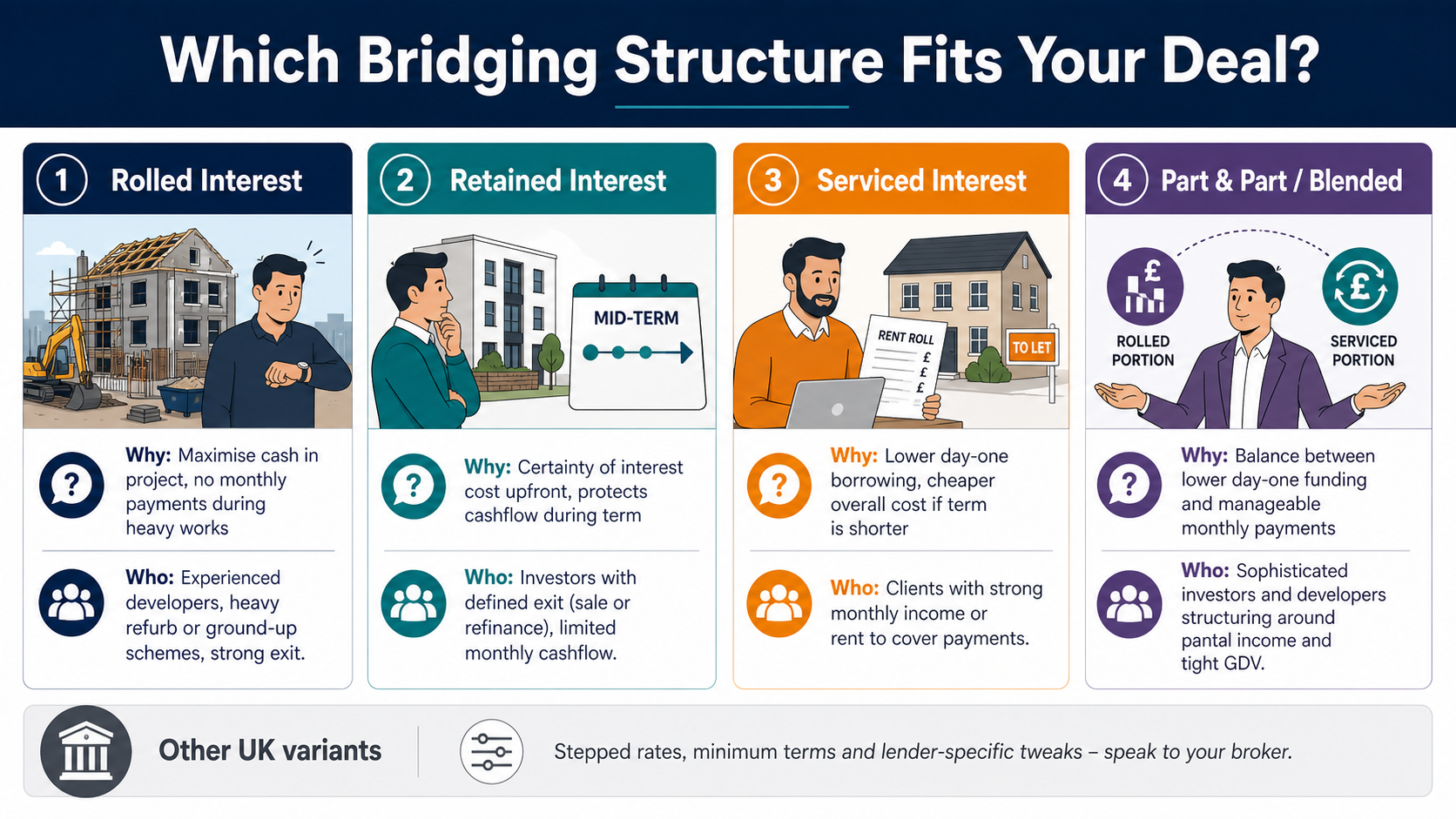
Bridging suits a purchase that has to complete quickly, or land that is not yet ready for a full development facility. Typical uses on an option exercise include buying a site with planning, buying while a revised application is progressing, or covering the gap before a larger facility is in place. You can read how this works in our guide on arranging bridging finance for property deals, and see our bridging finance service.
Development finance
Where planning is granted and the scheme stacks up, development finance can cover the land and the build in one facility, with the build drawn down in stages. Our pages on why developers use development finance and how to structure development finance explain the mechanics.
Mezzanine debt and JV equity
When senior debt leaves a gap against the land price and costs, mezzanine debt or JV equity can fill it. This is the stacked approach we cover in our piece on stacking debt when development margins are tight. Each layer has its own pricing, security and intercreditor terms, so the structure needs planning from the start.
What lenders assess
Lenders do not generally think about “the option”. They think about the land you are about to own and whether they will be repaid. For land bridging loans, lenders typically assess type, location and planning status, requested LTV, the exit strategy, credit history, borrower experience and whether a RICS-accredited valuation has been completed.
Underwriting is exit-driven. Lenders want a credible route to repayment, such as a sale after planning or a refinance into development finance, and they treat planning status and the quality of the security as central.
That gives you a practical checklist to assemble while the option is running:
- a clear planning route or decision, with the consultant’s assessment of risk;
- an up-to-date valuation on the basis a lender will use;
- a costed appraisal showing viability after Section 106 and CIL;
- a written exit, with the refinance or sale route and a timeline;
- your track record, or that of your development partner;
- the structure of the borrowing entity, including any offshore element.
If your borrowing entity or owners are based outside the UK, expect extra tax and anti-money-laundering checks. Our article on non-resident developer finance in England explains how to avoid those checks delaying a deal.
Timing: matching the option period to your funding
The option period is your funding timetable. It should be clear, certain and workable, including clear expiry mechanics for notices, because ambiguity leads to disputes. The completion date should also leave enough time after exercise for conveyancing and searches. Funding needs the same time: valuation, credit approval, legal due diligence and drawdown all take days or weeks.
A sensible sequence looks like this:
- Before signing the option: talk to a broker about what is financeable and on what terms, so the price formula and period are realistic.
- During planning: keep lenders informed. A credit-approved indication in principle gives you a negotiating position and a clearer picture of the equity you will need.
- Before the exercise notice: have terms agreed, valuation instructed and legal work under way so that completion follows exercise without a scramble.
- After exercise: complete on the bridge or development facility, then refinance if the plan is to move from bridge into a longer term loan.
Risks to manage
For developers, the main risks are planning refusal, changes in viability or market conditions, and an inability to secure funding. For landowners, the land may be tied up for years with no certainty of sale. Good funding planning addresses the developer side directly.
The landowner’s mortgage lender
This one catches people out. If the landowner has a mortgage, the lender’s consent may be needed. Without it, the lender may be able to sell the property free of the option, leaving the developer with little to show for the spend. Lenders’ consent policies have in the past included time limits on options, so a long option may need specific agreement. Raise this with your solicitor before you pay a fee.
Formalities
An option will usually need to comply with section 2 of the Law of Property (Miscellaneous Provisions) Act 1989, with all agreed terms in a single signed document or properly exchanged counterparts. A defective option is not something any lender will fund against.
Planning obligations and viability
Understand Section 106 and CIL commitments before you exchange so that the budget is accurate. These affect overall project costs, and therefore the debt a lender will advance and the equity you need to put in.
Our perspective
Most of the option agreement deals that reach us are not short of ideas. They are short of sequencing. The developer has a good site, a landowner who is willing, and a planning route, but nobody has yet asked what the funding looks like on the day the option is exercised.
We would rather answer that question at the start. If we know the price mechanism, the option period and the planning path, we can take the scheme to the specialist lenders, private credit funds and family offices on our panel and test the structure while the developer still has options.
In our experience, the strongest structures are built backwards from the exit. Where a bridge is the right first step, we plan the refinance into development finance at the same time. Where senior debt leaves a gap, we look at mezzanine or JV equity early, rather than as a rescue.
Our role is to be your single point of contact across that process, so that you are not coordinating several lenders, solicitors and valuers on your own while the option clock runs.
James William Dawes
How we can help
We arrange bridging, development finance, mezzanine debt and JV equity for UK developers and investors, and we work with specialist lenders and private credit funds beyond the mainstream banks. If you hold an option, or are negotiating one, we can help you structure the funding for the exercise date before the option period starts to tighten.
Start with our development finance service for land and build funding, or our bridging finance service if you need to complete quickly. For a wider view, see our guide to structured property finance for UK developers and our overview of real estate funding sources.
FAQ
Can I get a loan to pay an option fee?
There is no standard product for it, because the sums are usually small compared with the land price. Developers normally fund the fee from their own capital, a JV equity partner or borrowing secured on another property. A broker can advise which fits your wider plan.
Can a lender lend against an option agreement?
Funding is usually arranged against the land once you acquire it, not against the option itself. The lender looks at planning, valuation, LTV and your exit. The practical step is to agree the funding structure while the option is running so that completion can follow quickly after you exercise.
Is an option better than a conditional contract if my funding is not in place?
An option can suit this position, because you can walk away if planning or funding does not work out. A conditional contract generally obliges you to complete once the conditions are met. Your solicitor should advise on which suits the site, and your broker on how each affects financing.
What happens if the landowner has a mortgage?
The landowner’s lender may need to consent to the option. If consent is not obtained, the lender may be able to sell the land free of your option. Ask your solicitor to deal with this before you pay any fee.
Do I pay stamp duty on an option?
SDLT can arise on the option fee and again on the land purchase, depending on the consideration and structure. Take advice from your solicitor or tax adviser at the outset so the cost is in your appraisal and your funding requirement.
Sources
- Unlocking development potential, Trowers & Hamlins
- Conditional contracts and option agreements, Paul Robinson Solicitors
- Differences between conditional contracts, option agreements and pre-emption agreements, Longmores
- Option Agreement Advice for Landowners and Developers, Myerson
- Arranging an option agreement, Highlands and Islands Enterprise
- What is an Option Agreement?, Boyes Turner
- Option agreement: conveyancing costs and process, Keyfolio
- Option Agreements: Common Pitfalls and How to Avoid Them, Birketts
- Real Estate Promoter Lawyers, Foot Anstey
- Can You Get a Bridging Loan for Land?, Bridging Loan Lawyers
- Lender’s consent to option agreements, Lexology
- Development Site Due Diligence, Marsons
Recommended
- Nonresident Developer Finance in England: Tax and AML Can Delay Deals
- The Shifting Development Finance Landscape
You must keep up your repayments to avoid repossession. We are not a lender. James William & Co Capital Ltd is an Appointed Representative of Flexi Network Ltd, FRN: 1060247. Flexi Network Ltd is authorised and regulated by the Financial Conduct Authority, FRN: 948658. Flexi Network Ltd is an authorised credit broker and not a lender. You can verify both on the Financial Services Register at register.fca.org.uk.
Related Topics
Speak to a specialist
Discuss your finance with James directly
Whole-of-market specialist finance — bridging, development, commercial and residential. No call centres, no obligation. James reviews every enquiry personally.
New to specialist finance? How unbiased broker advice works · Deals we have completed
Explore Related Finance