
Published · Updated
private credit vs banks£537bn Vs £59.5bn: When Private Credit Beats Banks for UK Borrowers
By James Dawes, CeMAP, Founder, James William & Co Capital

Private credit means tailored, directly originated lending from non-bank managers, funds and family offices, priced higher than bank debt but structured with far more flexibility on covenants, timing and security. Banks still dominate by volume, holding a significant majority of UK business lending, but private credit wins when speed, bespoke structuring or certainty of execution matter more than headline pricing. The right answer for most borrowers isn’t one or the other. It’s knowing when each earns its place in the stack.
TL;DR:
- Private credit offers faster execution with decision-making often completed within days, compared to banks that require several weeks through committee approval.
- It typically involves higher overall costs due to layered fees, such as arrangement, commitment, and monitoring fees, and often relies on bullet repayments or payment-in-kind structures.
- Private credit’s bespoke covenants and flexible structures are suited for acquisitions, disposals, and complex deals with tight timelines, while banks are better for day-to-day working capital needs.
- The sector’s floating-rate nature exposes borrowers to rising interest rates, and valuation opacity coupled with liquidity mismatches poses systemic risks under stressed conditions.
- A dual-track process involving both banks and private lenders can unlock better terms and ensure financing flexibility for deals requiring a mix of speed, structure, and cost efficiency.
Table of Contents
- Private credit vs banks: the practical comparison
- What private credit actually costs versus a bank loan
- Loan structures: what private lenders and banks actually offer
- What could go wrong: risk, rates and regulatory watch points
- How to choose between private credit and a bank: a decision checklist
- How a specialist broker structures the private credit and bank mix
- Why the smartest borrowers stop picking sides
- Structuring hybrid funding with James William & Co Capital
- Sources
- FAQ
Private credit vs banks: the practical comparison
The British Business Bank defines private credit as directly originated lending by non-bank managers, typically maturing in three to seven years with floating rates and covenants built around the deal rather than a standard template. Bank lending runs through committee, follows a house credit policy, and prices off a base rate plus margin that rarely strays far from sector norms. Both routes work. They just work for different situations, and the gap between them shows up clearly once you line the mechanics up side by side.
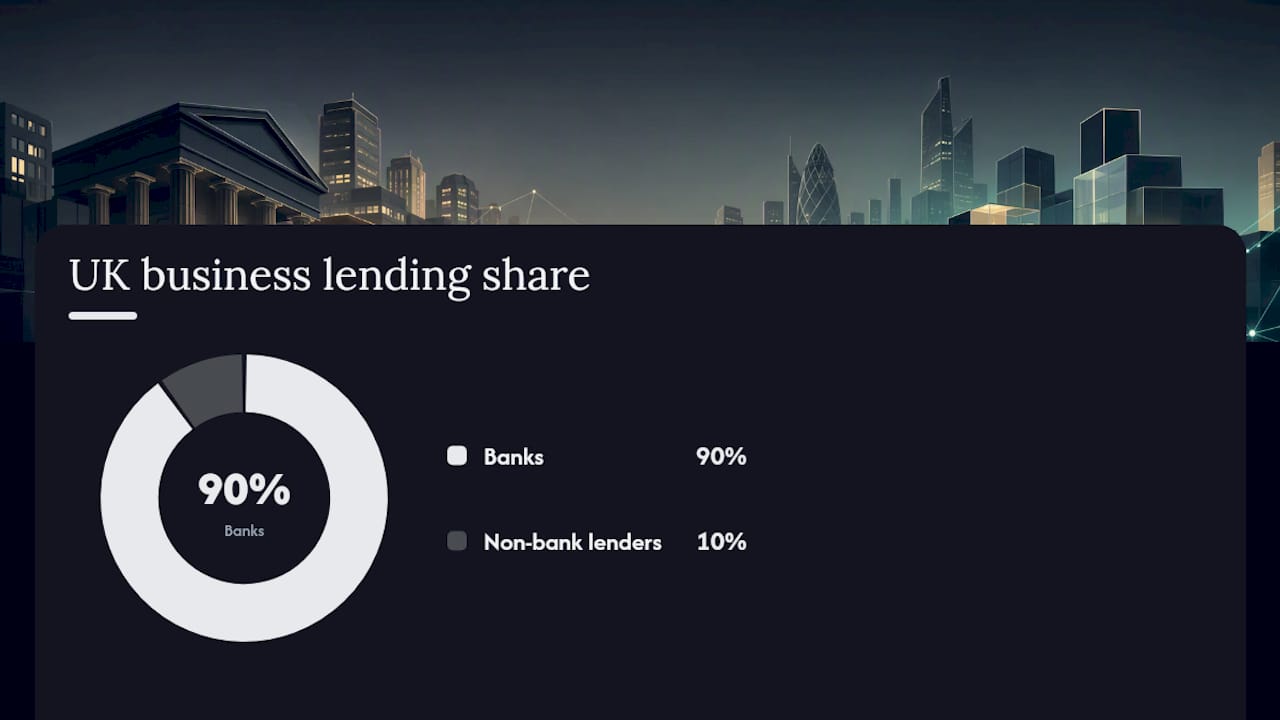
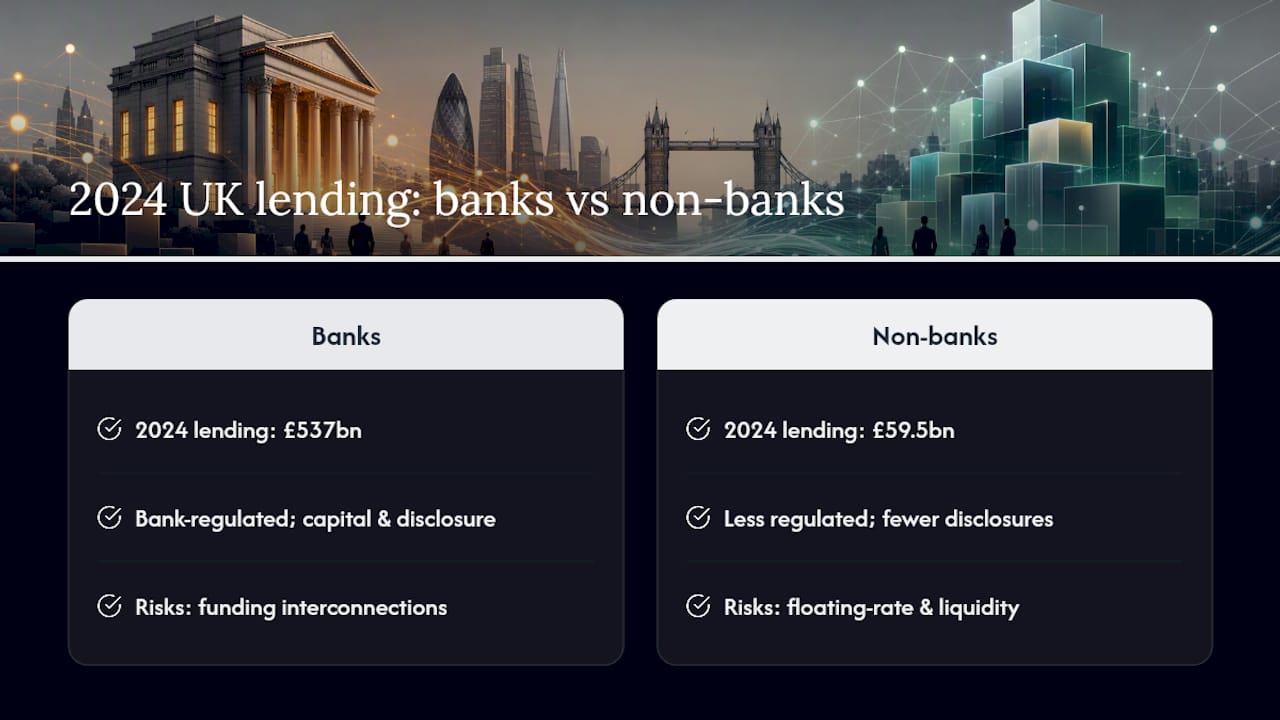
Scale still favours banks by a wide margin. Outstanding bank loans and overdrafts to UK businesses stood at £537bn in 2024, against £59.5bn from non-bank lenders including private credit funds, according to parliamentary evidence on UK lending markets. Private credit has grown fast off a small base. It hasn’t come close to displacing banks as the primary source of UK corporate debt.
Here’s how the two compare across the factors that actually drive a financing decision:
- Sources of capital: banks lend deposits and wholesale funding through a regulated balance sheet; private credit draws from closed-end funds, family offices and institutional capital raised for a specific mandate, which affects how quickly a lender can commit and how much internal negotiation happens before terms firm up.
- Speed and execution: bank facilities move through credit committee, often across several weeks for anything non-standard; private credit funds typically hold decision-making with the deal team, so terms can be agreed and drawn in days once diligence is done.
- Documentation flexibility: banks lean on standardised loan documentation and maintenance covenants tested quarterly; private lenders will often negotiate bespoke covenant packages, incurrence-based tests, or milestone triggers built around a specific business plan.
- Pricing shape: bank margins sit closer to base rate with modest arrangement fees; private credit adds a premium for flexibility, frequently layering commitment fees, exit fees and sometimes payment-in-kind interest on top of a higher headline margin.
- Liquidity and transferability: bank debt is often syndicated or sold down into a liquid secondary market; private credit positions are typically held to maturity by the fund that originated them, with little to no secondary trading.
- Typical use case: banks remain the default for revolvers, trade finance and day-to-day working capital; private credit is more often used for acquisitions, disposals, and time-pressured or structurally complex transactions, a pattern the Bank of England’s Bank Overground research confirms, noting that syndicated loans and bonds still account for over 75% of aggregate corporate market-based finance debt.
None of this makes one option universally better. A borrower refinancing a stable trading business with predictable cash flow rarely needs private credit’s flexibility and shouldn’t pay for it. A borrower closing an acquisition in six weeks, with a seller who won’t wait for committee approval, often has no realistic alternative to a fund that can commit on its own timetable.
What private credit actually costs versus a bank loan
Price is where the comparison gets uncomfortable for borrowers who haven’t modelled it properly. Private credit is generally more expensive than bank lending, and the gap isn’t just the headline margin. It’s the accumulation of fees layered around it.
A bank facility typically carries an arrangement fee (often 0.5% to 1.5% of commitment), a margin over base rate, and a modest commitment fee on undrawn amounts. Private credit adds more moving parts: arrangement fees that can run higher, ongoing monitoring fees to cover the lender’s asset management function, and sometimes an exit fee payable on repayment that bank lenders rarely charge.
What actually drives the all-in cost:
- Margin over reference rate: private credit margins commonly sit several percentage points above equivalent bank pricing to compensate for the fund’s illiquidity and higher risk tolerance.
- Arrangement and commitment fees: charged on both sides, but private lenders more often price commitment fees on the full facility rather than just the undrawn portion.
- Monitoring and agency fees: an annual charge private credit funds levy that banks typically absorb into their broader relationship economics.
- Amortisation profile: bank loans usually amortise on a schedule that reduces principal steadily; private credit frequently structures around a bullet repayment at maturity, which keeps cash flow lighter during the term but concentrates refinancing risk at the end.
- Bespoke security and covenant cost: a fund willing to lend against unusual collateral, or accept looser covenants, generally charges more for that flexibility, and multi-layered security packages add legal cost on top.
Pro Tip: Ask any private lender to quote the effective annual cost including all fees, not just the headline margin. A facility that looks 200 basis points more expensive on margin alone can be 400 basis points costlier once arrangement, monitoring and exit fees are annualised across the loan term.
Real-estate lending illustrates the pricing squeeze well. Debt funds have expanded their share of UK commercial real-estate lending sharply through 2025, and as more capital chases the same deals, margins have started compressing, according to market analysis from Fladgate. Underwriting discipline and documentation quality are becoming the differentiators lenders compete on, not just price.
Bullet repayments and payment-in-kind interest, both common in private credit structures, defer cash cost during the loan’s life but store it up as a lump sum at maturity. That’s manageable when refinancing markets are open. It becomes a serious problem when they aren’t, a risk worth flagging before a term sheet locks it in.
Loan structures: what private lenders and banks actually offer
Bank lending tends to sit within a narrow range of familiar structures: term loans, revolving credit facilities, and asset-based lending against receivables or inventory. Private credit spans a wider set of instruments, largely because funds can tailor structure to the specific transaction rather than fitting borrowers into a standard product.
Common private credit structures:
- Senior secured term loans: first-lien debt against company or asset security, priced closest to bank-equivalent terms among private structures.
- Unitranche facilities: a single blended tranche combining senior and subordinated debt into one instrument with one lender, simplifying the capital stack for mid-market borrowers.
- Mezzanine debt: subordinated to senior debt, higher-priced, often carrying equity-like features such as warrants, used to bridge a gap between senior debt capacity and total funding need.
- Asset-backed facilities: lending secured against a specific pool of assets (receivables, equipment, property) rather than the whole business.
- NAV facilities: lending against a fund’s net asset value, increasingly used by private equity sponsors to release liquidity without selling portfolio positions.
Where multiple lenders sit in the same capital stack, an intercreditor agreement governs who gets paid first, who controls enforcement, and how standstill periods work if the borrower runs into trouble. This becomes more complex when a bank revolver sits alongside a private credit term loan, which is increasingly common as banks and funds develop complementary relationships rather than competing head-on.
Covenant design differs meaningfully between the two. Banks typically rely on maintenance covenants tested every quarter regardless of activity. Private lenders more often use incurrence covenants, tested only when a borrower takes a specific action like drawing more debt, or build milestone-based triggers tied to a development or growth plan rather than a blanket financial ratio. That flexibility is genuinely useful for a business with lumpy cash flow. It also means the covenant package needs careful negotiation, since bespoke terms cut both ways.
Maturities for private credit commonly run three to seven years, and prepayment terms often include call protection during the first year or two, a fee for repaying early that compensates the lender for lost expected return. Bank facilities tend to allow more flexible prepayment, particularly on revolvers, though term loans sometimes carry similar step-down prepayment fees.
What could go wrong: risk, rates and regulatory watch points
Floating-rate exposure is the risk borrowers underestimate most often. Most private credit is priced on a floating margin over a reference rate, which means a rate rise passes straight through to debt service cost. The Bank of England has flagged this directly.
Private credit’s floating-rate structures pass interest-rate risk onto borrowers, and the sector’s rapid growth has created deeper interconnections between private funds and the banking system that now warrant closer monitoring, according to a Bank of England speech by Lee Foulger.
That interconnection point matters more than most borrowers realise. Banks increasingly finance the private credit ecosystem itself, providing subscription lines and NAV finance to the funds that then lend directly to companies. A stress event in one part of that chain doesn’t stay contained. It’s precisely why the Financial Policy Committee has been running system-wide exploratory scenarios to test how stress transmits between banks and private markets.
Valuation opacity compounds the problem. Private credit funds mark their own loan books, often quarterly and often using models rather than observable market prices, which makes it harder for outside investors and regulators to judge real credit quality until something breaks. Bank loans, by contrast, sit inside a supervised institution with regulatory capital requirements and disclosure obligations that private funds simply don’t carry in the same form.
Key statistic to hold onto: non-bank lenders, including private credit, provided £59.5bn against banks’ £537bn in 2024 UK lending, which means private credit remains a fraction of system size. That scale limits (but doesn’t eliminate) the systemic risk regulators worry about.
Liquidity mismatch inside funds is the other watch point. Investors in some private credit vehicles can redeem on relatively short notice, while the loans those funds hold are illiquid and can’t be sold quickly to meet redemptions. It’s a structural tension that has drawn ongoing regulatory attention, and it’s worth asking any fund how its redemption terms match its underlying loan maturities before relying on it as a long-term financing partner.
How to choose between private credit and a bank: a decision checklist
Run the decision on five criteria before talking to a single lender, because the answers determine which route even makes sense to pursue.
- Purpose of the funds: acquisitions, disposals and time-pressured deals lean private credit; working capital, revolvers and trade finance lean bank.
- Timing pressure: if completion is weeks away and the deal collapses without funding certainty, a fund that can commit outside committee cycles usually wins.
- Cost tolerance: model the all-in cost including fees, not just margin, and decide honestly whether the flexibility premium is worth paying.
- Covenant preference: a business with volatile but ultimately sound cash flow often benefits more from incurrence covenants than a rigid quarterly test that risks a technical breach.
- Appetite for a longer relationship: banks tend to build multi-product relationships over years; private credit relationships are often more transactional, tied to a specific facility and exit.
Once the criteria point a direction, put these questions to any lender before signing a term sheet: What’s the realistic turnaround time from signed term sheet to funds flowing? What triggers an amendment fee, and how is a waiver priced if a covenant test is close? If there’s an intercreditor agreement, what happens to my position if the other lender enforces first?
Watch for red flags on both sides. In private-credit offers, be wary of opaque valuation clauses that give the lender wide discretion to reprice risk, and aggressive payment-in-kind features that quietly inflate the balance owed at maturity. In bank offers, watch for maintenance covenants set so tightly they’ll trip on ordinary trading volatility, blocking growth plans that would otherwise make sense.
Pro Tip: Run a dual-track process on anything above a modest ticket size. Getting indicative terms from both a bank and a private credit fund simultaneously, even informally, gives you real negotiating leverage on both sides and surfaces structural options neither lender would volunteer alone.
How a specialist broker structures the private credit and bank mix
The hardest part of choosing between private credit and banks usually isn’t the choice itself. It’s coordinating both when a deal genuinely needs elements of each, a bank revolver alongside a private term loan, say, where intercreditor mechanics, security ranking and covenant alignment all have to work together rather than pulling in different directions.
A capital-concierge approach exists precisely for that friction point: one point of contact structuring the deal across multiple lender types, negotiating terms with each in parallel, and managing the intercreditor conversation so the borrower isn’t stuck relaying terms between two lenders who’ve never spoken directly. That structuring work is where a specialist broker earns its place. Left unmanaged, a bank and a fund sitting in the same stack will each protect their own position at the expense of speed.
Due diligence for private credit funds can be as demanding as a bank credit committee, sometimes more so, because valuations are more subjective and security packages more layered. Coordinating that diligence alongside a bank’s own process, rather than running them sequentially, is usually what separates a six-week completion from a six-month one.
Common trade-offs a broker resolves include balancing a bank’s need for a clean first-lien position against a fund’s requirement for structural protection on a subordinated tranche, or negotiating milestone covenants on a development facility that satisfy a private lender’s risk appetite without triggering a bank’s standard maintenance tests. Neither side moves first without seeing the other’s terms, so someone has to run both conversations at once. For a deeper look at how these debt stacks come together on live projects, see this guide to types of property finance for UK developers.
Why the smartest borrowers stop picking sides
The framing of private credit versus banks is mostly wrong, and it’s worth saying plainly. Treating them as rivals for the same mandate misses how most well-structured deals actually get financed. Banks remain the backbone for liquidity, revolvers and day-to-day cash management. Private credit earns its premium when speed or bespoke structuring genuinely changes the outcome, an acquisition that closes or doesn’t, a development that gets built on schedule or slips.
The mistake I see most often isn’t choosing the wrong lender type. It’s choosing without running both conversations at once, which means never finding out what the alternative would have cost or offered. A dual-track process forces better terms from both sides, because each lender knows it’s not the only option on the table.
The other discipline finance teams underweight is refinancing planning. Bullet repayments and payment-in-kind structures feel manageable when they’re signed. They become a genuine problem three or five years later if nobody’s mapped when the cliff arrives relative to market conditions and hedging needs. Build that calendar on day one, not in year four when the maturity is suddenly close.
— James William Dawes
Structuring hybrid funding with James William & Co Capital
Getting a bank and a private credit fund to sit comfortably in the same deal takes more than good terms from each side. It takes someone managing both negotiations at once so the intercreditor mechanics don’t become the reason a completion slips. James William & Co Capital works as that single point of contact, structuring debt stacks that blend bridging finance, development finance, commercial mortgages, mezzanine debt and JV equity across a network of family offices, private credit funds and specialist lenders.
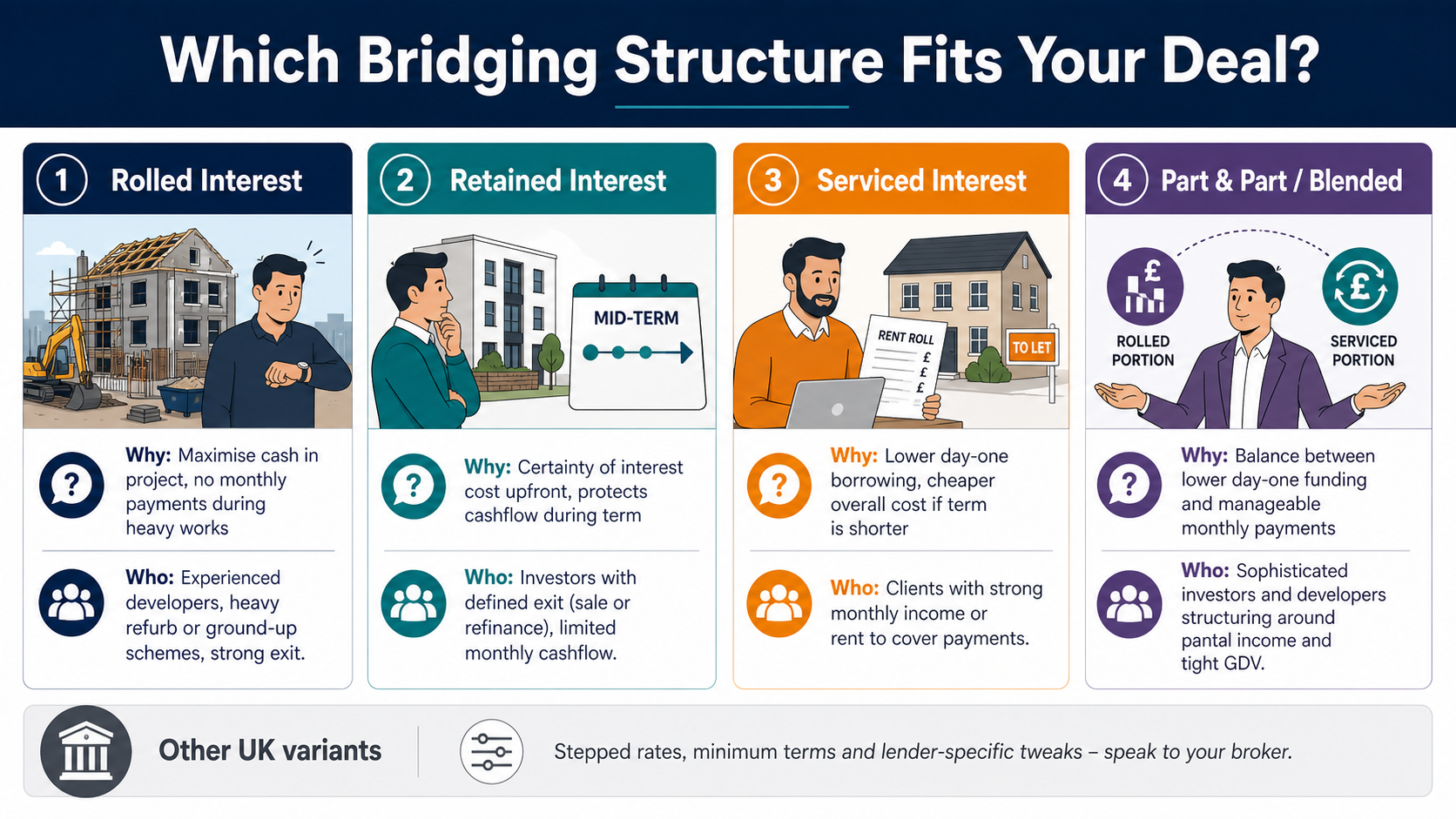
The firm’s role covers structuring the facility mix itself, introducing the right lenders for a specific deal profile, and negotiating and executing the documentation, including the intercreditor detail that determines what happens if one lender wants to move faster than the other, supported by experienced real estate lawyers in Spain. This work typically suits property developers, institutional investors, asset managers and corporate clients running acquisitions, ground-up developments or refinances where a single lender type won’t cover the full requirement. If a deal you’re structuring needs a bank facility and a private credit tranche working together rather than competing, James William & Co Capital’s specialist property finance team is the practical next call to make.
Sources
- Parliamentary written evidence — market sizing for bank vs non-bank lending
- What is private credit? — British Business Bank
- Why do UK companies raise market-based finance debt? — Bank of England (Bank Overground)
- UK real estate private credit trends, challenges and market outlook — Fladgate
FAQ
How is private credit different from a bank loan?
Private credit is originated directly by non-bank funds with flexible, bespoke terms and floating rates, while bank loans come from regulated institutions using standardised documentation and committee-based approval. Private credit is typically faster to arrange but carries a higher all-in cost.
What are the downsides of private credit?
The main downsides are a higher price of capital, floating-rate exposure that passes interest-rate risk to the borrower, and refinancing concentration risk where bullet repayments or payment-in-kind interest build up a large sum due at maturity. Liquidity is also limited since positions aren’t traded on a secondary market the way syndicated bank debt often is.
Is private credit in trouble, and why does it draw regulatory scrutiny?
Private credit isn’t in crisis, but the Bank of England has flagged growing interconnections between funds and banks, valuation opacity within funds, and liquidity mismatches between fund redemption terms and underlying loan maturities as points requiring closer monitoring rather than confirmed failure points.
What is an example of private credit in practice?
A common example is a mezzanine loan or unitranche facility funding a company acquisition, where a fund lends against the target’s cash flow with a bespoke covenant package rather than a standard bank template. Development finance for a property project structured with milestone-based covenants, arranged through a specialist broker like James William & Co Capital, is another typical use.
Is private credit safer than banks for a borrower?
Neither is inherently safer; each carries different risks. Bank lending sits within a regulated, capital-backed institution with standard covenants, while private credit offers more structural flexibility but at higher cost and with less transparency around fund-level valuation and liquidity.
Recommended
Related Topics
Speak to a specialist
Discuss your finance with James directly
Whole-of-market specialist finance — bridging, development, commercial and residential. No call centres, no obligation. James reviews every enquiry personally.
New to specialist finance? How unbiased broker advice works · Deals we have completed
Explore Related Finance