
Published · Updated
personal guarantee insurance propertyPersonal Guarantee Insurance for Property Directors
By James Dawes, CeMAP, Founder, James William & Co Capital
Personal guarantee insurance (PGI) can recover a meaningful share of what a lender takes from you personally when a guarantee is called, typically 60 to 80 percent of the sum guaranteed, but it never removes the underlying legal obligation you signed under Companies Act 2006. It tends to make sense once your personal exposure passes roughly £25,000. Below that threshold negotiation usually beats insurance. Read on for how cover, cost and timing actually work.
TL;DR:
- Personal guarantee insurance typically covers 60 to 80 percent of the guaranteed amount when a lender calls it, but it does not release you from contractual liability.
- Premium costs range from 1 to 5 percent of the insured sum annually, with lower premiums often available for invoice finance than unsecured loans.
- The policy’s exclusions often hinge on guarantee wording, existing financial distress, or fraud, making precise negotiations essential to manage risk.
- You can usually obtain PGI after signing the guarantee if the company shows no material distress, but coverage is impossible once insolvency proceedings begin.
- Negotiating guarantee terms before signing, such as caps, time limits, and security alternatives, reduces your personal risk more effectively than relying solely on insurance.
Table of Contents
- What is personal guarantee insurance property cover, and how does it differ from other protections?
- What does PGI typically cover, and where do the exclusions bite?
- How much does personal guarantee insurance cost?
- What are the alternatives to signing an open-ended guarantee?
- Can you get personal guarantee insurance after signing?
- How do brokers use PGI inside larger property finance structures?
- Does personal guarantee insurance affect your personal credit rating?
- Are there tax implications when buying or claiming on PGI?
- What legal responsibilities come with holding a PG insured by PGI?
- What does the PGI claims process actually involve?
- What do successful and unsuccessful PGI claims in property deals have in common?
- A broker’s take on growth versus personal risk
- How James William & Co Capital can help with property finance and PG exposure
- Sources
- FAQ
What is personal guarantee insurance property cover, and how does it differ from other protections?
A personal guarantee is a contract clause where you, as a director, promise to repay a company debt from your own pocket if the business cannot. It sits outside the protection of limited liability entirely. Lenders use it precisely because it pierces that corporate shield, and Gov confirms directors should treat it as a personal, not corporate, liability from day one.
Personal guarantee insurance property cover pays out when a lender validly calls that guarantee, usually following insolvency and formal demand. It does not cancel the guarantee itself. As one legal commentary puts it plainly, PGI is a financial buffer, not a discharge of your contractual duty. You remain legally on the hook; the policy simply reimburses part of what you pay.
This is where directors most often get confused. Directors’ and officers’ (D&O) insurance covers breach-of-duty claims against you for how you ran the company. PGI addresses something completely different: contractual liability arising from a lender’s call on a guarantee you gave voluntarily. The two rarely overlap and neither substitutes for the other.
What does PGI typically cover, and where do the exclusions bite?
Standard PGI policies pay a percentage of the guaranteed sum once the lender enforces validly, with sums insured commonly ranging from around £25,000 to £500,000 or more. Specialist providers serving property developers sometimes offer higher limits and bespoke structures for larger project exposures, though terms and pricing vary considerably between insurers.
Exclusions matter more than the headline cover figure. Most policies will not pay where fraud or misrepresentation is involved, or where the business was already in demonstrable financial distress at the point cover was bought. Insurers underwrite against the guarantee wording itself, so the following details change your exposure materially:
- “All monies” clauses cover any current or future debt, not just the facility you had in mind when you signed.
- Continuing guarantees stay live indefinitely until formally released, even after you leave the business.
- Joint and several wording means a lender can pursue you alone for the full amount, not just your proportionate share.
- Interest and recovery costs often sit outside the core guaranteed sum and outside some policy limits.
Commercial mortgage guidance consistently flags these wording traps as the difference between a manageable guarantee and an open-ended one.
How much does personal guarantee insurance cost?
Premiums generally sit at 1 to 5 percent of the sum insured per year. On a £200,000 guarantee, that translates to roughly £2,000 to £10,000 annually, alongside any broker placement fee.

Underwriters price on several factors: the sector you operate in, company turnover, your personal credit history, and critically, the type of facility behind the guarantee. Invoice finance facilities tend to attract lower premiums than unsecured term loans, because the lender has other recovery routes and the guarantee is less likely to be the sole fallback.
Policy terms typically run annually and renew alongside the underlying facility, though some insurers will match cover to the loan term where that’s shorter. Get more than one quote. Pricing varies enough between insurers on identical risk that shopping around genuinely moves the number, and a broker who places PGI regularly will usually know which underwriters price your sector most competitively.
What are the alternatives to signing an open-ended guarantee?
The best time to reduce your exposure is before you sign, not after. GOV.UK explicitly encourages directors to negotiate rather than accept the first draft, and lenders concede more ground here than most directors expect.
Practical levers worth pushing for:
- A cap on the guaranteed amount rather than “all monies” wording, so your exposure has a ceiling.
- A time limit or automatic step-down once the loan-to-value or trading position improves.
- Company-level security instead, such as a debenture or fixed charge, which keeps the debt at the corporate level.
- Cash collateral held against a smaller, defined sum rather than an open personal commitment.
- Staged reductions in guarantee size tied to repayment milestones or covenant performance.
A broker-led approach can often reduce the need for a broad guarantee altogether by restructuring the facility mix rather than simply insuring the risk after the fact. Reviewing real estate funding structures before you commit to a lender often reveals options that never require a personal guarantee at all.
Pro Tip: Negotiate the guarantee terms before you sign the facility letter, not after. Once the ink is dry, your only remaining lever is insurance, and insurers will not touch a guarantee that’s already showing signs of trouble.
Can you get personal guarantee insurance after signing?
Yes, in most cases. Insurers will generally write cover after the guarantee is already in place, provided the company shows no signs of material financial distress at the point you apply. This surprises a lot of directors who assume PGI has to be arranged at the same time as the loan.
The window closes fast once things go wrong. Once a winding-up petition is filed or formal insolvency steps begin, insurers will decline to write new cover. The risk has already crystallised, so there’s nothing left to underwrite.
Placement itself follows a fairly standard sequence: you provide the guarantee wording, company accounts, and details of the facility; the insurer underwrites against sector, turnover and your personal credit profile; and, assuming everything checks out, the policy issues, usually within a few weeks.
A claim only pays once two things happen: a genuine insolvency event, and a formal demand from the lender against the guarantee, backed by evidence of the shortfall. From validated claim to payout, expect the insurer’s own timeline to run alongside the wider insolvency process rather than in isolation. Settlement rarely happens quickly, because the insurer needs the underlying debt and demand fully evidenced first.
How do brokers use PGI inside larger property finance structures?
Personal guarantee requests show up most often on bridging loans, development finance and unsecured business facilities, where the lender has limited recourse if the project underperforms, according to construction lender requirements for CRE brokers. A broker structuring a multi-layered debt stack can sometimes negotiate the guarantee down and place PGI alongside it, protecting you personally while keeping the facility fundable.
The better approach layers protection across the whole stack: mezzanine finance or JV equity to reduce how much senior debt relies on your personal signature, paired with PGI on whatever guarantee remains. James William & Co Capital structures these arrangements across bridging, development and mezzanine facilities, working with lenders directly on covenant wording rather than leaving it to the standard template.
Before signing anything, ask your broker three questions: can this facility be secured without a personal guarantee at all, what’s the realistic cap you could negotiate, and does the guarantee wording use “all monies” language that extends beyond this one deal.
Does personal guarantee insurance affect your personal credit rating?
PGI itself has no direct bearing on your credit file. Buying the policy is not reported anywhere and does not appear on your credit history, because it’s a private insurance contract between you and the insurer, not a financial product tied to your borrowing.
What damages your credit rating is the underlying event: a lender formally calling the guarantee after default or insolvency. That call, and any resulting court judgment or County Court Judgment (CCJ) against you personally, will show up on your credit file regardless of whether PGI later reimburses part of the loss. Insurance pays money back to you; it doesn’t erase the record of what happened.
This matters for timing. If a guarantee is called and you have PGI in place, the payout can reduce the financial damage substantially. But the credit event itself, the missed payment, the default, the judgment, has already been recorded. Directors sometimes assume insurance protects their credit standing the way it protects their bank balance. It doesn’t work that way.
The practical takeaway is that PGI is loss mitigation for your finances, not a shield for your credit history. If preserving your personal credit rating matters as much as your cash position, the priority should be negotiating the guarantee down or replacing it with company-level security in the first place, since that’s the only way to avoid the credit event entirely. Insurance is your second line of defence, not your first.
Are there tax implications when buying or claiming on PGI?
Premiums you pay personally for PGI are generally not tax-deductible against your personal income, because the guarantee itself is a personal liability rather than a business expense, even though the underlying loan funded company activity. Some directors query whether the company can pay the premium on their behalf; where it does, that payment is likely to be treated as a benefit in kind and taxed accordingly, so get specific advice from your accountant before assuming otherwise.
Claim proceeds sit in a different category again. When PGI pays out following a valid call on your guarantee, the payment reimburses you for a personal loss you’ve already suffered, essentially restoring some of the money you paid the lender. Because it’s compensation for a loss rather than income, it’s not typically treated as taxable income in the way a salary or dividend would be. But the exact tax treatment depends on how the guarantee, the underlying facility and the insurance policy are structured, and small differences in wording can change the answer.
None of this is a substitute for proper advice. Every director’s situation differs based on how the company is structured, whether the guarantee sat behind a limited company or a group structure, and how the loss itself is characterised. If you’re weighing up whether to buy PGI, or you’re already facing a call and wondering how a payout will be treated, speak to a specialist tax adviser before you assume anything about deductibility or liability. The stakes are too high for guesswork.
What legal responsibilities come with holding a PG insured by PGI?
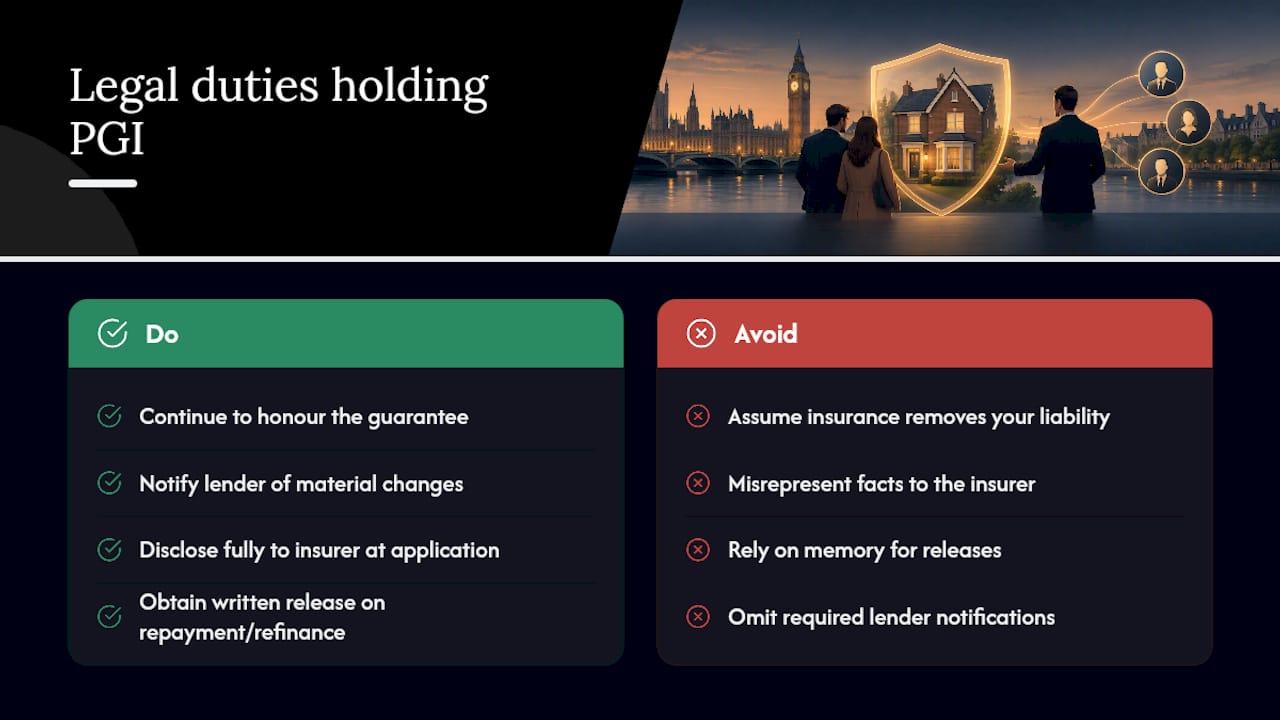
Buying PGI changes nothing about your underlying legal position. You remain personally and contractually bound by the guarantee you signed, under ordinary contract law, and the Companies Act 2006 framework that governs corporate liability does nothing to soften that. Insurance is a private arrangement between you and an insurer; the lender’s rights against you under the guarantee are entirely separate and untouched by whether or not you’ve insured yourself.
You still need to honour any notification obligations in the guarantee itself. Many guarantee documents require you to inform the lender of material changes, such as a change in company ownership or a restructuring, and failing to do so can weaken your position regardless of what insurance you hold. Read the wording carefully, not just the loan agreement.
You also carry a duty to your insurer. Most PGI policies require full and honest disclosure at application, covering the company’s financial position, the exact guarantee wording, and anything that might affect underwriting. Misrepresent any of that and the insurer can void the policy entirely, precisely when you need it most.
Finally, remember that a guarantee doesn’t automatically end when a facility is repaid or refinanced, particularly under continuing or “all monies” wording. Getting a formal release in writing from the lender is a legal step directors frequently skip, and skipping it can leave a live guarantee attached to your name long after you assumed it had lapsed. If you’re unsure whether an old guarantee has genuinely been released, get that confirmed in writing before relying on memory or assumption.
What does the PGI claims process actually involve?
A claim only becomes payable once two conditions are met: a genuine insolvency event affecting the borrowing company, and a formal demand from the lender against your personal guarantee, supported by evidence of the shortfall owed. Insurers won’t advance on a claim built on assumption or an informal warning from a lender; they need the paper trail.
Expect to provide the original guarantee document, the loan or facility agreement it relates to, evidence of the company’s insolvency (such as liquidator or administrator correspondence), the lender’s formal written demand, and a breakdown of exactly what sum is being claimed against you. Insurers will also want to see your original policy application to confirm the disclosures you made at the outset still match reality.
Timelines vary with the complexity of the underlying insolvency, but settlement rarely happens quickly. The insurer typically needs the insolvency process itself to progress far enough to confirm the shortfall figure is accurate and final, which can take weeks rather than days once you factor in liquidator reporting and lender reconciliation. Keep every piece of correspondence from the point trading difficulties first emerge; gaps in the paper trail are the most common reason claims get delayed or challenged.
What do successful and unsuccessful PGI claims in property deals have in common?
A claim tends to succeed where the paperwork lines up cleanly: the guarantee wording was specific rather than open-ended, the company’s insolvency was genuinely unconnected to fraud or misrepresentation, and the director disclosed the full picture honestly when the policy was bought. In these cases, the insurer has a clear, evidenced shortfall to pay against, and the process moves through relatively predictably once the formal lender demand lands.
Claims fail, or get contested hard, for more predictable reasons than directors expect. If the company was already showing signs of distress when the policy was taken out and that wasn’t disclosed, insurers will challenge the claim on non-disclosure grounds. If the guarantee wording turns out to be broader than the director understood, an “all monies” clause capturing debts the director thought were unrelated, insurers may argue the claim falls partly or fully outside the sum actually insured. And where a lender’s call is disputed as procedurally invalid (wrong notice period, incorrect demand format), the claim can stall entirely until that underlying dispute resolves.
The pattern across both outcomes is the same: PGI rewards precision. A guarantee negotiated down to a defined sum, with clear wording and honest disclosure at underwriting, gives insurers little room to contest. A vague, open-ended guarantee bought into without full transparency gives them plenty.
A broker’s take on growth versus personal risk
Guarantees are sometimes unavoidable, but far less often non-negotiable than most directors assume. Before signing, push for a cap, a time limit and clear release triggers rather than accepting the lender’s first draft. If you’re mid-facility already, pull your latest term sheets and check the wording now, not when a lender calls.
— James William Dawes
How James William & Co Capital can help with property finance and PG exposure
Some firms act as debt structuring partners for property developers, investors and business owners, offering more than just loan introduction. For example, they may provide direct access to specialist lenders and private credit funds beyond mainstream banks, and help negotiate guarantee wording, caps and time limits before you sign, rather than leaving you to insure against a bad deal after the fact.
A first engagement typically starts with a review of your existing or proposed facility, including any bridging loan or development finance structure, followed by a conversation about where personal guarantee exposure can be capped, restructured with company-level security, or reduced through mezzanine or JV equity layering. If protection cover is the right fit for your situation, we can talk you through that alongside the finance itself, via our protection advisory service.
If you’re negotiating a facility now, or reviewing a guarantee you’ve already signed, get in touch for an initial consultation before the terms are locked in.
Sources
For the underlying rules and market data referenced above, GOV.UK’s guidance on personal guarantees covers negotiation and alternatives directly. MarketInvoice’s PGI guide sets out current payout and pricing norms, Trethowans explains the legal distinction between PGI and discharge, and the Companies Act 2006 provides the statutory backdrop for corporate liability.
- Gov
- Personal guarantee insurance UK guide — MarketInvoice
- Industry commentary on PGI and director liability — Trethowans
- Legislation
FAQ
Can you get insurance to cover a personal guarantee?
Yes. Personal guarantee insurance reimburses a percentage, typically 60 to 80 percent, of a guarantee once a lender validly calls it following insolvency. It’s widely available for guarantees tied to business loans, bridging finance and development facilities.
What is a personal guarantee in the UK?
A personal guarantee is a legal promise by a director or business owner to personally repay a company debt if the business itself cannot. It sits outside limited liability protection entirely, making your personal assets, including your home, potentially recoverable by the lender.
How much does personal guarantee insurance cost?
Premiums typically run 1 to 5 percent of the sum insured per year, so a £200,000 guarantee might cost roughly £2,000 to £10,000 annually. The exact figure depends on your sector, turnover, personal credit history and the type of facility involved.
What are the risks associated with a personal guarantee?
The main risk is that your personal assets, savings, property, and investments, become recoverable by a lender if the business defaults and the guarantee is called. Guarantees with “all monies” or continuing wording can also extend your exposure well beyond the original loan you had in mind when signing.
Is personal guarantee insurance worth it for smaller exposures?
It becomes clearly worthwhile once your personal exposure reaches around £25,000 or more, where the premium cost is proportionate to the risk being covered. Below that, negotiating the guarantee down or securing it against company assets instead is usually the more cost-effective route.
Recommended
Related Topics
Speak to a specialist
Discuss your finance with James directly
Whole-of-market specialist finance — bridging, development, commercial and residential. No call centres, no obligation. James reviews every enquiry personally.
New to specialist finance? How unbiased broker advice works · Deals we have completed
Explore Related Finance