
Published
serviced vs retained bridge interestServiced vs Retained Bridge Interest: Which Suits Your Deal?
By James Dawes, CeMAP, Founder, James William & Co Capital

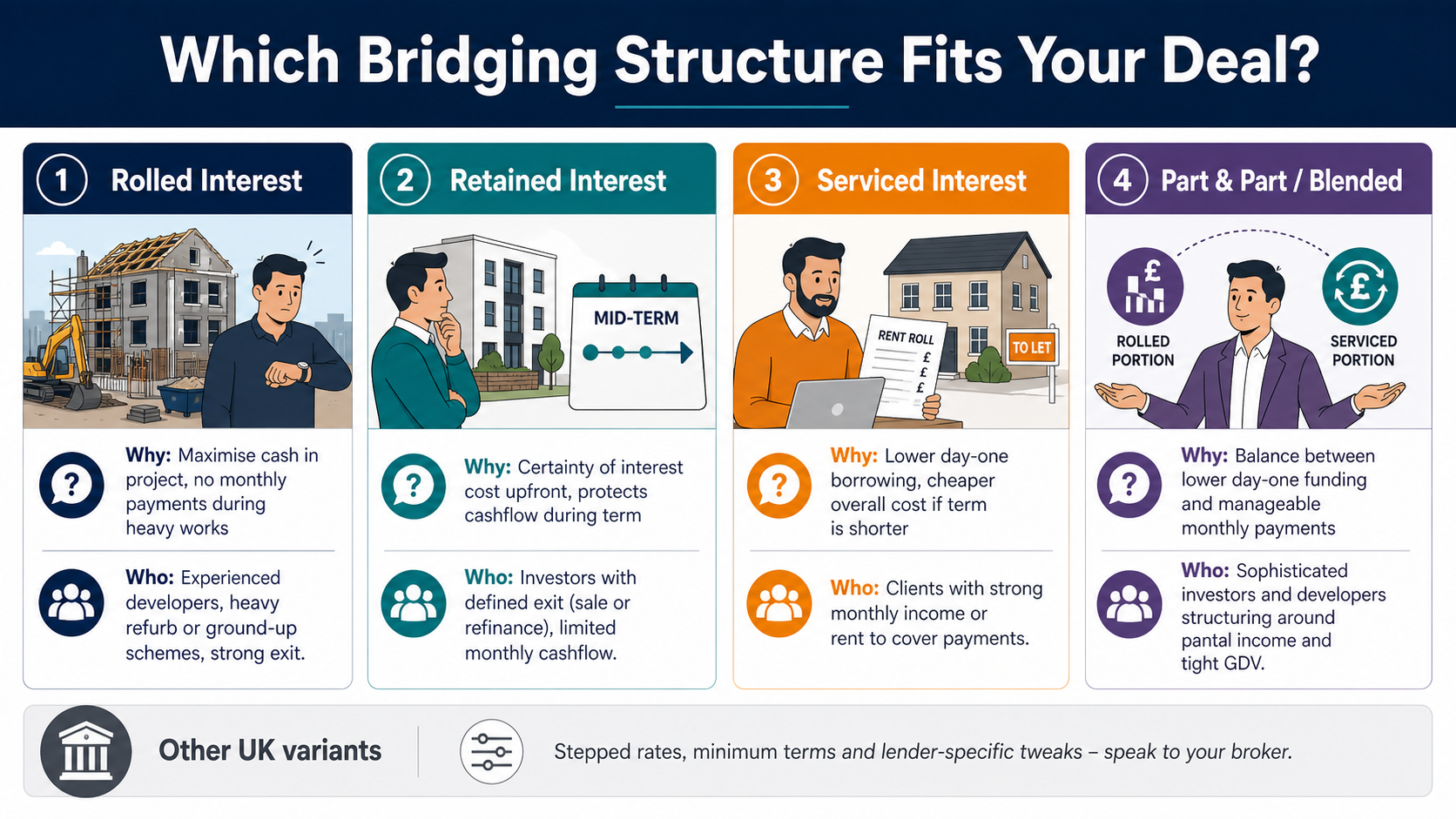
Serviced interest means you pay the interest each month and the loan balance stays put. Retained interest means the lender deducts the interest for the agreed term at the start, so you pay nothing monthly but receive a smaller net advance. Serviced is usually the cheaper route if you have reliable cash flow. Retained gives certainty when there is no income to pay from until the exit. The right choice depends on your cash flow, your exit date and how much cash you need on day one, and the choice is worth settling before you compare headline rates.
TL;DR
- Serviced interest: you pay monthly, the balance does not grow, and total borrowing cost is typically the lowest. Lenders will want to see the liquidity to pay it.
- Retained interest: the lender holds back the interest for the term from your advance. You make no monthly payments, but you receive less cash on completion.
- Rolled up interest is the third common option: interest is added to the balance and repaid at exit. We mention it here only as a comparison point.
- Choose by cash flow and exit: rental income or trading revenue points to serviced; a development or refurbishment with no income until sale or refinance points to retained.
- Compare on net advance and total cost, not on the monthly rate alone.
Table of Contents
- What serviced and retained interest mean
- How the cost compares: a worked example
- Cash flow: what each option does to your month
- Which one suits which borrower
- What lenders ask for
- Questions to settle before you choose
- Who is regulated
- Promo: structuring the interest with us
- The James William & Co perspective
- FAQ
- Sources
What serviced and retained interest mean
Bridging finance is short-term, secured lending, usually against property or land. Interest is the main cost, and how it is paid is a term you negotiate, not a fixed feature of the product. The two options you will see most often are these.
Serviced interest. You pay the interest monthly, in the same way you would on an interest-only mortgage. The loan amount you owe at exit is the amount you drew.
Retained interest. The lender calculates the interest for the whole agreed term and holds it back from the loan at the outset. The loan is drawn gross, but the cash that reaches you is the gross amount less the retained interest (and fees, where the lender deducts those too). You owe the full gross amount at exit.

The third option, rolled up interest, is added to the balance and paid when you repay. Many lenders offer a mix, for example serviced for the first few months and retained for the rest, so it is worth asking what a lender will allow before assuming only one choice is open.
How the cost compares: a worked example
Take a worked example from a published industry illustration: a £350,000 loan at 0.8% per month over nine months works out at £2,800 of interest a month, £25,200 in total, so £375,200 goes out over the term when the interest is serviced.
Now apply the same terms to the retained structure as an illustration of our own arithmetic:
| Serviced | Retained | |
|---|---|---|
| Gross loan | £350,000 | £350,000 |
| Interest rate | 0.8% per month | 0.8% per month |
| Term | 9 months | 9 months |
| Paid monthly | £2,800 | £0 |
| Interest held back at day one | £0 | £25,200 |
| Net advance before fees | £350,000 | £324,800 |
| Repaid at exit | £350,000 | £350,000 |
The interest total is the same in this simple case. What changes is when the money leaves you. With serviced interest, the cash comes from your income across nine months. With retained, you are effectively borrowing £25,200 more than you receive, because the lender holds it back from the advance. If your purchase needs £350,000 of cash on completion, a retained structure means the gross facility has to be larger, so you borrow against more of the property’s value.
That last point matters for loan-to-value (LTV, the loan as a percentage of the property’s value). Lenders set their maximum LTV on the gross loan, which includes retained interest. A retained structure can therefore consume headroom that a serviced one leaves free. The Intermediary’s Q1 2026 Bridging Trends data put the average bridging LTV at 52%, with an average term of 12 months and an average rate of 0.82% per month for the quarter. Those are market averages published for one quarter, and rates move with lender pricing and funding costs, so treat them as context and not as a quote for your deal.
Because interest is typically charged monthly on the balance, the serviced route is the one where the balance does not build up. The same industry illustration notes that serviced interest typically gives the lowest overall borrowing cost, since the balance is not growing while you hold the loan.
Cash flow: what each option does to your month
The practical difference is in your bank account.
Serviced takes a fixed payment every month. On the £350,000 example that is £2,800. If a refurbishment overruns by three months, you carry three more payments, so your running cost is visible and predictable but never pauses.
Retained takes the whole payment at the start. Nothing leaves your account monthly, which suits a project with no income. The trade-off is that the term you retained for is fixed in the numbers. If your exit is later than planned, interest continues to accrue beyond the retained period, and how that extra interest is charged and settled is set out in the lender’s facility terms. This is the point to settle in writing before you sign, because lenders differ on it.

Which one suits which borrower
The pattern is consistent across the market. Serviced interest tends to suit experienced investors with rental income, businesses with regular revenue, and borrowers who expect to hold the loan close to the full term. Retained interest tends to suit borrowers who want certainty from day one and have a clear exit and a fixed timeline, such as a developer waiting for a sale or refinance with no regular income in between.
Property investors with rental income
If you hold a let portfolio, serviced interest usually makes sense: the rent covers the payments and you keep the lowest cost and the largest net advance. It also pairs well with a bridge-to-let strategy, where you buy, refurbish, let and refinance onto a buy-to-let mortgage.
Developers and refurbishers
A ground-up scheme or heavy refurbishment generates no income until the sale or refinance. Retained interest means no monthly payments to find during the works. If the project is larger and phased, development finance is often the better fit than a bridge, and our guide to bridging versus development finance sets out the difference.
Business owners and acquirers
A company funding an acquisition or a property purchase through the business may have strong trading revenue, so serviced payments can come from cash flow. If the money from the sale of another asset is the planned exit, retained interest keeps trading cash free in the meantime.
Accountants and advisers
For clients, the question to ask is not which is cheaper in the abstract, but which leaves the right cash position at completion and at exit. Serviced interest is a recurring cost that sits in the monthly forecast. Retained interest is a day-one deduction from proceeds. Check with the tax adviser handling the entity how the interest is treated, because that depends on the borrower’s circumstances.
What lenders ask for
Lenders do not offer serviced interest to everyone. They need confidence that the payments will be made. For example, Assetz Capital’s bridging product guide states that where the borrower services the interest, liquidity is required to support at least three months of interest payments. Requirements vary lender to lender and change over time, but the principle is common: expect to evidence cash reserves or income.
Retained interest puts the lender’s focus elsewhere: the value of the security, the gross LTV and the credibility of the exit within the term.

Questions to settle before you choose
Work through these in order. They take ten minutes and usually make the answer obvious.
- Where will the monthly payment come from? If you can name an income stream that covers it comfortably, serviced is the default.
- How much cash do you need on completion? Calculate the net advance under each structure and check it covers the purchase price, works and costs.
- What is the gross LTV under each option? Retained interest adds to the gross loan, so check it still fits the lender’s maximum.
- How firm is your exit date? The longer and less certain the timeline, the more the terms for overruns matter.
- What happens on early repayment? Ask whether unused retained interest is refunded, in full or in part, and whether there is a minimum interest period. This is set in each lender’s terms, so get it in writing.
- What happens beyond the term? Ask how interest is charged on any extension or default period.
On the third and fourth, a mixed structure can help: for instance, serviced during a let period and retained during works. Not every lender will do this, which is the main reason to look beyond a single provider.
Who is regulated
Bridging loans for business or investment purposes are generally unregulated, while loans secured on a property the borrower lives in, or intends to live in, can fall under Financial Conduct Authority (FCA) regulation. If the property is, or will be, your home, say so at the outset, because it changes which lenders can lend and which protections apply.
Promo: structuring the interest with us
We arrange bridging finance for property developers, investors and business owners, and the interest structure is one of the first things we settle with you. Our bridging lender panel and our bridging comparison give you direct access to specialist lenders beyond mainstream banks, and you have a single point of contact from first conversation to completion.
If you are weighing serviced against retained for a live deal, tell us the purchase price, the works budget, the expected exit and the income available. We will show you the net advance and total cost under each structure and which lenders will accept it. You can start from our bridging finance page.
The James William & Co perspective
Most borrowers ask us about the rate first. We would ask about the structure first, because a lower rate with the wrong interest treatment can leave you short of cash on the day you complete.
Our approach is to put the deal on one page: gross loan, net advance, monthly cash out, exit date and total cost under serviced, retained and, where relevant, a blend of the two. Once the numbers sit side by side, the right answer is usually clear, and it is rarely the same for a landlord with rent coming in as for a developer mid-build.
This is where access matters. We work with specialist lenders, private credit funds and family offices, so we are not limited to whichever structure one lender happens to offer. We aim to find the lender whose terms fit your cash flow and exit, and to negotiate the details that decide the outcome: early repayment, extension terms and how interest is calculated.
If you are working to a deadline, that is the situation we are built for. Speed matters, but so does getting the structure right the first time.
James William Dawes
FAQ
Is serviced or retained bridging interest cheaper?
Serviced is typically cheaper overall, because you pay interest as you go and the balance does not grow. Retained costs the same interest on a simple fixed term, but it reduces your net advance, so you may need a larger gross loan for the same cash. Compare the total cost and the net advance together.
Do I get retained interest back if I repay early?
It depends on the lender’s terms. Some refund unused retained interest, sometimes less a minimum interest period, and others do not. Check the facility letter before you sign, and ask your broker to confirm it in writing.
Can I mix serviced and retained interest?
Some lenders allow a blend, such as retaining interest for the works period and servicing it afterwards. It is not universal, so it needs to be raised at the outset. We can tell you which lenders on our panel will consider it for your deal.
Does retained interest affect how much I can borrow?
Yes. Retained interest is part of the gross loan, so it counts towards the lender’s maximum LTV. The same property supports a smaller net advance under a retained structure than under a serviced one.
Sources
- Bridging Loan Interest Explained: Rolled Up, Retained or Serviced
- Bridging lending holds steady in Q1 2026, Bridging Trends
- Assetz Capital bridging product guide, March 2023
Recommended
- First Charge vs Second Charge Bridging: How to Choose
- Bridging vs Development Finance: Which Fits Your Project?
- SPV vs Trading Company Mortgages: Which Structure Lenders Prefer
- Conversion Finance vs New Build: Which Funding Fits?
You must keep up your repayments to avoid repossession. We are not a lender. James William & Co Capital Ltd is an Appointed Representative of Flexi Network Ltd, FRN: 1060247. Flexi Network Ltd is authorised and regulated by the Financial Conduct Authority, FRN: 948658. Flexi Network Ltd is an authorised credit broker and not a lender. You can verify both on the Financial Services Register at register.fca.org.uk.
Related Topics
Speak to a specialist
Discuss your finance with James directly
Whole-of-market specialist finance — bridging, development, commercial and residential. No call centres, no obligation. James reviews every enquiry personally.
New to specialist finance? How unbiased broker advice works · Deals we have completed
Explore Related Finance