
Published
rolled up vs serviced interestRolled-Up vs Serviced Interest on UK Bridging Loans
By James Dawes, CeMAP, Founder, James William & Co Capital

With serviced interest you pay the interest every month and the balance stays flat. With rolled-up interest nothing is paid during the term: the interest is added to the loan and cleared, with the capital, when you redeem. Serviced is usually cheaper overall and keeps the exit balance low. Rolled-up keeps your cash free while a project cannot yet earn. Which one is right depends on where your money comes from during the term and how certain your exit date is.
We arrange bridging and development finance for UK developers, investors and business owners, and this choice comes up on almost every deal. Below we explain both structures, run the numbers, cover retained interest (the third option you will see on term sheets) and set out how we would decide.
TL;DR
- Serviced interest is paid monthly, so the loan balance does not grow. It needs provable income or cash flow to cover the payments.
- Rolled-up interest is added to the balance and repaid at redemption. It protects cash during the term but costs slightly more overall because it compounds.
- Delays hurt rolled-up loans most, because the interest bill keeps building until you repay.
- Retained interest is a different thing: it is set aside at the outset, so your day-one advance is smaller.
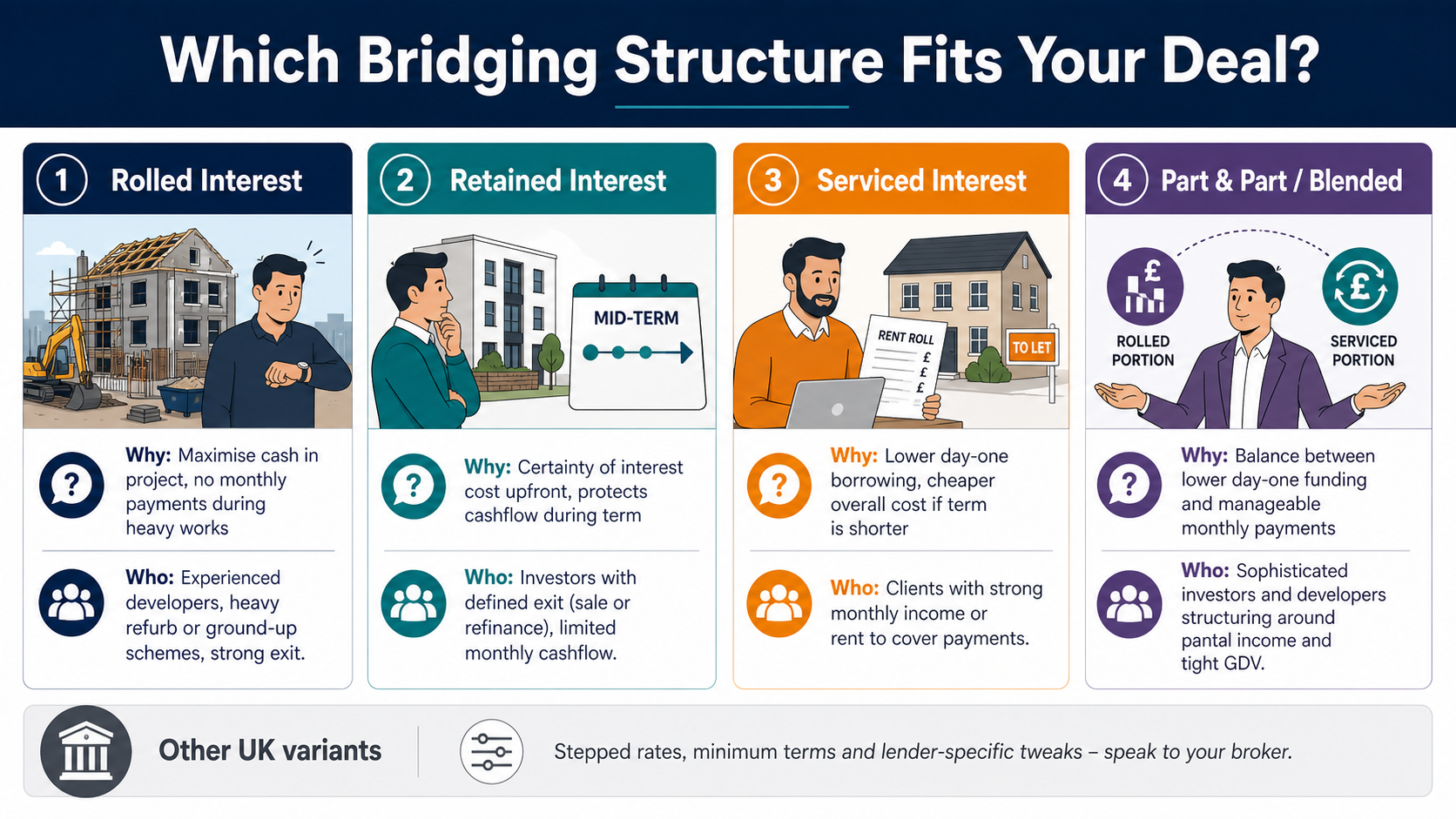
- Many deals work best as a hybrid, for example serviced while a property lets and rolled while it is empty.
Table of Contents
- What rolled-up and serviced interest mean
- The numbers: how the cost differs
- Cash flow, leverage and exit: the real trade-off
- When serviced interest makes sense
- When rolled-up interest makes sense
- A quick decision guide
- Questions to ask before you sign
- Our perspective
- Structuring interest on larger or layered deals
- How we can help
- FAQ
- Sources
What rolled-up and serviced interest mean
Both terms describe when you pay the interest on a short-term secured loan, not how much the lender charges. The rate is quoted monthly on most UK bridging loans, so the structure decides when that monthly charge leaves your pocket.
The National Residential Landlords Association describes the split in plain terms: rolled-up interest, also called capitalised interest, is applied to the balance owing each month, while serviced interest is paid off monthly.
Serviced interest
You pay the month’s interest by direct debit, much as you would on a standard mortgage. The capital you owe on the last day is the capital you borrowed on the first. The lender will want evidence that you can afford the payments for as long as the loan might run, not only for the planned term.
Rolled-up interest
Each month’s interest is added to the loan. The next month’s interest is then charged on the larger figure, which is why rolled-up costs more than serviced at the same headline rate. You make no monthly payments and the whole amount, capital plus accrued interest, is settled from your exit: a sale, a refinance or a term loan.
Retained interest
Retained interest is often confused with rolled-up. With retained interest, the lender calculates the interest for the whole planned term and holds it back from the facility at the start. You make no monthly payments, but your day-one cash is lower than the headline loan figure. That is why you will see the terms “gross” and “net” loan on term sheets. With rolled-up interest, you receive the full advance and the interest is added later.
The numbers: how the cost differs
The NRLA’s worked example uses £100,000 at 1% a month. Rolled up, the balance is £101,000 after month one, £102,010 after month two and £104,060.30 after month four. Serviced, the same loan costs £1,000 a month, or £12,000 over 12 months.
Extending the same compounding to a full year gives our own illustration:
| £100,000 at 1% a month, 12 months | Serviced | Rolled-up |
|---|---|---|
| Monthly payment | £1,000 | None |
| Interest over 12 months | £12,000 | £12,682.50 |
| Owed at redemption | £100,000 | £112,682.50 |
| Extra cost of rolling | n/a | £682.50 |
On a small loan the gap looks modest. On a development facility it matters more. Take a hypothetical £1,500,000 facility at 0.85% a month over 18 months (illustrative figures, not a quote):
| £1.5m at 0.85% a month, 18 months | Serviced | Rolled-up |
|---|---|---|
| Monthly payment | £12,750 | None |
| Total interest | £229,500 | roughly £246,900 |
| Difference | n/a | roughly £17,400 more |
Compounding conventions vary between lenders, and some charge on a daily basis or apply the interest differently, so always ask for the lender’s own redemption illustration before you commit.
What a delay does
This is where the structures separate. If that 18-month project overruns by three months, the serviced borrower pays three more instalments of £12,750, which is £38,250. The rolled-up borrower’s interest grows by roughly £44,900, and it all falls due at the end, when the project is already behind schedule. The NRLA is clear on the point: with rolled-up interest, delays increase the interest payable. A cost you cannot see month by month is easy to underestimate.

Cash flow, leverage and exit: the real trade-off
Numbers aside, the decision is about three things.
- Cash during the term. Serviced payments reduce what you can spend on refurbishment, running costs and other property expenses. Rolled-up leaves that cash in the project.
- The balance at exit. Serviced keeps it equal to what you borrowed. Rolled-up grows it, so your refinance or sale must clear a bigger number.
- How much you can raise. The NRLA notes that a borrower may consider serviced interest to maximise the cash raised, provided they can demonstrate affordability. When interest is rolled or retained, the lender counts it within the facility and the loan-to-value (LTV) limit, so there is less room for your own use of funds.
In short, serviced gives up cash flow to protect the exit. Rolled-up gives up exit headroom to protect cash flow. Neither is better in general; each fits a different kind of project.
When serviced interest makes sense
Serviced interest tends to suit borrowers with money coming in while the loan runs:
- A let property or an operating business. Rent or trading profit covers the payments, so there is no reason to let interest compound.
- A refinance exit. Because the terminal debt stays lower, the term lender’s valuation and income tests are easier to pass. This matters for the bridge-to-let route, where the bridge must be cleared by a buy-to-let mortgage sized on rent.
- Strong outside income. A property investor or high-net-worth borrower with a wider portfolio can often evidence affordability without difficulty.
The warning that goes with serviced is simple: you must keep paying for as long as the bridge is outstanding. Lenders may ask for affordability evidence, and those checks can need extra information and slow completion, so start the paperwork early if you are working to a deadline.

When rolled-up interest makes sense
Rolled-up suits projects that cannot pay for themselves yet:
- Ground-up and heavy refurbishment schemes. There is no income until completion, so rolling the interest keeps cash for the build.
- Vacant property purchases. An auction purchase or a unit awaiting change of use generates nothing in the meantime.
- Borrowers who want to keep personal liquidity for other deals, tax bills or working capital.
The discipline needed is a realistic timetable. Build a contingency into the term, ask for an extension option up front, and test your exit at a month or two later than planned. Our article on bullet versus amortising loans covers the principle behind this: plan the exit first, then choose the repayment shape.
A quick decision guide
| Your situation | Likely fit |
|---|---|
| Let property, steady rent | Serviced |
| Operating business with spare cash flow | Serviced |
| Refinance onto a term loan is the exit | Serviced, or hybrid |
| Ground-up development, no income until sale | Rolled-up |
| Refurbishment, then sale or refinance | Rolled-up or hybrid |
| Need maximum day-one cash, with proven income | Serviced |
| Exit date uncertain | Serviced if affordable, otherwise rolled with a buffer |
Hybrids are common. On a refurbish-and-let scheme, for example, the interest may be rolled during works and serviced once tenants move in. If a term sheet offers only one structure, ask whether the lender will move to another; specialist lenders often will for the right deal.
Questions to ask before you sign
- Is the interest calculated monthly or daily, and does it compound?
- Is the rate a monthly or annual figure, and what is the cost in pounds over the full term, not just the first month?
- What is the gross loan, the net advance and the redemption figure at months 6, 12 and 18?
- What happens if the term is extended, and are extension fees or a default rate applied?
- Are there exit fees, and do they apply to the initial advance or the rolled interest?
- If serviced, what affordability evidence is required and how long does it add to the timeline?
The lender’s redemption statement answers most of these in a single page, and a broker should be able to line up several lenders’ illustrations side by side. You can see the kind of panel we work with on our bridging lenders page and run a first comparison on our bridging loan comparison tool.
Our perspective
Most borrowers ask us which structure is cheaper. It is the wrong first question. The better one is: where does the money come from in month nine, and what if the sale slips to month twelve?
On large-scale acquisitions and ground-up schemes we work with, the headline rate is only part of the picture. A rolled-up facility with a realistic buffer and an agreed extension option can protect a project far better than a serviced one that strains the sponsor’s cash. Equally, a serviced loan on an income-producing asset will usually leave a borrower in a stronger refinance position.
Our approach is to model both structures against your actual exit, then go to lenders and private credit funds that will price either, including hybrids. Where a deal has several layers, for example senior debt with mezzanine or joint venture equity behind it, we look at how the interest on each layer behaves, because rolled interest on a junior tranche can quietly erode the margin. We design our structures to keep your plans moving, not to fit a lender’s default template.
James William Dawes
Structuring interest on larger or layered deals
On development finance, the interest structure sits inside a wider debt stack. Senior debt might be serviced from rental income on a completed phase, while mezzanine finance rolls up until sale. Joint venture equity may share profit rather than charge interest at all. Each piece changes how much cash leaves the project and when.
If your margins are tight, small differences in how interest is charged can decide whether a scheme works. Our guide to structuring a development finance deal when margins are tight walks through the stacking logic, and our overview of real estate funding sources for UK developers shows where each layer typically comes from.

How we can help
We are a specialist broker for property developers, investors, business owners and high-net-worth clients. For bridging, we compare structures across specialist lenders and private credit funds, not only high-street names, and present the interest options with the full cost to redemption so you can decide on facts. A single point of contact handles the process from term sheet to completion.
If you have a purchase, refurbishment or refinance in view, tell us the timetable and the exit, and we will model serviced, rolled-up and hybrid options against it. Start with our bridging finance page, or for a build or conversion project see our development finance service.
FAQ
Is rolled-up interest more expensive than serviced?
Usually yes, by a small margin, because the monthly charge is added to the balance and then earns further interest. On £100,000 at 1% a month over 12 months, the difference in our example is £682.50. The gap widens with larger loans, higher rates and longer terms, and with any delay to repayment.
What is the difference between rolled-up and retained interest?
Rolled-up interest is added to the loan each month and repaid at redemption, so you receive the full advance. Retained interest is calculated for the whole term and held back at the start, so the net cash you receive is lower. Neither involves monthly payments.
Can I switch from rolled-up to serviced during the loan?
Sometimes. Some lenders will agree hybrid arrangements or a change once a property is let or income begins, but it depends on the lender and the facility terms. Ask for this to be written into the offer at the outset rather than negotiating later.
Do lenders check affordability for serviced interest?
Yes, they commonly do. A lender will want evidence that you can meet the monthly payments for as long as the bridge is outstanding, and those checks can require extra information and slow completion. Having your income evidence ready before you apply helps.
Which is better for a development project?
For ground-up schemes with no income until sale or refinance, rolled-up interest is usually the practical choice because it preserves project cash. Build a time buffer in, since delays increase the final interest bill. A hybrid can work well where part of the scheme starts to earn before the loan ends.
Sources
Recommended
- Bullet vs Amortising Loans in UK Property Finance: Plan the Exit First
- Specialist Property Finance
- Specialist Property Finance
- Bridge to let: a UK investor’s guide to the two-stage strategy
You must keep up your repayments to avoid repossession. We are not a lender. James William & Co Capital Ltd is an Appointed Representative of Flexi Network Ltd, FRN: 1060247. Flexi Network Ltd is authorised and regulated by the Financial Conduct Authority, FRN: 948658. Flexi Network Ltd is an authorised credit broker and not a lender. You can verify both on the Financial Services Register at register.fca.org.uk.
Related Topics
Speak to a specialist
Discuss your finance with James directly
Whole-of-market specialist finance — bridging, development, commercial and residential. No call centres, no obligation. James reviews every enquiry personally.
New to specialist finance? How unbiased broker advice works · Deals we have completed
Explore Related Finance