
Published · Updated
ssas property lendingNegotiate SSAS Property Lending in the UK With 2026 Benchmarks
By James Dawes, CeMAP, Founder, James William & Co Capital

In this article, “SSAS property lending” means specialist, bespoke property finance arranged through a broker: bridging loans, development finance, mezzanine debt and joint venture equity, not pension trustee rules. For complex, time-sensitive or multi-layered capital stacks, the practical move is to engage a specialist broker early. We structure exactly this kind of finance.
TL;DR:
- Development finance margins averaged around 474 basis points at a loan-to-cost ratio of 63% in 2025, with debt funds providing 57% of UK development lending.
- Typical capital stacks include senior debt, mezzanine or unitranche debt, joint venture equity, and short-term bridging or revolving credit, arranged in layers based on risk and priority.
- Choice between bank loans and debt funds depends on preference for lower costs or faster speed, as both types have seen increased volumes in recent years.
- Comparing term sheets requires examining all-in costs, security, draw mechanics, covenant tightness, and lender track records rather than just headline margins.
- The full process from lender selection to completion can take several weeks, especially for complex, multi-lender stacks, so early engagement with a specialist broker is advised.
Table of Contents
- 1. What products and use cases this type of finance covers
- 2. UK market context: lending volumes, development share and pricing
- 3. How typical deals are structured: capital stacks and covenants
- 4. How to evaluate and compare term sheets
- 5. Risks, exit routes and timing across the deal lifecycle
- 6. Overview of SSAS regulations specifically governing property lending to ensure compliance
- 7. Tax implications and benefits associated with SSAS property lending
- 8. Typical costs and fees involved in structured property finance transactions
- 9. How James William & Co Capital approaches structuring and delivery
- 10. Getting a complex deal structured: what we offer and what we need from you
- FAQ
- Sources
1. What products and use cases this type of finance covers
Specialist property lending spans several distinct products, each suited to a different stage of a deal. Bridging finance covers short-term cashflow gaps, typically for acquisition, auction completion or chain-breaking. Development finance funds ground-up builds and conversions, usually released in staged draws against a build programme. Commercial mortgages provide longer-term senior debt once a scheme is income-producing or complete. Mezzanine debt sits behind senior lending to close a funding gap without diluting equity, and joint venture equity brings in a capital partner who shares profit and risk rather than charging interest.
These products combine in practice rather than standing alone:
- Land and plot purchases ahead of planning consent, often bridge-funded.
- Acquisition-to-refinance strategies, where a bridge buys time before longer-term debt replaces it.
- Short-term cashflow bridging between sale completions or fund drawdowns.
- Ground-up development funding structured around staged construction draws.
- Revolving credit facilities that recycle capital across a live portfolio.
This article stays with brokered property finance throughout. It does not address SSAS pension scheme borrowing rules, which is a separate regulatory topic for pension trustees and administrators, not for the developers and investors this guide is written for.
A fuller breakdown of how these products interact sits in our guide to funding sources for UK developers.
2. UK market context: lending volumes, development share and pricing
The scale of new lending into UK commercial real estate has shifted markedly, and the figures matter for anyone pricing a deal in 2026. New commercial real estate lending in the UK rose to £52.7 billion in 2025, a 29% increase year on year, with roughly 60% of that activity tied to refinancing rather than new acquisitions.
Development finance made up roughly 16-22% of new lending in 2025, with residential development loan margins averaging 474 basis points at a loan-to-cost ratio of around 63%. That margin and LTC pairing gives developers a reasonable benchmark when a term sheet lands on the desk.
The lender mix has also changed shape:
- Debt funds supplied the majority of commercial development finance, around 57% as of the first half of 2025.
- Banks remained dominant in residential development finance, supplying roughly 56%.
- The split affects speed, covenant tightness and fee structure: debt funds tend to move faster but price for flexibility, while banks offer lower headline margins against tighter conditions.
Borrowers weighing a bank against a debt fund are really choosing between price and pace, and 2025’s volumes suggest both routes are busier than they have been in years.
3. How typical deals are structured: capital stacks and covenants
A representative capital stack for a mid-sized development or acquisition usually layers several debt types rather than relying on one lender.
- Senior debt from a bank or institutional lender, typically secured against the asset with first-ranking charge.
- Mezzanine or unitranche debt, sitting behind senior debt, closing the gap between senior lending and the equity a sponsor can put in.
- JV equity, where a capital partner takes a profit share rather than a fixed return, often used when a sponsor wants to preserve cash.
- Bridging or revolving credit, layered in where short-term cashflow needs sit outside the main facility, such as between land completion and the start of construction drawdowns.
Ranking determines who gets repaid first on a default or sale, and it shapes every other term in the deal. Covenant packages commonly include interest cover tests, conditions attached to each construction draw, and completion triggers that release retained funds only once defined milestones are certified.
Pro Tip: Read the intercreditor agreement before the facility letter. It usually dictates what each lender can and cannot do if the deal slips, and that matters more than the headline rate.
This is where broker value is concrete rather than theoretical: sourcing lenders willing to sit in a junior position, negotiating subordination language that protects the sponsor’s flexibility, and coordinating multiple lenders so completion happens on one timeline rather than three. Government-backed routes can also form part of a stack. The National Housing Bank arranges bespoke lending alliances that can provide senior or mezzanine capital alongside private lenders, and the Home Building Fund lends from around £250,000 to over £10 million to support SME housebuilders and larger schemes.
4. How to evaluate and compare term sheets
Two term sheets with similar headline margins can carry very different real costs once fees, security scope and draw mechanics are factored in.
- Compare all-in cost, not just headline margin: arrangement fees, exit fees and any non-utilisation charges on undrawn facilities.
- Check security and ranking carefully, including whether personal guarantees or cross-collateralisation across other assets are required.
- Scrutinise LTC/LTV buckets and the draw mechanics, since a lender offering a higher LTC with slow, document-heavy draws can cost more in delay than a lower LTC with fast releases.
- Read covenant tightness and remedies closely: what happens on a breach, and how much room exists to cure it before default.
- Weigh speed and certainty of funding against price, particularly where planning or build timelines are tight.
- Ask about the lender’s track record on similar assets and locations, since appetite varies sharply by sector and region.
Negotiation levers worth pushing on include an interest reserve built into the facility rather than funded from day one, phased draws tied to realistic milestones, caps on exit fees, and a clearly defined scope of security rather than an open-ended debenture.
Pro Tip: Ask any broker or adviser for a comparative term sheet summary, lender risk notes and a written execution plan before you commit, not after. Our bridging loan comparison tool is one starting point for benchmarking terms across lenders.
5. Risks, exit routes and timing across the deal lifecycle
Every structured deal carries risks that are foreseeable if planned for early, and most failures trace back to a mismatch between financing terms and project timing.
- Refinancing windows closing when market conditions shift, leaving a sponsor exposed to a bridge or development facility’s maturity date with no exit lined up.
- Construction delays that push completion past the facility term, triggering default interest or covenant breaches.
- Regulatory gates, including the Building Safety Levy, which must be paid before a completion certificate is issued and can quietly delay both completion and refinance timing if not budgeted for.
- Interest-rate volatility, which affects both the cost of a new facility and the pricing on any refinance.
Primary exit routes include refinancing into longer-term senior debt once a scheme is complete and let or sold, selling completed units or a whole portfolio, bringing in an equity recap to reduce gearing, or a structured sale to a single buyer. Which route makes sense depends on market liquidity at the point of exit: current commentary suggests liquidity remains strong for best-in-class assets, with lenders increasingly willing to deploy into higher-yielding secondary stock for well-packaged deals.
Realistic timing checkpoints to budget for: lender selection and soft offers (typically a few weeks), due diligence and legal work, the construction draw schedule itself, and the completion certificate and refinance window that follows.
6. Overview of SSAS regulations specifically governing property lending to ensure compliance
This guide deliberately sits outside pension-scheme regulation. A Small Self-Administered Scheme, or SSAS, is a pension vehicle governed by its own trust rules, HM Revenue and Customs requirements and borrowing limits set under pension law, and that framework is a matter for pension trustees and scheme administrators, not for the property developers and investors this article is written for.
The brokered property finance covered here, bridging, development finance, mezzanine debt and commercial mortgages, is regulated differently: through lender-specific terms, the Financial Conduct Authority where a facility falls within regulated activities, and standard property and company law governing charges, security and company borrowing. A developer or investor raising capital through a corporate vehicle or special purpose vehicle is subject to company law and the terms negotiated in the facility agreement, not pension scheme rules.

Anyone whose finance question genuinely concerns a SSAS pension scheme’s own property investment or lending powers should take that question to a pension trustee or scheme administrator, since the compliance framework, contribution limits and connected-party lending rules that apply there are entirely separate from the facility structuring, covenant negotiation and lender sourcing this article addresses. Conflating the two risks applying the wrong set of rules to a deal, which is why professional borrowers structuring acquisitions or developments should work with advisers who are clear about which regime their finance sits under before terms are agreed.
7. Tax implications and benefits associated with SSAS property lending
As with the regulatory position, the tax treatment of a pension scheme’s own property lending activity is a distinct area governed by pension and HMRC rules, and sits outside the scope of this guide. The tax position relevant to brokered property finance, by contrast, follows standard corporate and property tax principles.
Interest paid on development finance, bridging loans or mezzanine debt is generally treated as a finance cost for the borrowing entity, subject to the usual rules on deductibility against trading or rental profit, and the precise treatment depends on how the borrowing vehicle is structured, whether as a trading company, a special purpose vehicle or a partnership. Stamp Duty Land Tax applies to the underlying property transaction itself rather than to the financing arrangement, though the structure chosen, such as using a corporate vehicle, can affect the rate and reliefs available. JV equity arrangements carry their own tax considerations around profit share treatment, since a return structured as equity participation is not treated the same way as loan interest.
Because tax treatment depends heavily on the specific vehicle and jurisdictional structure used, particularly where offshore vehicles or multi-layered stacks are involved, professional borrowers should take specific tax advice before finalising a structure rather than relying on general guidance. A broker arranging the finance can flag where a particular structure has tax implications worth raising with an accountant or tax adviser, but the advice itself sits with that adviser.

8. Typical costs and fees involved in structured property finance transactions
Costs on a structured deal extend well beyond the headline interest rate, and the layering of multiple facilities tends to multiply the fee lines rather than simplify them. Arrangement fees are charged upfront by most lenders, typically as a percentage of the facility, and apply separately to senior, mezzanine and any bridging element within a stack. Exit fees, where charged, are usually levied on redemption and can be a fixed percentage or a minimum return threshold written into the facility agreement.
Valuation and legal fees are payable on most facilities, with multi-lender stacks often requiring each lender’s own legal representation, which adds cost compared with a single-lender facility. Monitoring surveyor fees apply on development finance, covering the staged inspections that trigger each construction draw. Non-utilisation fees can apply on revolving facilities or undrawn tranches, charged on the unused portion of a facility rather than the amount actually drawn.
Broker fees, where applicable, are typically disclosed and agreed as part of the engagement, separate from lender-side arrangement costs. Because fee structures vary by lender and by how a stack is arranged, the only reliable way to compare true cost across competing offers is to build an all-in cost comparison covering every fee line, not just the headline margin, before signing a term sheet.
9. How James William & Co Capital approaches structuring and delivery
We work as a single point of contact across sourcing, negotiation and execution, which matters most when a deal needs several lenders moving on one timeline rather than three separate processes running in parallel. The role of a broker is to find lenders willing to take a particular position in a stack, negotiate the subordination and intercreditor terms that protect client flexibility, and keep completion on schedule once terms are agreed.
A recent example of that structuring work is a £600,000 revolving credit facility secured against a £5 million property portfolio, arranged to give the client recyclable capital across an existing portfolio rather than a single-use facility. Clients preparing for a mandate review should expect to bring portfolio or project financials, an outline of the exit strategy and existing lender relationships. Timelines vary by complexity, but early engagement, well before a facility deadline looms, gives us the most room to negotiate favourable terms.
— James William Dawes
10. Getting a complex deal structured: what we offer and what we need from you
We arrange the full range of products covered in this guide, including bridging finance, development finance, joint venture equity and mezzanine finance, and commercial mortgages for longer-term senior refinance once a scheme is complete. Where a stack needs several lenders working to one timeline, that coordination is where a broker-led mandate earns its place rather than leaving a sponsor to run three separate lender conversations alone.
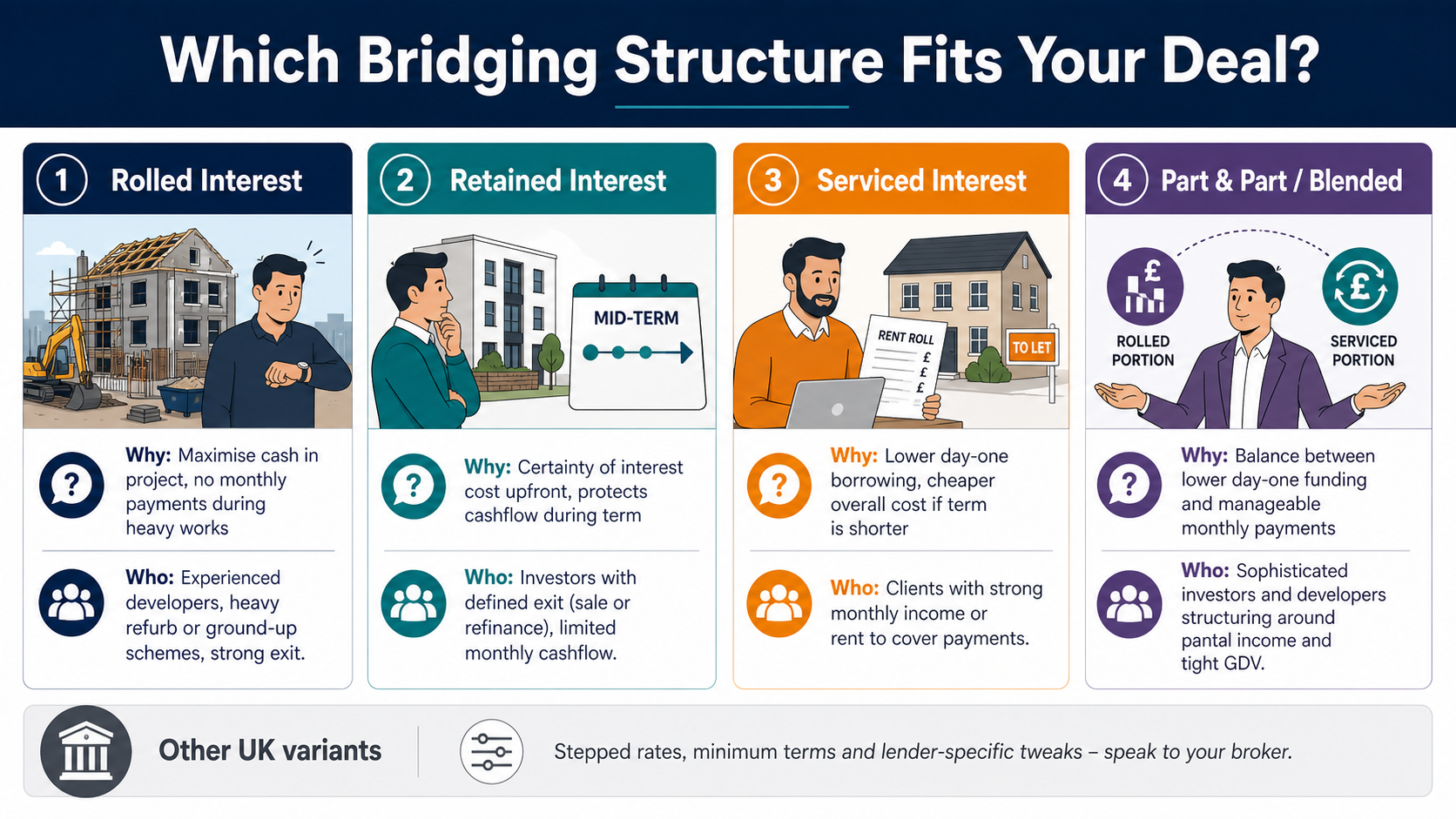
For an initial mandate review, it helps to have recent portfolio or project financials, a clear statement of the exit strategy, and details of any existing lender relationships ready to hand over.
- Bridging, development and mezzanine finance sourced from lenders beyond the mainstream high street.
- Covenant negotiation and subordination terms structured around your actual exit timeline.
- A single point of contact coordinating multiple lenders toward one completion date.
Get in touch through our bridging finance or development finance pages to start a mandate review, or visit Jwcapital to see the full range of services.
FAQ
What does “SSAS property lending” mean in a broker context?
Here it refers to specialist, bespoke property finance such as bridging loans, development finance and mezzanine debt arranged by a broker for developers and investors, not to pension scheme borrowing rules. The products and structuring approach in this article apply to commercial and development property deals rather than pension trustee matters.
How much do UK development loans typically cost?
Residential development loan margins averaged around 474 basis points at a loan-to-cost ratio of roughly 63% in 2025. Actual pricing varies by lender type, with debt funds generally pricing for speed and flexibility and banks pricing lower against tighter conditions.
Who provides most development finance in the UK, banks or debt funds?
Debt funds supplied the majority of commercial development finance, around 57% as of the first half of 2025, while banks remained dominant in residential development finance at roughly 56%. The split affects both pricing and how quickly a facility can be arranged.
When should I bring in a specialist broker rather than approaching lenders directly?
A broker earns its place once a deal involves more than one lender, a tight completion timeline, or terms that need negotiating across senior, mezzanine and equity layers simultaneously. For straightforward single-lender facilities, direct approaches can work, but multi-layered stacks typically move faster and price better with coordinated sourcing.
What is a realistic timeline for arranging a multi-layered capital stack?
Timelines vary with complexity, but lender selection and soft offers typically take a few weeks, followed by due diligence, legal work and, for development deals, a staged draw schedule through to completion. Starting the process well ahead of any existing facility deadline leaves more room to negotiate favourable terms.
Sources
- New commercial real estate lending rises to highest in a decade
- Banks and development financing drove UK commercial real estate lending surge in first half of 2025
- National Housing Bank — Lending alliances with banks and lenders
Recommended
Related Topics
Speak to a specialist
Discuss your finance with James directly
Whole-of-market specialist finance — bridging, development, commercial and residential. No call centres, no obligation. James reviews every enquiry personally.
New to specialist finance? How unbiased broker advice works · Deals we have completed
Explore Related Finance