
Published · Updated
what is preferred equityWhat is preferred equity in real estate finance?
By James Dawes, CeMAP, Founder, James William & Co Capital

TL;DR:
- Preferred equity grants investors priority payments above common equity but below debt, without adding extra leverage. It relies on contractual rights instead of security, offering governance control and downside protection. This instrument is mainly used in UK property development to bridge funding gaps and preserve capital control.
Preferred equity is defined as an equity investment that grants investors priority distribution payments ahead of common equity holders, without creating an additional debt layer on the capital structure. It sits in a distinct position within the real estate capital stack: above common equity but subordinate to senior and mezzanine debt. For UK property developers and investors, understanding this structure is not optional. It determines how capital is raised, how returns are distributed, and who controls the asset when things go wrong.
What is preferred equity and where does it sit in the capital stack?
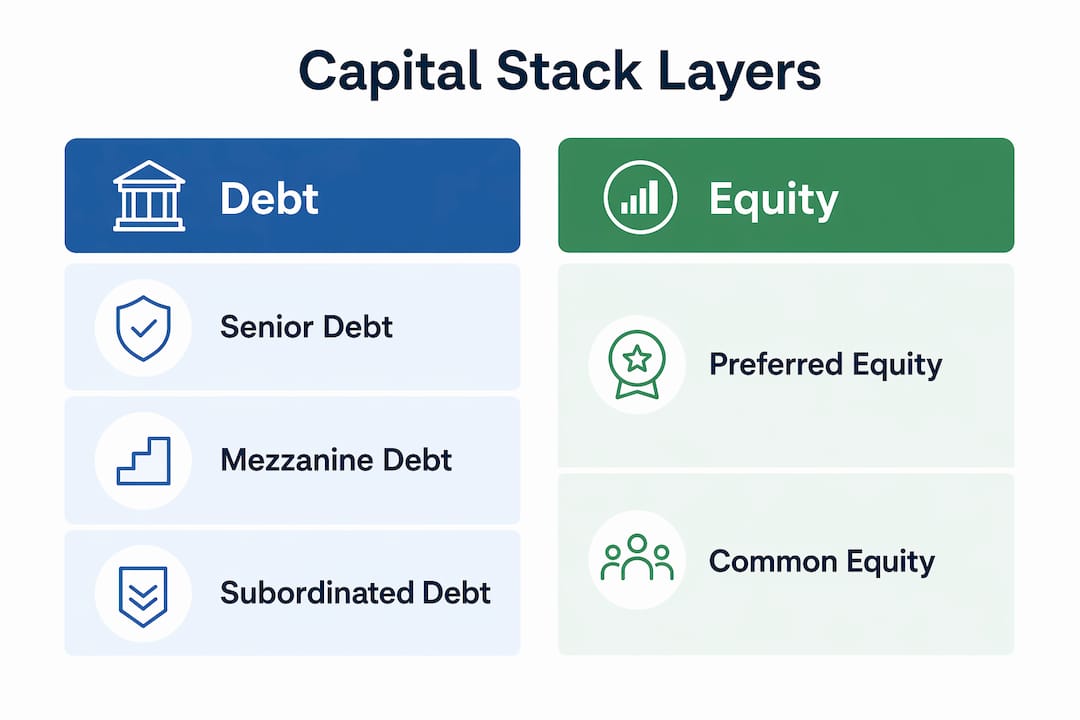
Preferred equity investors acquire shares that grant priority distribution payments calculated ahead of common equity holders, while remaining structurally subordinated to senior debt. This position in the capital stack is what defines its risk and return profile. Senior debt sits at the base, carrying the lowest risk and the first claim on assets. Mezzanine debt sits above that, followed by preferred equity, with common equity at the top carrying the highest risk and the greatest upside.

The practical consequence of this ranking is straightforward. In a distribution waterfall, preferred equity investors receive their agreed return before any profit reaches common equity holders. If the project underperforms, preferred equity investors absorb losses before senior lenders but after common equity. That asymmetry is the core trade-off.
The table below illustrates how each layer compares across key criteria.
| Layer | Security | Return type | Risk level |
|---|---|---|---|
| Senior debt | First legal charge on assets | Fixed interest | Lowest |
| Mezzanine debt | Second charge or intercreditor | Fixed interest plus fees | Moderate |
| Preferred equity | Contractual rights within SPV | Priority dividend, cumulative | Moderate to high |
| Common equity | Residual ownership | Variable profit share | Highest |
Pro Tip: When assessing a capital stack, map each layer’s security position before pricing your return expectation. Preferred equity without strong governance rights is not the same instrument as preferred equity with consent and control mechanisms built in.
Capital stack structures rank preferred equity with priority returns ahead of common equity but structurally subordinate to secured lending, often with enhanced governance rights attached.
How does preferred equity differ from mezzanine debt?
The most common source of confusion in real estate finance is treating preferred equity and mezzanine debt as interchangeable. They are not. The distinction is legal, not just structural.
Unlike mezzanine debt, preferred equity providers do not take a formal legal charge on assets. They acquire priority through contractual rights within the SPV operating agreement. Mezzanine debt, by contrast, is secured by a second charge or intercreditor arrangement, giving the lender direct recourse to the underlying property. That difference matters enormously when a senior lender prohibits secondary charges on development land, which is common in UK ground-up development finance.
Preferred equity is legally an ownership stake rather than a loan. This avoids the regulatory and structural complexities that come with additional debt layers. It also means preferred equity investors cannot appoint a receiver or enforce a charge in the way a secured lender can. Their protection comes instead from negotiated governance rights.
Those governance rights typically include:
- Consent rights over major decisions, including asset sales and refinancing
- Information rights requiring regular financial reporting from the borrower
- Covenant packages restricting the sponsor’s ability to take on further debt
- Control takeover mechanisms triggered by specific default events
Pro Tip: Always engage your senior lender before finalising a preferred equity term sheet. Senior lenders frequently impose restrictions on governance rights, particularly control takeover provisions. Early alignment prevents costly renegotiation at the point of drawdown.
For developers comparing mezzanine debt and preferred equity, the choice often comes down to whether the senior lender will permit a second charge and whether the sponsor wants to preserve equity control.
How does preferred equity work financially?
Preferred equity returns are structured around priority dividends, cumulative mechanisms, and profit participation thresholds. Understanding each component is what separates investors who price this instrument correctly from those who do not.
The preferred return is paid before any distribution reaches common equity. If the project generates insufficient cash flow in a given period, cumulative preferred equity structures build up unpaid returns, providing downside protection while enabling flexible payment timing. Those accumulated returns must be settled in full before common equity holders see a penny.
Once the preferred return is paid in full, a catch-up mechanism often activates. Catch-up payments increase the investor’s profit share until an agreed internal rate of return hurdle is reached. After that threshold, the developer reclaims a larger share of residual profits. The structure rewards patience and protects against underperformance.
A simplified payment priority for a typical preferred equity structure looks like this:
| Priority | Payment | Recipient |
|---|---|---|
| 1st | Return of capital | Preferred equity investor |
| 2nd | Preferred return (cumulative) | Preferred equity investor |
| 3rd | Catch-up to agreed IRR | Preferred equity investor |
| 4th | Residual profit share | Common equity and sponsor |
This waterfall structure means preferred equity investors carry meaningful downside protection. They do not, however, carry the same upside as common equity unless the deal significantly outperforms the agreed IRR hurdle.
Practical uses of preferred equity in UK property finance
Preferred equity is widely used to bridge refinancing gaps when senior loan proceeds fall short, avoiding dilutive common equity injections and preserving ownership control. That use case alone explains much of its growth across UK and European real estate markets.
The most common applications in UK property development and investment include:
- Refinancing shortfalls: When a senior lender will not extend further debt, preferred equity fills the gap without disturbing the existing loan facility.
- Development finance: Ground-up schemes often use preferred equity to fund cost overruns or phase two capital requirements without renegotiating the senior facility.
- Refurbishment and lease-up: Transitional assets with unstabilised income profiles attract preferred equity from private credit funds and family offices seeking fixed-priority returns.
- Joint ventures: Preferred equity defines the economic hierarchy between joint venture partners, giving the capital provider priority while the operating partner retains day-to-day control.
- Platform growth: Investors backing property platforms use preferred equity to fund multiple acquisitions without diluting the founding sponsor’s common equity position.
Preferred equity investors negotiate enhanced governance rights including consent rights, information rights, covenants, and control takeover mechanisms triggered by specific events. Those protections are what make the instrument viable for institutional capital providers who cannot take security in the traditional sense.
For sponsors, the appeal is equally clear. Preferred equity does not appear on the balance sheet as debt. It preserves the sponsor’s equity stake and avoids the dilution that comes with bringing in a new common equity partner. For a developer running multiple schemes, that distinction has a direct impact on how future financing is structured and priced.
James William & Co Capital regularly structures preferred equity solutions for UK developers and investors operating in exactly these scenarios, from ground-up development finance to complex refinances involving multi-layered debt stacks. Understanding how to structure development finance correctly from the outset determines whether preferred equity adds value or creates friction later in the deal.
Pro Tip: When preferred equity is used in a joint venture, define the control takeover trigger events with surgical precision. Vague default definitions create disputes at the worst possible moment, typically when the project is already under stress.
Key takeaways
Preferred equity is the most misunderstood layer in the real estate capital stack, combining priority returns and governance rights without the security of debt or the full upside of common equity.
| Point | Details |
|---|---|
| Capital stack position | Preferred equity ranks above common equity but below senior and mezzanine debt in every distribution waterfall. |
| Legal nature | Preferred equity is an ownership stake, not a loan, so investors hold no legal charge over the underlying asset. |
| Cumulative returns | Unpaid preferred returns accumulate and must be settled before common equity holders receive any distribution. |
| Catch-up mechanisms | Once the preferred return is paid, investors receive a higher profit share until an agreed IRR hurdle is reached. |
| Governance rights | Preferred equity investors protect their position through consent rights, covenants, and control takeover provisions rather than security. |
Preferred equity: what fifteen years of structuring deals has taught me
The textbook explanation of preferred equity makes it sound tidy. In practice, it is one of the most negotiation-intensive instruments in property finance, and the gap between a well-structured deal and a poorly structured one is enormous.
The single biggest mistake I see is sponsors treating preferred equity as a quick fix for a funding gap without thinking through the governance implications. They focus on the headline return and the absence of a second charge, then discover six months into the project that their preferred equity investor has consent rights over a refinancing they need to execute urgently. That friction is not a flaw in the instrument. It is a consequence of not reading the term sheet carefully enough at the outset.
Preferred equity’s effectiveness depends on careful structuring, clear alignment of interests, and a realistic understanding of its hybrid nature. That sentence is true, but it understates the difficulty. Alignment of interests sounds straightforward until the project hits a planning delay and the preferred equity investor’s cumulative return is compounding while the developer’s profit margin is shrinking.
What actually works is getting all parties around the table before the term sheet is finalised. Senior lenders, preferred equity providers, and sponsors need to agree on the intercreditor framework, the default triggers, and the exit mechanics before capital is deployed. The deals I have seen fail were not undone by market conditions. They were undone by ambiguity in the documentation.
The other thing worth saying plainly: preferred equity is not a substitute for adequate senior debt. It is a complement to it. Sponsors who use preferred equity to paper over a fundamentally over-leveraged capital structure are borrowing trouble, not capital.
— James William Dawes
How James William & Co Capital structures preferred equity finance
James William & Co Capital works with UK property developers, investors, and high-net-worth clients who need preferred equity structured correctly from day one.
The firm’s capital concierge approach means a single point of contact handles the full process: from term sheet negotiation and senior lender engagement through to intercreditor documentation and drawdown. James William & Co Capital’s network of family offices, private credit funds, and specialist lenders gives clients access to preferred equity capital that is priced and structured for the specific deal, not a generic product. For developers and investors operating in London and across the UK, the specialist property finance team at James William & Co Capital delivers the speed and precision that complex transactions demand.
FAQ
What is the preferred equity definition in real estate?
Preferred equity is an equity investment that grants investors priority distribution payments ahead of common equity holders, without creating an additional debt layer. It sits above common equity but below senior and mezzanine debt in the capital stack.
How does preferred equity differ from common equity?
Preferred equity holders receive their agreed return before common equity holders receive any distribution. Common equity carries higher risk and higher potential upside, while preferred equity offers priority returns and enhanced governance rights.
What are the main risks of preferred equity investment?
Preferred equity investors hold no legal charge over the underlying asset, so their protection relies entirely on contractual governance rights. If those rights are poorly drafted or the senior lender restricts enforcement, the investor’s downside protection is weakened.
Can preferred equity be used in UK development finance?
Preferred equity is regularly used in UK ground-up development, refurbishment, and lease-up projects to fill funding gaps without disturbing senior lending arrangements or diluting the sponsor’s common equity position.
What does cumulative preferred equity mean?
Cumulative preferred equity means that any unpaid preferred returns accumulate over time and must be settled in full before common equity holders receive any distribution, providing investors with compounding downside protection.
Recommended
Related Topics
Speak to a specialist
Discuss your finance with James directly
Whole-of-market specialist finance — bridging, development, commercial and residential. No call centres, no obligation. James reviews every enquiry personally.
New to specialist finance? How unbiased broker advice works · Deals we have completed
Explore Related Finance