
Published · Updated
defining loan tranchingDefining loan tranching: a UK property finance guide
By James Dawes, CeMAP, Founder, James William & Co Capital

TL;DR:
- Loan tranching divides debt into segments with different risk, return, and priority to manage project financing effectively. It includes phased drawdowns for liquidity and capital layering based on seniority, with each serving distinct purposes in property development. Proper structuring minimizes risk, aligns incentives, and avoids costly errors in complex UK property projects.
Loan tranching is defined as the division of a debt facility into distinct segments, each carrying its own repayment priority, risk profile, and terms. In UK property development finance, this structure is the foundation of the capital stack. Defining loan tranching correctly matters because the two words cover two separate practices: phasing drawdown across construction milestones, and layering capital by seniority. Confusing them leads to mispriced risk and poorly structured deals. This guide separates the two, explains how each tranche type works in practice, and sets out what real estate professionals and investors need to know before committing to a structure.
What is loan tranching and how does it work?
A tranche is a slice of a pooled loan or debt facility with its own risk, return, and repayment priority, managed through a payment waterfall. The waterfall determines who gets paid first when cash flows in from the project. Senior lenders sit at the top and receive repayment before anyone else. Mezzanine lenders follow. Equity investors receive whatever remains.

This hierarchy is not arbitrary. It reflects the risk each party accepts. Senior lenders take the least risk and accept the lowest return. Mezzanine lenders accept a subordinated position in exchange for a higher yield. Equity investors carry the most risk and target the highest return. The structure aligns incentives and makes complex, multi-party financing possible on large UK development schemes.
Loan tranching has two main uses: phasing drawdown for liquidity management across construction stages, and creating risk layers for capital stack efficiency. Professionals who treat these as interchangeable make costly structural errors. Each use demands a different approach to documentation, security, and lender coordination.
The repayment waterfall in practice
The waterfall works in a fixed sequence. Senior debt is repaid in full first, including accrued interest and any exit fees. Mezzanine debt follows, with its higher interest rolled or serviced depending on the agreement. Equity distributions come last. On a ground-up residential scheme, for example, the senior lender might fund 60% of gross development value, the mezzanine lender a further 15–20%, and the developer contributes equity for the remainder. If the project sells at a shortfall, the equity position absorbs the loss first, protecting both debt layers.
How do senior debt and mezzanine finance differ in a tranche structure?
Senior debt is secured by a first legal charge and repaid first, carrying lower risk and typically lower cost in UK property finance. It underwrites the downside protection and funds the core facility. Senior lenders assess loan-to-value, loan-to-cost, and debt service coverage ratios before committing. Their security position means they can enforce against the asset directly if the borrower defaults.
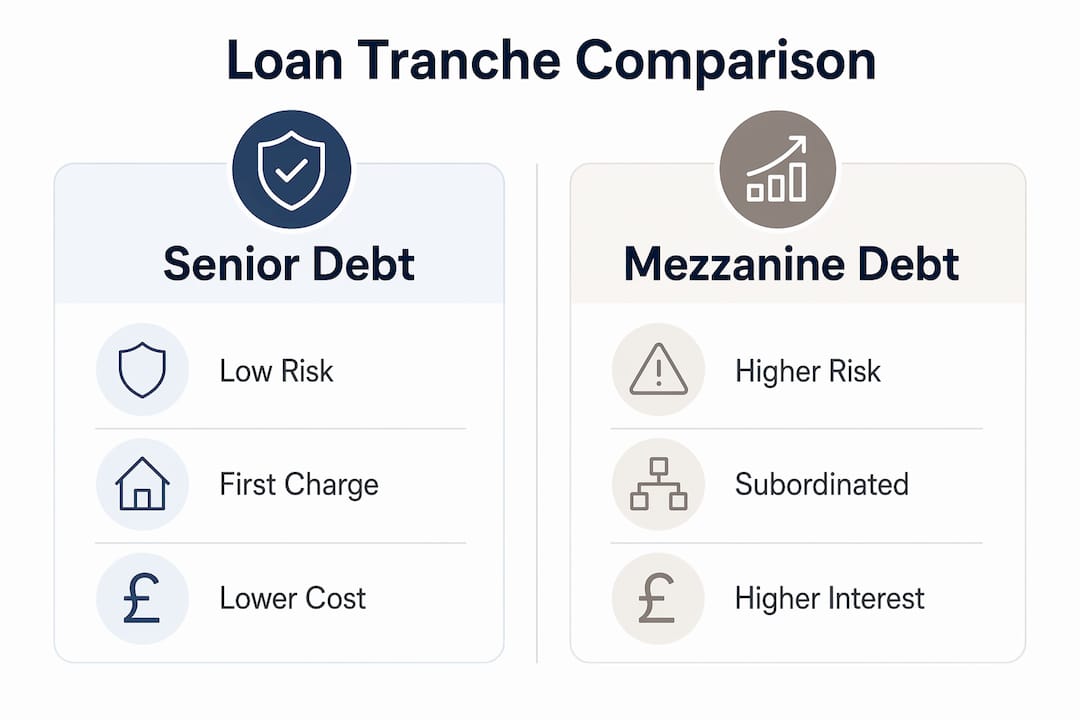
Mezzanine debt fills the funding gap left by senior lenders, sits subordinated in the capital stack, carries higher interest costs, and is often secured by a share pledge over the borrowing vehicle rather than a first charge. This distinction matters enormously. A mezzanine lender cannot simply appoint a receiver over the bricks and mortar. They enforce through the shares of the special purpose vehicle, which is a slower and more complex process.
| Feature | Senior debt | Mezzanine debt |
|---|---|---|
| Security | First legal charge on the asset | Share pledge over the SPV |
| Repayment priority | First in the waterfall | After senior, before equity |
| Typical cost | Lower, reflecting lower risk | Higher, reflecting subordinated position |
| LTV coverage | Up to 60–65% of GDV | Bridges gap to 80–85% of GDV |
| Enforcement route | Direct asset enforcement | Share enforcement via SPV |
The most common mistake developers make is treating mezzanine finance as a last resort or a sign of a weak deal. Mezzanine finance is structurally designed to fill specific loan-to-value gaps, not merely to add expensive debt. When project returns credibly exceed the cost of mezzanine, the structure makes commercial sense.
Pro Tip: Always model the mezzanine cost against your projected internal rate of return before committing. If the IRR on the project sits comfortably above the mezzanine rate, the tranche is accretive to equity returns, not destructive.
Drawdown tranching vs risk-layering tranching: what is the difference?
These two applications of tranching serve entirely different purposes. Conflating them is one of the most frequent errors in UK development finance.
-
Drawdown tranching releases funds in stages tied to construction milestones. The lender monitors progress, a monitoring surveyor certifies each stage, and the next tranche of funds is released. This approach protects the lender from funding a project that stalls mid-build. For the developer, it means managing cash flow carefully across phases, since undrawn funds do not accrue interest but also are not available until the milestone is certified.
-
Risk-layering tranching refers to the capital stack segmentation described above. Senior debt, mezzanine debt, and equity each represent a separate tranche with distinct risk and return characteristics. This is the structure that intercreditor agreements govern, specifying repayment priority, enforcement rights, and coordination between creditor classes.
-
The practical distinction matters for cash flow planning. A developer who misunderstands drawdown tranching as risk layering may fail to plan for the timing of fund releases, creating a liquidity gap mid-construction. Conversely, treating risk-layering tranching as merely a drawdown schedule misses the legal and structural complexity of managing multiple creditor classes with competing rights.
-
A worked example clarifies the difference. On a 30-unit residential scheme in the Midlands, the senior lender might release funds in four drawdown tranches tied to foundations, superstructure, practical completion, and sales. Separately, the capital stack includes senior debt at 60% of GDV, mezzanine at 20%, and developer equity at 20%. These are two distinct tranching mechanisms operating simultaneously on the same project.
For a fuller picture of how these structures fit together, the guide on how to structure development finance in the UK covers the capital stack in detail.
How to structure loan tranches for capital efficiency in UK property development
Structuring tranches well requires more than matching debt to project cost. The goal is to maximise the amount of development that can be funded at the lowest blended cost of capital, while keeping the structure viable through to exit.
Key considerations for tranche design include:
- Project IRR versus blended debt cost. If the project IRR sits at 18% and the blended cost of senior and mezzanine debt is 11%, the structure is accretive. If the IRR falls to 12% under stress, the mezzanine cost erodes equity returns sharply. Model both scenarios before fixing the tranche sizes.
- Senior debt limits and LTV headroom. Most UK senior development lenders cap at 60–65% of gross development value. The gap between that ceiling and the total funding requirement determines how much mezzanine or equity is needed.
- Exit strategy and refinance risk. Tranche structures must account for exit strategy and refinance risk, particularly under volatile UK market conditions with rising interest rates and tighter lending standards. A structure that works at today’s rates may not refinance cleanly if rates move 150 basis points.
- Intercreditor agreement terms. The intercreditor agreement governs the relationship between senior and mezzanine lenders. Poorly drafted intercreditor terms create enforcement disputes that can freeze a project at the worst possible moment.
- Equity cushion size. A thin equity tranche increases lender risk and may trigger higher pricing or tighter covenants from the senior lender. A developer contributing 20% equity signals commitment and typically secures better terms.
Pro Tip: Negotiate the intercreditor agreement before you finalise either debt facility. Lenders who agree terms in isolation often find conflicts in the intercreditor that require renegotiation, adding weeks to the timeline.
Real estate professionals looking to refine their approach to capital stack structuring will find that tranche design is where deals are won or lost on returns.
What are the most common pitfalls in loan tranching?
Most errors in tranche structuring come from one of five recurring mistakes.
- Treating mezzanine as expensive filler. Mezzanine costs 12–20%, bridging the gap between senior debt limits and equity. Developers who dismiss it without modelling the return impact miss viable deals. The question is never whether mezzanine is expensive in isolation. The question is whether the project return justifies the cost.
- Ignoring refinance timing. A development loan that matures before the project reaches practical completion creates a refinance cliff. Build in sufficient term, or structure a facility with an extension option tied to milestones.
- Overreliance on senior debt limits. Assuming a senior lender will stretch beyond their published LTV parameters wastes time and damages credibility. Structure the deal within realistic parameters from the outset.
- Failing to coordinate tranche terms. Mismatched maturity dates between senior and mezzanine facilities create enforcement conflicts. Both facilities should mature on the same date or include coordinated extension provisions.
- Skipping the intercreditor negotiation. Developers sometimes treat the intercreditor agreement as a formality. It is not. It determines who controls enforcement, who can cure a default, and in what order proceeds are distributed.
For a broader view of real estate funding sources available to UK developers, including how tranching fits within the wider financing toolkit, the linked guide covers the full range of options.
Key takeaways
Loan tranching structures a debt facility into senior, mezzanine, and equity layers, each with distinct repayment priority, security, and cost, giving developers and lenders a clear framework for managing risk and return across a project.
| Point | Details |
|---|---|
| Two types of tranching | Drawdown tranching phases fund releases; risk-layering tranching segments the capital stack by seniority. |
| Senior debt sits first | Secured by a first legal charge, senior debt carries the lowest cost and the first claim on repayment. |
| Mezzanine fills the LTV gap | Mezzanine debt bridges the funding shortfall between senior limits and total project cost, not merely adding cost. |
| Intercreditor agreements are critical | These documents govern enforcement rights and repayment priority between creditor classes and must be negotiated early. |
| IRR must exceed blended debt cost | Model project returns against the combined cost of all debt tranches before committing to a structure. |
Why tranche structuring is more nuanced than most developers expect
I have sat across the table from developers who have read the term sheet, understood the headline rates, and still walked into a structure that nearly collapsed their project. The issue was never the interest rate. It was the intercreditor agreement, the drawdown schedule, or a mezzanine facility that matured six weeks before the senior loan.
Tranche structuring rewards the people who read the detail. The payment waterfall, the enforcement mechanics, the cure rights in the intercreditor, the milestone definitions in the drawdown schedule: these are where deals succeed or fail. A developer who focuses only on the blended cost of capital and ignores the structural mechanics is optimising the wrong variable.
The market in 2026 is less forgiving than it was three years ago. Senior lenders have tightened LTV parameters. Mezzanine pricing has moved. Refinance risk is real. The developers who are executing well are the ones who designed their tranche structure around a realistic exit, not an optimistic one. They modelled the downside, negotiated the intercreditor before signing either facility, and kept their equity contribution at a level that gave senior lenders confidence.
My honest advice: treat the tranche structure as the most important document in the deal, not the purchase price or the sales forecast. Get the structure right and the numbers follow. Get it wrong and no amount of market recovery will save you.
— James William Dawes
Structured tranche advice from James William & Co Capital
James William & Co Capital works with UK property developers, investors, and high-net-worth clients to design and arrange multi-layered debt structures across the full capital stack.
Whether you are structuring a ground-up development with senior and mezzanine layers, refinancing a complex existing facility, or assessing whether a specialist property finance solution fits your project, the team at James William & Co Capital acts as a single point of contact for structuring, negotiation, and execution. Working with family offices, private credit funds, and specialist lenders, the firm arranges bespoke facilities tailored to project parameters rather than off-the-shelf products. If your next deal involves a multi-tranche structure, speak to James William & Co Capital before you approach lenders directly.
FAQ
What is loan tranching in property finance?
Loan tranching is the division of a debt facility into segments with different repayment priorities, risk profiles, and terms. In UK property development, it typically refers to either phased drawdown of funds or the layering of senior, mezzanine, and equity capital within a capital stack.
How does the repayment waterfall work in a tranched loan?
The waterfall pays senior lenders first, mezzanine lenders second, and equity investors last. This sequence means senior lenders carry the least risk, while equity absorbs losses before any debt is impaired.
What is the difference between senior debt and mezzanine debt in tranching?
Senior debt is secured by a first legal charge and repaid first at a lower cost. Mezzanine debt sits below senior debt in the capital stack, is secured by a share pledge over the SPV, and carries a higher interest rate reflecting its subordinated position.
Why do intercreditor agreements matter in loan tranching?
Intercreditor agreements govern the rights and protections between senior and mezzanine lenders, including repayment priority and enforcement rights. Without a well-drafted intercreditor, competing creditor claims can freeze a project at a critical stage.
Is mezzanine finance always too expensive for UK development projects?
Not when project returns exceed the cost. Mezzanine finance costs 12–20% and fills the LTV gap between senior debt limits and total project cost. When the project IRR sits credibly above that range, mezzanine is accretive to equity returns rather than destructive.
Recommended
Related Topics
Speak to a specialist
Discuss your finance with James directly
Whole-of-market specialist finance — bridging, development, commercial and residential. No call centres, no obligation. James reviews every enquiry personally.
New to specialist finance? How unbiased broker advice works · Deals we have completed
Explore Related Finance