
Published · Updated
what is structured equityWhat is structured equity in property finance?
By James Dawes, CeMAP, Founder, James William & Co Capital

TL;DR:
- Structured equity is a hybrid investment between senior debt and common equity, offering priority returns and governance rights without requiring a mortgage charge. It provides developers with flexible funding and maintains operational control, but it carries higher costs and complex legal requirements. Proper documentation and careful negotiation are essential to maximize its benefits and minimize risks.
Structured equity is defined as a hybrid capital instrument that sits between senior debt and common equity in the property capital stack, providing investors with preferential returns, contractual governance rights, and downside protection without the fixed repayment obligations of a loan. In UK property development, it most commonly takes the form of preferred equity, where an investor holds a membership interest in the property-owning entity rather than a charge over the asset itself. For developers and investors evaluating their financing options in 2026, understanding structured equity is the difference between an efficient capital stack and an unnecessarily expensive or restrictive one. James William & Co Capital structures these instruments regularly for ground-up developments, large-scale acquisitions, and complex refinances across the UK.
What is structured equity and how does it fit within the property capital stack?
Structured equity is a hybrid financial instrument combining features of debt and equity, providing preferential rights and downside protection. It occupies the middle tier of the capital stack, sitting above senior debt in risk but below common equity. That position matters because it determines the order in which investors receive distributions and repayments when a project completes or is sold.

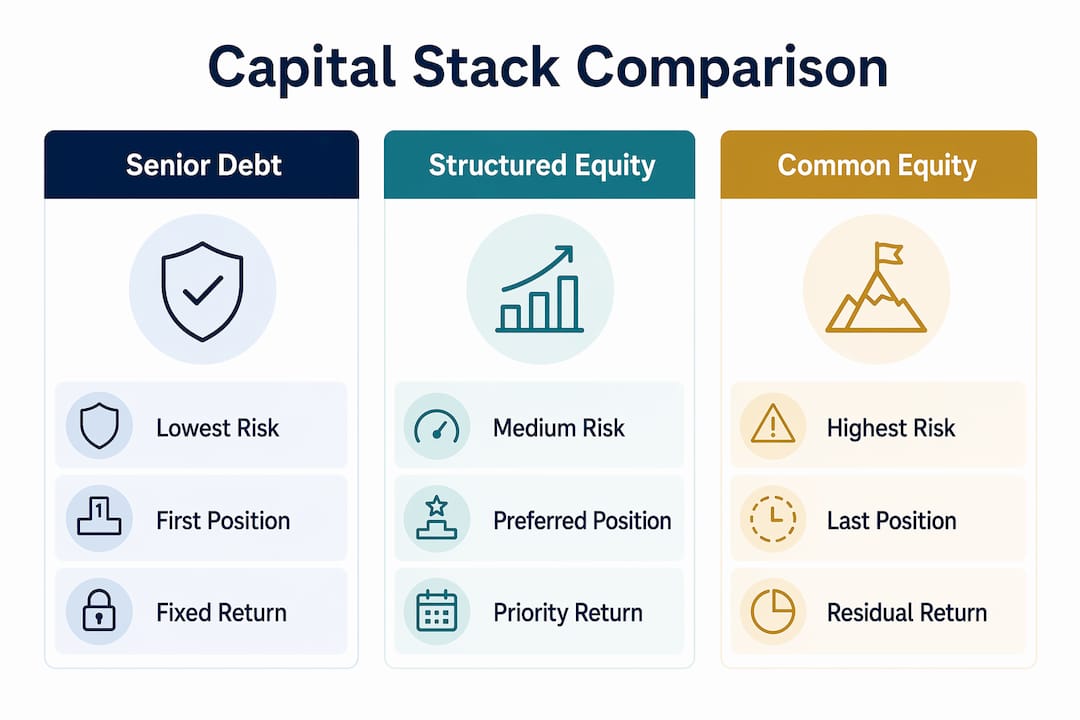
The capital stack places senior debt first, followed by structured equity in the preferred position, and then common equity at the highest risk and return position. Senior lenders hold a first charge over the asset and get paid before anyone else. Structured equity investors receive their returns next, ahead of the developer’s own equity but after all debt obligations are met.
Structured equity instruments include preferred shares, convertible instruments, redeemable shares, and bespoke equity rights. Each variant carries different terms around return timing, conversion triggers, and exit mechanisms. The specific instrument chosen depends on the project type, the investor’s risk appetite, and the developer’s need for operational control.
Pro Tip: When reviewing a structured equity term sheet, pay close attention to whether the preferred return is “current pay” (paid periodically) or “accruing” (rolled up to exit). Accruing returns reduce cash pressure during the build phase but increase the total cost of capital at completion.
The table below shows how structured equity compares to common equity and senior debt across the key dimensions that matter to developers and investors.
| Feature | Senior debt | Structured equity | Common equity |
|---|---|---|---|
| Position in stack | First (lowest risk) | Middle | Last (highest risk) |
| Security | First charge over asset | Membership interest, no charge | Ownership stake |
| Return type | Fixed interest | Preferred return (often 8–12%) | Variable, profit-dependent |
| Repayment priority | Highest | Middle | Lowest |
| Governance rights | Covenant-based | Contractual rights negotiated | Full voting rights |
| Downside protection | Strong | Moderate | Minimal |
How does structured equity differ from common equity and mezzanine debt?
The distinction between structured equity and common equity is most visible at the point of loss. Preferred equity investors receive priority over common equity holders in liquidation scenarios, providing a cushion during losses that common equity does not offer. A developer’s own equity sits at the bottom of the waterfall and absorbs losses first. Structured equity investors absorb losses only after common equity is wiped out.
Mezzanine debt is a different instrument entirely, and conflating it with structured equity is one of the most common mistakes developers make. Mezzanine debt is a secured loan with rights to equity pledges, while structured equity is an unsecured membership interest investment lacking foreclosure rights. That distinction has real consequences. A mezzanine lender can foreclose on the equity pledge and take control of the project entity if the borrower defaults. A structured equity investor cannot.
The key distinctions between the three instruments are:
- Preferred equity (structured equity): Membership interest in the property entity; priority returns; no mortgage charge; cannot foreclose; governance rights negotiated contractually.
- Common equity: Full ownership stake; highest risk; last in the waterfall; full voting rights; no priority return.
- Mezzanine debt: Secured loan with equity pledge; sits between senior debt and equity; lender can foreclose on the equity pledge; fixed interest obligations.
Developers often underestimate how much the absence of foreclosure rights changes the dynamic with a structured equity investor. Without that enforcement mechanism, the investor relies entirely on contractual protections, which makes the quality of the documentation critical. For a detailed comparison of mezzanine and structured finance options, the distinctions in security and enforcement rights are worth examining carefully before committing to either route.
What are the benefits and risks of structured equity?
Structured equity fills a vital financing niche by combining downside protection with upside participation. For investors, the primary benefit is priority in the distribution waterfall. Preferred equity holders receive priority returns of often 8–12% and have governance rights but do not hold a mortgage or deed of trust on the property. That return profile sits above what senior debt typically pays, reflecting the additional risk taken.
For developers, the main advantage is flexibility. Structured equity carries no fixed monthly repayment schedule in the way that a bank loan does. That preserves cash flow during the construction phase, which is when liquidity pressure is highest. The developer also retains operational control, because the structured equity investor holds governance rights rather than ownership rights.
The risks are real and should not be underestimated. The key ones are:
- Higher cost than senior debt. Preferred returns of 8–12% sit well above typical senior lending rates, increasing the overall cost of capital.
- Complex contractual terms. Waterfall structures, anti-dilution provisions, and exit ratchets require careful legal drafting. Poorly written terms create disputes at the worst possible time.
- Variable returns for investors. Unlike fixed-rate debt, some structured equity returns depend on project performance, particularly where profit participation rights are included.
- Limited enforcement for investors. Without a mortgage charge, investors rely on contractual remedies rather than asset security if a developer defaults.
- Governance friction. Negotiated governance rights can slow decision-making if approval thresholds are set too broadly.
Pro Tip: Developers should negotiate governance thresholds carefully. Requiring investor consent for every material decision creates operational drag. Limit consent rights to defined events such as refinancing, asset disposal, or changes to the business plan.
Practical risk mitigation starts with documentation. Clear documentation of waterfall distribution and preferred return triggers avoids disputes and ensures alignment between developers and investors. Seasoned developers prioritise precise terms on preferred returns and exit mechanisms before any capital is committed. For investors looking at risk protection in preferred equity, the contractual framework is the primary line of defence.
How does structured equity work in practice in UK property development?
Structured equity deals in UK property development follow a consistent contractual framework, even when the specific terms vary. The core elements are the preferred return mechanism, the waterfall distribution sequence, and the governance rights package. Getting all three right at the outset determines whether the deal runs smoothly from groundbreaking to exit.
Preferred return mechanisms and waterfall structures are the central contractual features governing distribution priority and cash flow sequencing. A typical waterfall for a ground-up residential development might run as follows:
| Distribution tier | Recipient | Basis |
|---|---|---|
| 1st | Senior lender | Loan repayment plus interest |
| 2nd | Structured equity investor | Preferred return (accrued or current pay) |
| 3rd | Structured equity investor | Return of capital |
| 4th | Common equity (developer) | Remaining profit share |
Structured equity investors often negotiate special rights including anti-dilution provisions, exit ratchets, and information access to balance their risk while ceding full operational control. Anti-dilution provisions protect the investor’s percentage interest if the developer raises additional equity at a lower valuation. Exit ratchets adjust the investor’s profit share based on the achieved return multiple, incentivising the developer to maximise the exit price.
Conversion options are another feature worth understanding. Some structured equity instruments include a right for the investor to convert their preferred position into common equity if the project outperforms projections. That gives the investor access to higher upside returns while retaining the downside protection of the preferred position until conversion is triggered.
James William & Co Capital structures these arrangements across a range of UK development projects, working with family offices, private credit funds, and specialist lenders to build capital stacks that match the project’s risk profile. The firm’s approach covers the full documentation process, from term sheet negotiation through to completion, giving developers a single point of contact for the entire structuring exercise. Developers looking to optimise their real estate funding should consider how structured equity fits within a broader multi-layered debt stack before approaching lenders.
For developers new to this type of financing, real estate crowdfunding platforms also offer exposure to structured equity instruments at smaller ticket sizes, which can be a useful way to understand the mechanics before deploying capital at scale.
Key takeaways
Structured equity is the most flexible capital instrument in the property stack, offering priority returns and governance rights without the enforcement risk of debt or the full exposure of common equity.
| Point | Details |
|---|---|
| Capital stack position | Structured equity sits between senior debt and common equity, receiving distributions after lenders but before developers. |
| Preferred return range | Investors typically target returns of 8–12%, paid as current pay, accruing, or a hybrid of both. |
| No mortgage charge | Structured equity investors hold a membership interest, not a charge, so they cannot foreclose on the asset. |
| Documentation is critical | Waterfall terms, preferred return triggers, and governance thresholds must be precisely drafted to avoid disputes. |
| Developer control retained | Developers keep operational control; governance rights are contractually limited rather than ownership-based. |
Why I think most developers misread structured equity
The most common mistake I see is developers treating structured equity as expensive debt. They look at the preferred return rate and compare it directly to a senior lending rate, conclude it is too costly, and walk away. That comparison is wrong because it ignores what structured equity actually provides: no fixed repayment schedule, no charge over the asset, and a capital partner whose returns are tied to the project’s success.
The second mistake is underinvesting in documentation. I have seen deals where the waterfall was described in three sentences. Three sentences to govern millions of pounds of distribution priority. When the project exits at a different value than projected, those three sentences become the subject of a very expensive conversation. The governance rights section deserves the same attention as the financial terms.
The third thing I would flag is the negotiation of consent rights. Developers sometimes accept broad consent thresholds to close the deal quickly, then find themselves needing investor approval for routine decisions six months into the build. Narrow those thresholds at the term sheet stage. Once the money is in, your negotiating position changes.
Structured equity, structured properly, is one of the most useful instruments in UK property finance. The developers who use it well treat it as a partnership instrument, not a last resort.
— James William Dawes
Structured equity financing with James William & Co Capital
Property developers and investors working on complex UK transactions need a financing partner who understands how structured equity fits within a full capital stack, not just how to source it in isolation.
James William & Co Capital arranges structured equity alongside senior debt, mezzanine finance, and JV equity for ground-up developments, large-scale acquisitions, and complex refinances across the UK. The firm works with family offices and private credit funds to build bespoke capital structures that match each project’s risk profile and timeline. Whether you are structuring your first preferred equity arrangement or refinancing an existing stack, the team at James William & Co Capital provides end-to-end support from term sheet to completion. Contact the team through the specialist property finance page to discuss your project.
FAQ
What is structured equity in simple terms?
Structured equity is a hybrid capital instrument that sits between senior debt and common equity in the property capital stack. It gives investors priority returns and governance rights without requiring a mortgage charge over the asset.
How does structured equity differ from mezzanine debt?
Mezzanine debt is a secured loan with an equity pledge, allowing the lender to foreclose if the borrower defaults. Structured equity is an unsecured membership interest, so the investor relies on contractual protections rather than asset security.
What returns do structured equity investors typically receive?
Preferred equity investors typically receive priority returns of 8–12%, which can be structured as current pay, accruing, or a hybrid depending on the project’s cash flow profile.
Can a structured equity investor take control of a property project?
A structured equity investor cannot foreclose on the property because they hold no mortgage charge. Their control is limited to the governance rights negotiated in the investment agreement, such as consent over refinancing or asset disposal.
Why do UK property developers use structured equity?
Developers use structured equity to access capital without fixed monthly repayments, retain operational control, and avoid diluting their common equity position further than necessary. It is particularly useful for bridging the gap between senior debt and the developer’s own equity in large-scale projects.
Recommended
Related Topics
Speak to a specialist
Discuss your finance with James directly
Whole-of-market specialist finance — bridging, development, commercial and residential. No call centres, no obligation. James reviews every enquiry personally.
New to specialist finance? How unbiased broker advice works · Deals we have completed
Explore Related Finance